Vol 14 Issue 49 ~ Editor: Rev. Fr. Courtney Edward Krier
December 4, 2021 ~ Saint Peter Chrysologus, opn!
1. Sacrament of Penance
2. Second Sunday in Advent
3. Saint Crispina
4. Family and Marriage
5. Articles and notices
Dear Reader:
This Advent season we should take time to ask ourselves where is our focus in our lives. The Birth of Christ is the culmination of Advent—four weeks of preparation for that moment. That is, Christ’s Coming is the focus of Advent: the Incarnation of the Word of God. Everything should be centered on the Incarnation—not that it is the only thing, but rather from the Incarnation everything else takes meaning. If one looks at a picture on the wall, everything else is on the periphery; but the picture remains the center of one’s focus and that is because it is what one is thinking of at the moment. So one must ask oneself: What am I always thinking of? Is it financial security, a new home, pleasure, revenge, what others are thinking about me? control or ambitions? But, then, where is Christ in all this? Where is my faith in Christ? Because these focuses put Christ on the periphery if not completely out of view. This is the difficulty we have when we say we want to go to heaven, but live for the things of this world—knowing it is contradictory and living we are living in a contradiction. Christ told us that we cannot serve God and mammon. If we give to one, it is only by taking from the other. If we see it in this light, then we understand why we use the world to serve God, not take the life God gave us to serve the world. John the Baptist gives us the example this Advent as we see in him one who forsakes all to serve Christ, not a reed shaken with the wind nor a man clothed in soft garments (cf. Matt. 11:7ff.). May we focus again on Christ and draw everything toward that vision.
The following are some articles that it would be well for our parents to read. As we try to direct our children toward Christ, the ancient serpent and his world are doing all in their power to draw their attention away from Christ. We have the responsibility to make sure they don’t become victims of the worldly spirit.
As always, enjoy the readings provided for your benefit.—The Editor
________________
WHAT IS THE SACRAMENT OF PENANCE
What is the Sacrament of Penance?
An Outward Sign, Instituted by Christ, to Give Grace
To Give Grace
One may enumerate the effects, from the above, as follows:
1. Restores us to the favour of God, and unites us to him in the closest bonds of friendship.
This is accomplished by justification which is the infusion of sanctifying grace through the remission or blotting out of sin. The Council of Florence words it as: The effect of this sacrament is absolution from sins. (Decretum pro Armenis; cf. DB 699) The Council of Trent, opposing the Protestant rejection of the Sacrament of Penance and presenting a clear dogmatic teaching of the Church, declares:
The reality and effectus of this sacrament, however, so far as concerns its force and efficacy, is reconciliation with God, which at times in pious persons and in those who receive this sacrament with devotion is wont to be followed by peace of conscience and serenity with an exceedingly great consolation of spirit. The holy Council, while recording these matters regarding the parts and effect of this sacrament, condemns the opinions of those who maintain that the parts of penance are the terrors of conscience and faith. (Sess. XIV, Chap. 3; cf. DB 896)
2. Tranquillity and peace of conscience.
The Protestants looked at the Penance only as a means to calm a terror of conscience but Confession itself had nothing to do with forgiveness, only the fiduciary faith of the person. The Church looks at tranquility and peace of the soul as a secondary effect that results with both the knowledge that the sin is forgiven by the absolution of the priest and the grace that is given by the Sacrament.
3. Sweetest spiritual joy.
The Council calls this a consolation of spirit. The soul is once more able to see itself as a child loved by God and, with baptismal grace restored, call on Him as a Father. There is added the assurance that, preserving sanctifying grace, one’s future is to be in heaven and will not suffer the pains of hell.
4. There is no sin, however grievous, no crime however enormous or however frequently repeated, which penance does not remit.
All mortal sins are forgiven, and therefore one need not fear that if one falls into sin again, those sins previous absolved are once more imputed; nor need one fear that certain sins cannot be forgiven even with absolution. This is stated as an effect, but is contained in that justification can only be true if there is a restoration of sanctifying grace and this can only be if no mortal sins are present in the soul.
5. Revival of merits.
One regains the merits one has acquired while in the state of grace, though lost through mortal sin. No acts performed while in mortal sin are meritorious; but one sees in the Parable of the Prodigal Son that the son is accepted back as when he left—a son and not a servant.
6. The Sacramental grace is assistance to avoid sin in the future.
All Sacraments bestow Sacramental Grace—the actual graces to help obtain the end of the Sacrament. Pohle, taking as his source Francisco Suarez (+1617), says sacramental grace is simply a moral claim to actual graces, which are not conferred all at once, but one by one, as they are needed, though always with reference to the Sacrament of which they are the effects. (Sacraments I, 72) In the Sacrament of Penance the sacramental grace is penance in as much as it is the act of penance (atonement) and not willing to commit sin in the future.
The Specific Sacramental grace of the Sacrament of Penance is Sanctifying Grace, in so far as it is adapted to the healing of the soul from sin (D 695: per poenitentiam spiritualiter sanamur). The claim to the actual graces necessary for one’s preservation from sin in the future is also bestowed with the Sanctifying Grace. (Ott, 437)
What we call the sacramental grace of the Sacrament of Penance—the grace that belongs to this Sacrament and which is not given and cannot be given by any other Sacrament—is sanctifying grace with the special power and function of remedying the debility of soul and the lack of vigour and courage and energy caused by venial sin and of strengthening the soul and removing the obstacles that the working of grace encounters in it. (Baur, 17)
The Seal of Confession
A blessing found in the Sacrament of Penance is the Seal of Confession. This means that whatever is discussed in the Sacrament of Penance (Confession) may not be revealed by the priest or anyone else perchance hearing it. This allows a person to speak freely and openly and through the Sacrament have qualms of conscience settled, sins confessed, and counsel given without having to consider the possibility of others knowing and acting upon the Confession. A priest, even if he knows one is about to commit a crime, cannot—after the Confession, intervene. The relationship is between the penitent and God, the sins confessed are between the penitent and God, the counsel taken is between the penitent and God. Otherwise, and truly why Christ instituted it in this fashion, no one would want to confess if the confession is to become public.
Christ the Saviour, who instituted the Sacraments, demands, for the direct reconciliation of sinful man with God, confession made to a priest, which confession He has permitted to be made to the priest alone, as to God. Note well that the sinner confesses to the priest not as to a man but as to God.
St. Thomas teaches (Suppl. q. 11): “That which is known through confession is as it were not known, since one does not know that as man but as God.” And again: “That secrecy (of sin) is of the essence of the Sacrament, inasmuch as (the priest) knows it as God, whose place he takes in confession.”
What an incentive this should be to openness in the confessional! You are telling it, not to a man, but to God, who knows all things. (Herbst, 47-48)
There are several saints to the seal of the Confession, such as Saint John Nepomucene (+1393), who was drowned for not revealing to the king the queen’s confession. Padre Mateo Correa Magallanes (+1927) is another martyr of the seal of confession. During the Cristero War, after hearing the confessions of Cristeros in prison, he was ordered by General Eulogio Ortiz to tell what they had had confessed. At Father Mateo’s prompt refusal, he was taken and shot. It is said that Father Leo Heinrich (+1908), a Franciscan Priest in Denver, Colorado, was warned by his assassin, Giuseppe Alia, in the confessional that he would kill him before finally shooting him at the Communion rail. The Anarchist, bragging, told all the details of his horrible crime. In other words, a priest would rather die than act on or say anything said in Confession.
But as all are anxious, that their sins should be buried in eternal secrecy, the faithful are to be admonished that there is no reason whatever to apprehend, that what is made known in confession will ever be revealed by any priest, or that by it the penitent can, at any time, be brought into danger or difficulty of any sort. All laws human and divine guard the inviolability of the seal of confession, and against its sacrilegious infraction the Church denounces her heaviest chastisements. [Ex Leonis Papæ epist. 80.] “Let the priest,” says the great Council of Lateran, “take especial care, neither by word nor sign, nor by any other means whatever, to betray, in the least degree, the sacred trust confided to him by the sinner.” [Cap. 21.] (Rom. Cat., II, 5)
Choosing a Confessor
No one may be forced to confess their sins to a particular priest, one is able to confess their sins to any priest of their choice. The freedom and the benefit of this choice is to guarantee that one will make a good confession and not commit a sacrilege. Sometimes a choice is not always available, but one may notice a priest still does not force one to confess. At the same time, one should understand with the Seal of Confession and that one is confessing to God through the instrumentality of the priest one’s pride should not be the reason. Still, if there are several priests one can go to confession, one is free to go to whom one prefers. At the same time, one should not be going to various priests in the sense of hiding sins. Confession is to free one from sin and going to a priest who does not know your spiritual state inhibits him from giving the spiritual help needed. If one is ill, one chooses a doctor—but one returns to that doctor because the doctor already knows your physical illnesses. To choose a different one would only be to start again and again and never obtain the results desired: healing one’s soul of the spiritual sickness of sin. If, therefore, one has this opportunity one should take advantage of returning to the same confessor.
In general it is ideal for the spiritual direction of the penitent if the confessor knows the person. He knows, let us say, just who the penitent is, what kind of a family he comes from, what kind of an education he got, where he is working, what he is doing, his environment, his interests, his plans for the future. A knowledge of all that will throw light upon the penitent’s accusation and will enable the priest to give salutary admonitions and practical spiritual guidance.
It often happens that the accusation is rather general or follows a routine, utterly sincere though it may be, so that from the sins that have been told the confessor cannot give pertinent direction, since he has absolutely no idea whom he has before him. He does not know just what would benefit this particular penitent. But if the confessor knows that the penitent comes from such and such a family, works in such and such a place or belongs to such and such a profession, if he knows something about his character and his former life, he can give good, solid, personal advice, exhortation, admonition.
But people usually think that there would have to be certain restraints if confessor and penitent knew each other or when they happened to associate with each other outside the confessional. They could not then be as free with each other as would otherwise be the case.
That is quite a wrong notion; for even when confessor and penitent are personally acquainted with each other, the confessor will surely never think of what the penitent told him in the confessional should they meet each other afterwards, for instance in the work of parish organizations or any other way. Indeed, the confessor may never without reason reflect upon the sins of the penitent; and never may he speak to a penitent about the sins confessed to him by the same unless the penitent himself begins to talk about them. If some candid penitent begins to speak to the confessor outside of the confessional about some sin confessed—and some of our frank American youth do that in such an offhand way—he by that very fact gives the confessor permission to speak about it; but that permission extends only to speaking about the matter of which the penitent began to speak. (Sullivan, 49-51)
(To be continued)
————————–
The Sunday Sermons of the Great Fathers
M. F. Toal
MATTHEW xi 2-10
At that time: When John had heard in prison the works of Christ: sending two of his disciples he said to him: art thou he that art to come, or look we for another? And Jesus making answer said to them: Go and relate to John what you have heard and seen. The blind see, the lame walk, the lepers are cleansed, the deaf hear, the dead rise again, the poor have the gospel preached to them. And blessed is he that shall not be scandalised in me. And when they went their way, Jesus began to say to the multitudes concerning John: What went you out into the desert to see? A reed shaken with the wind? But what went you out to see? A man clothed in soft garments? Behold they that are clothed in soft garments, are in the houses of kings. But what went you out to see? A prophet? Yea, I tell you, and more than a prophet. For this is he of whom it is written: Behold I send my angel before thy face, who shall prepare thy way before thee.
FROM ST JEROME’S EXPOSITION OF THE PROPHET ISAIAS
There shall come forth a Rod out of the Root of Jesse, and a flower shall rise up out of his Root. Isaias xi 1. Roman Breviary.
A Rod shall rise out of Jesse. Up to the beginning of the vision, which Isaias the son of Amos saw, and which was of the burden of Babylon, all this prophecy relates to Christ; the which we propose to explain, part by part, so that the subject treated of, and the discussions upon them, may not confuse the mind of the reader. The Jews interpret the Shoot and the Flower of Jesse as the Lord Himself; namely, that by the Rod is signified His Royal Power, and by the Flower His Beauty.
We however believe that the Holy Virgin Mary is the Rod from the Root of Jesse, to which no enriching plant hath cleaved, and of whom we earlier read: Behold a Virgin shall conceive, and bear a son. And the Flower is the Lord Our Saviour, Who says in the Canticle of Canticles: I am the Flower of the field, and the lily of the valleys. Upon this Flower then which of a sudden will rise up from the stock and the root of Jesse, through the Virgin Mary, the Spirit of the Lord will rest: because in Him it hath pleased all the fulness of the Godhead to dwell corporeally: and not in part, as in others who were sanctified; but as the Nazarenes read in their Gospel, written in the Hebrew tongue: The whole fountain of the Holy Spirit shall come down upon Him. Now the Lord is a spirit. And where the Spirit of the Lord is, there is liberty.
ST JOHN CHRYSOSTOM: ON THE GOSPEL
1. Now when John had heard in prison the works of Christ . . . Luke tells us that his own disciples came and told John of the miracles, and that he sent them (Lk. vii. 18, 19). This creates no contradiction, but it does provide us with a reflection, namely; that they seemed inflamed with envy against Jesus. What follows is to be carefully considered. What means this saying: Art thou he that art to come, or look we for another? For he who had known the Lord before these signs and wonders, who had been taught by the Holy Spirit, who had received knowledge of Him from the Voice of the Father, who had proclaimed Him before all men, now sends to Him, that he may learn whether it is He or not?
And if you know not whether this is He, how can you deem yourself worthy of belief, giving testimony of things you know not? For he who gives testimony ought first be worthy of belief Did you not say: The latchet of whose shoe I am not worthy to loose? (Lk. iii. 16) Did you not say: And I knew him not, but He who sent me to baptize with water, said to me: He upon whom thou shalt see the Spirit descending He it is who baptizeth with the Holy Ghost (Jn. i. 33). Have you not seen the Spirit in the form of a dove? Have you not heard the Voice? Did you not stay Him, saying: I ought to be baptized by thee, and comest thou to me? (Mt. iii. 14) Did you not say to your disciples:
He must increase, but I must decrease? (Jn. iii. 30) Did you not teach all the people, that He would baptize in water and the Holy Spirit (Lk. iii. 16)? And that he was the Lamb of God, who taketh away the sins of the world (Jn. i. 29)? Did you not even before these signs and wonders preach Him to all men? How then, when He is known to all, when His fame flies in every direction, after He has raised the dead, put evil spirits to flight, and manifested such signs of power, do you send to ask this concerning Him? What then has happened? Were all these testimonies false, and but fables and old wives’ tales?
Who of sound mind would utter such things? Not certainly of John, I say, who leaped in the womb of his mother (Lk. i. 41); who, unborn, had yet proclaimed Him; the dweller in the desert, of the angelic life. But even if he were one of the lowest of men, he could not be doubtful after such testimony, his own and that of others. And so it is plain that he did not send as one in doubt; nor inquire as one in ignorance. Neither may any one say that he did know, but that he had become timid through prison. For he did not expect to be freed from prison, nor if he did would he have betrayed the truth; prepared as he was again and again to die. For unless he were ready to die, he would not have shown such strength of soul before a people who were ever disposed to shed prophetic blood. Neither would he have rebuked the cruel tyrant with such courage, in the face of all the city and the people, if those who heard him could chide him as a coward.
If he had become timid, why was he not ashamed to send his own disciples, in whose presence he had borne testimony, to so many and to such tremendous things? Yet he inquired through them, when he ought rather to have put his question through others; especially since he knew well that they were envious of Christ, and were but seeking to find fault with Him. And how was it he was not also ashamed before the Jewish people; he who had prophesied to them so many things?
And whence could any help come to him, to free him from prison? For it was not on account of Christ that he was thrown there, or because he had proclaimed His Kingdom, but because he had condemned an unlawful union. Would it not rather be the conduct of a weak man, or of a worldly man, to win public favour for himself? What then is in question here? From what has been said there can be no question of doubt, as regards John, nor indeed of anybody, in like circumstances, even a weak minded person. We must then give an answer. Why did he send to ask? The disciples of John were moved by jealousy against Christ, as is seen from what they once said to their master: He who was with thee across the Jordan, to whom you gave testimony, behold he baptizeth, and all men come to Him (Jn. iii. 26). And again from the complaint made by the Jews, and by one of the disciples of John: We and the Pharisees fast often, but your disciples do not fast.
2. They did not yet know who Christ was; thinking that He was a mere man, but that John was more than a man, they were grieved at seeing Jesus now celebrated, and John’s fame growing less; even as he had himself foretold. This attitude had kept them from drawing near to the Lord; envy holding them back. As long as John was among his disciples, he endeavoured to convince them of the truth regarding Christ. But now about to leave them, because of the death he expected at the hands of Herod, he was gravely concerned over them. He feared to leave them in an unsettled state of belief; and that they might remain thus separated from Christ towards Whom he had from the beginning striven to guide them. And since he had failed, now nearing his end, he tried again with great earnestness. Had he said to them: “Go, follow Him, for He is greater than me,” he would not have convinced them, and further, through speaking in this way, they would have believed that he spoke out of humility, and would only have become more attached to him. If he remains silent, the situation remains as it was.
What then does he do? He waits till he hears from them that Christ is working signs and wonders. Nor does he send all of them; just two, whom perhaps he believed more prejudiced than the rest; so that the questioning might be without suspicion, so that from what they saw, they might then learn how great was the distance between him and Christ. So he says: Go ye and say: art thou he that is to come, or look we for another?
Christ, understanding the mind of John, did not immediately reply: “Yes, I am He”, for that would have offended His hearers; though it could well be answered. But he allowed them to learn the answer from the deeds they witnessed. For it is narrated, that then and there He cured many from among those who came to Him. Where would be the sequence of this action if, questioned as to whether He was the One, He makes no reply but immediately begins to cure the sick, unless that He wished to do as I say? He deemed testimony from deeds more credible than any words, and less liable to suspicion.
Since then as God He knew with what purpose John had sent those men, He forthwith heals the blind, the lame, and many others; not so as to instruct John; for why instruct one who already knew and believed: but that He might confirm the minds of John’s doubting disciples. And then when He had cured many, He says: Go and relate to John what you have seen and heard. The blind see, the lame walk, the lepers are cleansed, the deaf hear, the dead rise again, the poor have the Gospel preached to them. Then He adds: And blessed is he that shall not be scandalised in Me; showing that He knew the secret thoughts of their hearts.
If He had said, in answer to their direct question, I am, He would have offended them, as I have said before, and they would have thought, though they might not have said, that which the Jews had already said to Him: Thou givest testimony of Thyself (Jn. viii. 13). And so He did not say this, but so disposed that from His miracles they would learn that which they needed to know; giving them in this manner an answer that was simple and unanswerable.
In the same way He added the last sentence; secretly rebuking them. For they had been scandalised in Him. He had seen into their souls, and calling no one to witness their inward railing against Himself, He left this to their own consciences, and so drew them the more to Him by saying simply: Blessed is he that is not scandalised in Me. He said this, revealing themselves to themselves.
Lest however we appear to be giving only our own opinion in this question, we think it desirable to present to you that also which has been said by others, so that from a comparison of opinions, the truth may be evident. Now what do others say about John sending his disciples? That the explanation which we give is not the true one; that John did not really know; that he did not know fully; that he knew indeed that this was truly the Christ, but that He was to die for men John did not know, and so for this reason he asks: art thou he that art to come, that is, who is about to descend into hell?
This conflicts with right reason. John was not ignorant of this truth. For he had proclaimed it from the first, when he said to his disciples: Behold the lamb of God who taketh away the sins of the world. He here truly calls Him lamb, thus foretelling the Cross, as when he says: Who taketh away the sins of the world, he signifies the same thing. For in no other way than that of the Cross was this accomplished. This Paul has also declared: He cancelled the deed which excluded us, the decree made to our prejudice, swept it out of the way by nailing it to the Cross (Col. ii. 14).
Again, when he said: He shall baptise with the Holy Ghost (Lk. iii. 16), he foretold that which was to happen after the Resurrection. But, they say, that He was to rise again from the dead John knew, and also that He would bestow the Holy Spirit; but he did not know that Christ was to be nailed to a cross. But how was He to rise again, Who would neither have suffered, nor have been crucified? How was he greater than the prophets, if he knew not the things the prophets knew?
———————–
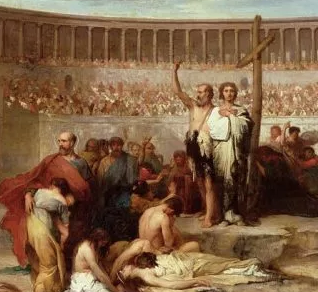
December 5: ST CRISPINA, MARTYR (A.D. 304)
ST AUGUSTINE frequently mentions St Crispina as one well known in Africa in his time, and we learn from him that she was a woman of rank, native of Thagara in Numidia, married, with several children, and worthy of estimation with such famous martyrs as St Agnes and St Theda. During the persecution of Diocletian she was brought before the proconsul Anulinus at Theveste, charged with ignoring the imperial commands. When she came into court Anulinus asked; “Have you understood the meaning of the decree?” Crispina replied; “I do not know what that decree is.”
ANULINUS: It is that you should sacrifice to all our gods for the welfare of the emperors, according to the law given by our lords Diocletian and Maximian, the pious. Augusti, and Constantius, the most illustrious Caesar.
CRISPINA: I will never sacrifice to any but the one God and to our Lord Jesus Christ His Son, who was born and suffered for us.
ANULINUS: Give up this superstition and bow your head before our sacred gods.
CRISPINA: I worship my God every day, and I know no other.
ANULINUS: You are obstinate and disrespectful and you will bring upon yourself the severity of the law.
CRISPINA: If necessary I will suffer for the faith that I hold.
ANULINUS: Are you so vain a creature that you will not put away your folly and worship the sacred deities?
CRISPINA: I worship my God every day, and I know no other.
ANULINUS: I put the sacred edict before you for your observance.
CRISPINA: I observe an edict, but it is that of my Lord Jesus Christ.
ANULINUS: You will lose your head if you do not obey the emperors’ commands. All Africa has submitted to them and you will be made to do the same.
CRISPINA: I will sacrifice to the Lord who made the heavens and the earth, the sea and all things that are in them. But I will never be forced to sacrifice to evil spirits.
ANULINUS: Then you will not accept those gods to whom you must give honour if you would save your life?
CRISPINA: That is no true religion that forces the unwilling.
ANULINUS: But will you not comply, and with bent head offer a little incense in the sacred temples?
CRISPINA: I have never done such a thing since I was born, and I will not do it so long as I live.
ANULINUS: Do it, however, just to escape the penalty of the law.
CRISPINA: I do not fear what you threaten, but I fear the God who is in Heaven. If I defy Him then shall I be sacrilegious and He will cast me off, and I shall not be found in the day that He comes.
ANULINUS: You cannot be sacrilegious if you obey the law.
CRISPINA: Would you have me sacrilegious before God that I may not be so before the emperors? No indeed! God is great and almighty; He made the sea and the green plants and the dry land. How can I consider men, the work of His hands, before Himself?
ANULINUS: Profess the Roman religion of our lords the unconquerable emperors, as we ourselves observe it.
CRISPINA: I know one only God. Those gods of yours are stones, things carved by the hands of men.
ANULINUS: You utter blasphemy. That is not the way to look after your own safety.
Then Anulinus ordered her hair to be cut off and her head shaved, exposing her to the derision of the mob, and when she still remained firm asked her: “Do you want to live? Or to die in agony like your fellows Maxima, Donatilla and Secunda?”
CRISPINA: If I wanted to die and abandon my soul to loss and endless fire I should treat your demons in the way you wish.
ANULINUS: I will have you beheaded if you persist in mocking at our venerable gods.
CRISPINA: Thank God for that. I should certainly lose my head if I took to worshipping them.
ANULINUS: Do you then persist in your folly?
CRISPINA: My God, who was and who is, willed that I be born. He brought me to salvation through the waters of baptism. And He is with me to stay my soul from committing the sacrilege that you require.
ANULINUS: Can we endure this impious Crispina any longer ?
The proconsul ordered the proceedings that had taken place to be read over aloud, and he then sentenced Crispina to death by the sword. At which she exclaimed: “Praise to God who has looked down and delivered me out of your hands!” She suffered at Theveste on December 5, in the year 304.
(Butler’s Lives of the Saints)
_______________
LETTERS TO JACK
WRITTEN BY A PRIEST TO HIS NEPHEW
By the
RIGHT REV. FRANCIS C. KELLEY, D.D., LL.D.
(1917)
XXI
OLD THINGS
I SYMPATHIZE with the man who is only the servant of a machine. . . . I think there is a deeper reason than the question of pay for the modern strike.
I LIKE to see progress; but I do not like to pay for it with the old ideals that first made it possible.
EVIL may be shouting in our souls constantly; but it is for us to say whether or not we are to hear its voice.
My dear Jack:
Some of my friends show a sort of mild and superior tolerance of what they call my “junk.” I have to acknowledge that I am very fond of the things that are old—old pictures, old books, old prints, old china. It is not, however, because things are old that I like them; nor yet because they help me get the atmosphere in which history may best be read; but rather because the old things, nearly all of them, speak to me of devotion and an ideal in work that we have not in this age of machinery. Now, I have nothing against the age of machinery; in fact, I rather like living in these times. I never had, for example, any prejudices against automobiles. When I travel, I take advantages of modern comforts; and this is the most comfortable age of the world for travel. Still, I constantly feel like lamenting the fact that machinery has driven out the personal interest and devotion men used to take in producing things. There isn’t much inspiration to be gotten out of a modern factory. I visited one a few weeks ago, and the composite picture I took away was distressing. It seemed as if one big machine, and the men around it, made a picture for me of the whole factory. Two men were engaged in mechanically picking up long steel bars, placing them singly in a certain groove, leaving each one there until a hammer banged holes in them, and then throwing them on the pile of “finished” work. The men were too much like the machine they attended. The head of the factory told me that they do nothing else from morning until night. The bar forms part of a bed; but the other parts are made in the same way. No individual workman in the factory makes an entire bed. It takes two hundred employes, starting from the designer and winding up with the finisher, to do that. The only inspiration there is in the whole factory is that of the designer. It seemed to me that he was the only man who had a chance to actually enjoy his work.
You can readily see why I am sorry that the machine has, almost entirely, eliminated the workingman who could start producing something, and finish it all by himself. Machinery has taken the inspiration, and therefore the pleasure, out of work. It is no wonder to me that the age of machinery is the age of labor troubles. I sympathize with the man who is only the servant of a machine. I cannot find the heart to blame him for being dissatisfied. So I think there is a deeper reason than the question of pay for the modern strike. Without knowing it, the men have gotten into the state of working for pay alone. In the olden days there was more pleasure in a man’s craftsmanship than in the money he received for it. The old workman was often an artist; for even when he did not have the skill, he had the feeling; and he did not take his pleasure out of his skill, but out of his feeling. I dropped into a little shoe-shop one day to have a lift put upon a heel. It was quite late in the evening, but the shoemaker was pegging away. “You don’t keep union hours,” I remarked. The old man looked up at me with a smile. “No,” he said, “but my boy does. You see, Father, he works in a shoe factory, and when the whistle blows he stops. A man cannot take very much interest in stamping out soles, and that’s what he does. I often work until ten o’clock because I cannot lay my work aside. You wouldn’t think, would you, that I could take interest enough in a pair of shoes to keep me from my evening paper! But I do. Now here,” he continued, picking up a pair of shoes, “is something I am very proud of. I made these shoes myself. They will last three years. The shoes that are turned out by the factory my son works in look prettier, but they will not last six months. These are honest shoes and there is honest labor in them.” I thoroughly understood the old man, and I liked his point of view. I know, of course, that we must have factories. I would not turn back the hand on the clock if I could; but at the same time I rejoice that there still is, and always will be, a demand for the things that are made in the old way; not that we need these things so very badly, but that we need the sort of men who persist in making them. I suppose these are only the William Morris views I picked up from an occasional glance over the now defunct “Philistine.” I certainly know that they are not original; but I am aiming at the giving of advice rather than at originality.
This love for the old things that I have, concerns more than the things that I can see and touch. For example, I love the old spirit that, alas! now seems to be passing away. Last week, as I was going into my office, I saw a regiment of soldiers marching from the railway station to their armory. They were returning from the Mexican border. The band was playing a patriotic air as I walked to the curb to watch the regiment go by. The flags passed a minute later. My hat was the only one that was doffed; and I could not help the fact that my eyes became a little dim. What astonished me was that nobody else seemed to get any sentiment out of the marching men, the flags and the music. I thought at first that perhaps it was because I was a little different, since I had served with the colors in a very mild sort of a war. But later on, while going up in the elevator to my office, I knew that I was wrong. The people have changed. The curse of riches is on us and the evils of prosperity are our own. I was fifteen minutes at my desk before I could get down to work. I sat thinking of twenty years ago when, in the little town where I was pastor, I made my first patriotic address, before a mound erected in the cemetery, “To the Unknown Dead.” That day there were addresses by four or five Protestant ministers as well as myself. Some of these ministers were bigoted men, and they usually disliked me because I was a priest; but they did not dislike me that day. There was a sort of “Truce of God” on Memorial Day; and I never can forget the heartiness with which the ministers, the old soldiers and the crowd received what they thought were most unusual sentiments from the mouth of a “Romanist.” Bless their poor blind hearts! I think the “Romanist” felt the occasion more deeply than any of them; for even prosperity does not stampede him; and prosperity has stampeded more than one of the men who stood with moist eyes about the mound that day. I like to see progress, but I do not like to pay for it with the old ideals that first made it possible. Progress does not rush. It moves with dignity and safety. Its effect is to make good things better; but it does not destroy that which is good. If a machine only succeeds in producing great quantities of inferior things, without even the excuse of giving more leisure for self-development to the workman, I am inclined to look doubtfully at the ultimate value of the machine.
Truth is, my dear Jack, that the love for the old things is a response to one of those mysterious voices that speak to us constantly from within and without. “Two voices there are, one of the Earth and one of the Sea; each a mighty voice,” said some poet. The poet was conservative. There is a mighty voice also from the heavens; Bob Service is a new sort of poet, but he has the idea:
“Here by the camp fire’s flicker,
Deep in my blanket curled,
I long for the peace of the pine-gloom,
When the scroll of the Lord is unfurled,
And the wind and the wave are silent,
And world is singing to world.”
There are a myriad of lesser voices from earth, sea and sky, wordless whispers in our ears, speaking everywhere and always. What we call “inspiration” is the message of these voices. The highest inspiration is the Voice of God. The lesser inspirations are His in a way also, since from Him comes all good. But His Voice in the minor things sound through His works. Byron was no saint, but when he heard the ocean’s voice, and was inspired to address to it his immortal eulogy: “Roll on, thou deep and dark blue ocean, roll,” he could not help confessing God’s power. The same thing happened when he heard the voice of St. Peter’s at Rome, and his praise reached the heights of sublimity in the words: “Worthiest of God, the Holy and the True.” Shakespeare heard the voices and confessed it, for to him there were “sermons in stones.” It was fitting that the architecture of the Middle Ages inspired the idea of its being called “frozen music.”
Life is full of eloquence raised to the sublimity that moves the soul. Even life’s smallest things have great messages, if you will only stop to hear them. There is nothing prosaic in life, if you will but attune your ear to catch the voices that arise out of all its movements. Even what men think are only “disorders,” like sickness and death, even these speak, with a voice that can· be understood, and their message is one of consolation.
It is only when the fallen nature of mankind gets the upper hand that the voices from within are evil; and it is only when these interior voices are evil that the voices from without are misunderstood or ignored. I could almost say that all the voices from without are good. We merely fail sometimes, because of what speaks within us, to hear them aright. If you have a perfectly adjusted receiver on your phonograph, the record will be perfect. If the receiver is wrong, you will get only a jumble of sounds. The phonograph will give out, not what is spoken into it, but what the recorder engraves on the cylinder. The trouble is all with the phonograph. So it is with us. We hear the perfect message, but, if we are ourselves defective, we do not record it as it was spoken; and, therefore, cannot reproduce it in our live…