Vol 14 Issue 19 ~ Editor: Rev. Fr. Courtney Edward Krier
May 8, 2021 ~ Saint Michael, opn!
1. What is the Holy Eucharist
2. Fourth Sunday after Easter
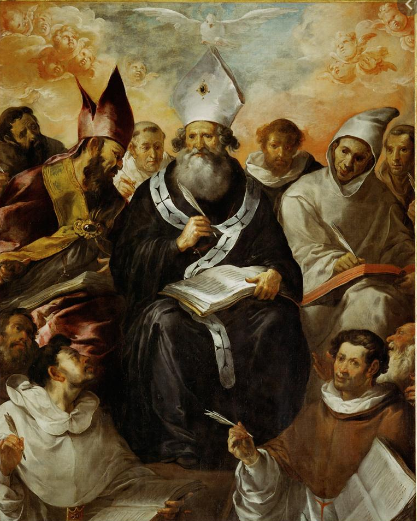
3. Saint Gregory Nazianzen
4. Family and Marriage
5. Articles and notices
Dear Reader:
In addressing our children, one must take note that they are unfortunately being enticed into self-destructive behaviors that are propagated as self-fulfilling. I am sure that some of us who slept in till noon after wasting an evening in partying thought that this was life—until the reality of failing a class that set one indefinitely behind and unable to obtain the goal one looked forward to fulfilling. It may be harder for our youth to see this when schools don’t fail anyone and the staff look down on those who do excel. That is, one may feel it is self-fulfilling, but it is actually self-destructive. They, and we their parents, must see this particularly regarding the social media platforms prevalent in many lives today.
In this, one, especially our youth who are more prone, must be weary of falling into the emotional relativism that is current in an approval obsessed society. For, as one expresses one’s feelings in a controlled media platform the connected group provides approbation or condemnation; the promoted reaction must be accepted or one will find oneself excluded for not being inclusive, white, Christian, etc.—even though one may not be white, Christian, etc—as these are considered undesirable oppressors of a Woke society, and why our children do not want to identify. Such enslavement to the media platform has caused the advancement of the most ridiculous cults: boys wanting to be girls, girls wanting to be boys; criminals being heroes and heroes being criminals; hard working individuals having their wages confiscated and those refusing to work being paid; foreign invaders having rights and citizens having no rights; some people being entitled and others being disenfranchised; we the government and not we the people. This litany of insanity could go on, but it is only to demonstrate the topsy-turvy state of affairs when truth and justice, rational principles, are set aside to follow emotional relativism. Doesn’t the little girl cry to get her way knowing it works on permissive parents? Doesn’t the little boy throw his temper-tantrum to get his way knowing it works on permissive parents? And we look at the parent and think: How can you make your decisions based upon how the child vents its emotions—are you not the adult? Yet decisions by the present permissive (progressive) government that have grave repercussions are being made today based on the emotions conjured and acted upon for being what is now touted as best for everyone.
Hopefully, as Catholic parents, you are in your right senses and understand that you are responsible for your child’s future and not anyone else; and this is why you are directing the development of his or her character and personality, the virtues and work habits, the talents and mental competency so they are capable of living a life reflecting an honest, mature individual who knows he or she will succeed in their chosen vocation.
The difference between those following their emotions and those following reason is the former are dependent and the latter are independent. The former are easily controlled, the latter refuse to be controlled. This does not mean independence is synonymous with rebellion, but rather independence here means one will do what is right because it is right, not because everyone else does it or because one is bribed.
Am I trying to wean you and your children from social media? Yes, because this pacifier may satisfy the emotions, but it deprives you of the sustenance for a healthy life: spiritual, mental and physical. Children and youth need to make real friends, live a real life, become human once again and not just another “like”. But you are the example and cannot have them uncouple from the bandwagon if you are still going for the ride.
As always, enjoy the readings provided for your benefit.—The Editor
________________
WHAT IS THE HOLY EUCHARIST
By Rev. Courtney Edward Krier
II
The Holy Eucharist is a True Sacrifice
An Explanation of Holy Mass
Part 2
The Mass of the Faithful
THE CANON OF THE MASS
The celebrant reads the Canon of the Mass in an inaudible voice. This is a very ancient custom, and is intended to make us realize that the change effected in the bread and wine, is the effect of the invisible and imperceptible operation of the Holy Ghost. (Smyth, 33)
During the Canon of the Mass the Sign of the Cross is made twenty-three times, eight times before the words of Consecration, twice at the words of Consecration, again eight times after and in addition there are the five times at the Per Ipsum that closes the Canon. Some commentators write of twenty-five signatures of the Cross, but this excludes the priest signing himself as one with the Oblation and adds the three said after the Pater Noster, at the Pax Domini. There is the pattern of 3-5-1-1-5-3 (excluding the Per Ipsum which is with the Host and correlates with the Pax Domini sit semper and added make eight). Three refers to the Three Divine Persons, five refers to the Passion of Christ bearing his five wounds, two refers to the Incarnation and His Body and Blood. As the Consecration is the center, the symmetrical signage points to both the Incarnation being the center of the Mass as also the Sacrifice of Jesus Christ accomplished by the double transubstantiation. Therefore the Prayer of the Canon is not to be viewed as moving toward and away, but as surrounding the Consecration.
Especially on account of the symmetrical arrangement of its parts, the Canon appears to be the work of a single individual; Gregory the Great calls him Scholasticus, that is, the scholar (Epist. 9, 12). The symmetry appears clearly in the three crosses at the beginning and the three at the end, and in the five immediately before and the five immediately after Consecration; furthermore, it appears in the arrangement of the narrative of the institution, which has a place in the middle of the Canon; then there is the Memento of the living before and the Memento of the dead after Consecration, and a list of twelve Apostles and twelve martyrs before and another of seven male and seven female saints after Consecration. Churches were not built in Rome in honor of some of these saints until the time of Pope Symmachus. (Stapper, 273)
In the centre of the Canon is the Consecration; in the centre of this mystic drama stands the Cross. The six groups clustered about it are the six Mementos. They are: (l) the Church; (2) the Living; (3) the Saints of God; (4) the Poor Souls; (5) we ourselves; (6) Nature. Thus all creation, except the angels and demons, is gathered under the Cross. The angels are not in need of redemption; the demons are beyond redemption. In what glorious company does the devout Catholic who intelligently assists at holy Mass kneel on this spiritual Calvary! The six Mementos are, as it were, the outer of three concentric rings grouped about the Canon. The centre, the first ring is occupied by the Consecration, preceded by an account of the Last Supper, and followed by the “anamnesis” or loving memory of Jesus. The second ring contains the four exquisite oblation prayers, two before and two after the Consecration. Then come the Mementos, three before and three after the Elevation. (Linneweber, 8)
The priest spreads out his up-lifted hands in prayer. As the Holy Ghost was invoked earlier, now God the Father is invoked, yet in the perichoresis or circuminsessio, that is, the working of all Three Persons, therefore the threefold signage over the oblation with the three corresponding synonymic words. This is followed by the intercession for the living: For the Church on earth as a whole and in particular those who are her members, the Pope as head of the Universal Church, the Ordinary of Diocese as head of the local Church, of the true faithful who believe in and defend the Church—referring mainly to the assisting bishops and priests. Orthodox is a Greek word that indicates true or correct as one giving true glory to God. When there is no pope and/or ordinary (local bishop) the name or names are left out. The rubrics (because written in red) have: Sede autem vacante verba prædicta omittuntur, meaning, the seat being vacant, the preceding words are omitted which are Together with . . .
The priest then continues the Memento for the Living:
Be mindful, O Lord, of Thy servants and handmaids N. . . . and N. . . . and of all here present, whose faith and devotion are known to Thee, for whom we offer, or who offer up to Thee this Sacrifice of praise for themselves and all those dear to them, for the redemption of their souls and the hope of their safety and salvation: who now pay their vows to Thee, the everlasting, living and true God.
First are to be mentioned those who are to be particularly remembered through a request (Mass stipend) or whom the priest wishes to remember. If a person is asked to be remembered at Mass who is not a practicing Catholic, their name may not be inserted but a general intention is formulated for the conversion and graces this person needs. The Church has associated the complete Canon as guarding the words of Consecration, and the words at the consecration of the Chalice include pro multis—which shall be shed for you and for many for the forgiveness of sins. So she excludes the names of those not within her bosom. The priest folds his hands and pauses here to remember those he desires and allowing the faithful also to remember all whom they desire to be included. In the early centuries there were the diptychs with the names of those to be remembered and read. Now there is the silent pause so all can recall to mind those for whom they wish to offer the Mass. When the priest continues, he again spreads out uplifted hands and begins to express what is desired for those who have been remembered: for the redemption of their souls and the hope of their safety and salvation.
This is followed by the Communicantes, the joining with the Saints in heaven.
In communion with and honoring the memory, first, of the glorious ever Virgin Mary, Mother of God and our Lord Jesus Christ; and also of Thy blessed apostles and martyrs, Peter and Paul, Andrew, James, John, Thomas, James, Philip, Bartholomew, Matthew, Simon and Thaddeus, Linus, Cletus, Clement, Sixtus, Cornelius, Cyprian, Lawrence, Chrysogonus, John and Paul, Cosmas and Damian, and all Thy saints; by whose merits and prayers grant that we may be defended in all things by the aid of Thy protection. Through the same Christ our Lord. Amen.
The priest bows to the image of Mary on his left as he mentions Mary’s name. He bows to the tabernacle if Blessed Sacrament present, otherwise to the crucifix, when mentioning our Lord Jesus Christ. The role of Mary is as Co-redemptrix, being Mother and the New Eve. As a Mother, she offered Her divine Son and as Co-redemptrix she interceded for us at the foot of the Cross. Pope Pius XI expresses it as follows:
And now lastly may the most benign Virgin Mother of God smile on this purpose and on these desires of ours; for since she brought forth for us Jesus our Redeemer, and nourished Him, and offered Him as a victim by the Cross, by her mystic union with Christ and His very special grace she likewise became and is piously called a reparatress. Trusting in her intercession with Christ, who whereas He is the “one mediator of God and men” (1 Timothy ii, 5), chose to make His Mother the advocate of sinners, and the minister and mediatress of grace . . . (Miserentissimus Redemptor, 21)
The Church joins with her as one reads in the Acts of the Apostles:
And when they were come in, they went up into an upper room, where abode Peter and John, James and Andrew, Philip and Thomas, Bartholomew and Matthew, James of Alpheus, and Simon Zelotes, and Jude the brother of James. All these were persevering with one mind in prayer with the women, and Mary the mother of Jesus, and with his brethren. (Acts 1:13-14)
Afterwards is the mention of the Twelve Apostles, which includes Saint Paul—for the Church never separates Saint Peter from Saint Paul in the Liturgy. The Apostles are the pillars of the Church, giving up their lives so that the seed would not only be planted, but watered and nurtured with their blood.
Then follows a list of five popes, the first three successors to Saint Peter who are Linus (September 23), Cletus (April 26) and Clement (November 23), and two other popes, Sixtus (August 6) and Cornelius (September 16). Cornelius was martyred on September 14, 252, and his defender the bishop of Carthage, Cyprian (September 16) was martyred six years later in the year 258 on the same day—preserving the unity of the Church against an anti-pope. The same year, on August 10, 258, Saint Lawrence (August 10), the deacon of Pope Saint Sixtus (II) was martyred. As one sees Saints Cornelius and Cyprian united, so one sees Saints Sixtus and Lawrence separated—a poetic ploy? These four Saints re-enkindled the zeal of the Christians in their time to die for Christ after many Christians gave up their faith for fear of death. The next Saint Chrysogonus (November 24) was zealous in converting pagans in Rome before his martyrdom in 304. The last four are two sets of brothers. Saints John and Paul (June 26) were martyred under Julian the Apostate on June 26, 362, for refusing to sacrifice to the gods. Saints Cosmas and Damian (September 27) were doctors freely assisting the sick and thereby converting many to the faith for which they were martyred in 297. All of the Saints mentioned in the Canon are martyrs and therefore most closely united to the sacrifice Christ offers.
During the liturgical year there are four other variations of the Communicantes: Christmas, Epiphany, Easter, Ascension and Pentecost which introduce the mystery celebrated and are to be found in the earliest sacramentaries and ordos indicating they are to be placed in the Canon (infra actionem). Christmas Communicantes begins:
In communion with, celebrating the most sacred day on which the inviolate virginity of blessed Mary brought forth the Saviour into the world, and honoring the memory . . .
After the Communicantes the priest places his hands over the oblation and recites the Hanc igitur.
This oblation, therefore, of our service, and that of Thy whole family, we beseech Thee, O Lord, graciously to accept, and to dispose our days in Thy peace and to command us to be delivered from eternal damnation, and to be numbered in the flock of Thine elect. Through Christ Our Lord. Amen.
Christ, while on earth, announced: Do not think that I am come to destroy the law, or the prophets. I am not come to destroy, but to fulfill. (Matt. 5:17) As Christ fulfilled the prophecies so within the Mass is fulfilled all the types of the Sacrifice of Christ, and here one sees the fulfillment of the scapegoat. But one of them, named Caiphas, being the high priest that year, said to them: You know nothing. Neither do you consider that it is expedient for you that one man should die for the people, and that the whole nation perish not. (John 11:50)
According to its fundamental signification, it is always a symbol of the transferring of one thing to another; for example, in the Mosaic worship the laying on of hands was a symbolical representation of the transferring of sin and guilt to the animal that was to be sacrificed, which vicariously had to suffer death instead of man. Here in the Mass the laying on of hands has a similar object; for it shows that Christ offers Himself on the altar, in our place, for our sake, and on account of our sins, thus fixing deeply in our mind the sacrificial character of the Eucharist. Moreover, it indicates that we should unite ourselves with this sacrifice, offering ourselves along with it. (Gihr, 660)
The type, therefore, is found in the book of Leviticus:
After he hath cleansed the sanctuary, and the tabernacle, and the altar, then let him offer the living goat: And putting both hands upon his head, let him confess all the iniquities of the children of Israel, and all their offences and sins: and praying that they may light on his head, he shall turn him out by a man ready for it, into the desert. And when the goat hath carried all their iniquities into an uninhabited land, and shall be let go into the desert (Levit. 16:20-22)
The importance is shown by Saint Paul, who writes about its fulfilment: Wherefore Jesus also, that he might sanctify the people by his own blood, suffered without the gate. Let us go forth therefore to him without the camp, bearing his reproach. (Heb. 13:12-13) And John writes that the place where Jesus was crucified was nigh to the city. (John 19:20) And the Synoptic Gospels all speak of Simon of Cyrene helping the Christ carry the cross for the high priest shall turn him out by a man ready for it. (cf. Matt. 27:32; Mark 15:21; Luke 23:26; Lev. 16:21)
The Hanc igitur varies on Holy Thursday, to commemorate the institution of the Holy Eucharist; on the Paschal and Pentecost Octaves, to commend the newly baptized; and at the consecration of a bishop, to commend the newly consecrated. On Easter and Pentecost the priest adds: Which we make in behalf of those also upon whom you have bestowed new life by water and the Holy Spirit, granting them remission of their sins. On Holy Thursday is added: Which we make to you in memory of this day on which our Lord Jesus Christ gave his disciples to celebrate the sacred rite of his body and blood.
At the ending words, through Christ our Lord, Amen, the priest folds his hands. The prophecy fulfilled, with the priest casting the guilt of the people upon the Victim, the priest turns to that act of Christ being Crucified in a mystical way by signing the Host and Chalice with the five crosses . . . .
(To be continued)
————————–
The Sunday Sermons of the Great Fathers
M. F. Toal
THE GOSPEL OF THE SUNDAY
John xvi. 23-30
At that time: Jesus said to his disciples: Amen, amen, I say to you: if you ask the Father anything in my name, he will give it to you. Hitherto you have not asked anything in my name. Ask, and you shall receive; that your joy may be made full.
These things I have spoken to you in proverbs. The hour cometh, when I will no more speak to you in proverbs, but will shew you plainly of the Father. In that day you shall ask in my name; and I say not to you that I will ask the Father for you: For the Father himself loveth you, because you have loved me, and have believed that I came out from God. I came forth from the Father, and am come into the world: again I leave the world, and I go to the Father.
His disciples say to him: Behold, now thou speakest plainly, and speakest no proverb. Now we know that thou knowest all things, and thou needest not that any man should ask thee. By this we believe that thou camest forth from God.
I. ST BASIL THE GREAT, BISHOP AND DOCTOR
That Prayer is to be placed Before all Things
1. Dearly Beloved, each word and deed of Our Saviour Jesus Christ is for us a lesson in virtue and piety. For this end also did He assume our nature, so that every man and every woman, contemplating as in a picture the practice of all virtue and piety, might strive with all their hearts to imitate His example. For this He bore our body, so that as far as we could we might repeat within us the manner of His Life. And so therefore, when you hear mention of some word or deed of His, take care not to receive it simply as something that incidentally happened, but raise your mind upwards towards the sublimity of what He is teaching, and strive to see what has been mystically handed down to us.
Martha did indeed welcome the Lord; but Mary sat at His feet. In each sister was an earnest good will. Yet note what each does. Martha served Him by preparing what would be needed for the refreshment of His Body; Mary, seated at His feet, listened to His words. The one ministered to the visible man; the other bowed down before the Invisible. And the Lord Who was there as both God and Man was pleased with the good dispositions of both women.
But Martha, busy with her task, cried out to the Lord to speak for her to her sister, that she should come and help her. Speak to her therefore, she says, that she may get up and help me. But the Lord said to her: Martha, Martha, thou art careful, and art troubled about many things. But one thing is necessary. Mary hath chosen the best part, which shall not be taken away from her (Lk. x. 38-42). We have not come here for this purpose, to sit at ease at the table, to fill our stomachs. We are here to nourish you, with the word of truth, and by the contemplation of heavenly mysteries. Yet though He did not tum the one away from her task, He praised the other because of that to which she had devoted herself.
Here we see the two states placed before us by means of the two women; the lower, choosing to serve Him in corporeal ministrations which also is most profitable, and that which, ascending to the contemplation of the sacred mysteries, is the more spiritual. Take these things spiritually, you who listen, and choose that which you wish. And should you choose the way of service, render your service in the Name of Christ. For He said: As long as you did it to one of these my least brethren, you did it unto me (Mt. xxv. 40). And so whether you receive the stranger, or feed the poor, or comfort the afflicted, or give help to those who are in need and in pain, or take care of the sick, Christ receives your service as bestowed on Him. But should you choose to imitate Mary, who, putting aside the service of bodily need, ascended to the contemplation of the divine glories, seek truly to do this. Leave the body, leave the tilling of the earth, and the preparation of what is eaten with bread. Sit at the feet of the Lord, and give your mind to His words, that you may become a sharer of the mysteries of the divine nature which Christ reveals. For to contemplate that which Christ teaches is a work above the service of corporal need.
2. You have then, Beloved, received both divine teaching and an example of life. Strive for whichever you will, and be either a servant of the needy of this world, or a zealous lover of the words of Christ. And if it be that you strive after both, then from both gather the fruit of salvation. But the spiritual motive is the first, all the rest come second; For Mary, He says, has chosen the better part. If then you would enter in to the mysteries of Christ, let you sit by His feet, and receive His Gospel, and abandoning your way of life let you live apart from men and free from all concern; let you have no further thought for your body, and then you will be enabled to enter into mystic converse with Him in contemplation of His truth, and so imitate Mary, and gain the highest glory.
And when you pray, see that you ask not for what is alien to your life, and provoke the Lord. Ask not for money, nor for human glory, nor power, nor for any of the things that pass away. But seek for the kingdom of God, and all that is needed for your body will be provided; as the Lord Himself has said: Seek ye the kingdom of God, and his justice, and all these things will be added unto you (Mt. vi. 33).
Twofold, Beloved, are the methods of prayer. One is to give praise to God from a humble heart; the other, the lower, is the prayer of petition. Therefore, when you pray, do not immediately begin with petitions; otherwise you may then be accused of praying to God only when in need. So when you come to pray, leave self behind, leave wife and children. Let the earth go, and rise up to heaven. Leave behind every creature, the visible and the invisible, and begin with the praise and glory of Him Who has made all things. And as often as you offer Him praise be not wandering here and there in your mind. And choose not your words from fables, like the Greeks, but from the holy Scriptures, and say: O Lord, patient and forbearing, I praise Thee because Thou hast spared me who offend Thee daily; giving to all a season for repentance; and because of this Thou art silent, and art patient with us, O Lord, that we may offer glory and praise to Thee who hast care for the salvation of all men. Thou dost help us, now by fear, now by counsel, now through the prophets, and last of all through the coming of Thy Anointed; For thou hast made us, and not we ourselves (Ps. xcix. 3).
3. And when you have praised and glorified God from the Scriptures, with all your heart, then begin with humility to say: Lord, I am not worthy to praise Thee, for I have sinned most grievously. And though you may not be conscious of any fault, yet so must you speak to Him. For save God alone there is no one without sin. We commit many sins, and the greater part of them we forget. Because of this the Apostle said: I am not conscious to myself of anything, yet I am not thereby justified (I Cor. iv. 4); that is, I have committed many sins, and taken no notice of them. And because of this the prophet also says: Who can understand sins? (Ps. xviii. 13). So you do not speak falsely when you say you are a sinner. And if you do know that you are one, you also sin when you say: I am not a sinner. Say rather: I have sinned more than other sinners, for I have broken the commandment which says: When you have done all things commanded of you, say: we are unprofitable servants; we have done that which we ought to do (Lk. xvii. 10). So must you think to yourself: I am a profitless servant.
And again: In humility let each esteem others better than himself (Phil. ii. 3). Pray to the Lord therefore with fear and with humility. And when you pray to Him from a humble heart let you say: I give Thee thanks, O Lord, because Thou hast borne with my sins in patience, and hast left me even till now without chastisement. For I have long deserved to suffer many afflictions; and to be banished from Thy sight; but Thy most clement mercy has borne with me in patience. I thank Thee again, although I am unable to render Thee such thanks as are due Thy mercy.
And when you have fulfilled in turn the duty of praise and of humility, then ask for what you ought to ask for; not for riches, as I said, not for the glory of this earth, not for health of body: for He made you and your health is His care, and He knows which state is profitable to each one, to be healthy or to be infirm. But let you seek, as He has told us, for the kingdom of heaven. For, as I said before, He will provide for your body’s needs. For our King is of infinite dignity, and it is unfitting that anyone should ask of Him what is not becoming. Be mindful therefore when you pray that you do not bring upon yourself the anger of God; but seek from Him the things that are worthy of God our King. And when you pray for the things that are worthy of being asked of God, cease not from praying till you receive them. For the Lord has intimated this to us where He says in the Gospel: Which of you shall have a friend, and shall go to him at midnight, and shall say to him: friend, lend me three loaves, because a friend of mine is come off his journey to me, and I have not what to set before him. And he from within should answer, and say: Trouble me not, the door is now set shut, and my children are with me in bed; I cannot rise and give thee. Yet if he shall continue knocking, I say to you, although he will not rise and give him, because he is his friend; yet because of his importunity, he will rise, and give him as many as he needeth (Lk. xi. 5-8).
4. Our Lord puts this example before us to teach us that we should be strong and persistent in faith.
He takes the example of one man’s prayer to another man, that you may learn never to be discouraged, so that when you pray and do not receive the answer to your prayer, you should not cease from praying till you do receive it; provided that, as I said, you ask for what God wishes you to ask. And do not say: I am a sinner, and therefore He does not listen to me. That you may not lose heart on this account He says to us: Although he will not give him, because he is a friend; yet because of his importunity he will give him as many as he needs.
So henceforth, if a month goes by, or a year, or three years, or four, or many years, do not give up praying till you receive what you ask for; but ask on in faith, and be at the same time steadfast in doing good. It will happen often that someone in his youth strives earnestly for chastity. Then pleasure begins to undermine his resolution, desires awaken his nature, he grows weak in prayer, wine overcomes his youth, modesty perishes, and the man becomes another man. So we change because we have not with high courage of soul stood firm against our passions. It behoves us therefore to resist all things, yet we must cry out to God, that He may bring us aid.
For if a man through folly gives way to evil desires, and betrays himself to his enemies, God will not aid him, nor hear him, because through sin he has turned away from God. He who hopes to be helped by God should have no part with what is unworthy. But he who does not betray what he owes to God will never be in want of the divine aid. It is just and fitting that in nothing should we be condemned by our own conscience. Only then may we cry out for divine aid and cry earnestly, and not with minds wandering here and there. For one who so prays, not alone shall he continue unheard by God, but he will also provoke the Lord yet more. For if a man stands in the presence of a king, and speaks with him, he will stand there with great trepidation of mind, careful not to let either his eyes or his mind go wandering. With what greater fear and trembling should we stand in the presence of God, having our whole mind intent on Him alone, and on nothing else whatsoever? For He beholds our inward life; not merely the outward one which men see.
Standing then in God’s Presence, in a manner truly worthy, and laying before Him all the desires of your heart, cease not to pray till you receive what you ask for. But should your conscience tell you that you are praying unworthily, and should you stand in prayer while your mind goes wandering when you could well pray with recollection, then venture not to stand thus in the presence of the Lord for fear your prayer becomes an offence. Should it be however that your soul has become weak through sin, and that you are unable to pray without distraction, strive with yourself as best you can, striving manfully before the Lord, having your mind steadfast on Him, and calling upon Him, and God will have compassion on you, since it is not because of indifference but through infirmity that you cannot pray as you ought when you kneel before God. Let him who so strives with himself in every good work cease not to pray till he obtains what he asks for; but in making his request let him knock patiently at the door: For everyone, He says, that asketh, receiveth; and he that seeketh, findeth; and to him that knocketh, it shall be opened; for that which you desire to obtain, what is it but salvation in God?
———————–
9: ST GREGORY NAZIANZEN. BISHOP OF CONSTANTINOPLE, DOCTOR OF THE CHURCH (A.D. 390)
IN view of his resolute defence of the truths promulgated by the Council of Nicaea, St Gregory Nazianzen has been declared a doctor of the Church and has also been surnamed “the Theologian”—a title which he shares with the Apostle St John. Born about the year 329 at Arianzus in Cappadocia, he was the son of St Nonna and of St Gregory the Elder, a landowner and magistrate who, being converted to Christianity by his wife, had been raised to the priesthood and for forty-five years was bishop of Nazianzus. The younger Gregory and his brother, St Caesarius, received the best education available. Having studied together for a time at Caesarea in Cappadocia, where they made the acquaintance of St Basil, Gregory, who was intended for the law, went to Caesarea in Palestine, which had a famous rhetorical school, and then went on to join his brother at Alexandria. It was usual for scholars to pass from one great educational centre to another, and Gregory, after a short stay in Egypt, decided to complete his training in Athens. As the vessel which bore him rolled tempest—tossed for days, the young man realized with terror the danger he ran of losing not only his body, but also his soul, being still unbaptized. But he probably shared the views of many pious men of that period with regard to the difficulty of obtaining forgiveness for post-baptismal sin, for he does not appear to have been baptized until many years later. During the greater part of the ten years Gregory spent in Athens he enjoyed the companionship of St Basil, who became his intimate friend. Another but less congenial fellow student was the future Emperor Julian, whose affectations and extravagances even then disgusted the serious young Cappadocians. Gregory was thirty when he left Athens, having learnt all that its masters could teach him. It is not clear with what plans he returned to Nazianzus; if he had intended to practise law or to teach rhetoric, he soon changed his mind. He had always been earnestly devout, but about this time he was led to adopt a much more austere mode of life—apparently as the result of a great religious experience, possibly his baptism. Consequently when Basil, who was living the life of a solitary in Pontus, on the river Iris, invited him to join him, Gregory responded eagerly to the call. In a wildly beautiful spot which Basil has described in graphic language, the two friends spent a couple of fruitful years in prayer and study, compiling a collection of extracts from Origen and adumbrating that life which was to form the basis of all Christian monastic life in the East, and through St Benedict was to influence the West.
From this peaceful existence Gregory was called home to assist his father—then over eighty years old—in the management of his diocese and estate. Not content, however, with the help his son could give him as a layman, the aged bishop, with the connivance of certain members of his flock, ordained him priest more or less by force. Taken by surprise, and terrified at finding himself invested with a dignity from which he had always shrunk in the consciousness of his own unworthiness, he acted on the impulse of the moment and fled to his friend Basil. Ten weeks later, however, he returned to shoulder his responsibilities in obedience to what he realized was a call from on high. The apology he wrote for his flight is a treatise on the priesthood which has been drawn upon by countless writers on the same subject from St John Chrysostom to St Gregory the Great down to our own day. An incident was soon to show how much his assistance was needed. The old prelate, like many others, had been led to give his assent to the decisions of the Council of Rimini in the hope of conciliating the semi-Arians. This gave great offence to many of the most zealous Catholics—especially the monks—and it was entirely due to Gregory’s tact that a schism was averted. His oration on the occasion of the reconciliation is still extant, as are also two funeral discourses he delivered at that period of his life, the one, in 369, on his brother Caesarius, who had been the imperial physician at Constantinople, and the other on his sister, St Gorgonia.
In the year 370 St Basil was elected metropolitan of Caesarea. At that period the Emperor Valens and the procurator Modestus were doing their utmost to introduce Arianism into Cappadocia and were finding Basil the chief obstacle in their way. To diminish his influence, Cappadocia was divided into two, Tyana being made the capital of a new province. Anthimus, bishop of Tyana, promptly claimed archiepiscopal jurisdiction over the newly-established province, whilst St Basil maintained that the civil division did not affect his own authority as metropolitan. It seems to have been solely to consolidate his position by settling a friend on disputed territory that he nominated Gregory to a new bishopric which he established at Sasima, a miserable unhealthy town on the borderland between the two provinces. Gregory did, indeed, very reluctantly submit to consecration, but he never went to Sasima, the governor of which was an open adversary. In reply to the reproaches of St Basil, who accused him of slackness, he declared that he was not disposed to fight for a church. Gregory was deeply hurt at the treatment he had received, and although he became reconciled to St Basil, the friendship was never again the same. He actually remained at Nazianzus, acting as coadjutor until his father’s death the following year. He had long desired to live a solitary life, but was induced to carry on the government of Nazianzus until a new bishop was appointed. His health, however, broke down in 375 and he withdrew to Seleucia, the capital of Isauria, where he spent five years.
The death of the persecuting Emperor Valens brought peace once more to the Church, and it was decided to send learned and zealous men to those cities and provinces where the faith had suffered the greatest set-back. It was realized that the church of Constantinople was of all others the most desolate, having been dominated by Arian teachers for between thirty and forty years, and being without a church in which to assemble the few orthodox who remained in it. At the suggestion of several bishops, an invitation was sent to St Gregory to come and rebuild the faith. To the sensitive peace-loving recluse the prospect of being plunged into that whirlpool of intrigue, corruption and violence must, indeed, have seemed appalling, and at first he declined to leave his solitude. Eventually, however, he was induced to consent, but his trials were to begin with his entrance into Constantinople, for as he made his appearance, poorly clad, bald, and prematurely bent, he was ill received by a populace accustomed to dignity and splendour At first he lodged with relations in a house which he soon converted into a church and to which he gave the name of Anastasia—the place where the faith would rise again. In this small building he preached and taught his little flock, and it was here that he delivered the celebrated Sermons on the Trinity which won for him the title of Theologian—meaning in effect one who apprehends aright the divinity of our Lord Jesus Christ. Gradually his audience increased and the fame of his eloquence spread. On the other hand, the Arians and Apollinarists pursued him unrelentingly with slanders, insults and even personal violence. They broke into his church; they pelted him in the streets and dragged him before the magistrates as a brawler. He comforted himself by reflecting that if his adversaries were the stronger party, he had the better cause: though they had the churches. God was with him; if they had the populace on their side, the angels were on his. Moreover, he won the esteem of some of the greatest men of the age: St Evagrius of Pontus came to serve him as archdeacon, and St Jerome, arriving in Constantinople from the deserts of Syria, was glad to sit at his feet and learn of him.
Yet trials of all sorts continued to beset the Catholic champion, from his own party as well as from heretics. A certain Maximus, an adventurer in whom he had believed and whom he had publicly praised, actually tried to supersede him by obtaining consecration from some passing bishops and causing himself to be proclaimed while St Gregory was ill. The would-be usurper was promptly driven out, but St Gregory himself was greatly chagrined and mortified, especially as Maximus had won the ear of some whom Gregory had regarded as his friends.
Early in the year 380 the Emperor Theodosius was baptized by the orthodox bishop of Thessalonica and shortly afterwards he promulgated an edict to his Byzantine subjects, bidding them observe the Catholic faith as professed by the pope of Rome and the archbishop of Alexandria. This he followed up when he came to Constantinople by giving the Arian bishop the option of subscribing to the Nicene faith or leaving the city. The prelate chose the latter course, and Theodosius determined to install Gregory in his place. Hitherto he had been a bishop in Constantinople, but not the bishop of Constantinople. The nomination having been confirmed synodically, St Gregory was solemnly installed in the cathedral of the Holy Wisdom amid the acclamations of the people. He did not, however, retain the seat for many months. His old enemies rose against him, and fresh hostility was aroused by his decision in the matter of the vacant see of Antioch. The validity of his election was contested, and attempts were actually made upon his life. Always a lover of peace, and fearing lest the unrest should lead to bloodshed, Gregory determined to lay down his office. “If my tenure of the see of Constantinople is leading to disturbance”, he cried out in the assembly, ” I am willing, like Jonas, to be thrown into the waves to still the tempest, although I did not raise it. If all followed my example, the Church would enjoy tranquillity. This dignity I never desired; I assumed the charge much against my will. If you think fit, I am most ready to depart.” Having obtained the emperor’s reluctant consent, he then prepared to leave the city, after delivering a dignified and touching farewell to the citizens. His work there was done: he had rekindled the torch of the true faith in Constantinople when it was well-nigh extinguished and had kept it burning at the Church’s darkest hour. It was characteristic of his magnanimity that he always maintained cordial relations with his successor Nectarius, a man who, in every respect but birth, was his inferior.
For some time after leaving Constantinople, Gregory divided his time between his parental estate upon which he was born and the city of Nazianzus, which was still without a bishop; but after the year 383, when through his efforts his cousin Eulalius was appointed to fill the see, he retired completely into private life, leading a secluded existence and taking much delight in his garden, with its fountain and shaded grove. Yet he practised at the same time severe mortifications, never wearing shoes or seeing a fire. Towards the end of his life he wrote a number of religious poems, partly for his own pleasure, partly for the edification of others. They have considerable biographical and literary interest, because in them he recounts his life and sufferings, and they are written in graceful verses which occasionally rise to sublimity. Upon them, upon his orations and upon his excellent letters, his reputation as a writer has rested through the centuries. He died in his retreat in the year 390, and his remains, which were first translated from Nazianzus to Constantinople, now repose at St Peter’s in Rome.
St Gregory greatly loved to dwell upon the condescension of God to men. ” Admire the exceeding goodness of God”, he writes in one of his letters. “He vouchsafes to accept our desires as though they were a thing of great value. He burns with an ardent longing that we should desire and love Him, and He receives the petitions we send up for His benefits as though they were a benefit to Himself and a favour we did Him. He gives with a greater joy than the joy with which we receive. Only let us not be too apathetic in our petitions, or set too narrow bounds to our requests: nor let us ask for frivolous things which it would be unworthy of God’s greatness to propose that He should grant us.” (Butler’s Lives of the Saints)
_____________________
PLAIN TALKS ON MARRIAGE
FULGENCE MEYER , O.F.M.
(1954)
CHAPTER VI.
Sins Against Holy Marriage
PART THREE
Stoned to Death
In the Old Testament God Himself ordained that the woman who was caught in adultery was to be publicly stoned to death; the accusing witness had to pitch the first stone at her heart, and the others were to continue pelting her with stones until she died a shameful death. In view of this attitude against adultery on the part of God, no one should let himself or herself be beguiled into what the world calls a broad or liberal mind with reference to this horrid and abominable sin against God and man.
Bismarck, the Iron Chancellor of Germany in the last century, was not a model in many things; but in his married life he appeared to be loyal and true to his wife. In his old age he said to his wife: “God knows, that since I married you, there are only two that I loved: God and you!” Every married man should be able to say the same in all sincerity to his wife, no matter how long he lives: “Since I married you, there are only two that I loved: God and you!” And every married woman should be able to give the same assurance to her husband.
The Wedding Ring
The ring which you gave your wife at the wedding ceremony was an emblem as well as a token of your love. It was a ring of pure gold, to indicate that your love was pure and unalloyed. It was strong and round, to show the strength and the endlessness of your love for her. This is the love you professed as you put the ring on her finger; and she professed the same love for you as she accepted it. She will keep her troth if you keep yours. When she is on her deathbed, she will no doubt be able to hand you back the ring and say: “To this ring and its signification I have never been disloyal, not even in thought or desire. Since you gave it to me before the altar of God I have loved no other man but you. You controlled all the affection and devotion of my heart, all the warmth and glow of my imagination, and all the feelings and emotions of my being. Receive this ring, then, as pure and as hallowed as it was when I received it from you on our wedding day.” Happy you, if you can then respond with the same declaration of untarnished and unwavering loyalty.
The Crime of Crimes
By far the most heinous crime committed by married people is that of abortion, by which they wilfully murder an unborn child. After the woman has conceived or becomes pregnant, she consciously and deliberately has the fruit of her womb removed, either through an operation which she performs on herself, or has performed by someone else: say a doctor, midwife or nurse; or she drinks certain teas, or takes other medicines, or uses hot baths or other appliances to recover her menses: in other words, to get rid of the child that is forming in her womb. This is murder of the worst possible kind, not only for the unnatural mother who resorts to it or allows it, but also for the husband who directly or indirectly endorses it, or does not hinder it when he can; and for everyone else who somehow is accessory, or a partner, to it. And here we at times even meet with certain monstrous types of mothers and mothers-in-law who, not content with the terrible responsibility for their own personal sins, even counsel and instruct their own married daughters or daughters-in-law as to godless family restriction, not only in the way of contraception, but at times even of abortion. What a tremendous burden of sin they will have when they appear before the judgment seat of God!
If in a fit of anger you would take an ax and plunge it into the head of your little innocent child of three years, and cut it in twain from head to foot: this would be blood-curdling murder. But in reality it would not be so bad as the murder of an unborn child. The soul of the three year old child, no sooner it was separated from the body, would wing its flight to God to see Him face to face in indescribable rapture: whereas the soul of the unborn child, which is killed before it has a chance to be baptized, is forever deprived of the vision of God, due to the inhumanity of its parent, its progenitor and divinely intended angel guardian.
They Cry to Heaven for Vengeance
This is in a high degree one of the sins that cry to heaven for vengeance, as much, if not more so than the sin of Cain who brutally and treacherously killed his brother Abel. And as Cain by his murder extinguished not only the life of Abel, but indirectly also the lives of all of those who would have descended from Abel, had he been allowed to live: so, too, abortionists are responsible not only for the loss of one human life, but also for the loss of the entire progeny of which their victim would have been the parent, had not their enormous crime interfered. And as Cain bore the ugly mark of God’s anger at his sin as long as he lived, and roamed aimlessly and restlessly about the world ever after, so too the abortionist is usually haunted and dogged by the spectre of his murder throughout the course of his or her life.
When the daily papers record and describe some ghastly murder, many women, and men, too, for that matter, appear to be unutterably shocked; and yet they themselves in secret may have perpetrated a far more brutal homicide on their own unborn child. The Pharaoh of Egypt, who commanded that all the male infants of the Jews should be put to death by the midwives who attended the mothers; and the cruel Herod, who had the male infants of Bethlehem and vicinity slain in his pursuit of Jesus, are historic types of unspeakable inhumanity: and yet the Jewish infants who were slain had a chance to be circumcised, and thereby go to heaven; and the Blood of Christ, in addition to their circumcision, in an especial manner availed the infants of Bethlehem unto salvation: whilst the victims of abortion have no prospect whatever of going to heaven. The Chinese women, in exposing their female infants to starvation and death, make our blood run cold with horror: but these babies are often gathered by devoted Sisters or other kindly persons who baptize them and dispose their souls for the beatitude of heaven before they die: a boon that is cruelly, definitely and everlastingly denied the poor victims of abortion by their own parent, or the very one who should love them most and be most interested in their well-being for this life and the next.
Excommunicated!
Because of the heinousness of this sin, the Church punishes abortionists with excommunication from her fold, and reserves to the bishop the power to absolve them from this censure, either in person, or through a priest delegated for the purpose.
Nor does it make any difference whether abortion is committed early or late in the time of gestation: whether in the seventh or eighth month, or on the first day after conception has taken place. As soon as the mother conceives, a new human life is there. The principle of this life is the immortal soul of the child. This is evident, for if the child is permitted to develop naturally, the same identical principle of life that was there in the beginning is with and in the child all along until it is born, and ever after. It is never replaced by any other vital principle. Everyone admits this. For if there is a substitution, when does it occur? The same soul, then, that reasons and wills in the mature man or woman, is latent with all its essence and powers in the embryo of a day or an instant. And to expel it unwarrantedly from its corporal container is nothing short of brutal murder. It belongs to God alone to separate the soul from the body of man.
Illegal Operations
A word must be added in regard to certain illegal operations that bear on the matter under consideration. There is craniotomy, for instance. When a birth threatens to be very difficult and seriously endangers the life of the mother and the child, there are those who counsel the direct killing of the child by crushing its head in order to save the mother. This is direct murder, and is positively sinful and, consequently, always unlawful. The child is not at all responsible for the danger accruing to the mother; it did not put itself where it is, but the parents themselves are responsible for its being there at all. It can not therefore be considered an unjust aggressor, against whom the mother may defend her own life even at the expense of the life of the child. Nowadays the dangers of a difficult birth are quite successfully and very morally dealt with through what is called the Caesarian operation, which saves both the mother and the child.
Other operations result in rendering conception impossible, for example the sterilization of man, or the removal of the ovaries, or some kindred process, in woman. Whenever these or similar operations are necessary because of some disease, they are lawful; but they are always immoral when they are resorted to merely to forestall further conception. If a case involving such operations occurs, it is the part of prudence to consult a conscientious Catholic physician, and to procure the advice of the priest before submitting to surgical treatment.
Whiter than Snow
It has not been a pleasant task for me by any means to mention the various sins and crimes committed directly or indirectly by married people against the holy sacrament of matrimony; but in mentioning them as I did I have had nothing else in view than the reader’s enlightenment and possible correction, and his timely recourse to God for mercy and pardon. No matter what sins you have done, and how you have done them, and how often you have done them: once you truly repent of them, and sincerely and contritely confess them, they will be forgiven by God as though they had never been. Crimson as your soul may be with sin, crime and iniquity, abortion and other murder not excepted, the Blood of Jesus, flowing upon it in the holy sacrament of penance, worthily received, will wash it clean and render it as immaculate in the sight of God as it was the moment after it was baptized, without a spot of the sins remaining. As King David, after his own terrible crimes and consequent sorrow, tells us, God washes the soul of the penitent sinner whiter than snow. There ought to be solid comfort in this assurance for every contrite sinner.
How Must You Say It?
What bothers you, however, is how to confess your sins to the priest. This ought not to be hard after the preceding instruction. As the case may be, you will say, for instance:
Father, I have sinned by self-abuse . . . by refusal of the marriage duty . . . by sinful birth-control . . . by adultery with a single or married person with a sister-in-law or other close relative by abortion . . . so many times . . . I have not been confessing this sin for the last . . . months or years, etc., etc. Many sins can be said in a few words. There is no necessity of going into any indelicate details of the sin: just so the priest knows the nature and the number of the mortal sins, together with those circumstances that involve additional mortal sins, the confession is complete enough. If he wants further information the priest will ask for it. Do not let any false shame keep you from making a sincere and candid confession. It was a shame to sin, but it is not a shame but a great credit and honor to confess the sin with humility and contrition. Besides, do not believe that your sad story is solitary or unique in the history of the confessional. Human nature varies but little: hence you can be sure that the confessor has met your type before; in fact, he has no doubt heard far worse things than you have to tell him. Take heart, therefore, and make a clean breast of it all, and you will be at peace with God and yourself. The more you humble yourself, the higher you will rise in God’s love and the higher will soar your soul’s lasting joy and happiness. But always remember our Lord’s balmy yet warning words to the adulteress: “Neither will I condemn thee. Go, and now sin no more” (John, 8, 11).
————————-
Father Krier will be in Albuquerque, New Mexico (Saint Joseph Cupertino) on May 11. He will be in Eureka, Nevada (Saint Joseph) on May 27.
————————-
The topics of Faith and Morals will correspond to the Roman Catholic Faith in Tradition and the Magisterium. The News will be of interest. The commentaries are for the reader to ponder and consider. The e-mail address will be for you to provide thought for consideration. The donations will be to support the continuation of this undertaking.
While the Newsletter is free of charge it is not free of cost. Please consider supporting St Joseph’s Catholic Church with a tax – deductible donation by clicking the secure link: Donate
Or if you prefer send a check to
Catholic Tradition Newsletter
c/o St Joseph’s Catholic Church
131 N. 9th St
Las Vegas, NV 89101
Visit us on the Worldwide Web: http://stjosephlv.org
e-mail news and comments to: tcatholicn@yahoo.com