Vol 14 Issue 6 ~ Editor: Rev. Fr. Courtney Edward Krier
February 6, 2021 ~ Saint Titus, opn!
1. What is the Holy Eucharist
2. Sexagesima Sunday
3. Saint Romuald
4. Family and Marriage
5. Articles and notices
Dear Reader:
This Thursday the Church will celebrate the Apparition of Our Lady of Lourdes. In France, since the French Revolution, the metropolitan centers had become centers of atheism and hedonism, leading to anarchy and revolt. Our Lady had first appeared in the French Capital, Paris, in 1830 to Saint Catherine Laboure with the request that the medal known as the Miraculous Medal (or medal of the Immaculate Conception) should be moulded and distributed to bring fallen away Catholics back to Her Divine Son. Conversions were attested, but they seemed to do little to turn the ever-increasing tide of secularism—only a short time of peace was secured after the tumultuous upheavals caused by the French Revolution and its aftermath. Just before, Our Lady appeared to two children in the Alps of France to warn that a chastisement of famine throughout Europe was coming because Catholics were not attending Mass, keeping Sunday holy and were using God’s Name irreverently (as also, as she inquired of the children, not praying daily). This appearance to Melanie and Maximin seemed more to explain to European Catholics why they were suffering the catastrophies of 1848: it was a result of Catholic Europe turning away from God. But there was no conversion. It seemed that when Our Lady appeared to the young girl of Lourdes, it was now more a plea for Catholics who were faithful to hold tight to their faith as they were holding tight to their rosaries. Our Lady came as Mary, conceived without sin—the Immaculate Conception—to remind Catholics of her intercessory role in being the Mother of Christ to whom had been entrusted the faithful to her maternal care (as seen in the apparition of Our Lady of Guadalupe to indigenous newly converted Juan Diego). Again she asked for prayer and penance—knowing that (as at Fatima) the two go together—for prayer without sacrifice has a presumptive challenge rather than a propitiatory supplication. Bernadette was a simple person who had faith in the Virgin and did as she was told without question. A blessing for her, that Melanie did not have, was the intervention of the local bishop to protect and guide her once the veracity of the apparition was determined. It would be the same for the surviving seer of Fatima that kept—before Angelo Roncalli—the message in its pristine state. The words of Mary were like that of the Marriage Feast of Cana, at which time she simply said: Whatever He says, do! What were her words at Lourdes? “Penance! Penance! Change your lives! Pray the Rosary! Pray for sinners! Kiss the ground for sinners!” Remember, she was talking to Catholics failing in fully living their faith.
Saint Jean Vianney lived during the time of these apparitions (Rue de Bac, La Salette, Lourdes) and his life and example of keeping his flock in the faith and not adopting the secular material concepts brings to light that the adaptation by Catholics of secularism not only weakened their faith but also ceased to draw down the graces needed to bring their families and relatives back to the faith.
As always, enjoy the readings provided for your benefit.—The Editor
________________
WHAT IS THE HOLY EUCHARIST
By Rev. Courtney Edward Krier
II
The Holy Eucharist is a True Sacrifice
The Sacrifice of the Mass
THE HOLY EUCHARIST AS A SACRIFICE
An Explanation of Holy Mass
(Four Ends of Mass Continued)
These are spiritual blessings. Temporal benefits also flow from the riches of Holy Mass. By means of our part in this perfect offering we prove to God that we are worthy of those natural gifts which we request of Him. The gift of health, the benefit of employment, the favor of peace these and many other temporal needs are blessings which we may worthily request in the Mass. But we know that we should submit our requests to God’s will and abide submissively by what His supreme wisdom decides. In the Collect for the Ninth Sunday after Pentecost we pray that we may ask “what is pleasing to God.” (36-37)
The last two, satisfaction and petition, are considered the Fruits of the Mass in as much as they are the benefits received for the Mystical Body of Christ as a whole and individually according to personal union with the Mass. Individually the priest receives first the benefits of the Mass. Next is the one contributing the material for the sacrificial act—now done in the form of a stipend, that is the costs for what is needed to offer Mass (hosts, wine, candles, vestments, etc.). Then all those who are present and join in offering the Mass receive benefits (the faithful assisting).
The person or persons offering the stipend present an intention that is set before the eternal Father as Christ offers His Body and Blood. It corresponds to Christ, who, as He is being crucified, says: Father, forgive them, for they know not what they do. (Luke 23:34) Again, as the Good Thief who says to Jesus: Lord, remember me when thou shalt come into thy kingdom. And Jesus said to him: Amen I say to thee, this day thou shalt be with me in paradise. (Luke 23:42-43) In the early Church the petitions would be given by the people as all would contribute before the Mass of the Faithful. The Sunday Holy Day Mass is offered (at least one) Pro populo—For the intentions of the people as a continuation of all contributing to the sacrifice showing they have a claim to the fruits of the Mass without writing down all the intentions on diptychs. Diptychs are two small panels hinged together that can be closed. The inside panels are covered in wax so one can write on them. The wax can be softened or melted so they can written on again. They were placed on the Altar and the priest would read the intentions for the living and the dead from these diptychs. Even this custom ceased—some writers indicate that because of the public announcement, some insisted on having their names announced at each Mass and it became a point of strife. Now the priest pauses after silently mentioning the names of the living and the dead so all, in silence also, can add their own intentions and generally the Mass intention of the stipend donor is published but not announced publicly. If one wishes to offer an intention it should be noted that the priest cannot mention the name of someone who is not a practicing Catholic or did not die as a practicing Catholic. Here the priest holds the intention of offering to God the Mass for the conversion of the person or that they received the grace to die in His grace. The Mass is the sacrifice which shall be shed for many unto remission of sins, (Matt. 26:28) which means the elect; but Christ died for all and desired the salvation of all: The Son of man came not to destroy souls, but to save. (Luke 9:56) This John confirms in quoting the words of Christ: For I came not to judge the world, but to save the world.
(John 12:47) And therefore His prayer for His executioners and those reviling Him: Father, forgive them, for they know not what they do. (Luke 23:34)
Besides being offered for the living and the dead, the Church offers Mass to honor the Saints, expecting their intercession as may be noticed on their feast days. Many will therefore offer a Mass in honor of a Saint for this reason—or in thanksgiving.
Assisting at Mass
Every Catholic who has reached the age of reason (discretion) must be present at Holy Mass on all Sundays and Holy days. The Church says that all priests in charge of the faithful, such as parish priests, must provide Mass for them as they are responsible to see the faithful attend Holy Mass. If a priest does not offer Mass himself on these days of obligation, he, too, must assist at Mass. But one must not be present at a Mass offered by a known schismatic or heretical priest, for though they offer a valid Mass, they do so sinfully and we partake in their sin.
There are various ways of assisting at Mass, especially to be considered if one attends Mass frequently—besides the days of obligation.
1. Since prayerbooks are now readily available, it becomes easier to read the prayers of the Mass along with the priest. Sometimes it is difficult to understand the mindset of the Conciliar Church in their services they call Mass.
Until recently there were no prayerbooks with the Mass. The laity did respond to the prayers of a country priest; but the large churches had clergy who made the responses. The laity did attend vespers in the large churches—but they just listened to the beautiful chant, only joining in spirit. It was the Protestants who first obtained printed copies of the Bible and in the spirit of pride both felt they no longer needed the priest and that they were just as inspired as the Church in understanding the Word of God. The end result was a myriad of faiths all claiming to be true that has made Christianity in the eyes of the world a disjointed membership of various opinions. In adopting the spirit of Protestantism during Vatican II, the Conciliar Church, too, is viewed in the same light as Protestantism and why there seems so little distinction in the minds of the secular leaders.
The sacredness of the Mass held in the past that kept the Mass prayers out of the hands of the laity should inspire one to hold fast to its sacredness and cherish every inspired word. Those who threw away the Mass—like the Protestants—during Vatican II profaned worship and made it base and vulgar. But Mass has always been held as a divine institution. Some commentaries will admit that the reason why the words of Consecration are different than the words of the Gospel is because they are more ancient—words said at Mass before the Gospels were written and therefore not copied from the Gospels but from the lips of Christ as Peter and the Apostles heard them and, as inspired by the Holy Ghost, promised them that they would recall the words—But the Paraclete, the Holy Ghost, whom the Father will send in my name, he will teach you all things, and bring all things to your mind, whatsoever I shall have said to you. (John 14:26) And so the Council of Trent was bold enough to declare:
And since it is fitting that holy things be administered in a holy manner, and this sacrifice is of all things the most holy, the Catholic Church, that it might be worthily and reverently offered and received, instituted the sacred canon many centuries ago, so free from all error [can. 6], that it contains nothing in it which does not especially diffuse a certain sanctity and piety and raise up to God the minds of those who offer it. For this consists both of the words of God, and of the traditions of the apostles, and also of pious instructions of the holy Pontiffs. (Session XXII, Chapter 4)
And then adds: Canon. 6. If anyone says that the canon of the Mass contains errors, and should therefore be abrogated: let him be anathema.
This is why, since Pope Saint Pius X made the Mass prayers to be available in the vernacular, faithful Catholics have been so assiduous in having a missal and following the priest.
2. Another way of assisting is to simply pray one’s devotional prayers, such as the Rosary, but in acknowledging one is in the presence of the Holy Sacrifice being renewed in front of one.
3. One may also meditate upon the actions of the priest as they correspond to the Passion and Death of Christ. The priest, as he performs the various functions, does not do so but for a reason and connects it to the Passion and Death of Christ so as to enter more fully into the Sacrifice.
The Liturgy of the Mass
Roman Rite
And since such is the nature of man that he cannot easily without external means be raised to meditation on divine things, on that account holy mother Church has instituted certain rites, namely, that certain things be pronounced in a subdued tone [can. 9] in the Mass, and others in a louder tone; she has likewise made use of ceremonies such as mystical blessings, lights, incense, vestments, and many other things of this kind in accordance with apostolic teaching and tradition, whereby both the majesty of so great a sacrifice might be commended, and the minds of the faithful excited by these visible signs of religion and piety to the contemplation of the most sublime matters which lie hidden in this sacrifice. (Council of Trent, Session XXII, chapter 5)
Liturgy is a Greek word, Λειτουργία (leiturgia) which denotes a public service. The Septuagint, the Old Testament in Greek, used this word to denote the ritual service in the Temple. It has since been used by the Church to denote the ritual service in the Church. This includes not only Mass, but the Divine Office (Psalms and readings the clergy pray) and prescribed rites for the Sacraments, as well as Holy Week Ceremonies and other ceremonies found in the Church Rituals.
As with the Sacraments, there are essential parts of the Mass without which Mass would not be Mass—that which, like the Sacraments, Christ instituted. The Church places these essentials in the Canon of the Mass, which is fixed to preserve it from corruption; but she also places them in other parts of the Mass: The Offertory and the Communion. There are other parts of the Mass that do not pertain to the Sacrifice, particularly what is called the Mass of the Catechumens. From this derives two parts of what is considered Mass: The Mass of the Catechumens and the Mass of the Faithful. Interestingly, but not that one should excuse oneself, one never commits a serious sin by missing the Mass of the Catechumens; one does commit a serious sin when one misses the Mass of the Faithful when under obligation. The name, Mass of the Catechumens, reminds one when, in the early centuries of the Church, most persons baptized were adults. They had to be instructed, but they were not allowed to attend the Sacred Mysteries (Holy Mass) so they would understand Mass was Sacred, that they would not be given to misunderstandings, and they would not reveal what the Sacred Mysteries were to the heathens who would then mock Christian worship or misinterpret the Sacred Action. But it did not start as an instruction course and is not considered such even till today—it was called this because after, the Catechumens were dismissed—and the word Mass, the Faithful dismissed after the Sacrifice and the word Mass = dismissal of the Catechumens, dismissal of the Faithful. The Mass of the Catechumens was a continuation of the Synagogue service so dear to the hearts of the Israelites. One reads in Scripture that Christ with His disciples went to the Synagogue: And they entered into Capharnaum, and forthwith upon the sabbath days going into the synagogue, he taught them. (Mark 1:21) And Christ came to Nazareth, where he was brought up: and he went into the synagogue, according to his custom, on the sabbath day; and he [Christ] rose up to read. (Luke 4:16) These things he said, teaching in the synagogue, in Capharnaum. (John 6:60) The Apostles are therefore found also going to the Synagogue on the Jewish Sabbath: But they passing through Perge, came to Antioch in Pisidia: and entering into the synagogue on the sabbath day, they sat down. (Acts 13:14) And he reasoned in the synagogue every sabbath, bringing in the name of the Lord Jesus; and he persuaded the Jews and the Greeks.
(Acts 18:4) Therefore every Christian gathering began with a New Testament Collecta or Assemblage (Ecclesia) where the Apostles showed the Israelites the fulfillment of the Scriptures in Christ after the Psalms and prayers and readings. Once the Assemblage was Christian, the Church eventually began reading the Epistles and Gospels in place of the Torah, or Pentateuch—first five books of the Old Testament attributed to Moses—and the Prophets and Writings. This was then followed by the Fractio Panis, or Holy Mass as it would later be called once the Church was firmly established and it was no longer the diaspora of the religious Jews being converted, but mainly the pagans who needed a complete instruction. At this time, as noted, there was then their dismissal before proceeding with the Eulogia (blessed) or Eucharistia (gave thanks).
St. Justin Martyr, writing about the year 150, gives us a detailed description of the Eucharistic service at Rome in his time. It does not differ much from the rite used in the Apostolic Age. There were lessons from the Scriptures, a sermon by the bishop, a long prayer said by all, standing, for all kinds of people, and the Kiss of Peace was given. Then bread and wine with water were brought to the altar and received by the bishop. After a long Eucharistic prayer, the Consecration took place, consisting of a prayer in memory of Our Lord’s Passion, and the words of Institution. The people answered Amen, and received Communion under both kinds. Deacons carried the Blessed Sacrament to those who were unable to be present. At some time during the service a collection for the poor was taken up. (Laux, 70)
For the Roman Church the preservation of the essential form is seen in the efforts of Leo I (440-461), Pope Gelasius (492-496), who gave the present Canon in its form—based on apostolicity—with a minor addition under Pope Gregory I (590-604) to the Canon by adding diesque nostros in tua pace disponas, atque ab aeterna damnatione nos eripi, et in electorum tuorum jubeas grege numerari (Order our days in Thy peace, save us from everlasting damnation, and cause us to be numbered among Thy chosen ones.) He also corrected the placement of the Pater Noster decreeing it to be recited before the breaking of the Host.
(To be continued)
————————–
The Sunday Sermons of the Great Fathers
M. F. Toal
THE GOSPEL OF THE SUNDAY
Luke viii. 4-15
At that time: when a very great multitude was gathered together, and hastened out of the cities unto Him, He spoke by a similitude. The sower went out to sow his seed. And as he sowed some fell by the wayside, and it was trodden down, and the fowls of the air devoured it. And other some fell upon a rock: and as soon as it was sprung up, it withered away, because it had no moisture. And other some fell among thorns, and the thorns growing up with it, choked it. And other some fell upon good ground; and being sprung up, yielded fruit a hundredfold. Saying these things, He cried out: he that hath ears to hear, let him hear And His Disciples asked Him what this parable might be. To whom He said: to you it is given to know the mystery of the kingdom of God; but to the rest in parables, that seeing they may not see, and hearing may not understand. Now the parable is this: the seed is the word of God. And they by the wayside are they that hear; then the devil cometh, and taketh the word out of their heart, lest believing they should be saved. Now they upon the rock, are they who when they hear, receive the word with joy: and these have no roots; for they believe for a while, and in time of temptation, they fall away. And that which fell among thorns, are they who have heard, and going their way, are choked with the cares and riches and pleasures of this life, and yield no fruit. But that on the good ground, are they who in a good and perfect heart, hearing the word, keep it, and bring forth fruit in patience.
I. ST JOHN CHRYSOSTOM, BISHOP AND DOCTOR
On Temperances
The Sower went out to sow his seed. What is the meaning of this parable? He went out to sow His seed. From where did He go out, Who is present everywhere, and fills all places? He went out, not into a place, but into a life and into a dispensation of things wherein He saved us, being brought close to us, by reason of becoming clothed in our flesh. Since we could not enter in, for our sins had shut the door to us, He came out to us. And why did He come out? Was it to destroy the earth that brought forth thorns? To punish the husbandmen? No. He came to till and to take care of the earth: to sow the word of compassion. For here He calls His teaching seed; the souls of men a ploughed field; and Himself the Sower. What happened to this seed?
Three amounts of it were lost and one saved. And as He sowed, some fell by the way side, and was trodden down, and the fowls of the air devoured it. He does not say that He threw it, but that it fell. And other some fell upon a rock: and as soon as it was sprung up, it withered away, because it had no moisture. And other some fell among thorns, and the thorns growing up with it, choked it. And other some fell upon good ground; and being sprung up, yielded fruit a hundredfold, and some sixty, and some thirty. He that hath ears to hear, let him hear.
A fourth portion is saved: and this again not in equal measure, for here there is a greater variation. He speaks in this manner to show that He is teaching all men alike, without any distinction. For as the sower makes no distinction in his field, but scatters his seed broadcast, so neither does He distinguish between rich and poor, between wise or unwise, the slothful or the diligent, the courageous or the timid, but addresses His words to all; fulfilling what was His to do, though He foreknew that which was to come to pass: that He might be able to say: What is there that I ought to do more to my vineyard that I have not done to it? (Is. v. 4). For the Prophets spoke of their people as a vineyard. For Isaias says: My beloved had a vineyard in a fruitful place; and says the psalmist: Thou hast brought a vineyard out of Egypt (Ps. lxxix. 9).
But here He speaks only of seed. What does this mean? That obedience will now be more easy, more prompt, and will bring forth more speedily. When you hear that the sower went out to sow his seed, do not regard this as expressing the same idea twice; for the sower often goes forth for other reasons, such as to plough his fields, to kill weeds, to uproot the thorns, and for similar reasons. But here the sower went out to sow his seed.
But why, tell me, is the greater part of the seed lost? Because of the earth that receives it, not because of the sower. It was because of the soul that heeded not. And why then does He not say: the careless received the remaining seed, and lost it; the rich, and they choked it; the self-indulgent, and they betrayed it? He did not wish to reprove them sharply, lest He throw them into despair but left the reflection to the consciences of those who would hear Him. He permitted this, not alone in the figure of the seed, but also in that of the net. For that too yielded many that were unprofitable. But He desired in this parable to form and to educate His disciples, so that should many of those who would receive the preaching of the Apostles be lost, they should not lose heart. For this happened also to their Teacher, Who, though knowing what was yet to be, ceased not from sowing.
But, you may say, what sense can there be in sowing among thorns and upon rock, and upon the wayside? As to seeds, and to the earth, there is no sense. But in the cultivating of men’s souls, and in their instruction, it has much to commend it. A farmer would rightly be reproved for doing this; for rock cannot become earth, nor a way cease to be a way, nor can thorns cease to be thorns. But in the things of the mind it is far otherwise. For the rock can be changed, and become rich and fruitful soil; and the way may cease to be trampled on, and to lie open to all that comes, and become a fertile field. Thorns can be uprooted, and the young plants, being freed of them, allowed to come to maturity. For unless this could be, He would not have sown.
That this transformation has not taken place in all is not the fault of the Sower, but of those who were unwilling to be changed. He has done His part, and if they have wasted the seed they received from Him, He that has shown such goodness, in this also is without blame. But note with me that the way of destruction is not one only, but manifold, and each one differs from the rest. For they that are like to the way side are the depraved, the slothful, and the indifferent. They that are compared to the rock are those that fall from weakness alone, for He says: some fell upon a rock, and as soon as it was sprung up it withered away, or refers to he that heareth the word, and immediately received it with joy, yet hath he no root . . . etc. (Mt. xiii. 20). Now it is not the same thing, that the word of doctrine should wither, when no one is either tempting or persecuting you, as when a man is under the pressure of temptations. They that resemble the thorns are less worthy of forgiveness than these last.
Lest we suffer any of these things, let us bury safe in our memory what has been taught to us. For though the devil may steal it, we are the masters as to whether or not he shall steal. And if the young shoots of the wheat wither, that is not because of the heat, for He did not say that it withered because of the heat, but because it had no roots. And if that which He has taught us is choked, neither is it the fault of the thorns, but of those who allow them to grow. For you can, if you will, oppose their evil growth, and make fitting use of your wealth. For this reason He says: not the world, but: the care of this world; not riches, but the deceitfulness of riches. Let us put blame, not on created things, but on the corrupted will.
For it is possible to be rich, and not to be deceived by riches; to be in this world, and not to be oppressed by its cares. For the rich man has two opposing disadvantages; the one: care, wearying and overclouding the mind; the other: luxury, making it soft. Rightly therefore does he speak of the deceitfulness of riches, for all that pertains to riches is a deceit to man. For they are but a name, merely, and not something inherent in the things themselves. Similarly pleasure, and praise, and the love of display, and all such things, are a sort of make believe, not the reality of things.
When He had spoken of the various ways of destruction, He then speaks of the good earth, so as not to allow them to become despondent; giving them the hope of a change of heart, and showing them how they can turn away from the paths now mentioned, to this one. And if the earth be rich and fruitful, and if the Sower be one, and the Seed the same, for what reason, therefore, have some brought forth fruit a hundredfold, and some sixty and other thirty? Here obviously the difference depends upon the nature of the earth; and even where the ground is good, there is a great variety here likewise. You see then that the Sower is not the cause of this, nor the seed, but the earth which receives it. The difference therefore arises not from our nature, but from our will. Observe here the divine goodness, which does not expect from all an equal measure of perfection, but cheerfully receives those that are the first, likewise those that come second, and for those that are third He also finds a place. All this He said, so that those who were listening to Him, might not think that merely to listen sufficed for salvation.
And why, you may ask, did he not mention the other vices, such as the desires of the body, and vanities of various kinds? In saying the cares of the world, and the deceitfulness of riches, He recounted all of them. For both vain glory and all the other things, are a part of the care of this world, and pertain to the deceitfulness of riches. Such are pleasure, gluttony, envy, vanity and all similar things. But He added both the way side and the rock, showing that it is not sufficient to free ourselves from the cares of riches, but that we must also cultivate the remainder of justice. For what if you are free of riches, if at the same time you are worthless and weak? And if you be not worthless in character, what if you are neglectful and contemptuous of listening to the word? For not one part of justice alone suffices for salvation; for first we must listen carefully; then be constantly mindful of what we hear; then steadfast in courage; then possess contempt of riches, and detachment from the things of the present life.
He put in the first place, careful attention to the word: then the other things; because this is the first task: How shall they believe him, of whom they have not heard? (Rom. x. 14). And we also unless we pay careful attention to what has been taught to us, shall not learn what it is that we must do. He places next, courage of soul; and after this detachment from the things of the present life.
Hearing all this, let us strengthen ourselves in every direction: attending to what He teaches, sending down deep the roots of our faith, and clean ourselves from worldliness. But should we do but one of the things He has taught us, and forget the rest, then we shall gain nothing. For if we do not lose ourselves in that way, we shall then in some other way. And what difference does it make should we lose our soul, not through riches, but through sloth; and if not through sloth, then because of sensuality. For the farmer grieves whether he loses the good seed by this means or that. Neither let us comfort ourselves that we shall not lose our souls by any one of these means; rather let us be in fear of losing our souls by any means whatever.
———————–
FEBRUARY 7
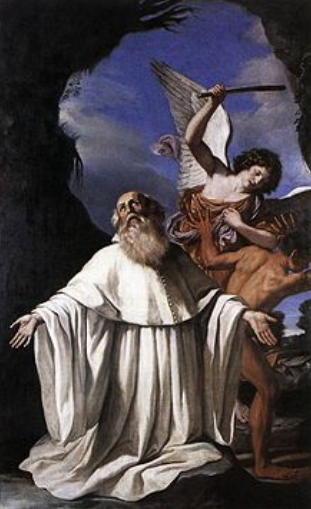
St. Romuald, Abbot and Confessor
1. St. Romuald, founder of the Camaldolese Order, was born about 952, of a prominent family. He grew up with his every wish fulfilled, but without education. Up to the age of twenty, he threw himself recklessly into every kind of pleasure; but then, the grace of God besieged and finally conquered him, after he had witnessed a duel in which his father killed a relative. The young man considered himself guilty, too, and he performed the forty-day ecclesiastical penance in the monastery of St. Apollinaris in Ravenna. During this time he decided to renounce the world and serve God alone. In 972 he entered the same monastery and soon became a model to the good and a stone of scandal to the negligent. When he found out that the latter were plotting against him he left the monastery, and in 975 joined the hermit, Martin, in Catalonia, Spain. On his return to Italy and to his monastery, he was elected abbot, in 996. On the insistence of Emperor Otto II he accepted the office, but, after two years he resigned in order to devote himself wholly to the reform of the Benedictine monasteries of Italy. As part of his campaign he founded a number of hermit-colonies, among them the one at Camaldoli in Tuscany. It was his purpose to combine the hermit’s manner of life with that of the cenobites living in community. St. Romuald died on June 19, 1027.
2. “What of us who have forsaken all and followed Thee?” (Gospel). No doubt, the young Romuald did not easily overcome his attraction to worldly pleasures and goods. He had grown up with a desire for human love, for dogs and horses, for hunting and falconry, for hilarious parties and sensual enjoyment. But, by the grace of God, there grew in his soul mysterious and unusual feelings and impulses. A deep longing for nobler and higher things sometimes took possession of him and made his worldly activities so distasteful that he occasionally withdrew from the company of friends and comrades, in spite of their taunts.
Finally, he could resist grace no longer. He broke with his previous habits so radically and completely that he soon surpassed his religious brethren in virtues, in fidelity to the rules, in zeal, and in self-sacrifice. Romuald lived only for God. For the rest of his life, he labored with indomitable energy against worldliness in monasteries and canonries. However, his sincere intentions were often misunderstood, misinterpreted, or suspected; he was insulted and mistreated, and was even ordered out of some monasteries. Nevertheless, he persisted in his efforts, for praise and abuse from men were alike meaningless to him. He was concerned only about the honor of God. He wanted nothing for himself; for his enemies he always had sincere love and sympathy, as well as the charity of his prayers.
“Well-loved by God, well-loved among men, on his name a benediction rests. The Lord gave him such honor as He gives to His holy ones; gave him renown by striking terror into his enemies. . . . He made him great in the eyes of kings, entrusted commandments to him in full view of the chosen people, made a revelation to him of divine glory. The Lord set him apart, chosen out from the rest of mankind, so loyal he was and so gentle; answered his prayer by taking him up into a cloud, and there, face to face, imparting commandments to him, the law that gives life and wisdom” (Lesson).
In these words the Church praises the holy monk and hermit. Like Moses, to whom the above text originally referred. Romuald was selected by God to be the inspired leader of the monks of his day, to conduct them out of the slavery of worldliness, through the desert of strict discipline, into the promised land of grace, virtue, and holiness, and, finally, into the blessed possession of God in heaven. As one “well-loved by God,” St. Romuald received the gift of sublime contemplation and of tears. He had an unusual facility in the understanding of Scripture, as well as an aptitude for counseling and comforting others. But, above all other gifts, love glowed brightly in his soul-a love that won all hearts; even sinners and the lukewarm felt their cold hearts inflamed by the fire of his love. Emperor St. Henry II rose from his throne when he saw St. Romuald coming and greeted him with the words: “I wish my soul were like yours.”
3. Joyfully, we honor the holy Founder in the words of the Introit: “Right reason is on the good man’s lips, well weighed: are all his counsels; his steps never falter, because the law of God rules in his heart.” Again, in the words of the Gradual, we sing: “With abundant blessings Thou hast met him on his way, hast set a jewelled crown on his head. He prayed for life, and Thou hast granted him life unfailing till the end of time.”
What would have become of Romuald if he had not followed the call of grace and begun a new life? What if he had rejected the grace of conversion? “May the offerings we lay upon Thy sacred altars, Lord, through the pleading of the holy abbot Romuald be of help to our salvation” (Secret).
Collect: May the intercession of the blessed abbot Romuald gain us Thy favor, we pray Thee, Lord, and may his advocacy win for us that which we do not ourselves deserve. Amen.
(Benedict Baur)
_____________________
PLAIN TALKS ON MARRIAGE
FULGENCE MEYER , O.F.M.
(1954)
Chapter I
Happiness in Marriage
“Blessed are all they that fear the Lord; that walk in His ways … Thy wife as a fruitful vine, on the sides of thy house. Thy children as olive plants, round about thy table. And mayst thou see thy children’s children . . . Peace upon Israel” (Ps. 127).
IN ROME, several years ago, one of the Reverend Consultors of the Sacred Congregation of the Sacraments told the writer, that the sacrament of matrimony gives the congregation more work and trouble than all the other sacraments taken together. Every bishop, pastor, missionary and confessor has about the same story to tell when he measures not so much the volume of the work as the worry it gives him. Nor will this surprise us when we consider that the sacrament of matrimony affects human nature in its most sensitive and self-assertive domain. It intends to moderate and regulate love, than which there is no more personal element, and no greater force in man or woman.
A Delicate, Yet Grateful Task
It is not without a degree of considerable diffidence and hesitancy, if not of positive reluctance, that a Catholic priest sets about to discuss the sacred and intimate relations of husband and wife. This is a most difficult and trying task because of the very important and highly delicate subjects that have to be treated, and which are altogether foreign to a priest’s personal life and consecration. He fears lest he may say a word or use a phrase inadvisedly, and thus create a false or sinister impression; or he may unwittingly omit to mention one or the other point that deserve to be emphasized; or, in general, his very knowledge of, and references to, certain phases of married life may be misconstrued.
On the other hand no treatise produces richer, deeper and more far-reaching results than the prudent and sympathetic discussion of the vocational duties of married men and women. It bears fruit not only with reference to those who read it, but also to countless others who will be indirectly benefited by it, and who, in times to come, may even owe their very existence to it. In this reflection there is much substantial consolation and encouragement for the writer, who feels that, if through his effort he forestalls the sinful denial of existence to but one human being, he will be abundantly rewarded for his labors.
The Pillar and the Cloud
Moreover, in offering enlightenment and inspiration to good Catholic fathers and mothers, the Catholic priest is satisfied, that he has an opportunity of paying off a part of the great debt he owes Almighty God for the signal favor the Lord bestowed upon him in giving him good Catholic parents, which is known to be one of the greatest graces which heaven dispenses. No matter how old anyone grows in life, and whatever his career may be, it always remains one of his sweetest thrills and most solid joys, when he can look back upon his youth and childhood, and say: “My parents were true Christians, in thought, word and deed. They were the outstanding grace of God for me in my life. They were parents after God’s own heart, and lovers to the core of Christ and His Church. Never did I hear them say, or see them do anything, that was unbecoming their dignity and profession as Catholic parents. Their example was an eloquent and a continuous sermon on the beauty of virtue and the value of religion to their children, clearly pointing out to them, and rendering easy for them, the way to heaven, the promised land, even as a pillar of fire by night, and as a sheltering cloud by day. May the Lord be eternally praised and thanked for the priceless. gift of so good a father and so dear a mother.”
As Others See Us
The married people who read this book are trying their best, I have reasons to believe, to belong to this type of men and women. It will be my object, in the course of this essay, to hearten and help them to keep on endeavoring to live up to the ideal of Catholic husbands and wives, and, respectively, of Catholic fathers and mothers. I do not intend to scold, or find fault, or embarrass anyone: but I aim to instruct, comfort and encourage. We all need to be periodically enlightened and animated with regard to our peculiar life duties. The Holy Father, the cardinals, bishops, priests, friars, brothers, and nuns make a retreat or a mission once a year. They are then told very plainly what are the duties of their state of life; they are warned against certain dangers; and their defects and shortcomings are pointed out to them, without gloss or varnish. They appreciate this much, and are sincerely grateful for it, conscious as they are of the blinding influence of self-love, and of the advantage there is in seeing ourselves as others see us. For the same reason I feel that my married readers are going to welcome this instruction.
On the Stage of Life
Life is often compared to a stage, upon which we are all given a part to play. God Himself has assigned our individual roles to us. In calling you to the married state He has allotted to you a distinguished and arduous part on the stage of life. And if you are a parent, your part is immensely more sublime and difficult. It is by no means easy to play well and creditably the part of a Catholic married person and parent. This requires virtue and ability of the highest order. Whoever in a dramatic play has to represent a difficult character, is glad to have someone instruct him and provide him with helpful cautions, hints and suggestions. I shall now attempt to do this in your behalf regarding the conduct of your married life.
God Has Chosen You
You must above all remember, that God has chosen you for the part you must play on the stage of life; and since He has chosen you for it, He will supply you with the strength you need to acquit yourself of it satisfactorily. Even if you married frivolously and thoughtlessly, or through mere passion or spite: now that you are bound by the marriage tie, you can be sure that God intended you should be bound thus: and consequently you can count on His help to achieve happiness and holiness in the marriage you have legitimately contracted, and from which you can no longer withdraw. All regrets as to what else might have been, had you not married as you did, are idle and futile. What matters now is that you make the most of your present situation through good sense and the grace of God. Do not make things worse by dwelling gloomily and pessimistically on your real or imaginary mistake in marrying as you did, and by thus increasing the evil effects of it: but rather make a virtue out of necessity, and turn your mistake, whatever it was, into a stepping stone to sanctity and everlasting glory. To those who entered the convent or the priesthood without a vocation from on high, and who realized their mistake after they had bound themselves by the holy vows for life, St. Augustine said: “If you are not called, see to it that you be called.” Similarly married people who, after they are married a while, find that they made a mistake in marrying at all, will apply the best remedy to their hard situation not by unavailing complaints or morbid self-pity, but by doing what they can to render their actual married life their real vocation. With the aid of God’s grace many have done this to their great contentment and sanctification. What others have done, you can do too, with the assistance of the same grace. Spiritually and religiously you may even thrive better for being unfortunately married.
A Vale of Tears
The fact alone that you are not fully happy in your married life, is not by any means a sign that you were not called or destined for it. No one, in the married or any other state of life, is completely happy on this earth. God did not intend that anyone should be entirely happy. This earth will always be a vale of tears no matter how we arrange it, in marriage, in the single life in the world, in the cloister, in the priesthood, and everywhere else. We are merely pilgrims or tourists steering towards our eternal home, and the more we are disposed to put up with the discomforts and annoyances of tourists or travellers, the less chagrined shall we be. Even in paradise there was the forbidden tree and the insidious serpent. No home or family life can therefore be expected to be without some trouble and worry. All we can do is to achieve a relative happiness here below, as a preparation for an eternal happiness beyond. Marriage offers a good opportunity for the accomplishment of both.
An Infallible Recipe
What, then, is the recipe of happiness for a married person? It is contained in the words of my text: “Blessed are all they that fear the Lord.” This is the recipe given by God Himself. If anyone knows the way to true and lasting happiness, it is the Lord Who created our heart and gave it its vehement and incessant craving for happiness. He condenses the whole manner of achieving happiness in the words I have quoted. All other recipes of happiness, divergent from this one, no matter by whom they have been or are given, are false and misleading. There is but one way for a Catholic couple to become thoroughly and permanently happy, and that one way is the fear of the Lord.
How does a Catholic couple practice and manifest the fear of the Lord? First of all by worshiping God faithfully. They say their prayers every morning and evening. In their home, which is duly blessed, they pray aloud with the family before and after meals; this, too, when guests are present, let them be Catholics or not. Grace at table always makes a good impression on company worth having.
————————-
Father Krier will be in Pahrump (Our Lady of the Snows Mission) February 11 and Eureka (Saint Joseph Chapel) February 18. He will be in Albuquerque (Saint Joseph Cupertino) February 23.
————————-
The topics of Faith and Morals will correspond to the Roman Catholic Faith in Tradition and the Magisterium. The News will be of interest. The commentaries are for the reader to ponder and consider. The e-mail address will be for you to provide thought for consideration. The donations will be to support the continuation of this undertaking.
While the Newsletter is free of charge it is not free of cost. Please consider supporting St Joseph’s Catholic Church with a tax – deductible donation by clicking the secure link: Donate
Or if you prefer send a check to
Catholic Tradition Newsletter
c/o St Joseph’s Catholic Church
131 N. 9th St
Las Vegas, NV 89101