Vol 13 Issue 50 ~ Editor: Rev. Fr. Courtney Edward Krier
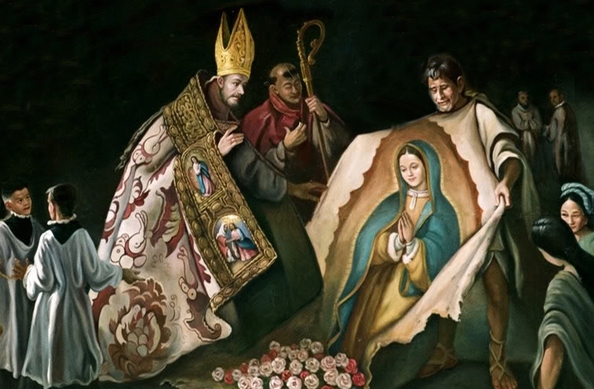
December 12, 2020 ~ Our Lady of Guadalupe, opn!
1. What is the Holy Eucharist
2. Gaudete Sunday
3. Saint Lucy
4. Family and Marriage
5. Articles and notices
Dear Reader:
Today is the Feast of Our Lady of Guadalupe. For those in the Americas it has special import as it was a miracle that changed two continents from heathenism into Christian civilizations. Christopher Columbus had discovered the Americas in 1492. By 1519 Hernando Cortez had penetrated the heart of what is now Mexico. He witnessed the horrific human sacrifices being offered by the Aztec priests to their pagan gods that put fear into the surrounding inhabitants—fear that they would be the next victims. Hernando Cortez encountered these tribes that asked him to assist in freeing them from the terrorism they were oppressed by. Gathering these forces, Hernando Cortés returned two years later on August 13, 1521, and easily conquered the Aztecs who expected their gods and universal fear they imposed to protect them. The breakdown of the Aztec system brought chaos as the Spanish were not able to communicate directly and had so few men—men who only wanted adventure and gold, not to be administrators. The Franciscan Missionaries were quickly sent to Tenochtitlán (Mexico City) and Tlatelolco to begin the instruction and teaching of the Christian faith and morals to the population—for only the consolation of faith could restore peace and tranquility. Were there bad players among the Spanish? Yes, but in general the Franciscans and Administrators were taking a barbaric blood thirsty, but fearful, people and changing them into a civilized, respectful people. In the beginning many were convinced of the good intentions and converted, but—as one recognizes it took centuries before the Roman Empire became Catholic. The miracle that changed the Americas into a Catholic Domain came not just from the sword as anti-Catholics would have one to believe but from the event that took place on December 12, 1531. It was at this time Northern Europe was in full swing of rejecting the Catholic Faith with the Augsburg Diet of 1530 and the formation of the Smalkaldic League in 1531 to defend themselves against Catholic Rulers ever trying to bring them back to the faith. The rejection of the maternal intercessory power of a Mother, who said to the servants of the wedding feast of Cana, whatever He (Jesus) says to you, do ye (cf. John 2:5) draws her to consider another people to show her powerful intercession and they accept the invitation and do what Christ commanded through His Church. Within a short time the peoples of what is now Mexico accepted Christ and His ministers, the greatest conversion story of all times. May we not, as unfortunately the rest of the world has, reject her Maternal intercessory power that keeps us under her mantle of protection and in the fold of the Church. Her Immaculate Heart will triumph in these times of evil because we know that those who stayed with her also stood faithful beside her at the Foot of the Cross (cf. John 19:25, 26) when everyone else abandoned her Divine Son.
And a great sign appeared in heaven: A woman clothed with the sun, and the moon under her feet, and on her head a crown of twelve stars . . . . And the woman fled into the wilderness, where she had a place prepared by God. . . . And the dragon was angry against the woman: and went to make war with the rest of her seed, who keep the commandments of God, and have the testimony of Jesus Christ. (Apoc. 12:1, 6, 17
As always, enjoy the readings provided for your benefit.—The Editor
________________
WHAT IS THE HOLY EUCHARIST
By Rev. Courtney Edward Krier
Part V
Reception of the Holy Eucharist: Holy Communion
The Reception of the Body and Blood of Christ
Receiving Holy Communion as a Sacrament
Form (continuation)
The Liturgy of Addai and Mari is another case of where the Conciliar Church departs from the Catholic Church teaching. This is because many of the schismatic and heretical Nestorians do not pronounce the words of consecration. They give the argument as follows:
The principal issue for the Catholic Church in agreeing to this request, related to the question of the validity of the Eucharist celebrated with the Anaphora of Addai and Mari, one of the three Anaphoras traditionally used by the Assyrian Church of the East. The Anaphora of Addai and Mari is notable because, from time immemorial, it has been used without a recitation of the Institution Narrative. As the Catholic Church considers the words of the Eucharistic Institution a constitutive and therefore indispensable part of the Anaphora or Eucharistic Prayer, a long and careful study was undertaken of the Anaphora of Addai and Mari, from a historical, liturgical and theological perspective, at the end of which the Congregation for the Doctrine of Faith on January 17th, 2001 concluded that this Anaphora can be considered valid. H.H. Pope John Paul II has approved this decision. This conclusion rests on three major arguments.
In the first place, the Anaphora of Addai and Mari is one of the most ancient Anaphoras, dating back to the time of the very early Church; it was composed and used with the clear intention of celebrating the Eucharist in full continuity with the Last Supper and according to the intention of the Church; its validity was never officially contested, neither in the Christian East nor in the Christian West.
Secondly, the Catholic Church recognises the Assyrian Church of the East as a true particular Church, built upon orthodox faith and apostolic succession. The Assyrian Church of the East has also preserved full Eucharistic faith in the presence of our Lord under the species of bread and wine and in the sacrificial character of the Eucharist. In the Assyrian Church of the East, though not in full communion with the Catholic Church, are thus to be found “true sacraments, and above all, by apostolic succession, the priesthood and the Eucharist” (U.R., n. 15).
Finally, the words of Eucharistic Institution are indeed present in the Anaphora of Addai and Mari, not in a coherent narrative way and ad litteram, but rather in a dispersed euchological way, that is, integrated in successive prayers of thanksgiving, praise and intercession.
In response—because if it does not matter a priest can say anything and therefore the Councils of Florence and Trent were wrong—each of the arguments will be addressed simply. An anaphora is the words of what is considered the Eucharistic Prayer (Prex Eucharistica), it starts with the Preface where the priest says:
P: The Lord be with you.
S: And with your spirit.
P: Lift up your hearts.
S: We have lifted them up unto the Lord.
P: Let us give thanks to the Lord, our God.
S: It is fitting and just.
P: It is truly right and just, proper and helpful toward salvation, that we always and everywhere give thanks to Thee, . . .
This repetition is called an anaphora in Greek. This is not the Canon of the Mass, but all liturgies begin with this anaphora that introduces the Consecration except the Nestorian schismatics. With this understanding of the anaphora, it is to look at the historical context. Goggin writes:
According to tradition, it was composed by Addeus and Maris, who evangelized Edessa, Seleucia-Ctesiphon and the surrounding country. This tradition is based on the narrative contained in the “Doctrine of Addai”, a work generally ascribed to the second half of the third century. The account states that King Abgar the Black, having heard of the wonderful works of Christ, besought Our Lord to come and cure him of a serious malady, but that he obtained only the promise that Our Lord would send one of His disciples, a promise which was fulfilled after the ascension, when Thaddeus (in Syriac, Addai), one of the seventy-two disciples, was sent by St. Thomas to Edessa to cure the King. Addeus and his disciple Maris are said to have converted the King and people of Edessa, to have organized the Christian Church there, and to have composed the liturgy which bears their names. There seem to be no documents earlier than the “ Doctrine of Addai” to confirm this tradition. Although good historical evidence concerning the foundation of the Church of Edessa is wanting, still it is quite certain that Christianity was introduced there at a very early date, since towards the end of the second century the king was a Christian, and a bishop (Palouth) of the see was consecrated by Serapion of Antioch (190-203). It was only natural that the Edessans should regard Addeus and Maris as the authors of their liturgy, since they already regarded these men as the founders of their Church. The Nestorians attribute the final redaction of the text of the Liturgy of Addeus and Maris to their patriarch Jesuyab III who lived about the beginning of the seventh century. After the condemnation of Nestorianism, the Nestorians retreated into the Persian kingdom, and penetrated even into India and China, founding churches and introducing their liturgy wherever the Syriac language was used. At the present time this liturgy is used chiefly by the Nestorians, who reside for the most part in Kurdistan. (Art., Liturgy of Addeus and Mari, CE)
The Liturgy, itself, resembles that of the Liturgy Saint Ephrem (+373) mentions and of that of the Liturgy of Saint Basil (+379)—only without the words of Institution. Saint Ephrem is highly venerated by the Nestorians and insert the Hymns of Saint Ephrem in their Liturgy. Why is there no mention of the Institution? Prior to Vatican II, it was admitted that there were the consecratory words, but that they were not written with the following explanation:
1. In the early Church they were committed to memory (cf. Fortesque, 86) because of the Discipline of the Secret (Disciplina arcani) and, just as today the words of Consecration are said silently, the Words of Institution were held then to be known only by the priest.
2. Because of the Orthodox claim that the Epiclesis (invocation of the Holy Ghost) confected the change of bread and wine into the Body and Blood, eventually it fell into disuse.
3. Because of its absence, it ceased to be observed with the reforms of Jesuyab III who lived at the beginning of the seventh century.
Yet, from all documents, there is the acknowledgement that the words of Institution were part of the Liturgy previous. The two other Liturgies the Nestorians retain, though later introductions, have the words of Institution (the Liturgies of Theodore and Nestorius). It is also clear that in returning to union the Chaldeans and Malabari either re-instated the words of Institution or showed that they had always retained the words of Consecration. Lang provides this outline:
The manuscript Vat. syr. 66 has the Institution Narrative written on a separate leaf (fo. 101a), followed by the incipit of the blessing that follows the fraction and other manual acts. This suggests that the Narrative should be inserted before the blessing. The oldest part of the codex consists of a Chaldean-rite Pontifical written in 1529; the rite of the Eucharist was added later, most likely in 1566 by Mar Joseph Sulaqua.
Mar John Simon sought union with the Holy See and went to Rome to be consecrated patriarch by Pope Julius III in 1553. This first union with Rome seems to have lasted for about 120 years; it lead to the development of a simple form of the East Syrian liturgy, which was adopted in the patriarchate united with Rome, and a more complex form of it, which was used in the rival patriarchate. The Vatican manuscript is a witness to the simpler form and presumably came with Mar Joseph, who was arrested by the Portuguese authorities under suspicion of heresy and sent as prisoner to Lisbon and later to Rome. A tribunal set up by Pope Pius V cleared him of these charges and confirmed his orthodoxy; Mar Joseph died in Rome in 1569. Anthony Gelston holds that the part of the manuscript containing the anaphora was written c. 1558.
The synod of Diamper in 1599 under Aleixo de Menezes, the Portuguese Archbishop of Goa (1595-1617), imposed a number of Latinisms on the Malabar rite, which was essentially the same as Addai and Mari. Intriguingly, canons 109-110 of the Diamper synod suggest that the Malabar liturgy already contained an Institution Narrative. Antonio de Gouvea, who in 1606 published an account of Menezes’ work, to which were appended the acts of Diamper and a Latin translation from the Syriac of the “Liturgy of the Apostles”, notes that “Chaldean prelates” had been “sent from Babylon” and that they, out of ignorance, had words added to or removed from the “forma da Consagração” at will. However, an archbishop, whom Gouvea credits with more theological erudition, introduced a fixed formula of consecration. It would seem, then, that the words of Institution were already part of the Malabar liturgy before Diamper and belonged to an oral tradition that had not yet been fixed. Burkitt thinks that the unknown archbishop was a Malabar prelate of the fifteenth century who must have been in touch with the Portuguese (note, however, that his form of consecration as cited by Gouvea is not identical with the Roman one). According to a report in Joseph Simeon Assemani’s Bibliotheca Orientalis, in the year 1490 the Malabar Christians sent an embassy to Simeon, the Catholicos of the Church of the East who resided near Mosul, and asked him to send them bishops, because Muslim persecution had apparently deprived the Malabar Church of clergy for some time. Simeon duly dispatched two bishops to Southern India, so that ecclesiastical life could be restored there. Perhaps the Chaldean prelates who tinkered with the words of Institution can be identified with these two bishops. In Burkitt’s view the Malabar liturgy as found by Portuguese in the sixteenth century results from “the Nestorian revival of 1490”. Since we have no witnesses to the unrevised form of the Malabar rite before 1599, it is impossible to draw any further conclusions with certainty. Francisco Roz SJ, the first Latin-rite bishop for the St Thomas Christians of India (1600-1624), inserted the Institution Narrative in its Roman form just before the elevation that precedes the fraction. This place was subsequently adopted by the printed Malabar missal of 1774. (Eucharist without Institution Narrative? The Anaphora of Addai and Mari Revisited, Nova et Veteris, 2007)
Returning to Goggin, who speaks of the Chaldeans: It is also used by the Chaldean Uniats of the same region, but their liturgy has, of course, been purged of all traces of Nestorian tenets. Finally, it is in use among the Chaldean Uniats of Malabar, but it was very much altered by the Synod of Diamper held in 1599. (Art., Liturgy of Addeus and Mari, CE)
For the second argument, that as to accepting that Vatican II, with the document, Unitatis Reintegratio, approved all Schismatic Rites
These Churches, although separated from us, possess true sacraments, above all by apostolic succession, the priesthood and the Eucharist, whereby they are linked with us in closest intimacy. Therefore some worship in common (communicatio in sacris), given suitable circumstances and the approval of Church authority, is not only possible but to be encouraged. (Par. 15)
somehow confirms that the schismatical Nestorians who still do not incorporate the words of Institution and who do not have all seven Sacraments (they do not have Extreme Unction and office of bishop is passed to nephew or closest relative) have validity in a non-consecratory liturgy opposes all past Apostolic teaching (as their liturgy comes after the Apostles—all liturgies from apostolic times have had the words of Institution and all have the seven sacraments) makes not for an apostolic faith, but a simple fiat. It is therefore no wonder that the vague third argument that somehow if they might intend it to be the Body and Blood without proper form, though through an euchalogical (what ever this is to mean) wish, it becomes so, reverts back to Lutheranism and the idea that it is the Body and Blood of Christ if the believer believes it is the Body and Blood of Christ—and if not, it is not the Body and Blood of Christ.
In conclusion, the Church has always taught that the words of Institution, that is the form, are necessary as Christ Himself changed bread and wine into His Body and Blood with these words in the first holy Mass.
(To be continued)
————————–
The Sunday Sermons of the Great Fathers
M. F. Toal
THE GOSPEL OF THE SUNDAY
JOHN i. 19-28
At that time: the Jews sent from Jerusalem priests and Levites to John, to ask him: Who art thou? And he confessed. and did not deny: and he confessed. I am not the Christ. And they asked him: What then? Art thou Elias? And he said: I am not. Art thou The Prophet? And he answered: No. They said therefore unto him: Who art thou, that we may give an answer to them that sent us? What sayest thou of thyself? He said: I am the voice of one crying in the wilderness, make straight the way of the Lord, as said the prophet Isaias. And they that were sent, were of the Pharisees. And they asked him, and said to him: Why then dost thou baptize, if thou be not Christ, nor Elias, nor The Prophet? John answered them, saying: I baptize with water; but there hath stood one in the midst of you, whom you know not. The same is he that shall come after me, who is preferred before me: the latchet of whose shoe I am not worthy to loose. These things were done in Bethania, beyond the Jordan, where John was baptizing.
ST AUGUSTINE: ON THE GOSPELS
From Tract 4 in St John’s Gospel
1. Your Sanctity has often times heard, and it is something that is well known to you, that John the Baptist, as there was none greater born of woman, and none more humble in the knowledge of God, so in like manner none more merited to be the Bridegroom’s friend: being zealous, not for himself, but for the Bridegroom; seeking not his own honour, but that of the Judge Whom he preceded as Herald. And as to the prophets who went before it was given to foretell what was to be fulfilled in Christ, so to John it was given to point Him out, as with the finger. For as Christ was not known by those who, before He came, believed not in the prophets, so was He unknown to them, though in their midst. For he first came in a lowly manner, and unperceived; and the more lowly, the more hiddenly; but the people through pride despised the lowliness of God, crucified their Saviour, and made Him their Condemner.
2. But He Who first came hiddcnly, because He came in lowliness, shall He not in due time come manifestly, because He shall come in glory? You have heard the psalmist say: God shall come manifestly: Our God shall come, and shall not keep silence (Ps. xlix. 3). He kept silence that He might receive judgment; He shall not keep silence, when He shall begin to give judgment. It would not have been said that He shall come manifestly, unless before He had come hiddenly. Nor that He shall not keep silence, unless before He had been silent. In what manner did He keep silence? Ask of lsaias: He shall be led as a sheep to the slaughter, and shall be dumb as a lamb before its shearer, and he shall not open his mouth (Is. liii. 7).
But He shall come manifestly, and shall not keep silence. How shall He be manifest? A fire shall burn before Him: and a mighty tempest shall be round about him (Ps. xlix. 3). This tempest has the power to sweep all chaff from the threshing floor, where it is now being treaded out; and the fire power to burn what the tempest has scattered. Now he keeps silence; silent in judgment, but not silent in precept. For if Christ keeps silence, what do these Gospels mean? And what the Apostolic teachings? What the song of the psalms, and the voices of the prophets? For in all these Christ keeps not silence. He keeps silence that He may not now give judgment; He is not silent in the Voice of His Teaching.
To give judgment He shall come in glory, and will appear to all, even to those who now believe not. But, among men, and Lowly, it must be that He was despised. For unless He were despised, He would not be crucified. Unless He were crucified, He would not shed His Blood; by which as with a price He redeemed us. He was crucified, that He might pay the price for us. He was despised, that He might be crucified. He came in lowliness, that He might be despised.
3. And because He appeared as it were in the night, in this mortal body, He lit for Himself a shining light, that He might be seen, This light was John (Jn. v. 35), of whom you have already heard many things: and the present passage of the Gospel contains the words of John, wherein He confesses from the beginning, what is most noteworthy: that he was not the Christ. For there was in John such virtue, that he would have been accepted as the Christ: and here his humility was tested: because he said that he was not, when it would have been believed of him that he was. Therefore this is the testimony of John, when the Jews sent from Jerusalem priests and Levites to him, to ask him: who art thou? They would not send, unless shaken by the power within him whereby he dared to give baptism. And he confessed and did not deny. What did he confess? And he confessed that: I am not the Christ.
4. And they asked him: What then? Art thou Elias! For they knew that Elias was to precede Christ. To no one among the Jews was the name of the Christ unknown. They did not believe this man was the Christ; nor did they entirely believe that Christ was not to come, since they were hoping He would come. And so they stumbled on Him, present among them; they stumbled as upon an unnoticed stone. That stone till now was small, though already cut out, without labour of hands, from the mountain: as the prophet Daniel says that he is a stone cut out of the mountain without hands. Then what followed? And it grew and became a great mountain and filled the whole earth (Dan. ii. 3 5).
Let your Charity reflect upon what I say. Christ, before the Jews were, was already cut out from the mountain. The kingdom of the Jews is the mountain. But the kingdom of the Jews did not fill the whole earth. From there was this stone cut, because from there was the Lord born into this world. But wherefore without hands? Because without the work of man the Virgin brought forth Christ. And now this stone, but without work of hands, was present before the eyes of the Jews. But it was unnoticed. And understandably, for this stone had not yet grown and filled the whole earth; as He made clear in His Kingdom, which is the Church, by which He has filled the whole earth.
Because it had not yet grown they stumbled on it, as upon a stone: and there happened to them as was written: Whosoever shall fall upon that stone, shall be bruised and upon whomsoever it shall fall, it will grind him to powder (Lk. xx. 18). They first stumbled on the Lowly One; He being raised on high will come down upon them; but that He Who is to come in glory may crush them, first as a humble stone He bruised them. They stumbled at Him (Rom. ix. 32), and they were bruised; not crushed, but bruised. Coming in glory, He will crush them.
But if the Jews are to be forgiven, because they stumbled at the stone that had not yet grown, what of those who stumbled even at the mountain? You know of whom I am speaking. They who deny the Church that is spread through the whole earth stumble, not at a humble stone, but at the mountain which this stone became when it grew. The Jews being blinded saw not the humble stone: what blindness not to see the mountain?
5. Accordingly they saw the Lowly One, and they did not know Him. He was revealed to them by a shining light. For from the very first he, than whom a greater among them born of woman had not arisen, declared: I am not the Christ. Then was it said to him: art thou then Elias? He answered: I am not. For Christ will send Elias to prepare the way before Him: and he said: I am not; presenting to us a difficulty.
For men must beware, lest understanding but little in this matter, they may think that Christ has said that which is contrary to what John said. For in a certain place in the gospel, when Our Lord Jesus Christ had told them many things concerning Himself, His Disciples asked Him: why then do the scribes, that is, those skilled in the Law, say that Elias must come first? And the Lord answering, said, Elias is already come, and they have done unto him whatsoever they had a mind; and if you will receive it, he is John the Baptist (Mt. xvii. 10-13; x. 11-14).
The Lord Jesus Christ said: Elias is come and he is John the Baptist. But John, when asked, declared that he was not Elias, as he was not the Christ. And as he spoke truly in saying that he was not the Christ, so likewise did he speak the truth when he declared he was not Elias. How then reconcile the words of the Herald with the words of the Judge? It is not to be thought of that the Herald spoke what was false! For he spoke that which he had heard from the Judge. How then is it John says: I am not Elias, and the Lord says: he is Elias.
On this occasion the Lord Jesus Christ desired to prefigure His own second coming, and to affirm this: namely that John came in the spirit of Elias. For what John was in relation to the first coming, Elias will be to the second. Since there are two Advents of the Judge so are there two Heralds of His Coming. He Himself is the Judge; the Heralds are two, but there are not two Judges. For the Judge must first come, that He may receive judgement. He sends before Him the first Herald, and He calls him Elias; because what John is in the first coming, Elias will be in the second.
6. And now let Your Charity apply your mind to the truth of what I am saying. When John was conceived, or rather when he was born, the Holy Spirit foretold that which was to be fulfilled concerning this man: and he shall, He says, go before Him in the Spirit and power of Elias (Lk. i. 17). Not Elias, but in the spirit and power of Elias. What means, in the spirit and power of Elias? In the same Holy Spirit as in the case of Elias. Wherefore as in the case of Elias? Because what Elias will be to the second coming, this same John was to the first coming.
John therefore answered rightly. For the Lord said in figure, John is Elias; but John spoke literally when he answered, I am not Elias. If you consider the allegorical meaning of the office of Precursor, John is Elias; for what the one is to the first coming, the other is to the second. If you consider the distinct being of each person, John is John, and Elias is Elias. Having regard to prefiguration, the Lord rightly said, He is Elias; having regard to his own distinct being, John rightly answered, I am not Elias. Neither John spoke falsely, nor Christ; neither the Herald, nor the Judge, declared what was not true; provided you understand. Who shall understand? He that will imitate the humility of the Herald, and discern the majesty of the Judge. None was there more humble than this Herald. My Brethren, John had no greater merit than that which came from this humility; for when he could have deceived men, and could have been believed to be the Christ, and could have been accepted as the Christ, as he was of such excellence and virtue, yet he confessed to all men, and said, I am not the Christ.
Art thou Elias? Had he said, I am Elias, then Christ, already appearing in His second coming, would have given judgement; nor would He, even now, in His first coming, be judged. As though answering: Elias is yet to come, he says: I am not Elias. Have regard for the Lowly One, Whom John preceded, lest you feel the might of the Exalted One, before Whom Elias will come. For the Lord so ended His words: he is John the Baptist that will come. Here Elias came in figure; in his own person he is yet to come. Then Elias shall be Elias in person, whom John is now in figure. Now John is John in his true person, who is Elias in figure. Both Heralds portray each other in figure, yet each retains his separate being. But the Lord Judge is One, whether this Herald or that shall go before Him.
———————–
DECEMBER 13
St. Lucy, Virgin and Martyr
1. St. Lucy probably suffered martyrdom about the year 304, during the persecution of Emperor Diocletian. She belonged to a prominent family in Syracuse, Sicily, and was brought up as a Christian by her mother Eutychia. On the occasion of the latter’s miraculous restoration to health at the tomb of St. Agatha in Catania, Lucy obtained her permission to remain a virgin and to distribute her property among the poor. This fired the wrath of her intended husband, and he denounced her as a Christian. The judge ordered her to be taken to a brothel; but she became miraculously fixed to the spot, and no one could move her. Nor did fire harm her. Finally, the thrust of a sword ended her life. This is the legendary account of Lucy’s death. History attests only to her existence and her martyrdom.
2. “Thou hast been a friend to right, an enemy to wrong” (Introit). This does not imply that Lucy would have done wrong by accepting matrimony. But God gave her the grace to see that “he who is unmarried is concerned with God’s claim, asking how he is to please God . . . . So a woman who is free of wedlock, or a virgin, is concerned with the Lord’s claim, intent on holiness, bodily and spiritual; whereas the married woman is concerned with the world’s claim, asking how she is to please her husband” (I Cor. 7:32, 34). For this reason, Lucy chose to remain unmarried. She distributed her wealth among the poor, thereby removing the greatest hindrances to her total dedication of herself to the Lord. At St. Agatha’s tomb she had found the “treasure hidden in a field” and the “pearl of great cost” (Gospel); she had come to recognize the nobility of a life for and with Christ. Therefore, she sold all her possessions and purchased the field, the pearl (cf. Gospel).
“Maidens shall follow in her retinue into the king’s presence; all rejoicing, all triumph, those companions of hers, as they, enter the palace of their Lord and King” (Offertory). In Lucy, the “lucent” saint of the Advent season, we recognize ourselves; we long for the coming of Christmas, the coming of Christ. Our gaze rises above earthly things to the heavenly realm of grace and supernatural life; we look up to the heaven which is Christ, whose coming we are now anticipating. St. Lucy leads the way as we hasten to meet Him when He comes to us in the Holy Sacrifice, in Holy Communion, in order to fill us with the holiness of His own divine life. We look forward to the time when He will take us to His home for the blessed nuptials. But we cannot claim to be good imitators of St. Lucy unless we free ourselves from inordinate attachment to creatures in daily life, for the sake of the “treasure” that we hope to acquire; unless we walk the way of martyrdom, of sacrifice, and suffering out of love for Christ.
3. During the Advent of earthly life, let us walk in the footsteps of St. Lucy, virgin and martyr, on our way to meet the coming Redeemer; and let us persevere in this holy practice until, at the hour of death, we shall be admitted to the celebration of an everlasting Christmas in heaven.
“Vexed by the causeless malice of princes, my heart still dreads thy warnings. Victors rejoice not more over rich spoils than lover thy promises” (Communion). Amid the afflictions of life, we will place our confidence in the promise given in the Holy Eucharist: “The man who eats my flesh and drinks my blood enjoys eternal life, and I will raise him up at the last day” (John 6:55). This promise of our Lord gives us strength and courage.
Collect: Listen to us, God our Savior, so that we who find joy in the festival of Thy blessed virgin and martyr Lucy may learn from her the spirit of godly service. Amen.
(Benedict Baur)
_____________________
A MOTHER’S LETTERS
A Book for Young Women
by
FATHER ALEXANDER , O.F.M.
(1923)
LETTER VI
DANGERS OF IGNORANCE
THANKS, dearest, for your last in which you assure me that you see how a badly-informed young woman may be a real danger to herself. That it is so there is no room for doubt. Although innocence is, in itself, a divinely-given shield that wards off many dangers, it cannot dispense a girl from acquiring prudence; for while we are counselled to be as innocent as the dove we are warned to be as wise as the serpent. No one can lay claim to wisdom sufficient for the steering of her way through the tempestuous waters of life if she is wilfully ignorant of the shoals and sunken reefs that lie in the way.
With regard to the difficulty you find in realizing that an innocent or ignorant girl may be a danger to others as well as to herself, you have but to think of some mishaps in ordinary domestic life. Why did that child (according to last night’s newspaper) cause not only her own death, but that of her little brother and sister? Because she was ignorant of the inflammable nature of flannelette. Examples could be multiplied a hundredfold. It is exactly so in the sphere of morals. A girl who is a dunce with regard to matters affecting the human race not only frequently says the wrong thing, or in the wrong place, but even more frequently does the wrong thing. Her ignorance paves the way to, nay sometimes invites familiarities, in speech and action, that would be abhorrent to one better informed. She, as a rule, is more apt to be a flirt than her well-instructed companions, and ignoring the fact that men are men (no matter what their age or station in life), she occasions in them desires that add fuel to flames already existent because of their human nature.
Here, again, we behold the wisdom of the Church in her disapproval of certain fashions and amusements. Although not proclaiming it from the housetop, the Church has ever in mind the nature of the sexes and strives to prevent one sex being a danger to the other. She would wish her children to rejoice and make merry—but in the Lord—i.e., in such prudent and harmless ways as would safeguard self-respect. One may be a danger to others through sentimental hand-pressure, fondling, ogling; through immodesty in dress, and through protracted meetings in lonely places or in the dark. If you remember what I have told you about the natural sex attraction which is in everyone, you will at once seize the point at issue. The above, and all such familiarities, are dangerous because of their remote or proximate connection with the sexual union I have before referred to. All of them are so many stages on the way and cannot be indulged in without causing temptation to others. It is no excuse for a girl to say: “I see nothing in those things; they don’t upset me.” She must be unselfish enough to think of others as well as herself. She must listen to those who speak with authority and with experience of the world and its ways. If she will be a law to herself, she will perish. “He who loves the danger will perish in the danger.”
You see how an ignorant girl—all unconsciously—might be a real danger to her neighbours, not only of the other sex, but of her own. The child who set the house on fire “meant no harm,” but oh! the harm that was nevertheless done can never be repaired.
I beg of you not to think that I am an alarmist or that I am labouring this question of sex too much. All the human race depends on this very question. For the moment it will, of course, be uppermost in your mind, but once you grasp the principles that I have laid down and feel that your questions are fully and satisfactorily answered, you will be surprised at the peace which will steal over your soul. Most of our worries are due to uncertainty—to our uncertainty regarding laws or facts. Once a law is made clear or a fact proved, the mind is at rest. Before that stage is reached, and especially during the process of elucidation, the mind is all in a flutter. It is worth while waiting for the peace which is sure to come through certainty.
Short of one being receptive of information from safe quarters and through proper channels there can be no peace of mind. To refuse to listen, to object to instruction, through timidity or shamefacedness, is to court life-long misery. As I write, I have various people in my mind who are as scrupulous, as restless, nervous, miserable and useless to-day as they were forty years ago, simply because of yielding to a timidity which usurped the place of calm solid judgment. They felt that it would be good to follow the pathway of common sense, but feared to take the necessary steps. Why? Because of their dread that their intentions were not quite straight. They, perhaps, argued from past slips in that direction. In such cases, the past should be regretted, but should not be morbidly pondered over. One should determine, here and now, to be mistress of her own soul by forming a right intention and protesting, in season and out of season, that she wishes to act only in conformity with it.
In my last letter I ventured to suggest that the poor girl you spoke of may have fallen through sheer ignorance. I dare say the majority of people might answer that the suggestion was more charitable than true. Be that as it may, such a fall is much rarer than those due to less excusable causes. The girl who goes into the world to get a husband by hook or by crook; or she who through depraved and morbid curiosity wishes to find out how far she can go without compromising herself; or she who proudly boasts that she can take care of herself and needs neither preaching nor advice, is in danger. She, moreover, who, scorning the advice of her mother, keeps late hours and walks out in lonely places, saying: ” Oh, I can trust my young man! And, besides, I’m no longer a child—I know a thing or two”; or she who fears to displease her male companion lest he should “give her up,” is likewise in danger. That girl also is especially in danger who consents to walk out with a man who seems to have dropped from the clouds-picked up through a chance meeting at a party, at a dance, by the seaside, or, for that matter, known only through some business transaction.
Women do not form intimate friendships with women, nor men with men, on the mere strength of a chance meeting; nor do they bring to their homes all who, in the course of their travels, extend to them ordinary courtesy. Yet, strange to say, numberless young women yield themselves up a ready prey to men who, for all they know, may be married, profligate, adherents of a false sect, freemasons, or utterly hostile to religion. Like fish, greedy for a bait, they allow themselves to be hooked without pausing to think of what is at stake. The reputation of their home, the honour of their body, the salvation of their soul, their obedience to the Church, their duty to God, are all dangling in the balance, but without bestowing a thought on those sacred things they surrender themselves to the companionship of the first man who offers himself.
Not only is this a pity, it is a degradation.
From the point of view of close companionship between members of the same sex, no man should take another on trust—nor should a woman. A fortiori, no woman should take a strange man on trust. He should present his credentials, and they should be tested. Those credentials should testify to his Catholicity, his freedom, his sobriety, his means of existence, his decency in general—for although, perhaps, poor, he should be decent.
This, which should be the A B C of womanly conduct, is generally disregarded. I have known hundreds of cases in which young women have kept company with the other sex for many months without the slightest knowledge of their religious belief. What a scandal!
Who can adequately describe the dangers run, in such cases, by close and long-continued companionship? From what I have said in my previous letters you have grasped that it is, occasionally, no easy matter to restrain the impetuosity of the sexual instinct (even when one wishes to be very good), apart altogether from any external exciting cause. What, then, of the danger run by the close proximity of those who gradually discover that they love each other—not in and for God (for God is never mentioned) but in and for self? Barrier after barrier of modesty and reserve is gradually broken down; they see nothing beyond the narrow boundary of self-indulgence, and ultimately everything sacred is surrendered for mutual gratification. Fallen human nature has conquered grace. Reason and faith have been thrown to the winds. The purity of soul and body has been lost in brutish indulgence.
In such cases there is perfect knowledge of the risks run to grace and honour, but all the knowledge in the world will not save young women who love the danger. Knowledge is useful only when accompanied by prayer, docility to good advice, frequentation of the Sacraments, diffidence in one’s own strength, and great reverence for one’s own soul and body, and the souls and bodies of others.
Thus, you see that it would be a grave mistake to take my insistence on the value of knowledge as meaning everything. Far from it! All along I have been pleading for its righteous use—viz., as a means of glorifying God in opposition to the many who use their knowledge to His dishonour and their own condemnation.
A conscientious girl, prior to keeping company with a young man, will assure herself of his Catholicity, his respectability, and his morality, but even if she believes him to be a saint she will never forget that he is a man, and that the longer the duration of the courtship and the more confidential their chats, the more she must be on her guard against allowing the instinctive attraction I have spoken of to lead her to any sacrifice of self-respect. And she should regard it as a duty and a privilege to assist her lover in the preservation of his self-respect. Her knowledge of human nature will lead her to say: “Should I fail, I shall harm the man who loves me so tenderly. I shall run the risk of making his conflict with his lower self less successful. God forbid I should! Therefore I must, in a calm, matter-of-fact way, repress all temptations to excess in my manner of greeting him. I must be cordial and loving, but I must, at the same time, remember we are only human and, if imprudent, might forget our duty by God and by ourselves. By nature I, as a woman, should be an example of modesty to man.”
Such reasoning, far from being “goody-goody,” is, or should be, the logical outcome of knowledge. In a case where knowledge is non-existent there is likely to be very little reasoning but, on the contrary, a great deal of sentimental and dangerous familiarity—all in the name of “love.” But real and lasting love—love which carries with it no remorse—is that which is based on knowledge. It is reverent, chaste, self-sacrificing, tender, true, divine. Should you, dearest, ever give your heart and hand to a man, may your love and his be like this. You know how it is to be fostered—by loving first of all your Lord and your God, and by keeping yourself ever under the protecting mantle of your sweet Mother Mary. God bless you!
————————-
Father Krier will be in Eureka December 28. He will be in Albuquerque December 30.
————————-
For those who purchase through Amazon, please help support the work here at Saint Joseph’s by going through this link: http://smile.amazon.com/ch/94-2855162
————————-
The topics of Faith and Morals will correspond to the Roman Catholic Faith in Tradition and the Magisterium. The News will be of interest. The commentaries are for the reader to ponder and consider. The e-mail address will be for you to provide thought for consideration. The donations will be to support the continuation of this undertaking.
While the Newsletter is free of charge it is not free of cost. Please consider supporting St Joseph’s Catholic Church with a tax – deductible donation by clicking the secure link: Donate
Or if you prefer send a check to
Catholic Tradition Newsletter
c/o St Joseph’s Catholic Church
131 N. 9th St
Las Vegas, NV 89101
Visit us on the Worldwide Web: http://stjosephlv.org
e-mail news and comments to: tcatholicn@yahoo.com