Vol 13 Issue 29 ~ Editor: Rev. Fr. Courtney Edward KrierJuly 18, 2020 ~ Saint Camillus de Lellis, opn !
1. What is the Holy Eucharist
2. Seventh Sunday after Pentecost
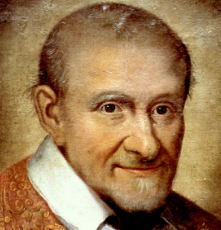
3. Saint Vincent de Paul
4. Family and Marriage
5. Articles and notices
Dear Reader:
Our Lord is in the midst of mankind. Behold I am with you all days, even to the consummation of the world. (Matt. 28:20). As Catholics we know that He is present in our Churches and Chapels where the Blessed Sacrament is reserved. But He still seems to be the last person many of the faithful have recourse to because of lack of faith. Imbibing the Protestant concept that God is everywhere and that one can pray in one’s room (cf. Matt. 6:6) just as well as in church one is practically denying Christ’s Real Presence. Instead of taking it in the proper context which is not being showy in one’s prayers—spreading a half dozen or more novenas in front of them and making all kinds of noise of sighs and page turning so people notice they are there and the amount they pray when truly they should be silent and tending toward uniting their hearts to the Christ present in the Blessed Sacrament just as the others are trying to do—they take it that one needs not to go to Church. They don’t see the hypocrisy of Protestantism in their showy emotional displays of narcissism in their halls as contrasted to the quiet self-abasement of the Catholic indistinguishable from everyone else talking to Christ Jesus in the Blessed Sacrament in the chamber of his or her heart giving adoration, thanksgiving, contrition and petition. Come to me, all you that labour, and are burdened, and I will refresh you. (Matt. 11:28) Suffer the little children, and forbid them not to come to me: for the kingdom of heaven is for such. (Matthew 19:14; Luke 18:16) All that the Father giveth to me shall come to me; and him that cometh to me, I will not cast out. (John 6:37) No man can come to me, except the Father, who hath sent me, draw him; and I will raise him up in the last day. (John 6:44) And on the last, and great day of the festivity, Jesus stood and cried, saying: If any man thirst, let him come to me, and drink. (John 7:37) Today we have need of coming to Our Lord more than ever. There is the spiritual welfare of our children, there is the seeming inevitability of being denied receiving the Sacraments, there is the need of our fathers to provide for their families, there is the diabolical forces bent on perverting our morality, there are the revolutionary forces of the Antifa and BLM rioting in our streets, there is the mysterious Covid-19 virus that is used to isolate us even though we are social beings and pushing us to be controlled by social media as a replacement for the human act of charity and accepting mob rule. We need the light of grace to know what is true and what is error, what is maliciously misleading and what is opinion in a time when narratives are now weaved together as events happen throughout but are portrayed in a way they want us to understand them according to the direction that assists in promoting an ideology. What is worse, too many do not turn to prayer in Church and asking for God’s grace and receiving the Sacraments, rather they turn to the internet for answers and, due to the myriad of opinions, become even more confused and misled. As we mentioned last week, we must live our faith fully within the circumstances presented to us. If Mass and the Sacraments are taken from us, then we must resort to simply praying in the home—where it should never be absent. But if Mass and the Sacraments are available, it would be the greatest ingratitude to reject the opportunity and we have only ourselves to blame if soon we find there is not even a priest to give us final absolution and anointing.
Two Catholic Churches were set on fire last weekend, one the historic San Gabriel Mission Church of Junipero Serra. It didn’t make the national news—it was the attitude of: Good riddance! Maybe more should be burned because nobody (politically) cares or wants the Catholic Church.
In such an atmosphere, let us remember Our Lord is in the midst of us and ask Him for the graces we need.
As always, enjoy the readings provided for your benefit.—The Editor
________________
WHAT IS THE HOLY EUCHARIST
By Rev. Courtney Edward Krier
Part III
The Real Presence
The clear teaching of the Church is found in the definition of the first chapter of the Decree on the Most Holy Eucharist during the Council of Trent, Session XIII, on October 11, 1551.
First of all the holy Synod teaches and openly and simply professes that in the nourishing sacrament of the Holy Eucharist after the consecration of the bread and wine our Lord Jesus Christ, true God and man, is truly, really, and substantially [can. I] contained under the species of those sensible things. For these things are not mutually contradictory, that our Savior Himself is always seated at the right hand of the Father in heaven according to the natural mode of existing, and yet that in many other places sacramentally He is present to us in His own substance by that manner of existence which, although we can scarcely express it in words, yet we can, however, by our understanding illuminated by faith, conceive to be possible to God, and which we ought most steadfastly to believe. For thus all our forefathers, as many as were in the true Church of Christ, who have discussed this most holy sacrament, have most openly professed that our Redeemer instituted this so wonderful a sacrament at the Last Supper, when after the blessing of the bread and wine He testified in clear and definite words that He gave them His own body and His own blood; and those words which are recorded [Matt. 26:26ff.; Mark 14:22; Luke 22:19 ff.] by the holy Evangelists, and afterwards repeated by St. Paul [1 Cor. 11:23 ff.], since they contain within themselves that proper and very clear meaning in which they were understood by the Fathers, it is a most disgraceful thing for some contentious and wicked men to distort into fictitious and imaginary figures of speech, by which the real nature of the flesh and blood of Christ is denied, contrary to the universal sense of the Church, which, recognizing with an ever grateful and recollecting mind this most excellent benefit of Christ, as the pillar and ground of truth [1 Tim. 3:15], has detested these falsehoods, devised by impious men, as satanical. (Cf. DB 874)
Joseph Pohle explains the definition as follows:
The three adverbs “truly, really, and substantially” were not arbitrarily chosen, but with a view to oppose the three fictitious interpretations of the Reformers, already mentioned. The word “vere” i. e. non significative tantum, was directed against the theory of Zwingli; “realiter,” i. e. non figurative, against the error of Oecolampadius; “substantialiter” i. e. non virtualiter tantum, against Calvin’s contention of a purely “dynamic” presence. The teaching thus positively set forth is once more antithetically repeated in the First Canon of the same Session: “If anyone denieth that, in the Sacrament of the most Holy Eucharist, are contained truly, really, and substantially the Body and Blood together with the Soul and Divinity of our Lord Jesus Christ, and consequently the whole Christ, but saith that He is only therein as in a sign, or in figure, or virtue, let him be anathema.” (Sacraments II, 53-54)
The topic of the formulation of the belief in the Real Presence of was covered in the Errors since correcting errors brings to light what the Church believes concerning the Real Presence. The progress is found from the institution of the Holy Eucharist up to and including the definition of the Real Presence during the Council of Trent. The following is a cursory review in bringing to clarity what the Church doctrine is:
1. Institution
Jesus Christ, according to the three synoptic Gospels, said: This is my Body, This is my Blood without qualification and in accord with John’s Gospel, in which Jesus Christ promised to give His Body and Blood to eat and drink (cf. John 6:52ff). Paul confirms the words of Institution of the synoptic Gospels and states:
For as often as you shall eat this bread, and drink the chalice, you shall shew the death of the Lord, until he come. Therefore whosoever shall eat this bread, or drink the chalice of the Lord unworthily, shall be guilty of the body and of the blood of the Lord. (1 Cor. 11:26-27)
The Church accepted that the Holy Eucharist was the Body and Blood of Christ.
2. Apostolic Church
Saint Ignatius (+117), writing to the Christians in Smyrna, warns them of the Docetists:
From Eucharist and prayer they hold aloof, because they do not confess that the Eucharist is the Flesh of our Savior Jesus Christ, which suffered for our sins, and which the Father in His loving-kindness raised from the dead. And so, those who question the gift of God perish in their contentiousness. It would be better for them to have love, so as to share in the resurrection. It is proper, therefore, to avoid associating with such people and not to speak about them either in private or in public, but to study the Prophets attentively and, especially, the Gospel, in which the Passion is revealed to us and the Resurrection shown in its fulfillment. Shun division as the beginning of evil. (c. 7)
And the same thoughts are addressed to the Philadelphians:
Take heed, then, to have but one Eucharist. For there is one flesh of our Lord Jesus Christ, and one cup to the unity of His blood; one altar; as there is one bishop, along with the presbytery and deacons, my fellow-servants: that so, whatsoever you do, you may do it according to God. (c. 4)
Justin (+165) defends the Catholic Faith in his Apology, writing about the Holy Eucharist:
And this food is called among us Εὐχαριστία [the Eucharist], of which no one is allowed to partake but the man who believes that the things which we teach are true, and who has been washed with the washing that is for the remission of sins, and unto regeneration, and who is so living as Christ has enjoined. For not as common bread and common drink do we receive these; but in like manner as Jesus Christ our Saviour, having been made flesh by the Word of God, had both flesh and blood for our salvation, so likewise have we been taught that the food which is blessed by the prayer of His word, and from which our blood and flesh by transmutation are nourished, is the flesh and blood of that Jesus who was made flesh. For the apostles, in the memoirs composed by them, which are called Gospels, have thus delivered unto us what was enjoined upon them; that Jesus took bread, and when He had given thanks, said, This do in remembrance of Me, Luke 22:19 this is My body; and that, after the same manner, having taken the cup and given thanks, He said, This is My blood; and gave it to them alone. Which the wicked devils have imitated in the mysteries of Mithras, commanding the same thing to be done. For, that bread and a cup of water are placed with certain incantations in the mystic rites of one who is being initiated, you either know or can learn. (First Apology, 66)
Irenaeus (+ cir. 200) presents the Eucharist
Inasmuch, then, as the Church offers with single-mindedness, her gift is justly reckoned a pure sacrifice with God. As Paul also says to the Philippians, I am full, having received from Epaphroditus the things that were sent from you, the odour of a sweet smell, a sacrifice acceptable, pleasing to God. Philippians 4:18 For it behooves us to make an oblation to God, and in all things to be found grateful to God our Maker, in a pure mind, and in faith without hypocrisy, in well-grounded hope, in fervent love, offering the first-fruits of His own created things. And the Church alone offers this pure oblation to the Creator, offering to Him, with giving of thanks, from His creation. But the Jews do not offer thus: for their hands are full of blood; for they have not received the Word, Who is offered to God. Nor, again, do any of the conventicles (synagogæ) of the heretics [offer this]. For some, by maintaining that the Father is different from the Creator, do, when they offer to Him what belongs to this creation of ours, set Him forth as being covetous of another’s property, and desirous of what is not His own. Those, again, who maintain that the things around us originated from apostasy, ignorance, and passion, do, while offering unto Him the fruits of ignorance, passion, and apostasy, sin against their Father, rather subjecting Him to insult than giving Him thanks. But how can they be consistent with themselves, [when they say] that the bread over which thanks have been given is the body of their Lord, and the cup His blood, if they do not call Himself the Son of the Creator of the world, that is, His Word, through whom the wood fructifies, and the fountains gush forth, and the earth gives first the blade, then the ear, then the full grain in the ear. Mark 4:28
Then, again, how can they say that the flesh, which is nourished with the body of the Lord and with His blood, goes to corruption, and does not partake of life? Let them, therefore, either alter their opinion, or cease from offering the things just mentioned. But our opinion is in accordance with the Eucharist, and the Eucharist in turn establishes our opinion. For we offer to Him His own, announcing consistently the fellowship and union of the flesh and Spirit. For as the bread, which is produced from the earth, when it receives the invocation of God, is no longer common bread, but the Eucharist, consisting of two realities, earthly and heavenly; so also our bodies, when they receive the Eucharist, are no longer corruptible, having the hope of the resurrection to eternity. (Against Heresies, IV.18.4, 5)
And later Irenaeus wrote:
But vain in every respect are they who despise the entire dispensation of God, and disallow the salvation of the flesh, and treat with contempt its regeneration, maintaining that it is not capable of incorruption. But if this indeed do not attain salvation, then neither did the Lord redeem us with His blood, nor is the cup of the Eucharist the communion of His blood, nor the bread which we break the communion of His body. 1 Corinthians 10:16 For blood can only come from veins and flesh, and whatsoever else makes up the substance of man, such as the Word of God was actually made. By His own blood he redeemed us, as also His apostle declares, In whom we have redemption through His blood, even the remission of sins. Colossians 1:14 And as we are His members, we are also nourished by means of the creation (and He Himself grants the creation to us, for He causes His sun to rise, and sends rain when He wills Matthew 5:45). He has acknowledged the cup (which is a part of the creation) as His own blood, from which He bedews our blood; and the bread (also a part of the creation) He has established as His own body, from which He gives increase to our bodies.
When, therefore, the mingled cup and the manufactured bread receives the Word of God, and the Eucharist of the blood and the body of Christ is made, from which things the substance of our flesh is increased and supported, how can they affirm that the flesh is incapable of receiving the gift of God, which is life eternal, which [flesh] is nourished from the body and blood of the Lord, and is a member of Him?— even as the blessed Paul declares in his Epistle to the Ephesians, that we are members of His body, of His flesh, and of His bones. Ephesians 5:30 He does not speak these words of some spiritual and invisible man, for a spirit has not bones nor flesh; Luke 24:39 but [he refers to] that dispensation [by which the Lord became] an actual man, consisting of flesh, and nerves, and bones — that [flesh] which is nourished by the cup which is His blood, and receives increase from the bread which is His body. And just as a cutting from the vine planted in the ground fructifies in its season, or as a grain of wheat falling into the earth and becoming decomposed, rises with manifold increase by the Spirit of God, who contains all things, and then, through the wisdom of God, serves for the use of men, and having received the Word of God, becomes the Eucharist, which is the body and blood of Christ; so also our bodies, being nourished by it, and deposited in the earth, and suffering decomposition there, shall rise at their appointed time, the Word of God granting them resurrection to the glory of God, even the Father, who freely gives to this mortal immortality, and to this corruptible incorruption, 1 Corinthians 15:53 because the strength of God is made perfect in weakness, 2 Corinthians 12:3 in order that we may never become puffed up, as if we had life from ourselves, and exalted against God, our minds becoming ungrateful; but learning by experience that we possess eternal duration from the excelling power of this Being, not from our own nature, we may neither undervalue that glory which surrounds God as He is, nor be ignorant of our own nature, but that we may know what God can effect, and what benefits man receives, and thus never wander from the true comprehension of things as they are, that is, both with regard to God and with regard to man. And might it not be the case, perhaps, as I have already observed, that for this purpose God permitted our resolution into the common dust of mortality, that we, being instructed by every mode, may be accurate in all things for the future, being ignorant neither of God nor of ourselves? (Ibid. V.2.2, 3.)
————————–
The Sunday Sermons of the Great Fathers
M. F. Toal
THE GOSPEL OF THE SUNDAY
MATTHEW vii. 15-21
At that time: Jesus said to his disciples: Beware of false prophets, who come to you in the clothing of sheep, but inwardly they are ravening wolves. By their fruits you shall know them. Do men gather grapes of thorns, or figs of thistles? Even so every good tree bringeth forth good fruit, and the evil tree bringeth forth evil fruit. A good tree cannot bring forth evil fruit, neither can an evil tree bring forth good fruit.
Every tree that bringeth not forth good fruit, shall be cut down, and shall be cast into the fire. Wherefore by their fruits you shall know them. Not every one that saith to me, Lord, Lord, shall enter into the kingdom of heaven: but he that doth the will of my Father who is in heaven, he shall enter into the kingdom of heaven.
EXPOSITION FROM THE CATENA AUREA
V. 15. Beware of false prophets.
CHRYSOSTOM, Op. Imp. on Mt. Hom. 19: What was written a little later; namely, that the prophets and the Law prophesied until John (Mt. xi. 13) was said because there would be no prophecy regarding Christ after He came. Prophets there were and are; but they do not prophecy of Christ, they interpret what was foretold of Christ by the ancients: that is, the Teachers of the Churches. Nor can any one interpret the meaning of prophecy unless through the Spirit of prophecy.
The Lord therefore, knowing that there would be false teachers, warns them of the various heresies to come, by saying: Beware of false prophets. And as these would not be obvious unbelievers, but persons cloaked with the name of Christian, He did not say: Look well at them, but, Beware. For where a thing is certain it is seen; that is, it may readily be seen. But when it is uncertain it is looked at, or watched carefully. And again He says, Beware: for to know whom to shun is a firm safeguard of security. He does not warn us to beware as though the devil will introduce heresies against God’s will, and not by His permission. For since He will not choose His servants without trial, He permits them to be tempted. And as He wills that they should not suffer through ignorance He therefore warns them.
And so that no heretical teacher may say, that He did not say here they were the false prophets, but rather the teachers from both Gentiles and Jews, He goes on to add: Who come to you in the clothing of sheep. For Christians are spoken of as sheep; and the sheep’s clothing is their outward pretence of Christianity and pretended religion. There is nothing that so menaces what is good as pretence. For evil that is hidden under the outward appearance of Good is not guarded against, since it is not known.
And that heretics may not here say that He is speaking of those who are true teachers, but also sinners, He adds this: But inwardly they are ravening wolves. Catholic teachers, though they may have been sinners, are not spoken of as ravening wolves, but as servants of the flesh: for they do not seek to destroy Christians. He therefore is manifestly speaking of heretical teachers: for it is to this end that they put on the garb of Christian; that they may rend Christians with the evil fangs of their seductions. And of these the Apostles said: I know that after my departure, ravening wolves will enter in among you, not sparing the flock (Acts xx. 29).
V. 16. By their fruits you shall know them etc.
AUGUSTINE, Sermon on the Mount, 2, 24, pars. 80, 81: And for this reason it may rightly be asked: What fruits does He wish us to seek for? For many hold as fruit certain things that belong to the sheep’s clothing, and in this way they are deceived by the wolves. As for example: fasting, alms, prayer, which they practise before men who seek to find favour with those to whom such things seem difficult. These practices therefore are not the fruits by which, He warns us, they are to be known. For such actions, done with a right intention, are part of the clothing of the sheep. When they are done with evil purpose, in deception, they clothe none other than wolves. But sheep must not for this hate their own clothing because it sometimes conceals a wolf. What the fruits are by which we may know an evil tree the Apostle then teaches us: The works of the flesh are manifest, which are fornication, uncleanness. And what the fruits are by which we shall know a good tree, the same Apostle makes known to us, saying: But the fruit of the Spirit is charity, joy, peace (Gal. v. 19, 22).
CHRYSOSTOM, Op. Imp: The confession of his faith is also part of the fruits of man. For he who cries out according to God, with the voice of true humility, and true confession of faith, is a sheep. But he who utters blasphemies against the truth, and howls against God, is a wolf.
JEROME: And what is here said of false prophets can also be understood of all who say one thing in word and manner and another in deed. Yet it seems to be said more particularly of heretics, who are seen to clothe themselves with continence and fasting as with a sort of garb of piety, but inwardly their spirit is poisoned; and so the hearts of simpler brethren are deceived.
AUGUSTINE, as above, 2, 12, par. 41: But we can guess from their works whether they practise these outward things for a particular purpose. For when under certain trials these very things begin to be taken from them, or denied them, which they have either obtained or hoped to obtain under this veil, then of necessity it will appear whether it is a case of a wolf in sheep’s clothing, or a sheep in its own clothing.
GREGORY: The hypocrite is also kept hidden through the peace the Church enjoys; and so he seems to our eyes clothed in the garb of true piety. But should a trial of faith arise, at once the ravening soul of the wolf throws off its sheep’s clothing; showing by persecution how great is his hatred of the good.
CHRYSOSTOM, in Hom: Hypocrites are easily detected: for the way they are bidden to walk is painful to them. And a hypocrite does not readily choose what is painful. And so that you may not say that it is impossible to know them He gives us proof from human experience, saying: Do men gather grapes of thorns, or figs of thistles?
CHRYSOSTOM, Op. Imp: The grape contains within it the mystery of Christ. For as the cluster has many grapes joined by the wood of the stalk, so Christ has many faithful joined by the wood of the Cross. The fig however stands for the Church, which holds the multitude of faithful in the sweet embrace of charity, as the fig contains so many seeds within its single covering.
The fig therefore stands for: charity in its sweetness, unity in its joining of many seeds. In the grape we have a figure of patience, in that it goes through the winepress; of joy, in that wine rejoices the heart of man; of sincerity, because it is unmixed with water; and of sweetness, in that it is delectable.
The thistles and thorns are heretics. As a thistle or a thorn has prickles on every side, so the servants of the devil, on whatever side you consider them, are filled with perversity. Such thorns and thistles can never bring forth the fruits of the Church. And what He has said under the figure of the fig and the grape, of the thistle and the thorn, He shows to be true in all cases, when He says:
V. 16. Even so every good tree bringeth forth good fruit . . .
AUGUSTINE, as above, 2, 23, par. 79: In this place we must be on our guard against those who say that the two trees refer to the two natures; the one of God, and the other which is not of God. These must be told that the two trees are no help to them. For it is clear to any one who reads what precedes this and what follows it that here He is speaking of mankind.
AUGUSTINE, City of God, 12, 4-5: The very natures of things displease the kind of men we have spoken of; as they do not value them because of their true usefulness. For it is not because of our gain, or loss, that a thing gives glory to its Maker, but out of its own nature. All natures therefore are good in that they exist, and have therefore their own form of being, their own beauty, and a sort of harmony (peace) within themselves.
CHRYSOSTOM, Hom. 24: That no one may say that a bad tree does in fact bring forth bad fruit, but that it also brings forth good fruit, and so in face of its two sorts of fruit it is difficult to know it, He goes on to say:
V. 18. A good tree cannot bring forth evil fruit, neither can an evil tree bring forth good fruit.
AUGUSTINE, as above, 2, 24, 79: From this saying the Manicheans assert that neither can an evil soul be changed into something better, nor a good soul into a worse; as though it had been said that: A good tree cannot become bad, and a bad tree cannot become good. But this is what was said: A good tree cannot bring forth evil fruit, and vice versa. The tree is the soul, that is, the man himself; its fruits are the works it brings forth. An evil man cannot therefore bring forth good works, nor a good man evil. And so if a bad man wishes to bring forth good works let him first become good. As long as a man is evil he cannot bring forth good fruit. As it may happen that what was snow is not now snow, but it cannot happen that snow should be warm; so it can happen that he who was evil is not now evil, but it cannot happen that he who is evil does good. And though at times what he does is useful, this is not due to him, but to the providence of God that makes use of him.
RHABANUS: A man is called a good tree or bad as his own will is either good or bad. His fruits are his works, which cannot be good when they come from a bad will, nor bad from a good will.
AUGUSTINE, Against Julian, V, 3 8, 41: As it is plain that all evil deeds come forth from an evil will, as evil fruit of an evil tree, so from where can you say the evil will itself arises, unless you say that it arose in man from man himself, and that the evil will of an angel comes from the angel? And what were each of these two creatures before the evil will arose in them but a good work of God, a good and praiseworthy nature? See then how out of good evil arises; nor was there any other thing out of which it could arise save good. I am speaking of the evil will itself; for there was no evil before it, no evil works, which arise only from an evil will as from an evil tree. Nor could the evil will be said to arise from good in this way, because it was made good from the good God. For it was made from nothing, not from God. [The text of the work continues: For all that can sin is made from nothing. For if it were not from nothing it would by nature be from God whatever it was. If by nature from God it would possess the nature of God, and could not sin.]
JEROME: Let us ask of these heretics, who assert that there are two opposing natures, if, as they understand it, a good tree cannot bring forth evil fruit, how was it possible for Moses, a good tree, to sin at the waters of contradiction? Or how did Peter deny the Lord in His Passion, saying: I know not the man? Or how it came about that the father-in-law of Moses, an evil tree, who did not believe in the God of Israel, should give good counsel?
CHRYSOSTOM, Hom. in Mt: Since He had not asked them to punish the false prophets (only to beware of them), He frightens those He speaks of with the punishment that will come to them from God, saying:
V. 19. Every tree that bringeth not forth good fruit shall be cut down, and shall be cast into the fire.
In these words the Jews seem to be referred to, and because of this He reminds them of the words of John the Baptist, threatening them with punishment in these same words. For he had spoken in this way to them, warning them of the axe, and of the tree that shall be cut down, and of unquenchable fire. If you consider this matter carefully you will see that here there are two punishments threatened: To be cut down, and to be cast into the fire; for he who is burned is also wholly cast out of the kingdom, which is the more grievous punishment. Many only fear hell. But I believe that the loss of glory is a more bitter torment than that of hell itself For what evil great or small will not a father endure in order to see and delight in a son who is most dear to him? Let us think in the same way of that glory; for there is no son so sweet to a father as the peaceful rest from toil to the just, and to be dissolved and to be with Christ. Intolerable indeed is the pain of hell. But were there ten thousand hells, such pain would be as nothing to falling from that blessed glory, and to be hated by Christ.
Gloss: From the foregoing parable He draws the conclusion, as something plainly evident, to what He had just been saying: Therefore by their fruits you shall know them (v. 20).
———————–
JULY 19
St. Vincent de Paul, Confessor
1. “Right thou shalt do and with love, and carry thyself humbly in the presence of thy God” (Mich. 6:8). In these words one has a thumbnail description of the life of Vincent de Paul. At a time when Europe was harassed by various heresies, God raised up this remarkable man in southern France—powerful in word and deed, a saint whom even kings consulted, a main-spring of every great movement in the France of his day. Vincent was born in 1576 to poor, simple, God-fearing parents. As a boy he watched his father’s sheep until he found an opportunity for studies, first with the Franciscans at Asar, and later in Toulouse. Ordained in the year 1600, he spent his time between 1605 and 1607 in cruel captivity in Tunis. Having escaped to Avignon and then to Paris, he experienced an interior conversion, in 1609, and promised God to spend the rest of his life in works of charity. The years 1615 to 1625 he passed as private chaplain and tutor in the home of Count Condy, General of the Galleys. In 1617 he founded the Congregation of the Lazarists for home mission work, and later the Sisters of Charity. He opened foundling homes in Paris in which, to this day, the sisters harbor and educate more than ten thousand orphan children. His society of Young Ladies of the Holy Cross provides education for girls who live in dangerous surroundings or are without homes. Vincent, the tireless worker driven by love of God and of immortal souls, died on September 27, 1660.
2. “The innocent man will flourish as the palm-tree flourishes: he will grow to greatness as the cedars grow on Lebanon: planted in the temple of the Lord, growing up in the very courts of our God’s house” (Introit). We marvel at the almost limitless range of St. Vincent’s activity and at the many institutions that he originated to support and promote the kingdom of God on earth. He recognized the evils of his time: the ignorance, the religious poverty, the moral degradation of the people, as well as the inactivity of the clergy. He therefore preached zealously and encouraged missions as an opportunity for works of mercy. He became poor in order to help the poor. On a trip to Marseilles, he learned about the sad lot of the galley slaves. In his desire to help them, he gladly accepted the post of Almoner General of the Galleys offered him by King Louis XIII. As such he was the chief pastor of these unfortunates. On one occasion he begged so persistently for the freedom of a slave that the overseer finally yielded; but Vincent had to accept the chains and oar himself. It was only after a considerable lapse of time that he was recognized and set free. He used every available means that his inexhaustible mercy could find or devise to alleviate physical and spiritual misery.
In collaboration with Louis Marillac, whose love of neighbor matched his own, St. Vincent founded the Sisters of Charity, of whom he wrote: “They had only the homes of the sick for cloister; a poorly furnished room served as a cell; their chapel was the parish church; their corridors were the streets of the city; their enclosure was obedience, their gate, the fear of God; and their veil, holy modesty.” The whole world loves these angels of mercy, whom Vincent advised: “Let us love God; but at the price of our hands and the sweat of our face.” He promoted retreats for lay people. Under Queen Mary Anne he defended the rights and welfare of the Church with frankness and with ultimate success, saving whole regions from death by starvation; he organized the war as the caring for refugees. Vincent was a powerful opponent of Jansenism, which was just beginning to spread. In addition to these interests inaugurated by himself, he was superior of the Visitation Order, founded by St. Francis de Sales, and acted as spiritual director of St. Francis de Chantal. His was a life of remarkable versatility. Truly, he flourished like a palm tree.
“The harvest . . . is plentiful enough, but the laborers are few” (Gospel). At the time of St. Vincent there were many bishops and priests in France, but workers like himself were few, and sorely needed. “I am sending you out to be like lambs among wolves. You are not to carry purse, or wallet, or shoes; you are to give no one greeting on the way.” Workers of apostolic simplicity, with minimum requirements and maximum trust in God, who would apply themselves with a total devotion that would allow nothing to drag them from their places, no one to draw them into other interests, unless these, too, served, their cause; who would live only to bring the kingdom of God into erring hearts, only to search out and tirelessly lead back souls to Christ: these were the workers needed.
St. Vincent was such a man. He saw Christ in sinners, in the poor, in the distressed and captive, and never forgot the truth, “When you did it to one of the least of my brethren here, you did it to me” (Matt. 25:40), or St. Paul’s, “With us, Christ’s love is a compelling motive, and this is the conviction we have reached; if one man died on behalf of all, then all thereby became dead men; Christ died for us all, so that being alive should no longer mean living with our own life, but with his life who died for us and has risen again” (II Cor. 5:14, 15). Vincent was on fire with love for Christ and for His needy brothers and sisters. “The harvest is plentiful enough . . . you must ask the Lord . . . to send laborers out for the harvesting,” workers filled with the faith and sacrificing courage of St. Vincent de Paul.
3. How rich in blessings and many-sided was the activity of this saint! Whence did he receive the strength and energy for such vast expenditure of himself in his vocation? Profound interior life was at the bottom of all. Filled with humility, he saw himself as a wretched instrument, and his ready retort to praise was, “God does it.” He was a man of much prayer, and he considered it an offence against God’s providence to worry unduly. Above all, love of God consumed him and made him love his fellow man so deeply that he would himself become a galley slave if only he could liberate souls from the captivity of Satan.
In the religious houses of St. Vincent there is frequently found this inscription: “God sees thee.” Always and everywhere he lived with God, gazing on this intimate friend enthroned in his heart. “The kingdom of God is close upon you” (Gospel).
Collect: O God, who is order that the gospel might be preached to the poor and the dignity of the ecclesiastical state enhanced, didst endow blessed Vincent with the zeal and power of an apostle, grant, we pray Thee, that we may not only revere his godly merits but also conform to the pattern of his virtues. Amen. (Benedict Baur)
_____________________
Good Morning,
Boys and Girls!
REV. THOMAS J. HOSTY, M.A., S.T.B.
(1952)
COMMAND PERFORMANCE
GOOD MORNING, BOYS AND GIRLS!
Do you know what a command performance is? If you were born and raised in England you would certainly know what it means. It is a command, given by the King himself, to put on some sort of play or act or entertainment. No matter how big a star you might be, you have no choice but to obey the King’s request. Not that anyone ever resents putting on a command performance—in England, the highest praise which can possibly be given to an actor or actress is to be told to take part in a command performance. The reason is evident. It means that that particular person has arrived at the top of his career. Naturally, we would expect that English people should feel honored to be summoned by their King; to do anything—but many of our American actors and actresses are just as anxious to appear before the King. In fact, one of the things which our American stars brag about the most is that they were asked to take part in a command performance, when they were in London.
The command performance is a very classy affair—all the “big shots” try to get in the theater that evening, but they are only admitted by invitation. Next to being one of the stars of these performances comes the social distinction of being invited by the King to be his guest at the affair. Strange as it may sound, many of those who are invited consider themselves far superior to the actors and actresses, whom they lookdown upon as mere performers. The only ordinary people in the whole theater are the lucky few who manage to get there hours before the show begins. They are rewarded by being allowed to sit way up near the ceiling, in the upper balcony or in the gallery. The rest of the poor people must be content to crowd around the entrance, with the hope of getting a quick glimpse of the King and the other celebrities as they enter the show. It’s a great deal like a Hollywood opening, when thousands of people gather outside to watch the big stars make a grand entrance into some movie house. The King and Queen and their very important guests would never want to have a command performance compared to a Hollywood opening, but that’s really what it amounts to.
Why am I spending so much time in describing a command performance to you? Do I think that any of you will ever be called upon, either to take part in one, before a king, or to be a guest at one? Startling as it may seem, I not only think that some of you will have the privilege, but I am absolutely certain that all of you will! And I mean not only as a performer, but also as a guest!
I can see that most of you think I am joking, but, believe me, I was never more serious. I’m not referring to just an ordinary king, either; I’m speaking about the King of kings. Boys and girls, every Mass which you attend on a Sunday or a holyday of obligation is a command performance, if you are seven years of age or over! The Catholic Church, in the name of Almighty God Himself, extends an invitation to you to be present at all Sunday and holyday Masses—and like all royal invitations, it is not simply an invitation, it is a command! To deliberately miss even the smallest part of a Sunday or holyday Mass is a sin, and to deliberately (that means through your own fault) miss one of the three most important parts of the Mass is a serious or mortal sin.
First of all, you are invited as a spectator. You are commanded to watch our Lord and Saviour, Jesus Christ, repeat the same performance (but in an unbloody way), which He went through on the cross at Calvary. Every time we are present at a Mass, we listen to and watch the priest celebrating the Holy Sacrifice. He renews the death of Christ on the cross, so that we might share in all the graces which Jesus merited by that death.
But we are more than mere spectators, or lookers-on, at the Mass. Being present at a Mass is not like being at a movie or at a ball game. It is not like watching a parade, either. When you’re at a movie or a ball game or a circus or watching a parade, you are only there as a watcher, you are not an active part of them. But when you are present at a Mass, you are expected by Almighty God to have an active part in that Mass. That is why the priest, in offering Mass, refers to it as “your sacrifice and mine.”
I’ll bet that some of you thought the priest was the only person who offers up a Mass to God. Well, you’re wrong! The priest joins with everyone in the church (and with everyone who is a true member of the Church of Christ), in offering up…
[Message clipped] View entire message