Vol 11 Issue 51~ Editor: Rev. Fr. Courtney Edward Krier
December 22, 2018 ~ Saint Frances Xavier Cabrini, opn!
1. What is the Sacrament of Confirmation
2. Fourth Sunday in Advent
3. Ten Holy Martyrs of Crete
4. Family and Marriage
5. Articles and notices
Dear Reader:
This week we will be celebrating the Birth of Our Lord Jesus Christ. Sunday will bring out the closeness of the anniversary and the vigil of Christmas that of the Mystery of the Incarnation, And all flesh shall see the salvation of God. (Luke 3:6.) Isaias had already prophesied: Behold a virgin shall conceive, and bear a son, and his name shall be called Emmanuel. (7:14) In Luke one reads: And in the sixth month, the angel Gabriel was sent from God into a city of Galilee, called Nazareth, to a virgin espoused to a man whose name was Joseph, of the house of David; and the virgin’s name was Mary. (1:26-27) The Woman, spoken of in Genesis 3:15 (I will put enmities between thee and the woman, and thy seed and her seed: she shall crush thy head, and thou shalt lie in wait for her heel.), was prepared by the Eternal Father (cf. Prov. 8:22ff: The Lord possessed me in the beginning of his ways, before he made any thing from the beginning. I was set up from eternity, and of old before the earth was made. [24] The depths were not as yet, and I was already conceived.) to become the Mother of His Son. She was immaculate, beloved by the Eternal Word who dwelt in her womb: Thou art all fair, O my love, and there is not a spot in thee. (Canticles 4:7). She could say in the words of Isaias: I will greatly rejoice in the Lord, and my soul shall be joyful in my God: for he hath clothed me with the garments of salvation: and with the robe of justice he hath covered me, as a bridegroom decked with a crown, and as a bride adorned with her jewels (61:10); and again, I will extol thee, O Lord, for thou hast upheld me: and hast not made my enemies to rejoice over me (Psalm 29:2). Therefore, when Elizabeth, her cousin, greets her as the Mother of God (And whence is this to me, that the mother of my Lord should come to me?—Luke 1:43) she can reply: My soul doth magnify the Lord, and my spirit hath rejoiced in God my Saviour. Because he hath regarded the humility of his handmaid; for behold from henceforth all generations shall call me blessed. Because he that is mighty hath done great things to me; and holy is his name. (Ibid. 1:46-49)
Establishing that Mary is the Woman (blessed art thou among women—Luke 1:28 and 42—two testimonies) that she is the Virgin (twice proclaimed), all things seem to be ready for the birth of the Lord. It isn’t so. Now begins also the suffering Mary is going to partake in by being the New Eve. This the Vigil of Christmas wants to remind us of even before finding there is no room for them in the Inn in Bethlehem (cf. Luke 2:7—And she brought forth her firstborn son, and wrapped him up in swaddling clothes, and laid him in a manger; because there was no room for them in the inn.) The Gospel of Saint Matthew informs us: When as his mother Mary was espoused to Joseph, before they came together, she was found with child, of the Holy Ghost. Whereupon Joseph her husband, being a just man, and not willing publicly to expose her, was minded to put her away privately. (Matt. 1:18-19) Joseph was confronted with a difficulty. Mary was with child and it was not his child. He knew the Law, which is reflected in the woman caught in adultery (cf. John 8:3ff): If any man commit adultery with the wife of another, and defile his neighbour’s wife, let them be put to death, both the adulterer and the adulteress. (Lev. 20:10). This was supported by Deuteronomy: If a man take a wife, and have her, and she find not favour in his eyes, for some uncleanness: he shall write a bill of divorce, and shall give it in her hand, and send her out of his house. (24:1) He was just and knew the Proverb: He that keepeth an adulteress, is foolish and wicked. (Prov. 18:22) Mary would be perfectly aware that Joseph—and probably the neighbors—knew the child was not his. What would be the decision? In total trust and confidence it could only be that God would protect her. Her only motivation would be the salvation of her people (the human race). She must be another Judith who would accept the thought that her action was going to scandalize some (But I desire that you search not into what I am doing, and till I bring you word let nothing else be done but to pray for me to the Lord our God.—Judith 8:33), but she must bear the judgment if her people would find salvation by her crushing the head of the enemy:
And when the men [of Holofernes] had heard her words, they beheld her face, and their eyes were amazed, for they wondered exceedingly at her beauty. And they said to her: Thou hast saved thy life by taking this resolution, to come down to our lord.… And it came to pass on the fourth day, that Holofernes made a supper for his servants, and said to Vagao his eunuch: Go, and persuade that Hebrew woman, to consent of her own accord to dwell with me…. And she struck twice upon his neck, and cut off his head, and took off his canopy from the pillars, and rolled away his headless body. (Ibid. 10:14-15; 12:10; 13:10)
Mary knew she had to be like Esther if she was to save her people and all peoples by her crushing the head of the enemy:
All the king’s servants, and all the provinces that are under his dominion, know, that whosoever, whether man or woman, cometh into the king’s inner court, who is not called for, is immediately to be put to death without any delay: except the king shall hold out the golden sceptre to him, in token of clemency, that so he may live…. and the king said to her again the second day, after he was warm with wine: What is thy petition, Esther, that it may be granted thee? and what wilt thou have done: although thou ask the half of my kingdom, thou shalt have it. [3] Then she answered: If I have found Favour in thy sight, O king, and if it please thee, give me my life for which I ask, and my people for which I request. [4] For we are given up, I and my people, to be destroyed, to be slain, and to perish…. And Esther said: It is this Aman that is our adversary and most wicked enemy….So Aman was hanged on the gibbet, which he had prepared for Mardochai: and the king’s wrath ceased. (Esther 4:11; 7:2-4, 6, 10)
Mary did not doubt that God’s will would be accomplished and so there are no words of her trying to convince Joseph. But Joseph had to also choose to accept what the woman presented to him, to partake in the New Eve’s consent to God. So Matthew writes: But while he [Joseph] thought on these things, behold the angel of the Lord appeared to him in his sleep, saying: Joseph, son of David, fear not to take unto thee Mary thy wife, for that which is conceived in her, is of the Holy Ghost. (Matt. 1:20) And tells Joseph to take the child as his own: And she shall bring forth a son: and thou [Joseph, as a father’s right] shalt call his name Jesus. For he shall save his people from their sins. (Ibid. 1:21) The words stated by Saint Matthew might well have been addressed to Joseph and to all: Now all this was done that it might be fulfilled which the Lord spoke by the prophet, saying: Behold a virgin shall be with child, and bring forth a son, and they shall call his name Emmanuel, which being interpreted is, God with us. (Ibid. 1:22-23) For, Joseph rising up from sleep, did as the angel of the Lord had commanded him, and took unto him his wife. (Ibid. 1:24) Ending with Matthew, proving the virgin birth, now the Church will open the Gospel of Saint Luke to relate the birth of Christ in Bethlehem that will be celebrated on Christmas Day.
With this issue we want to extend to all our readers a most blessing-filled Christmas. All the faithful and benefactors of Saint Joseph here in Las Vegas are remembered in the Christmas Masses offered.
As always, enjoy the readings and commentaries provided for your benefit. —The Editor
________________
WHAT IS THE SACRAMENT OF CONFIRMATION?
by Rev. Courtney Edward Krier
The Rituale Romanum’s Section on Confirmation
THE SACRAMENT OF CONFIRMATION
Decree of the Sacred Congregation of the Sacraments
on the Administration of Confirmation to Persons
Whose Lives Are Seriously Endangered by Illness;
Published September 14, 1946.
I
Catholic doctrine teaches that the gifts of the Holy Spirit are conferred by the sacrament of confirmation. Hence arises the solicitude of the Church that children, cleansed in the waters of baptism, be refreshed with this sacrament in which they obtain the spiritual gifts of the heavenly Paraclete to add strength to the faith received in baptism. And being thus imbued with an abundance of grace and sealed with the character of a soldier of Christ, they are the better prepared and proclaimed ready for every good work.
Although it is well established that confirmation is by no means necessary for salvation through necessity of means (canon 787), yet on account of its excellence and the many admirable gifts annexed to it, parish priests and others in charge of souls must make every effort that no Christian, given the opportunity, shall neglect so lofty a sacrament of health-bringing redemption. For confirmation is a wonderful help in resisting courageously the devil’s wickedness and the allurements of the world and of the flesh, and in gaining an increase of grace and all virtues in this life and glory in heaven (St. Thomas, III P., q. 72, art. 8, 4).
The watchful guardians of souls leave nothing undone in order that all the baptized, so far as possible, may be duly fortified with this sacrament, in fact as soon as they reach the age of discretion, which is approximately the seventh year. But this age may certainly be anticipated, as expressly provided for in canon 788: “If an infant is in danger of death, or it seems advisable to the minister for just and weighty reasons.” Nevertheless, it is evident from statistics that very many children, because of their high mortality rate and long before attaining the use of reason, depart this life without having been anointed with holy Chrism, particularly in these days following upon the most dreadful scourge of war. And daily experience testifies that the same holds true for many adults who for various reasons could not be confirmed in childhood.
Now this misfortune is precluded in the Eastern Church, where it is custom to confirm infants immediately after their baptism. The same procedure was the rule in the first centuries of the Church even among the Latins, and still holds true through lawful custom in certain countries. Yet the common law of the Latin Church, as incorporated in canon 788 cited above, decrees that the administration of this sacrament is to be deferred until the seventh year of age approximately, at which time children, having been given proper catechetical instruction, may derive fuller benefits from the sacrament. (Cf. Instruction of the Sacred Congregation of the Sacraments, published on Pentecost, May 20, 1934, for an ordinary priest who administers confirmation by delegation of the Holy See in “Acta Ap. Sedis,” XXVII, p. 11 ff; Instruction of the Sacred Congregation for Propagating the Faith, May 4, 1774; Instruction of the Holy Office, July, 1888.)
Hence the main reason why such an excessive number of Christians depart this life without having received this sacrament, must be ascribed to the fact that the opportunity for receiving it is denied them when they are in danger of death, owing to the absence of a bishop.
It is the Church’s defined doctrine that a bishop alone is the ordinary minister of confirmation (Council of Trent, session VII, “On Confirmation,” canon 3, Code, canon 782, 1). Therefore, the Holy See has always striven sedulously to reserve its administration to a bishop, as his proper duty and right. And this Sacred Congregation has ever been zealously cautious, lest the reverence due this sacrament be impaired and the hopes of the faithful be disappointed through being deprived of a bishop’s presence, or lest the brilliance and magnificence and due solemnity of its administration be lessened.
Yet whenever necessity and the welfare of the faithful demanded, the Holy See has more than once been compelled to allow an ordinary priest, constituted in some ecclesiastical dignity, to supply—as extraordinary minister of the sacrament—for a bishop, when the latter was not available, owing to certain circumstances ( canon 782, 2). A priest so empowered would discharge his ministration with befitting pomp, but always having first reminded the faithful that a bishop exclusively is the ordinary minister of this sacrament, and that he himself as a priest would confer it in virtue of a faculty granted by the Holy See (cf. Instruction of the Sacred Congregation of the Sacraments, III, cited above), as very many Pontifical indults clearly state. (Cf. Instruction of the Sacred Congregation of the Sacraments, I, no. 2, cited above; the above-mentioned Instruction of the Sacred Congregation for Propagating the Faith; the above-mentioned Instruction of the Holy Office; Formulae of the Sacred Congregation for Propagating the Faith.)
Consequently, in order to take into account the spiritual condition if so many infants, children, and adult faithful whose lives are seriously endangered by illness and most certainly would die without having been anointed with the sacred Chrism, if the observance of the common law regarding the ordinary minister were strictly adhered to—this Sacred Congregation has deemed it necessary to find and provide a remedy for such a very serious situation, so that an opportunity for receiving confirmation may be afforded this considerable group of he faithful.
Weighing the importance of this matter and desirous of providing more fully for the salvation of souls, His Holiness, Pope Pius XII, in utmost solicitude for the universal Church, has deigned to entrust this Sacred Congregation, because of its authority to solve the question, with the task of inquiring into the matter thoroughly in plenary committees and reporting to him the solution it would find suitable.
After obtaining the opinions of many consultors noted for their learning and sagacity and especially after reviewing again all previous documents and decisions which pertain to the discipline of confirmation, this Sacred Congregation submitted the entire question to the cardinals for their careful deliberation in several plenary assemblies.
Then upon mature consideration of the cardinals’ decision, the Sovereign Pontiff, in an audience granted to the Most Excellent Secretary of this Sacred Congregation on May 6, 1946, ordered this reverend spokesman to draw up a decree which would embody in summary form the rules for administering confirmation in the special circumstances explained above, in accord with the laws approved and graciously proclaimed by His Holiness with certain knowledge and mature deliberation.
Wherefore, this Sacred Congregation of the Sacraments, in faithful obedience to the Apostolic mandate, by this present document decrees for observance the following:
1. By a general indult of the Holy See, the faculty for conferring the sacrament of confirmation in the capacity of extraordinary ministers (canon 782, 2) is granted to the following priests and to them alone, and only in the cases and under the conditions herein enumerated:
a) pastors who have their own proper territory, thereby excluding pastors of private persons or families, unless they too have their own proper territory though held cumulatively;
b) vicars spoken of in canon 471 (i.e., priests in charge of parishes which are pleno jure united to a religious community, a chapter church, or another moral person) and administrators of parishes;
c) priests to whom the complete care of souls, together with all the rights and duties of pastors, is exclusively and permanently assigned in a definite territory with a determined church.
2. The aforesaid ministers may personally confer confirmation validly and lawfully on the faithful who live or are staying in the formers’ territory, not excepting persons who live in institutions withdrawn from the jurisdiction of the parish, i.e., not excluding seminaries, hospices, hospitals, and every other kind of institution, even though such belong to religious orders whether or not exempt (cf. canon 792); provided that these persons are in danger of death by reason of critical illness leaving no hope for recovery.
If the same ministers exceed the limits of this mandate, let them clearly understand that they act wrongly and perform an invalid ministration; moreover, the statute of canon 2365 retains its full force in their case.
3. They may use this faculty within the episcopal city itself and outside it, whether the see is filled or vacant, provided the bishop of the diocese is not available or is legitimately prevented from conferring confirmation himself, and no other bishop (even a titular bishop) in communion with the Holy See could substitute for him without serious inconvenience.
4. Confirmation is to be conferred in keeping with the rule enjoined by the Code of Canon Law, adapted to the situation as well as to the rite taken from the Roman Ritual, both of which are reproduced below in full. It is to be conferred without any kind of compensation.
5. If the recipients of the sacrament have reached the age of discretion, in addition to the state of grace a certain degree of disposition and instruction is required of them, in order that they may receive it profitably. The minister, therefore, must instruct each of the sick according to the latter’s capacity in the truths essential to be known, arousing in him some intention of receiving this sacrament which imparts strength to the soul. However, if the persons recover, they whose duty it is must see to it that the former are given adequate instruction on the mysteries of faith and the nature and effects of this sacrament. (Cf. Holy Office, April 10, 1861, in Collect. of the Sacred Congregation for Propagating the Faith [1907], Vol. I, p. 663, n. 1213; Roman Catechism, “Confirmation”; canon 786.)
6. According to the norm given in canon 798, the extraordinary minister shall enter a record of confirmation in the parochial register, indicating his own name, the names of the one confirmed (and if the latter is not his parishioner, also his diocese and parish), names of the parents and sponsor, date and place, and adding at the end these words:
“Confirmatio collata est ex Apostolico indulto, urgente mortis periculo ob gravem confirmati morbum” (“Confirmation was conferred by Apostolic indult, owing to danger of death by reason of serious illness of the party confirmed”). An annotation is to be made also in the register of baptism, in accord with the norm of canon 470, 2.
If the recipient belongs to another parish, the minister personally must as soon as possible inform the proper pastor of the party that this sacrament has been conferred. He will do so by means of an official document containing all the data mentioned above.
7. Moreover, the extraordinary ministers are bound on each occasion to forward at once an official notice of the confirmation conferred by them to their own Ordinary, including all circumstances of the case.
8. The Ordinary has the duty to instruct more fully the extraordinary ministers referred to above regarding the precepts of this decree, in the manner he deems best, explaining each point to them, so that they will be prepared to discharge so important an office.
9. It is the obligation of the same Ordinary to send to this Sacred Congregation annually, at the beginning of the subsequent year, a report of the number confirmed and the procedure followed by the extraordinary ministers of his jurisdiction in performing so distinguished a function.
His Holiness, Pius XII, by divine Providence, pope, in an audience granted to the Most Excellent Secretary of this Sacred Congregation on August 20, 1946, deigned to approve the foregoing decree and to confirm it with his Apostolic authority, all things to the contrary notwithstanding, even those worthy of special mention. Moreover, he enjoined that this decree be published in the official journal of the Holy See, the “Acta Apostolicae Sedis,” and that it have the force of law beginning with January 1, 1947.
(To be continued)
————————–
The Sunday Sermons of the Great Fathers
M. F. Toal
THE GOSPEL OF THE SUNDAY
LUKE iii. 1-6
Now in the fifteenth year of the reign of Tiberius Caesar, Pontius Pilate being governor of Judea, and Herod being tetrarch of Galilee, and Philip being tetrarch of Iturea, and the country of Trachonitis, and Lysanias tetrarch of Abilina; under the high priests Annas and Caiphas; the word of the Lord was made unto John, the son of Zachary, in the desert. And he came into all the country about the Jordan, preaching the baptism of penance for the remission of sins; as it was written in the book of the sayings of Isaias the prophet: a voice of one crying in the wilderness: prepare ye the way of the Lord, make straight his paths. Every valley shall be filled: and every mountain and hill shall be brought low; and the crooked shall be made straight; and the rough ways plain; and all flesh shall see the salvation of God.
EXPOSITION FROM THE CATENA AUREA
1. Now in the fifteenth year of the reign. . . GREGORY, Hom. 20 in Ev: The time in which the Precursor of the Redeemer received the word of his mission is marked by the commemoration of the names of the rulers both of the Roman Republic and of the Kingdoms of Israel, where it is said: In the fifteenth year of the reign of Tiberius Caesar, Pontius Pilate being governor of Judea . . . Because he was come to announce Him that would redeem some in Israel, and many from the Gentiles, the time of this announcing is signified as well through the King of the Gentiles as by the Princes of the Jews. Because the Gentiles were to be brought together, but one person is recorded as ruling the Roman Republic, in the words: The reign of Tiberius Caesar.
METAPHRASTES, Catena of G.F.; Augustus, from whom the Roman rulers adopted the name of Augustus, being now dead, and following him Tiberius, having succeeded to the Imperial power, was now in the fifteenth year of his reign. ORIGEN, Hom. 21 in Luke: In Prophesying to the Jews alone, only the kingdom of the Jews is referred to, as: The vision of Isaias in the days of Izias, Joachim, and Ezechias, kings of Israel (Is. i. 1). But in the gospel, which was preached to the whole world, the empire of Tiberius is spoken of; he who now seemed master of the world. If only those from the Gentiles were to be saved, it would have sufficed to mention Tiberius Caesar; but since it was also necessary for the Jews to believe, the kingdoms of the Jews, or the tetrarchies, are also recorded in the words: Herod being. . .
GREGORY, as above: Since because of their perfidy the Jews were to be dispersed, their kingdom was divided among many, according to the words: Every kingdom divided against itself shall be brought to desolation. BEDE, in Luke 3, 19: During the twelfth year of Tiberius Caesar, Pilate was sent into Judea as Procurator of the Gentiles and remained there for ten continuous years, almost till the end of the reign of Tiberius. Herod and Philip and Lysanias were the sons of that Herod under whom the Lord was born, among whom was also Herod Archelaus their brother, who reigned for ten years, and who being denounced to Caesar by the Jews, died in exile at Vienne, That the kingdom of the Jews might be made weak, the same Augustus commanded it to be divided into tetrarchies.
GREGORY: Because John preached Him Who was both King and Priest, Luke the Evangelist designates the time of his preaching, not alone through kings, but also through priests. Hence: Under the High Priests Annas and Caiphas. BEDE: Both, that is, Annas and Caiphas, were High Priests when John began his preaching. But Annas governed that year, Caiphas the year Our Lord ascended the Cross, three others having fulfilled the office of Pontiff in the meanwhile; but those who had especially to do with the Passion are commemorated by the Evangelists. For by this time all legalities had been set aside, and because of violence and ambition the honour of the Pontificate was given to no one by reason of merit or descent; the dignity of the office being now allotted by the supreme power of Rome. Josephus relates that Valerius Graccius, Annas being deposed from the Pontificate, named Ismael son of Baphos as Pontiff. A little later, setting him aside, he put in his place Elazar, the son of the Pontiff Ananias. After a year he excluded him from the office, and gave the Pontificate to a certain Simon, son of Caiphas, who, barely filling it for the space of a year, was succeeded by Josephus, to whom the name Caiphas also belonged. So that all this time in which it is written that our Lord was teaching, is contained within the space of four years.
AMBROSE. Book II in Luke: The Son of God, being about to bring together His Church, first works through his young servant: and so it is well said: the word of the Lord was made unto John, etc., so that the church has its beginning not from man, but from the Word. Fittingly does Luke use brevity in declaring John a prophet, saying: The word of the Lord was made unto John. He does not add more. He needs no confirmation who abounds in the word of the Lord. He therefore speaks but one word, and in that says all. But Matthew and Mark wished also to show him a Prophet, in his clothing, in his cincture, and in his food.
CHRYSOSTOM, Homily 10 in Matth: The word of God is here said to have been sent; because not of himself went forth the son of Zachary, but moved by God. THEOPHYLACTUS: All the time previous to this, until his manifestation, he was hidden in the desert, and this is why there is here added: in the desert, so that no suspicion would arise among men, that he undertook this task by reason of kinship with Christ, or because of their association in childhood; hence he himself giving testimony says: and I knew Him not (Jn. i, 33).
GREGORY NYSSA, De Virginitate: Entering this life as he did, in the spirit and power of Elias, he also removed himself from all human concourse, giving himself to the consideration of things invisible, lest, habituated to the kinds of deceptions that enter through the senses, he might fall into confusion or error in the discernment of the true good. Because of this he was raised to such a degree of divine favour, that even more than the prophets was he enriched with divine grace; because, being free of the world, and of every natural passion, he made to the divine Presence the offering, from the beginning unto the end, of all his desire. AMBROSE: The desert is also the church; for many are the children of the desolate, more than of her that hath a husband (ls. liv. 1). The word of the Lord came therefore, so that she who before was desolate, might from the earth bring forth fruit in us.
2. And he came into all the country about the Jordan, etc., AMBROSE: The word being made, the voice follows; the word being formed interiorly, then follows the service of the voice; hence is said: and he came into all the country about the Jordan. ORIGEN Luke 2, Homily 2: Jordan means a descent. The river of God descends, a stream of wholesome water. What place more fitting to go to give baptism than the neighbourhood of the Jordan? So that should it happen that a man is moved to repentance, the contrite soul could quickly run to the nearby stream, to receive the baptism of penance. The Evangelist continues: preaching the baptism of penance unto the remission of sins.
GREGORY, Homily 20: It is plain to all who read, that John not merely preached the baptism of penance, but also bestowed it on many; yet he could not give his baptism in forgiveness of sins.
CHRYSOSTOM, Homily 10, 2, in Matthew: Since the Victim had not been offered, nor had the Holy Spirit yet descended, of what kind was this remission of sins? What does Luke mean by this: for the remission of sins? Because the Jews were ignorant and unreflecting, and had not weighed carefully the evil of their own sins. And since this was the reason of their tribulations, that they might acknowledge their sins, and make ready for the Redeemer, John came, exhorting them to penance, so that being thus disposed and truly contrite, they may be ready to receive forgiveness. Fittingly therefore, when he had said he came preaching the baptism of penance, he adds: for the remission of sins; as if to say: he persuaded them to repent of their sins, so that later they might the more easily receive pardon through believing in Christ. For unless brought to it by repentance, they would not seek for pardon. His baptism therefore served no other end than as a preparation for belief in Christ.
GREGORY: Of John it is written, preaching the baptism of penance for the remission of sins; since he preached the baptism which could wipe out sins, but which he was unable to bestow. As he preceded the Incarnate Word of the Father by the word of preaching, so did he precede the baptism of penance, by which sins are forgiven, by his own baptism, by which sins could not be forgiven. AMBROSE: And for this reason many regard John as a Type of the Law, in this, that he could reprove sin, but could not pardon it.
GREGORY NAZIANZEN, Oratio 39: Let us here treat briefly of the different kinds of baptism. Moses baptized, but in water, in the cloud and in the sea; but this he did figuratively. John also baptized, not indeed in the rite of the Jews, not solely in water, but also unto the remission of sins; yet not in an entirely spiritual manner, for he had not added: in the spirit. Jesus baptized, but in the Spirit; and this is perfection. There is also a fourth baptism, which is wrought by martyrdom and blood, in which Christ Himself was also baptized, which is far more venerable than the others, in as much as it is not soiled by repeated contagion. There is yet a fifth, but more laborious, by tears; with which David each night bedewed his bed, washing his couch with tears (Ps. vi. 7).
———————–
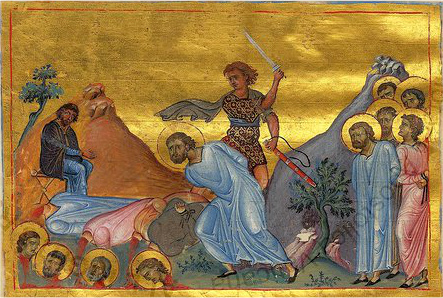
23: THE TEN MARTYRS OF CRETE (A.D. 250)
UPON the publication of the edict against Christians under Decius the activity of a barbarous governor soon made victims in the isle of Crete. Among the martyrs who there triumphed none were more conspicuous than Theodulus, Saturninus, Euporus, Gelasius, Eunician, Zoticus, Cleomenes, Agathopus, Basilides and Evaristus, commonly called the Ten Martyrs of Crete. The three first were citizens of Gortyna, the capital. United in their confession of Christ, they were arrested, dragged along the ground to prison, beaten, stoned by the mob, and at length presented to the governor at Gortyna. As soon as they appeared in court they were ordered to sacrifice to Jupiter, because on that very day their countrymen celebrated a festival in his honour. They answered that they would never sacrifice to idols. The president said, ” You shall know the power of the gods; you show no respect to this great assembly, which worships the omnipotent Jupiter, Juno, Rhea and the rest”. The martyrs replied that they were only too well acquainted with the history of the life and actions of Jupiter, and that those who look upon him as a god must look upon it as a divine thing to imitate his wickedness.
The people were ready to tear them to pieces on the spot if the governor had not restrained them and commanded the martyrs to be tortured. They endured all with joy, and answered to the cries of the mob, who pressed them to spare themselves by obeying and sacrificing to their gods, “We are Christians and would rather die a thousand times”. The governor at length, seeing himself vanquished, condemned them to die by the sword. They went forth triumphantly to the place of execution, praying that God would have mercy on them and on all mankind, and would deliver their countrymen from the blindness of idolatry. When their heads were struck off, and the crowds dispersed, other Christians buried their bodies, which were afterwards taken to Rome. The fathers who composed the Council of Crete in 458, writing to the Emperor Leo I, claimed that through the intercession of these martyrs their island had been till that time preserved from heresy.
(Butler’s Live of the Saints)
_______________________________
The Catholic Marriage Manual
Reverend George A. Kelly
Random House, New York 1958
10
The In-Law Problem
To avoid the dangers described above, parents must accept the fact that they now occupy second place in the affection of their married children and that they are outsiders insofar as the new marriage is concerned. They might well recall their own early years of marriage when they too sought to establish a new life without interference. They should willingly give the same opportunity to their children. Parents also should now treat their married children like grownups who are capable of reaching their own conclusions about their problems and of deciding what is in their best interests. Difficult as it may be to do at times, parents should not take sides in arguments. If a son or daughter reports personal disagreements, the parents might suggest gently that disagreements be confined to the marriage. Sometimes their children virtually force parents to listen to tales of marital conflicts. When this happens, parents should try to play the role of peace-maker. In the long run, the in-laws’ refusal to take sides will win respect for themselves and will encourage the young couple to solve their own problems.
When serious troubles over in-laws arise in a marriage, it is often found that the newlyweds share at least some of the blame. For example, they often impose upon their parents shamelessly. Sometimes doting grandparents find that they have become perpetual baby-sitters who are called upon to care for their grandchildren not only for an occasional evening but for long periods when the parents themselves are off on vacations. Grandparents are often treated like finance companies, except that they are not expected to want the loan repaid. When the grandparents decide that they will not be played for easy marks, their children often resent the withdrawal of what they have come to consider as their rights. Thus tension over in-laws frequently develops because the younger people lack the maturity to shoulder their own obligations and resent their parents’ unwillingness to accept their responsibilities for them. While in-laws should help a young couple over genuine rough spots in marriage, they should not be expected to extricate the youngsters from every financial hole. Here, as in other aspects of the in-law relationship, moderation must prevail.
Whether you live with your in-laws or not, you should observe three basic principles:
1. In-laws are a part of your life and you must expect to see them, at least occasionally. Try to make your relationship a cordial one. Bending over backward to avoid resentment over anything they may say or do will help you enormously to avoid more serious friction in your marriage. Remember that your mate has spent a lifetime to date with your in-laws; they represent more to your mate than you will ever appreciate. Try to avoid incidents in which a choice must be made between you and your in-laws.
2. Try to ease your entry into your mate’s family by calling the mother by the same term of endearment that he or she uses. Try to stay on a friendly basis with the sisters and brothers—never on a competitive one. To keep the relationship noncompetitive, a husband should not tell his wife what wonderful homemakers and cooks his mother and sisters are; and the wife should not parade the perfections of her father or brothers before her husband. The husband should not permit his family to criticize his wife under any circumstances, nor should the wife permit her family to criticize her husband. This rule implies, of course, that neither husbands nor wives will carry tales about their partner back to their families.
3. Any discussion of in-laws’ shortcomings should be strictly out-of-bounds whenever a disagreement arises between husband and wife. In one case, the husband’s father was unable to hold a job; whenever husband and wife disagreed over any matter, she could not resist the urge to tell him that he was like his “shiftless” father. Although she always treated the older man courteously, her husband could not believe that her show of affection was not mere sham. He always felt uncomfortable when his wife was with his family; he found himself wondering what incident would occur which she would use against him later. Her angry outbursts became etched in his memory and beclouded the in-law relationship for years.
Problems in caring for parents. As a result of the average increase in the life span of Americans, many parents now reach an age when they can no longer support themselves and need help from their children. The question is often raised as to how much support a married couple should give their parents. Obviously the first responsibility of husband and wife is to each other and to their children. They are not morally obliged to deprive their children. However, they are obliged to help parents in desperate need even if they must suffer some privation themselves.
Children have an unfortunate habit of overlooking the tremendous sacrifices their parents made on their behalf. If your parent is penniless today, it probably results directly from his inability to save while spending thousands of dollars on your upbringing. Therefore justice requires that you repay your parents when the latter lack adequate food or shelter. However, you are not obliged to support them in a state beyond that in which you yourself live. Sometimes an older man could pocket his pride and do work to pay at least part of his living expenses. Sometimes the older woman could obtain baby-sitting jobs in the neighborhood to defray some costs. They should earn what they can to ease the burden upon their children.
Even parents who are supported by their children should have separate living quarters, if possible. An elderly husband and wife in a simple one-room flat will be happier than if they shared a luxurious home with their children. When conditions make it necessary to allow an in-law to share the home, the guest should be made to understand in a kind but firm way that he or she will not be permitted to interfere in the couple’s right to run it in their own way.
Overprotecting the elderly. Some couples go to the harmful extreme of refusing to allow their elderly parents to do anything for themselves. Whenever a parent tries to move, the younger people jump up to help him. If an elderly woman wants to cook a meal, she is told to sit down while her daughter-in-law cooks it. The elderly man who could repair the squeaking door is told not to do it, but to let it squeak until his son-in-law finds time to repair it.
This overprotection of the aged is on a par with the overindulgence of children. It gives old people the feeling that they are unable to perform even basic chores for themselves and it destroys their self-confidence—their most precious possession. To help your elderly parents feel that they are still useful, encourage them to do things for themselves.
Often retired men who have financial security will nevertheless take part-time jobs in occupations lower in prestige than those they formerly held. Children should disregard what “people might think” and should encourage the elderly man to do what makes him happy. One retired corporation executive took a job as a clerk in a stationery store. His children were shocked that he would “lower” himself in this way. They overlooked the fact that he wanted above all to feel that he could contribute a service to society. Moreover, working in the shop enabled him to meet and talk to many friends; it was a pleasant way to pass the day. Nevertheless, the children exerted pressure upon him to quit the job, and it is probably no coincidence that he died soon thereafter. For the sake of your parent’s mental and physical health, therefore, permit him to work as long as he wants to, and as long as he can.
Sometimes old persons have deteriorated mentally or physically to such an extent that the married children cannot care for them properly at home. It may become necessary to place them in an institution for the aged. Before making the decision to do so, a couple should search their souls to determine whether they have exhausted all other means of providing proper care. For example, the younger persons should be certain that proper medical attention has been provided. Many medicines and treatments have been developed recently to enable doctors to extend the usefulness of older persons by many years.
If a home is chosen, it should be one which will enable the parent to enjoy the solace of the Faith in his declining days—either a Catholic institution or one which a priest regularly visits. Every effort also should be made to assure him that he is being placed in the home for his own welfare. He should be made to understand that you are motivated by love—not by a desire to be free of him.
Regardless of whether the old person possesses all his faculties or is senile, can provide for himself or depends upon charity, young children should be taught always to treat him with the utmost respect. Sometimes a husband and wife laugh at a parent’s eccentricities. Their children ape the parents and do likewise. The grandparent soon occupies a position of ridicule in which all his opinions are ignored. He becomes a pet who is humored but not taken seriously. Adults who permit this condition to develop do not give their parents the respect which is justly deserved. Moreover, they establish a pattern which may haunt them. For their children, taught to ridicule parents who are at the end of their days, will teach their own youngsters to act in a similar way. In this instance, the sins of the parents will return to be visited upon themselves.
(To be continued)
——————————
The following continues the sad saga of the Conciliar Church to dissolve their connection to the Catholic Faith and absorb a synchronization with the secular weltgeist. Instead of all Catholics celebrating the Birth of Christ, here one sees a “Kwanzaa” disservice. That is, instead of celebrating the birth of Christ that brought salvation to all peoples and a faith that unites us all, Kwanzaa seeks to set aside Christianity—an endearing influence in Africa since the time of the Apostles—and separate our brothers and sisters from both faith and unity by delineating the differences and imposing a separate non-Christian culture. Not only that, but as the next event for the Conciliar Church in Los Angeles informs its members, a non-Catholic is raised on their altars as a model to replicate—not Catholic Saints. What happened to Saint Peter Claver? Blessed Martin de Porres? Saint Augustine? or the many other Saints of Africa or of African descent? Apparently they are not worth representing the ideas the Conciliar Church wants to present to its members. They choose rather a secular saint that emulates the weltgeist of the age because of political correctness, not the standard of morality or of holiness—not even a member of the Church.—The Editor
Announcements of the Los Angeles Conciliar Archdiocese:
1. Altadena/Pasadena Black Catholic Association: Kwanzaa Celebration Mass, Saturday, December 29, in Altadena
The Altadena/Pasadena Black Catholic Association is hosting a Kwanzaa Celebration Mass on Saturday, December 29, at 5:00 p.m., at Sacred Heart Parish in Altadena. The celebrant is Msgr. Loreto “Mac” Gonzales and the Mass will feature the seven principles and the Sacred Heart Gospel Choir. For more information, please contact Edwina Clay at (626) 840-3562.
10. African American Catholic Center for Evangelization: 25th Annual Dr. Martin Luther King, Jr. Prayer Breakfast, Saturday, January 19, 2019, in Los Angeles
The African American Catholic Center for Evangelization is hosting its 25th annual Dr. Martin Luther King, Jr. Prayer Breakfast on Saturday, January 19, 2019, starting at 8:00 a.m. It will be held at the Proud Bird Restaurant, 11022 Aviation Blvd. in Los Angeles 90045. Cost is $50 per person. The Drum Major Awardees for the year will be Dn. Hosea Alexander and Dn. Emile Adams, Jr., who together have more than 80 years of service to the Archdiocese. The keynote speaker for the event will be Mr. Damien Goodman, who was chosen as one of Los Angeles’ 100 Most Influential African Americans. Tickets for this event are available from the African American Catholic Center for Evangelization at 323-777-2106.
_________________
Father Krier will be in Eureka on December 27. He will be in Los Angeles January 8 and in Pahrump, Nevada, January 10.
————————
For those who purchase through Amazon, please help support the work here at Saint Joseph’s by going through this link: http://smile.amazon.com/ch/94-2855162
—————————–
The topics of Faith and Morals will correspond to the Roman Catholic Faith in Tradition and the Magisterium. The News will be of interest. The commentaries are for the reader to ponder and consider. The e-mail address will be for you to provide thought for consideration. The donations will be to support the continuation of this undertaking.
While the Newsletter is free of charge it is not free of cost. Please consider supporting St Joseph’s Catholic Church with a tax – deductible donation by clicking the secure link: Donate