Vol 14 Issue 52 ~ Editor: Rev. Fr. Courtney Edward Krier
December 25, 2021 ~ Nativity of Our Lord Jesus Christ
1. Sacrament of Penance
2. Saint Stephen
3. Family and Marriage
4. Articles and notices
Christmas 2021. For let this mind be in you, which was also in Christ Jesus (Philip. 2:5)
Over 2021 years ago a young couple were making their way to Bethlehem. Their land and people had been occupied—by invitation—for over 150 years. The inhabitants were promised autonomous rule in exchange for protection and that agreement was provided by the leaders of those dwelling in the land. One would think that the people would be grateful for the peace that had come, allowing the people to live without fear of invading armies and thereby capable of building a society of economic opportunity and comfort. In truth, when one reads the Gospels describing the period of time, it does not present a picture of oppression by the occupying forces—rather the oppression was by the leaders of the people themselves over their own people. Only when these leaders later bring the Christ to the Procurator, Pontius Pilate, is one confronted with a system of government that is unusually arbitrary and cruel—one that was an exception, but within the norm as the prevalent idea of government.
This young couple was traveling to Bethlehem because of the traditions of their people that placed the family in its familiar tribe and town. Joseph was of the family of David and David’s town was Bethlehem. So, even though Joseph now lived in Nazareth, he had to go to Bethlehem to register as a civic duty in the census of the Roman Emperor, Cæsar Augustus. The Evangelists, Matthew and Luke, who record the birth of the Christ, have no comment upon the journey, other than Luke saying: Joseph also went up from Galilee, out of the city of Nazareth into Judea, to the city of David, which is called Bethlehem: because he was of the house and family of David, to be enrolled with Mary his espoused wife, who was with child. (2:4-5) Matthew will record that the Christ was to be born in Bethlehem not because of the decree of Cæsar, but because it was prophesied: And thou Bethlehem the land of Juda art not the least among the princes of Juda: for out of thee shall come forth the captain that shall rule my people Israel. (cf. Micheas 5:2ff; Matt. 2:5f) In other words, the journey of this young couple was already known and made known before it transpired—and the young couple knew their journey to Bethlehem was what God wanted, and they willingly accomplished His Will. Did they know there would be no room for them in the inn when they arrived? (cf. Luke 2:7) Probably not, or they would not have sought for shelter. They did know that since there was no room in the inn God had already known and they accepted that the Child of Mary would needs be born in a stable among the animals that served man because this Child came to serve man: The ox knoweth his owner, and the ass his master’s crib (cf. Isa. 1:3; Matt. 20:28)
In reading the Gospel accounts in conjunction with the whole of Sacred Scripture one gains an insight into the Mind of God:
For let this mind be in you, which was also in Christ Jesus: Who being in the form of God, thought it not robbery to be equal with God: But emptied himself, taking the form of a servant, being made in the likeness of men, and in habit found as a man. He humbled himself, becoming obedient unto death, even to the death of the cross. For which cause God also hath exalted him, and hath given him a name which is above all names: That in the name of Jesus every knee should bow, of those that are in heaven, on earth, and under the earth: And that every tongue should confess that the Lord Jesus Christ is in the glory of God the Father. Wherefore, my dearly beloved, (as you have always obeyed, not as in my presence only, but much more now in my absence,) with fear and trembling work out your salvation. For it is God who worketh in you, both to will and to accomplish, according to his good will. (Philip. 2:5-13)
When one ponders the mystery of the Incarnation it is easy to stress the humanity, denying the divinity; or stressing the divinity, denying the humanity. We have no experience of possessing the divine nature, we do have experience possessing the human nature. The exclusion of the divine nature makes the events coincidental such as meeting an old classmate at the airport. The exclusion of the human makes the events fate, that nothing could have changed. To place the human and the divine together makes the events a cooperation of fulfilling the Divine Will by the cooperation of the human will. The hypostatic union in Christ allows the cooperation of the human will to subject itself to the Divine will: Because I came down from heaven, not to do my own will, but the will of him that sent me. (John 6:38)
One should see the same in the circumstances of the Birth of Christ. Because Joseph and Mary cooperated with God’s will, that which God willed was fulfilled. Since Mary most perfectly submitted to the Divine Will in her fiat—Be it done to me according to thy word (Luke 1:38)—that which was foretold concerning her was perfectly fulfilled not just through her preservation from original sin, but her fiat to the words of the Archangel, the messenger of the Father seeking a mother for the Seed that would redeem mankind.
I will put enmities between thee and the woman, and thy seed and her seed: she shall crush thy head, and thou shalt lie in wait for her heel. (Gen. 3:15)
And in thy seed [Christ] shall all the nations of the earth be blessed, because thou hast obeyed my voice. (Genesis 22:18; 28:14) To Abraham were the promises made and to his seed. He saith not, And to his seeds, as of many: but as of one, And to thy seed, which is Christ. (Gal. 3:16)
Abraham, who is the figure for God Father, sends his messenger to find a mother for his Seed:
The Lord God of heaven, who took me out of my father’s house, and out of my native country, who spoke to me, and swore to me, saying: To thy seed will I give this land: he will send his angel before thee, and thou shalt take from thence a wife for my son. (Gen. 24:7)
And the woman, the virgin [Rebecca] that the messenger asks if she will accept the will of Abraham, is presented in this scene: An exceeding comely maid, and a most beautiful virgin, and not known to man: and she went down to the spring, and filled her pitcher and was coming back. And the servant ran to meet her (ibid. v. 16) So we read likewise in Luke: The angel Gabriel was sent from God into a city of Galilee, called Nazareth, to a virgin espoused to a man whose name was Joseph, of the house of David; and the virgin’s name was Mary. (Luke 1:26) And they said: Let us call the maid [virgin—Rebecca], and ask her will. And they called her, and when she was come, they asked: Wilt thou go with this man? She said: I will go. (Gen. 25:57-58) In this connection one may envision Mary at the well and being met by the Angel Gabriel, who asks her to begin the fulfilment of the Law and the Prophets, the Pentateuch and Prophetical Books of Sacred Scripture (cf. John 1:45; Luke 24:44; et al. ). And the scene of a young couple with a newborn baby in a stable in Bethlehem is the perfect scene of the birth of God Incarnate being in accordance to God’s Will and the cooperation of Mary and Joseph. Their cooperation is based on their faith in God’s word and knowing they exist to fulfill that Divine Will.
May our reflection upon the Nativity not just be a remembering of a nice story that too many take the related accounts in the Bible, but bring us to also fulfill God’s Will in our own lives by a complete faith in His Word that He reveals in the Bible.
Knowing also that the distance or lack of a priest may deprive many of you of the spiritual blessing of attending Holy Mass on Christmas Day, may you join in spirit where Holy Mass is offered as we unite with you. For all the faithful, especially the benefactors of Saint Joseph’s Catholic Church and the various faithful under my ministry as well as for the readers of my newsletters, be assured that you will all be remembered at the Altar when Christ offers Himself for us this Christmas day.
Father Courtney Edward Krier
As always, enjoy the following readings provided for your benefit.
________________
WHAT IS THE SACRAMENT OF PENANCE
What is the Sacrament of Penance?
How to Make a Good Confession
(Cont.)
Now that one has confessed his or her sins, one must accept the penance the priest gives.
I must be willing to do the Penance the priest imposes on me.
Sometimes one does not realize what is expressed in the penance the priest imposes on the penitent. The person commits a horrible serious sin and the priest tells the person to say three Hail Mary’s just as he did when the person was a child and disobeyed one’s parents. The Church looks to the salvation of souls. In the early Church, soon after the persecution ended, when She was just beginning to establish herself as a public institution with acceptable authority over the lives of her members, public sinners were given severe penances. One such common penance was that of receiving ashes at the beginning of the Lenten Season, kneeling at the entrance of the Church with sackcloth, and begging pardon of the entering faithful. This did not lead to a cessation of sin, but a cessation of public sinners confessing. Holy Mother Church stopped this practice, though she retained the distribution of ashes on Ash Wednesday for all Her children, saints or sinners. This is also found in confession. Everyone, saints or sinners, must confess at least once a year. This allows each to retain his or her honor—keeping the eighth commandment—by not being classified as a sinner through the reception of this Sacrament. That is, no one knows if those confessing are saints or sinners. Even the one so holy that his or her halo illumines the Church—and the lights could be turned off to save electricity—they still go to confession; just as the one who is so sinful the Church seems to get darker when he or she walks in. But if going into the confessional causes no distinction, so must coming out. If the saint receives an Ave and the sinner five Rosaries, would this not inform everyone? Also, as it is part of the Sacrament, and because the priest usually says the three “hail Mary’s” after Mass, for pastoral reasons, the priest is encouraged to prescribe this penance, which assures that the penance will be performed. One knows one has such forgetful memories. Men cannot even remember the birthday of the wife let alone the anniversary of the wedding. Is it not surprising that many forget to remember to say the three Hail Marys? Of course, this would not be if one made the proper thanksgiving after Confession.
The three Hail Marys are simple enough. What is difficult is the amendment. When our Lord said: Whose sins you shall forgive, they are forgiven them; and whose sins you shall retain, they are retained (John 20:21-23), sometimes sins are not forgiven by the priest. If a thief comes to confess he stole a thousand dollars and, to obtain pardon, he must return the stolen money, it may be difficult. If he refuses, he does not receive pardon. His sin is retained. If someone has a problem of going to a bar and getting drunk and does not want to stop going to the bar, the sin is not forgiven. If someone is living with another person in sin and refuses to leave the person, the sin is retained. It is sometimes harder to stop sinning than it is to say a few Rosaries. And it is the ceasing to sin that is required. Sometimes this stress is forgotten when one believes one can say a few Rosaries and still continue to sin. Be it venial sins confessed or mortal sins, the will to perform the penance the priest administers must be present at the time of absolution.
May one make use of this great Mercy of God, this Sacrament of Penance through worthy Confessions and express gratitude by a true sorrow for sin and amendment of life.
Sins Against the Holy Ghost
In Scripture Christ is quoted as saying:
Therefore I say to you: Every sin and blasphemy shall be forgiven men, but the blasphemy of the Spirit shall not be forgiven. And whosoever shall speak a word against the Son of man, it shall be forgiven him: but he that shall speak against the Holy Ghost, it shall not be forgiven him, neither in this world, nor in the world to come. (Matt. 12:31-32; cf. Mark 3:29 and Luke 12:10)
What is this blasphemy of the Spirit? It is the unrepentance of one’s sins. God can only forgive the repentant sinner. If one has become so perverse as to totally reject God’s grace—the working of the Holy Ghost—one cannot repent and, therefore, final impenitence brings eternal condemnation. All sins can be forgiven a person if the person is repentant—and therefore the person is not sinning against God’s grace, but cooperating with it even as witnessed in the conversion of Saint Paul (cf. Acts 9)
When we also meet in the Sacred Scriptures and in the writings of the Fathers, passages which seem to say, that some sins are irremissible, we are to understand such passages to mean, that it is very difficult to obtain the pardon of them. A disease may be said to be incurable, when the patient loathes the medicine that would accomplish his cure; and, in the same sense, some sins may be said to be irremissible, when the sinner rejects the grace of God, the proper medicine of salvation. To this effect St. Augustine says: “When, after having arrived at a knowledge of God, through the grace of Jesus Christ, any one opposes the fellowship of the faith, and maliciously resists the grace of Jesus Christ, so great is the enormity of his crime, that, although his guilty conscience obliges him to acknowledge and declare his guilt, he cannot submit to the humiliation of imploring pardon.” [33 Lib. 1. de sermon. Domini in monte, c. 42. et 44. et retract, lib. c. 8, 19. Aug. term. 1. de verbis Domini, et epist. 50. ad Bonif.] (CCT 261)
The Rite of Penance
The priest is seated in the confessional because he is acting as a judge. There is a screen and wall generally dividing the penitent from the priest so that the penitent is more comfortable in confessing as also recognizing the Confession is to Christ, though Christ is using the priest as His minister. Generally, too, there is a Crucifix for one to look upon to excite sorrow. Closing the door, one kneels on the prie-dieu and begins while signing oneself with the sign of the Cross:
Bless me, Father, for I have sinned.
The priest says at the same time:
May the Lord be in thy heart and on thy lips, that thou mayest rightly confess thy sins; in the name of the Father, and of the Son, and of the Holy Ghost. Amen.
The penitent continues: It has been one week (or one month, one year, etc.) since my last confession. These are my sins:
The penitent then confesses his or her sins: I have . . . After confessing all ones sins, starting with mortal sins if any, the penitent concludes: I also accuse myself of all the sins of my past life, especially of—(disobedience, for example). For these and all my other sins I am heartily sorry. (Pray Father, give me a penance and absolution.)
The penitent then listens to what the priest tells the penitent both as to advice and to receive the penance imposed. The penitent then says the act of contrition loud enough for the priest to hear.
O my God, I am heartily sorry for having ever offended Thee, and I detest all my sins, because I dread the loss of Heaven and the pains of Hell, but most of all because they offend Thee, my God, Who art all good and deserving of all my love. I firmly resolve, with the help of Thy grace, to confess my sins, to do penance, and to amend my life. Amen.
While the penitent is saying the Act of Contrition, the priest is giving absolution in this form:
May the almighty God have mercy on thee, forgive thee thy sins, and lead thee unto life everlasting. Amen.
Next he raises the right hand toward the penitent, and says:
May the almighty and merciful Lord grant thee pardon, absolution, + and remission of thy sins. Amen.
May our Lord, Jesus Christ, absolve thee, and by His very authority do I absolve thee from every bond of excommunication and interdict, in so far as lies within my power and thou hast need of it. Furthermore, I absolve thee from thy sins in the name of the Father, and of the Son, + and of the Holy Spirit. Amen.
The priest then says to the penitent:
Go in peace. Your sins are forgiven you. Please pray for me.
It is proper for the penitent to say:
Thank you.
As the penitent leaves the priest says (time allowing):
May the Passion of our Lord, Jesus Christ, the merits of the Blessed Virgin Mary and all the saints, the good thou hast done, and the ill thou hast endured profit thee unto the remission of sin, increase in grace, and reward in eternity. Amen.
(To be continued)
————————–
DECEMBER 26
ST. STEPHEN
GOSPEL
Matt. 23: 34-39.
AT THAT TIME, Jesus said to the scribes and pharisees, “Behold, I send you prophets, and wise men, and scribes; and some of them you will put to death, and crucify, and some you will scourge in your synagogues, and persecute from town to town; that upon you may come all the just blood that has been shed on the earth, from the blood of Abel the just unto the blood of Zacharias the son of Barachias, whom you killed between the temple and the altar. Amen I say to you, all these things will come upon this generation. Jerusalem, Jerusalem! thou who killest the prophets, and stonest those who are sent to thee! How often would I have gathered thy children together, as a hen gathers her young under her wings, but thou wouldst not! Behold, your house is left to you desolate. For I say to you, you shall not see me henceforth until you shall say, ‘Blessed is he who comes in the name of the Lord!’ “
“Full of grace and fortitude!”
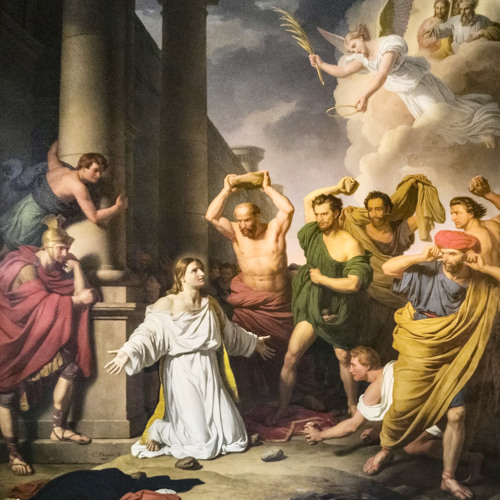
1. The liturgy places St. Stephen first among the saints who stand about the crib of the Savior. Stephen is a man “full of grace and the Holy Spirit,” the first martyr to bear witness to faith in Jesus Christ. The Lord comes into the world which has been alienated from Him through Satan and sin. Satan opposes Him at Bethlehem, and down through all the centuries since that time. At Christmas the gigantic struggle between Christ and Satan begins. Christ came to bring peace to men, peace with God, peace within their own hearts, and peace with their fellow men. But such peace is not possible without a struggle, a struggle against sin, against passion, against the fallen nature of man. The freedom of Christ demands a sword. It is for this reason that the feast of St. Stephen, the valiant soldier of Christ, follows immediately after Christmas. He who would be a disciple of Christ must be a companion in arms with St. Stephen.
2. At the command of the apostles, the faithful chose seven men “full of the Holy Ghost and wisdom,” among whom was Stephen, “a man full of faith and of the Holy Ghost” (Acts 6:3, 5)· The seven were brought to the apostles, who prayed over them and laid hands upon them, ordaining them deacons. The most distinguished of these is Stephen, who, “full of grace and fortitude, did great wonders and signs among the people” (Epistle; Acts 6:8). Courageously he acknowledges Christ. In the true spirit of detachment he endures the death of stoning at the hands of the very men whom he desired to bring to the love of Christ. Drenched in blood and on the point of death he prays, “Lord Jesus, receive my spirit .. _ . Lord lay not this sin to their charge” (Epistle). Thus died Stephen, a man full of faith and love, who lays down his life with a prayer on his lips for the forgiveness of his murderers. Thus the mystery of Christmas and the redemption was worked out in the life of St. Stephen.
St. Stephen is a type of the Church and of the true Christian. The coming of the Son of God is not merely a lovely idyl, a pastoral scene, or an idle play; it is a reality which must be accomplished in the life of the Church and in the life of each Christian. The Christian who wishes to celebrate Christmas in the proper spirit must become like St. Stephen, a man of faith and wisdom, a man of grace and fortitude in the Holy Spirit.
He must place his life and his strength at the service of the Son of God and, becoming an apostle of Christ, dedicate himself to the salvation of the souls of his fellow men. For it will come to pass that the Christian, too, will come “unto his own, and his own received him not” (John i i i r): then he will have acquired the spirit of Christ. The Christian, too, must become a martyr for Christ, for Christ came, not to bring peace, but the sword (Matt. 10: 34). Christ will and must be a king. He turns away resolutely from the old man, from all that is worldly and all that is sinful. “He that is not with Me is against Me” (Luke 11: 23). Those who accept Christ completely will themselves soon experience that which was written of the Son of God, “His own received Him not.” This repudiation has been the experience of the Church, and it will be the experience of each faithful Christian. This is the idea which St. Stephen personifies in the liturgy of today.
3. “Princes sat and spoke against me, and the wicked persecuted me …. [But] I see the heavens opened and Jesus standing on the right hand of the power of God” (Gradual). Stephen is a type of the Church, of the true Christian. The mob that murders him is a type of all those who attack and persecute Christ, His Church and His followers. But the Church sees the heavens open, and feels herself filled with the strength of Him who stands at the right hand of the Father. Like another St. Stephen, the Church feels nothing but love and compassion for those who persecute her and would destroy her. Concerned about the salvation of their souls, she prays unceasingly even for her enemies. “Forgive them, even as I forgive them and pardon them.”
In the Offertory of the Mass we bring forward our gifts of bread and wine; we bring to the altar our body and soul, our heart and our life, and we say as other Stephens: “Lord Jesus, receive my spirit.” Take all that I am and all that I have, O my King and my God.
PRAYER
Grant us, we beseech Thee, O Lord, so to imitate what we revere that we may learn to love even our enemies; for we celebrate the day of his birth to immortality, who could plead with our Lord Jesus Christ, Thy Son, even on behalf of his persecutors. Who with Thee liveth and reigneth world without end. Amen.
(Benedict Baur)
Good King Wenceslas
Lyrics by John Mason Neale
Good King Wenceslas looked out
On the feast of Stephen,
When the snow lay ‘round about
Deep and crisp and even;
Brightly shone the moon that night,
Though the frost was cruel,
When a poor man came in sight,
Gath’ring winter fuel.
“Hither, page, and stand by me,
If thou know’st it, telling,
Yonder peasant, who is he?
Where and what his dwelling?”
“Sire, he lives a good league hence,
Underneath the mountain,
Right against the forest fence,
By Saint Agnes’ fountain.”
“Bring me flesh and bring me wine,
Bring me pine logs hither;
Thou and I will see him dine,
When we bear them thither.”
Page and monarch forth they went,
Forth they went together,
Through the rude wind’s wild lament
And the bitter weather.
“Sire, the night is darker now,
And the wind blows stronger;
Fails my heart, I know not how,
I can go no longer.”
“Mark my footsteps, good my page,
Tread thou in them boldly;
Thou shalt find the winter’s rage
Freeze thy blood less coldly.”
In his master’s steps he trod,
Where the snow lay dinted;
Heat was in the very sod
Which the Saint had printed.
Therefore, Christian men, be sure,
Wealth or rank possessing,
Ye who now will bless the poor
Shall yourselves find blessing.
_______________
LETTERS TO JACK
WRITTEN BY A PRIEST TO HIS NEPHEW
By the
RIGHT REV. FRANCIS C. KELLEY, D.D., LL.D.
(1917)
XXIV
OPPORTUNITIES
NATURE alone is wonderful, but man often spoils her wonders.
WHEN the pleasure we get through our gifts is made the only thing desirable, we prostitute the gifts.
RIGHT living, doing and thinking lower down the net into the sea.
My dear Jack:
There is a play by Maurice Maeterlinck called “The Blue Bird,” which brought forth storms of criticism as well as zephyrs of praise. It is quite materialistic, reflecting much of its author’s false philosophy; but at the same time it is a beautiful production with more than one grain of truth in it. Mr. Maeterlinck senses the idea of “vocation” for each individual human being; but, unfortunately, he mixes in enough fatalism to destroy pretty nearly every vestige of free will. One of the strongest scenes of the play is laid in that vague “shadow-land” out of which come the souls of humans. When the curtain rises on this scene, the stage is shown full of unborn babies, all playing together, all wishful for the day of birth; and all of them with something to bring to the earth with them. One has an invention, another a disease; one has a war, another a treaty of peace; one has a virtue, another a vice; and so on. Father Time arrives with his boat headed earthward, and the children rush to enter it; but Time selects only those whom Fate has destined to be born that day. Each baby who tries to enter the boat without his contribution of good or evil to the world, is sent back to get it.
It is not hard to see that Maeterlinck has Shakespeare’s idea about Opportunities. The great English poet believes that there is but one for the whole lifetime of each individual. You remember from your school days the famous passage: “There is a tide in the affairs of men, which, taken at the flood, leads on to fortune,” etc. Shakespeare would have every one of us eternally watchful of his days, his hours and his minutes, in fear lest fortune’s knock come and find him asleep. So each of us, according to the poet’s views, brings something into the world; but, unlike Maeterlinck, Shakespeare believes that the something is always good. Bishop Spalding holds that Opportunities are spread out before every man in his daily life. He does not believe in fate but he does believe in alertness. He would have shown no patience with Maeterlinck had he read his play, and commented upon it before his lamented death.
I believe with Shakespeare that each and every human being has been given a certain something to do in this world; and that the certain something is good, and for the benefit of the human race. I believe that, in the eyes of God, the certain something which is given each one of us to do is a very great thing, even though it may appear very small to the eyes of men. I believe that, if this something be well done, the reward for the small will be as great as the reward for the big. Human beings judge only from what they see; and they see only what is material. God alone sees the hidden things. It is only the man who studies ants who realizes what wonderful little creatures they are, and how extraordinary are their works. When we carefully study an ant-hill, we have a sort of dim realization of how God sees men. Every little ant has its own work to do and he does it. Every little man and woman has his or her own work to do, and sometimes does not do it. When we do that work, we contribute to the harmony of life. When we do not, we lose our great Opportunity.
Shakespeare’s idea is pretty near to the truth. The Great Opportunity for each and every human being is the opportunity to reach his or her last end—union with God. That Great Opportunity is the same for everybody. There is, however, so I think, a special means given each of us, not only to attain that end, but also, in working for it, to help others attain it as well. I would call this latter the accidental Opportunity. It is not entirely necessary, but we do best when we have taken it. It is in grasping it that we secure the largest amount of happiness in life and labor.
No one is born into this world to spread disease, to steal, to commit murder—to sin in any way. But we have always our free will, and therefore the power to reject our opportunities. I believe that the evils of the world, beginning with the first, are all the result of rejected opportunities—sins of some kind. It is inconceivable that God laid out the world as men have made it. It is too plain that what men had no chance to interfere with is good and well ordered. No evils spring from nature, but all spring from men. In the Arctic regions one never gets a cold—until others come in; and behold the disorder starts at once. Nature alone is wonderful, but man often spoils her wonders. I do not think this would be, were men to grasp the knowledge of their Great Opportunity.
You will hear men offer remedies by the thousand for every ill from which society suffers. You will, possibly, be impressed with the cleverness of many of them. But, if you keep your spiritual eyes and ears open, you will note that shallowness is their all-embracing fault. The shallowness comes from the fact that most worldly men never think of the real end of their existence; never know anything of their Great Opportunity, or ignore it. Consequently, they place the “accidental” Opportunity, which is but the means to an end, as the goal of their desires. Money isn’t given the rich for their own pleasure. It is given to them only as stewards. You may say the same of force, logic, business ability, statesmanship, imagination, lucidity, fluency, etc., etc. When the pleasure we get through our gifts becomes the only thing we deem desirable, we prostitute the gifts. We miss our Great Opportunity.
Then what happens? Well, much the same as would happen if you insisted on damming up a river, because you wanted a lake for your own enjoyment. You send the water off into streams where none existed before. Things may readjust themselves to the change; but the readjustment has to take into account a flooded country that once was fertile; a barren riverbed that once was beautiful; the loss of pure water to a country that once was blessed with it; as well as some greater things that all have not vision enough to see. God’s streams in men’s hearts and souls are properly located. We cannot interfere with them for the sake of our own pleasures without doing harm. Sins are dams on the channels of God’s grace. The dams shut it off and send it another way, that is not God’s way. What we keep of it changes because it is not flowing and free. We make it ours, not God’s. Stagnant, its life is withdrawn from it. No sparkle of the sunshine on its bosom can make up for the loss of the riches in its depths. Happily, some freshness is constantly coming in, which is called ”Sufficient Grace,” so there is always the Opportunity to get our riches back again. To do that we have only to destroy the dam.
There is only one “great” accidental Opportunity given us. That is implied in the idea of “vocation.” But there are countless minor opportunities which, if grasped, may still suffice to bring us to our legitimate end. How does the one great, or the many minor opportunities come to us? Through the medium of our daily duties. We may not know when, but we surely know how. He who honestly tries to live right, to do right, to think right, is not going to miss his “vocation” and therefore is not going to miss his opportunities. Many of them, the minor ones, he has not even dreamed of. Right living, doing, and thinking lower down the net into the sea. Many fish may come into it; some we never thought to catch, some we never knew existed.
(To be continued.)
————————-
Father Krier will be in Eureka, Nevada (Saint Joseph, Patron of Families) on December 30.
————————-
The topics of Faith and Morals will correspond to the Roman Catholic Faith in Tradition and the Magisterium. The News will be of interest. The commentaries are for the reader to ponder and consider. The e-mail address will be for you to provide thought for consideration. The donations will be to support the continuation of this undertaking.
While the Newsletter is free of charge it is not free of cost. Please consider supporting St Joseph’s Catholic Church with a tax – deductible donation by clicking the secure link: Donate
Or if you prefer send a check to
Catholic Tradition Newsletter
c/o St Joseph’s Catholic Church
131 N. 9th St
Las Vegas, NV 89101
Visit us on the Worldwide Web: http://stjosephlv.org
e-mail news and comments to: tcatholicn@yahoo.com