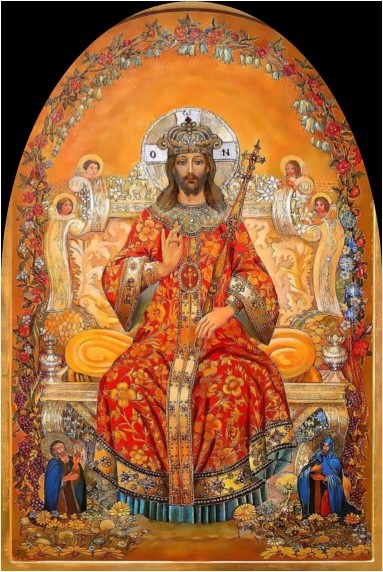
Vol 14 Issue 44 ~ Editor: Rev. Fr. Courtney Edward Krier
October 30, 2021 ~ Our Lady on Saturday
1. Sacrament of Penance
2. Christ the King
3. Ibidem
4. Family and Marriage
5. Articles and notices
Dear Reader:
The feast of Christ the King provides an opportunity to look at its placement in the Liturgy. Though it is clear that Christ is King, Scripturally, liturgically and doctrinally, the Feast itself was not introduced until the year 1925 by Pope Pius XI. World War I changed the scene of European and World politics such that God was completely removed from the affairs of mankind. The Catholic Church, possessing the largest body of members, was denied a seat at the table of negotiations that would affect its members throughout the world. Marxist Communism was being propagated as the answer to the economic woes even though millions were killed or died under its failing policies since its inception in 1848. The only voice the Church had was to plead with her members to influence the social fabric by teaching Catholic principles, voting for just civil servants, promoting just laws and living Catholic lives; the Church also reminded her members that they could not find solutions to material and moral impoverishment through atheistic anti-Christian governments. Therefore Pope Pius XI instituted the Feast when the Church celebrates the two feasts that remind Catholics the Church is the Mystical Body of Christ destined to reign in heaven forever and therefore to look toward the true purpose of mankind: not to fall into the perennial sin of mankind seeking to be gods and establish a utopia on earth, but to seek the kingdom of God and all else will be added besides (cf. Matt. 6:33; Luke 12:31). Therefore Pius XI writes:
This kingdom is spiritual and is concerned with spiritual things. That this is so the above quotations from Scripture amply prove, and Christ by his own action confirms it. On many occasions, when the Jews and even the Apostles wrongly supposed that the Messiah would restore the liberties and the kingdom of Israel, he repelled and denied such a suggestion. When the populace thronged around him in admiration and would have acclaimed him King, he shrank from the honor and sought safety in flight. Before the Roman magistrate he declared that his kingdom was not of this world. The gospels present this kingdom as one which men prepare to enter by penance, and cannot actually enter except by faith and by baptism, which, though an external rite, signifies and produces an interior regeneration. This kingdom is opposed to none other than to that of Satan and to the power of darkness. It demands of its subjects a spirit of detachment from riches and earthly things, and a spirit of gentleness. They must hunger and thirst after justice, and more than this, they must deny themselves and carry the cross.
Christ as our Redeemer purchased the Church at the price of his own blood; as priest he offered himself, and continues to offer himself as a victim for our sins. Is it not evident, then, that his kingly dignity partakes in a manner of both these offices?
It would be a grave error, on the other hand, to say that Christ has no authority whatever in civil affairs, since, by virtue of the absolute empire over all creatures committed to him by the Father, all things are in his power. Nevertheless, during his life on earth he refrained from the exercise of such authority, and although he himself disdained to possess or to care for earthly goods, he did not, nor does he today, interfere with those who possess them. Non eripit mortalia qui regna dat caelestia.
Thus the empire of our Redeemer embraces all men. To use the words of Our immortal predecessor, Pope Leo XIII: “His empire includes not only Catholic nations, not only baptized persons who, though of right belonging to the Church, have been led astray by error, or have been cut off from her by schism, but also all those who are outside the Christian faith; so that truly the whole of mankind is subject to the power of Jesus Christ.” Nor is there any difference in this matter between the individual and the family or the State; for all men, whether collectively or individually, are under the dominion of Christ. In him is the salvation of the individual, in him is the salvation of society. “Neither is there salvation in any other, for there is no other name under heaven given to men whereby we must be saved.” He is the author of happiness and true prosperity for every man and for every nation. “For a nation is happy when its citizens are happy. What else is a nation but a number of men living in concord?” If, therefore, the rulers of nations wish to preserve their authority, to promote and increase the prosperity of their countries, they will not neglect the public duty of reverence and obedience to the rule of Christ. What We said at the beginning of Our Pontificate concerning the decline of public authority, and the lack of respect for the same, is equally true at the present day. “With God and Jesus Christ,” we said, “excluded from political life, with authority derived not from God but from man, the very basis of that authority has been taken away, because the chief reason of the distinction between ruler and subject has been eliminated. The result is that human society is tottering to its fall, because it has no longer a secure and solid foundation.“ (Quas Primas, 1925)
As always, enjoy the readings provided for your benefit.—The Editor
________________
WHAT IS THE SACRAMENT OF PENANCE
What is the Sacrament of Penance?
An Outward Sign, Instituted by Christ, to Give Grace
The Matter of the Sacrament
The matter of the Sacrament, therefore, is commonly considered contrition, confession of sins and satisfaction on the part of the penitent and the absolution on the part of the priest:
The fourth sacrament is penance, the matter of which is, as it were, the acts of the penitent, which are divided into three parts. The first of these is contrition of heart, to which pertains grief for a sin committed together with a resolution not to sin in the future. The second is oral confession, to which pertains that the sinner confess integrally to his priest all sins of which he has recollection. The third is satisfaction for sins according to the decision of the priest, which is accomplished chiefly by prayer, fasting, and alms. The words of absolution which the priest utters when he says: Ego te absolve etc., are the form of this sacrament, and the minister of this sacrament is the priest who has either ordinary authority for absolving or has it by the commission of a superior. The effect of this sacrament is absolution from sins. (Exultate Deo, Nov. 22, 1439; cf. D.B. 699)
The Council of Trent repeats this teaching:
. . . The matter, as it were, of this sacrament . . . consists in the acts of the penitent himself, namely contrition, confession, and satisfaction. These, inasmuch as by the institution of God they are required in the penitent for the integrity of the sacrament for the full and perfect remission of sins, are for this reason called the parts of penance. The reality and effectus of this sacrament, however, so far as concerns its force and efficacy, is reconciliation with God, which at times in pious persons and in those who receive this sacrament with devotion is wont to be followed by peace of conscience and serenity with an exceedingly great consolation of spirit. The holy Council, while recording these matters regarding the parts and effect of this sacrament, condemns the opinions of those who maintain that the parts of penance are the terrors of conscience and faith. (Sess. XIV, Chapter 3; cf. D.B. 896)
This same is brough out in explanation by the Catechism of the Council of Trent:
As, then, amongst the sacraments there is none on which the faithful should be better informed, they are to be taught, that it differs from the other sacraments in this: the matter of the other sacraments is some production of nature or art; but the acts of the penitent, contrition, confession, and satisfaction, constitute, as has been defined by the Council of Trent, the matter as it were (quasi materia) of the sacrament of penance. [Sess. 24. de pœnit. c. 3. et can 4.]They are called parts of penance, because required in the penitent, by divine institution for the integrity of the Sacrament and the full and entire remission of sin. When the holy synod says, that they are “the matter as it were,” it is not because they are not the real matter, but because they are not, like water in baptism and chrism in confirmation, matter that may be applied externally. With regard to the opinion of some, who hold that the Sins in sins themselves constitute the matter of this sacrament, if well what sense weighed, it will not be found to differ from what has been already laid down: we say that wood which is consumed by fire, is the matter of fire; and sins which are destroyed by penance, may also be called, with propriety, the matter of penance. (Rom. Cat., II, 4)
The following is an explanation of each of the parts that make up the matter.
Contrition is, of itself, repentance—the metanoia—that consists of acknowledging one’s sin, being sorry for one’s sins and resolving to change one’s life, meaning, not committing the sins again. These dispositions are absolutely necessary to receive the Sacrament. A priest may absolve an unconscious person of their sins under the condition that the person held these dispositions, otherwise there is no absolution. As the Sacraments are for the salvation of souls, the Church allows the priest to administer this absolution in the prospect that the person can receive the Sacrament—but knowing there is an uncertainty. And, if the person becomes conscious and can confess, the person is obliged to do so. This contrition must be made manifest to the priest granting absolution—which is presumed by the penitent confessing and saying an act of contrition or showing some outward sign of contrition (striking of breast, downcast eyes, tears). The priest is acting in a judicial role as seen in the parable of the unjust servant:
Then came Peter unto him and said: Lord, how often shall my brother offend against me, and I forgive him? till seven times? Jesus saith to him: I say not to thee, till seven times; but till seventy times seven times. Therefore is the kingdom of heaven likened to a king, who would take an account of his servants. And when he had begun to take the account, one was brought to him, that owed him ten thousand talents. And as he had not wherewith to pay it, his lord commanded that he should be sold, and his wife and children and all that he had, and payment to be made.
But that servant falling down, besought him, saying: Have patience with me, and I will pay thee all. And the lord of that servant being moved with pity, let him go and forgave him the debt. But when that servant was gone out, he found one of his fellow servants that owed him an hundred pence: and laying hold of him, throttled him, saying: Pay what thou owest. And his fellow servant falling down, besought him, saying: Have patience with me, and I will pay thee all. And he would not: but went and cast him into prison, till he paid the debt.
Now his fellow servants seeing what was done, were very much grieved, and they came and told their lord all that was done. Then his lord called him; and said to him: Thou wicked servant, I forgave thee all the debt, because thou besoughtest me: Shouldst not thou then have had compassion also on thy fellow servant, even as I had compassion on thee? And his lord being angry, delivered him to the torturers until he paid all the debt. So also shall my heavenly Father do to you, if you forgive not every one his brother from your hearts. (Matt. 18:21-35)
The king judges according to the outward signs of the servant: falling down, besought him, saying: Have patience with me, and I will pay thee all. The king forgave, though the servant was not interiorly repentant. The priest also must judge, therefore he does so on the both the sin and the external signs of repentance.
This demands the confession of sins. The Church places the priest as a judge in the Sacrament of Penance:
Moreover, it is clear that this sacrament differs in many respects from baptism—For aside from the fact that in the matter and form, by which the essence of a sacrament is effected, it differs very widely, it is certainly clear that the minister of baptism need not be a judge, since the Church exercises judgment on no one who has not first entered it through the gateway of baptism. “For what have I to do,” says St. Paul, “to judge them that are without?” [ 1 Cor. 5:12]. It is otherwise with those of the household of the faith, whom Christ the Lord by the laver of “baptism” has once made “members of his own body” [1 Cor. 12:13]. For these, if they should afterwards have defiled themselves by some crime, He did not now wish to have cleansed by the repetition of baptism, since that is in no way permitted in the Catholic Church, but to be placed, as it were, as culprits before the tribunal, so that by the sentence of the priests they may be freed not only once, but as often as they, repentant for the sins committed, have had recourse to Him. Furthermore, the fruit of baptism is one thing; that of penance is another thing. For by putting on Christ by baptism [Gal. 3:27], we are made an entirely new creature in Him, obtaining a full and complete remission of all sins, to which newness and integrity, however, we can in no way arrive by the sacrament of penance without many tears and labors on our part, for divine justice demands this, so that penance has justly been called by the holy Fathers, “a laborious kind of baptism.” This sacrament of penance, moreover, is necessary for the salvation of those who have fallen after baptism, as baptism itself is for those as yet not regenerated. (Council of Trent, Sess. XIV, Chap. 2; cf. D.B. 895.)
The Council continues to call a priest a judge in the Sacrament of Penance, as found in Canon 9 of the Fourteenth Session:
Canon 9. If anyone says that the sacramental absolution of the priest is not a judicial act, but an empty service of pronouncing and declaring to the one confessing that his sins are forgiven, provided only that he believes that he has been absolved, or even if the priest does not absolve seriously, but in jest; or says that the confession of the penitent is not required, so that the priest may be able to absolve him: let him be anathema. (Ibid.; cf. D.B. 919)
This the same Council had already explained the placing of the minister of the Sacrament of Penance as a judge is to be found in Scripture:
From the institution of the sacrament of penance as already explained the universal Church has always understood that the complete confession of sins was also instituted by our Lord, [Jas. 5:16; John 1:9; (Luke 17:14)], and by divine law is necessary for all who have fallen after baptism [can. 7], because our Lord Jesus Christ, when about to ascend from earth to heaven, left behind Him priests as His own vicars [Matt. 16:19; 18:18; John 20:23], as rulers and judges, to whom all the mortal sins into which the faithful of Christ may have fallen should be brought, so that they in virtue of the power of the keys may pronounce the sentence of remission or retention of sins. For it is evident that priests could not have exercised this judgment without a knowledge of the matter, nor could they indeed have observed justice in imposing penalties, if the faithful had declared their sins in general only, and not specifically and one by one. From this it is gathered that all mortal sins of which they have knowledge after a careful self-examination must be enumerated in confession by the penitents, even though they are most secret and have been committed only against the two last precepts of the decalogue [Exod. 20:17; Matt. 5:28], sins which sometimes wound the soul more grievously, and are more dangerous than those which are committed openly. (Ibid. Chapter 5; cf. D.B. 899)
The reason is the concept of power of the keys: Amen I say to you, whatsoever you shall bind upon earth, shall be bound also in heaven; and whatsoever you shall loose upon earth, shall be loosed also in heaven. (Matt. 18:18) It is an amplification of the Primacy of Jurisdiction over the Church that Christ bestowed on saint Peter in Matthew 16:18: And I will give to thee the keys of the kingdom of heaven. And whatsoever thou shalt bind upon earth, it shall be bound also in heaven: and whatsoever thou shalt loose upon earth, it shall be loosed also in heaven. It finds its explanation in these words to the Apostles after bestowing the power of binding and loosing: And Jesus said to them: Amen, I say to you, that you, who have followed me, in the regeneration, when the Son of man shall sit on the seat of his majesty, you also shall sit on twelve seats judging the twelve tribes of Israel. (Matt. 19:28) And evidenced by Saint Luke quoting Christ addressing the Apostles in these words: That you may eat and drink at my table, in my kingdom: and may sit upon thrones, judging the twelve tribes of Israel. (Luke 22:30) In a proper sense this is a metaphor of the Sacraments of the Holy Eucharist and Penance, for the chief supernatural powers of the priest are to change bread and wine into the body and blood of Christ in the Holy Sacrifice of the Mass, and forgive sins in the sacrament of Penance (cf. Baltimore Catechism, Q. 454.) In heaven there is nothing to judge and therefore this cannot refer to heaven, but refers to the Church’s apostolicity.
Pohle speaks of the priest in confession as acting as a judge being consonant:
The power of a judge comprises three distinct elements: (1) legitimate institution; (2) the power to compel accused persons to appear before him; and (3) the power to sentence guilty criminals according to law. Now these three elements are present in the exercise of the power of the keys. Consequently, this power is judicial and its sentences are binding upon those concerned. (Pohle, 68)
Pohle also quotes these sources to support the Church’s continual insistence that the role of the priest in confession is one of judge:
St. Hilary of Poitiers says: “The immutable judgment of Apostolic severity ordained that those whom they bind on earth . . . and those whom they loose . . . by the terms of this Apostolic sentence are loosed or bound also in heaven.” [In Matth., c. 18, n. 8]
St. Chrysostom: “The chair of the priest standeth in heaven, and he has the prerogative to administer heavenly things. Who has said this? The King of Heaven Himself: ‘Whatever you shall bind upon earth,’ etc. What is there that can be compared with this honor? Heaven derives the principal power of judgment from earth. For the judge sits upon earth, the Lord follows His servant, and whatever the latter has judged here below, He ratifies in heaven.” [Hom. de Verb. Is., 5, n. 1.]
St. Jerome says that the clergy “have the keys of the kingdom of Heaven and, after a fashion, exercise the office of judges before the day of judgment.” [Ep. 14 ad Heliod., n. 8]
In the Pseudo-Apostolic Constitutions, which reflect the views of the fifth century, the bishop is apostrophized as follows: “Sit thou, O Bishop, preaching in the church, as thou hast the power to judge sinners. For to you bishops was it said: ‘Whatsoever you shall bind,’ etc. Judge, therefore, O Bishop, by virtue of thy power, as God Himself [judgeth].” [Const. Apost., 1. II, cap. 1 (Migne, P. G., I, 614.]
St. Gregory the Great (+604) says: ”The Apostles obtained the prerogative of supernal judgment, by which, as the representatives of God, they retain sins in some and loose them in others . . . . Behold how those who dread the strict judgment of God are made the judges of souls.” [Hom. in Evang., 26, 1. 2 (Migne, P. L., LXXVI, 1197)] (Sacraments, Vol. III, 69-70)
The priest, though, is also acting as a physician: Jesus hearing this, saith to them: They that are well have no need of a physician, but they that are sick. For I came not to call the just, but sinners. (Mark 2:17; cf. Luke 5:31)
(To be continued)
————————–
The Sunday Sermons of the Great Fathers
M. F. Toal
THE GOSPEL OF THE FEAST
JOHN xviii. 33-37
At that time: Pilate said to Jesus: Art thou the king of the Jews? Jesus answered: Sayest thou this thing of thyself, or have others told it thee of me? Pilate answered: Am I a Jew? Thy own nation and the chief priests have delivered thee up to me. What has thou done? Jesus answered: My kingdom is not of th.is world. If my kingdom were of this world, my servants would certainly strive that I should not be delivered to the Jews, but now my kingdom is not from hence.
Pilate therefore said to him: Art thou a king then? Jesus answered: Thou sayest that I am a king. For this was I born, and for this came I into the world; that I should give testimony to the truth. Every one that is of the truth, heareth my voice.
I. ST AUGUSTINE, BISHOP AND DOCTOR
The King of Israel
I
Blessed is he that cometh in the name of the Lord, the King of Israel, John xii. 13.
1. We are to take the words, in the name of the Lord as meaning in the name of the Father; although they can also be understood of His own Name, since He also is Lord. For it is written elsewhere: The Lord rained from the Lord (Gen. xix. 24). But His own words are a better guide to our understanding, where He says: I am come in the name of my Father, and you receive me not; if another shall come in his own name, him you will receive (Jn. v. 43). For Christ is our Teacher of humility: He Who humbled Himself, becoming obedient unto death; even to the death of the Cross (Phil. ii. 8). But in teaching us humility, He did not lessen His own Divinity; in His Divinity He is equal to the Father, in His lowliness He is like us. Through that in which He is equal to the Father, He created us and gave us existence; through that in which He is like us, He saved us lest we perish.
2. The multitude cried out to Him in praise: Hosanna. Blessed is he that cometh in the name of the Lord, the King of Israel. What envious torment of soul the rulers of the Jews suffered hearing such a multitude acclaim Christ their King! But what great honour was it for the Lord to be King of Israel? What honour was it to the King of Kings to become a King of men? For Christ was not King of Israel so that He might exact tribute or arm a host with the sword or defeat His enemies before the world. He was King of Israel that He might rule minds, that He might keep us in peace for ever, that He might lead those who believe in Him, who hope in Him, who love Him into the Kingdom of Heaven. That the Son of God therefore, Equal to the Father, the Word by Whom all things were made, wished to become King of Israel was a favour to us, not an honour to Him; a sign of His mercy, not an increase of His power. For He Who on earth is called the King of the Jews, in heaven is Lord of the Angels.
II
1. And they took Jesus, it says, and led him forth. And, bearing his own cross, he went forth to that place which is called Calvary, but in Hebrew Golgotha; where they crucified him (Jn. xix. 17). He goes therefore to the place where He was to be crucified. Jesus! Bearing His own cross. Sublime spectacle! For the blasphemous, a great mockery; to the eyes of the just, a great mystery. To the impious looking on, the supreme token of His ignominy; to those who love Him, the supreme comfort of the faith. The impious look, and laugh at a King bearing upon His shoulder, not the sceptre of His Kingdom, but the Wood of His own torment; piety looks and sees a King bearing the Cross on which He is to be fastened: a Cross hereafter to be fastened on the diadems of kings; that was to be mocked by the eyes of the godless, but in which the hearts of saints would glory.
To Paul, who was to say, But God forbid that I should glory, save in the cross of our Lord Jesus Christ (Gal. vi. 14); the Lord commends this very Cross by bearing it on His own shoulders. And for the candle that was to be lit, but not put under a bushel, He bore the candle-stick (Mt. v. 15). Bearing his own cross, therefore, he went forth to that place which is called Calvary, but in Hebrew Golgotha: where they crucified him, and with him two others, one on each side, and Jesus in the midst. These were the two thieves, as we learn from the other Evangelists, with whom He was crucified, and between whom He was made fast: He of Whom the Prophet had said beforehand: He was reputed with the wicked (Is. liii. 12).
2. And Pilate wrote a title also: and he put it upon the cross. And the writing was: JESUS OF NAZARETH, THE KING OF THE JEWS. This title therefore many of the Jews did read; because the place where Jesus was crucified was nigh to the city. And it was written in Hebrew, in Greek, and in Latin: The King of the Jews. These were the three principal languages in that place: Hebrew, because of the Jews who gloried in the Law of God; Greek, for the instructed among the Gentiles; Latin, because of the Romans, then ruling over many, indeed over almost all the nations.
3. Then the chief priests of the Jews said to Pilate: Write not: the King of the Jews. But that he said: I am the King of the Jews. Pilate answered: What I have written, I have written. O ineffable power of the workings of God, even in the hearts of the ignorant! Did not some hidden voice utter with, as we may say, clamorous silence within the breast of Pilate, that which had been foretold in the writings of the psalms: Destroy not the inscription of the title (Pss. lvi, lvii, title)? See how he would not destroy the inscription of the title. What he had written, he had written. And the priests also, they who had wished him to destroy it, what did they say? Write not, they say, the King of the Jews; but, that he said, I am the King of the Jews. What are you saying, you madmen? Why do you strive against that which you can no way change? Will that which Jesus said then not be true: I am the King of the Jews? If what Pilate wrote cannot be destroyed, can that be destroyed which Truth has uttered?
But is Christ King of the Jews only, or also of the Gentiles? He is King also of the Gentiles. For when He said in prophecy: I am appointed king by him over Sion his holy mountain, preaching his Commandment (Ps. ii. 6); lest anyone should say, because of the mount of Sion, that He had been appointed king only of the Jews, He straightaway continues: The Lord hath said to me: Thou art my son: this day have I begotten thee. Ask of me, and I will give thee the Gentiles for thy inheritance, and the utmost parts of the earth for thy possession. And for this same reason, speaking now from His own mouth among the Jews, He says: And other sheep I have that are not of this fold: them also I must bring, and they shall hear my voice, and there shall be one fold and one shepherd (Jn. x. 16).
Why then are we to see a great mystery in this title, in which was written: The King of the Jews, if Christ is King also of the Gentiles? Because the wild olive has become a partaker of the richness of the olive; not the olive a partaker of the bitterness of the wild olive (Rom. xi. 17). For in that the title was true of Christ, that He was the King of the the Jews, what are we to understand by Jews but the seed of Abraham, the children of the promise, who are the children of God (Rom. ix. 8)? For it is not the children of the flesh, says the Apostle, who are the children of God; but they that are the children of the promise, who are accounted his children. And they were Gentiles to whom he said: And, if you be Christ’s, then are you the seed of Abraham, heirs according to the promise (Gal. iii. 29).
Christ therefore is the King of the Jews, but King of those that are Jews by that circumcision which is of the heart, in the spirit, not in the letter; whose praise is not from man, but from God (Rom. ii. 29); who belong to that Jerusalem which is free, which is our mother in heaven, the spiritual Sarah, casting out the bondwoman and her son from the house of liberty (Gal. iv. 22-31). Therefore, what Pilate had written, he had written. For what the Lord has said, He has said. Amen.
———————–
Last Sunday of October
The Kingship of Our Lord Jesus Christ
1. “The Lord is King.” This is a day of thanksgiving to the Father, who has conferred universal kingship on His divine Son, the glorious hero of untold sufferings and humiliations. It is a day of homage to the man Christ, to whom “all power was given in heaven and on earth.” “His dominion will reach from sea to sea, from the great river [Euphrates] to the ends of the earth. All the kings of the earth shall bring their homage, all the nations serve him” (Gradual). We, too, do homage and serve Him.
2. The Gospel of today’s Mass concerns itself with that important moment in the history of mankind when Jesus was brought by the Jews to the judgment seat of Pilate, representative of pagan Roman world-power. “Art thou the king of the Jews? . . . Thou art a king, then? Pilate asked. Jesus answered: It is thy own lips that have called me a king. What I was born for, what I came into the world for, is to bear witness to the truth…. My kingdom…. does not belong to this world.” It is, rather, the kingdom of God, which is the Church, full of grace and truth. It is God’s realm, in which we are safe from the dominion of Satan and sin, and become sharers in the divine freedom. It is God’s rule that rejoices our hearts with its divine activity in us. It postulates that our thinking and striving be rooted in God by virtue of our living union with Christ, the Head. Jesus brought this kingdom to earth, establishing it by His teaching and example, but especially by His death on the Cross. He gives laws and commands; all judgment is His (cf. John 5:22). “Everything in heaven and on earth and under the earth must bend the knee before the name of Jesus, and every tongue must confess Jesus Christ as the Lord, dwelling in the glory of God the Father” (Phil. 2:10, 11). We render joyful homage: “Power and Godhead, wisdom and strength, and glory are his by right, the Lamb that was slain. Glory and power be his through endless ages” (Introit). “The Lord sits enthroned as King forever; the Lord will give his people his own blessing of peace” (Communion).
God has transferred us “to the kingdom of his beloved Son” and made us partakers of this kingdom. “In the Son of God, in his blood, we find the redemption that sets us free from our sins.” Emancipated from the power of sin, we obtain the life of grace, sonship of God, power over the world, over the flesh, over the urge of evil passions; we receive God’s gift of interior freedom of heart and spirit in the possession of His life. In addition there is the expectation we have of being taken up into the future kingdom of endless glory. “We return thanks to God our Father for making us fit to share the light which saints inherit, for rescuing us from the power of darkness, and transferring us to the kingdom of his beloved Son” (Epistle).
3. He is the true likeness of the God we cannot see; His is that first birth which precedes every act of creation”; He is the eternal Son of God, God from God, light from light, begotten, not made. It was through Him that all things came into being; everything was made by Him and for Him. All the marvelous and beautiful things that the universe contains are His property. He is the rightful master of the spirit, will, heart and body of man. To Him belong heaven and earth; He has the might and the right to make use of all earthly things. In every way the primacy was to become His. It was God’s pleasure to let all completeness dwell in Him, the man Jesus Christ. He must be King also over me, my very being and existence. I must live for whatever He wishes of me.
We rejoice with Holy Church that the Father made Him Lord and King of the universe, saying: “Ask thy will of me, and thou shalt have the nations for thy patrimony; the very ends of the world for thy domain” (Offertory). “Christ conquers; Christ rules; Christ is King” (Inscription on the obelisk in St. Peter’s square, Rome).
The Lord is a king; He directs with strong hand His kingdom, His Church, our souls. Powerful enemies will besiege His kingdom in vain. “Do not be afraid, you, my little flock. Your Father has determined to give you his kingdom” (Luke 12:32).
We dedicate ourselves and all we have to Christ the King. We pray that all men, all races and nations of the earth may bow to His dominion.
Collect: Almighty, ever-living God, who hast willed that in Thy beloved Son, the universal king, all things should be made new, grant in Thy loving-kindness that all peoples of the earth, now torn asunder by the wound of sin, may be subdued to the gentle sway of Him who is God. Amen.
(Benedict Baur)
_______________
LETTERS TO JACK
WRITTEN BY A PRIEST TO HIS NEPHEW
By the
RIGHT REV. FRANCIS C. KELLEY, D.D., LL.D.
(1917)
XVI
THE CONSERVATIVE
THE Conservative is not usually the one who produces great results; but he is nevertheless the one who enables others to produce them.
THE Conservative knows men better than they know themselves, and loves them more wisely.
My dear Jack:
I had to smile when Billy said he was a “libertine”. Billy does not know what “libertine” means. If he had known he would have hesitated about claiming such a title. Billy meant to say that he was a “liberal”—in things political. He is; but Billy is a “liberal” in other things as well. So far as the “other things”, at least, are concerned, so much the worse for Billy. Don’t mistake my meaning: I am not opposed to all liberalism; only to the dangerous kind that makes liberalism an engine of destruction. There is a true and a false liberalism. That which takes no heed of eternal principles is the false kind.
Liberalism is busy today flinging bricks at the Conservative. He deserves a few of them, but not all. As a matter of fact, he deserves more bouquets than bricks. He has done his work better than men realize. The Conservative is not usually the one who produces great results, but he is nevertheless the one who enables others to produce them. He is the watchman who guards the foundation of the building; the treasurer of all the real riches gathered in bygone ages, and which, wisely used, give new riches to the present, and will give them also to the future. He is the keeper of the granary wherein lie stored the seeds from which the world’s next crop of ideas, inventions and facts will spring. He is the unappreciated Joseph to thousands of spendthrift Pharaohs; but he wears no outward crown in proof of it, and holds no scepter of public honor. He is the power behind every throne that is firm upon its base. He is the port of refuge for every storm-driven ship. Without him there could be no progress; because there would be no tools preserved with which to labor, no principles upon which to rest, no weapons with which to fight truth’s battles. The armories and magazines of intellectual warfare are in his care; the fact that he hesitates and considers long before he lends the keys, is rather a proof of his sagacity than a reproach to his slowness. It is well for the world that the Conservative is thus hard to convince and thus slow to act. He has been, and is, largely responsible for a diminishing in the world’s stock of regrets. He scarcely knows the meaning of “it might have been”; and for him there is no Past Conditional tense. He alone can say, “it was”; but he alone never says, except of God, “it will be”.
It is the Conservative who comes upon the battlefield when the fight is done, and the bodies of the rash lie with glassy eyes uplifted to the unrelenting heavens. He it is who gathers up all that is useful for another fight, and stores it away until it is needed. It is he who goes to the council tent, and there takes the fruits of victory or defeat. It is he who treasures the lessons, whether they be in the form of tests of new explosives, the folly of entering into a war unprepared, or the crime of entering into it at all. When others think that all is lost, he quietly has laid away some spoils at least; and knows that even out of a rout something always can be gained. Though he did not face battle, yet he alone faces its consequences—more deadly oft-times than the fight itself.
The Conservative is thought to be the smallest and narrowest of men. It is partially true, but in his seeming defects are his uses and his victories. He is small, but one sees better from the small end of a telescope. He is narrow, but the path of Horatius to glory was a bridge only a few feet wide. He does look backward, but behind are the things that justify looking ahead. His foresight is not great, but it is the careful start that makes a glorious finish possible.
It is not a reproach to the Church that in her fold the Conservative reigns supreme. Centuries have tried to oust him from this stronghold, but he has beaten the centuries. So the Present and Future do not refuse an admiring salute with the sword, before they join the Past in thrusting at him. But they will thrust in vain, for he knows his ground. He has lived to see and study men, and he has not learned to scorn but to love them. He knows them better than they know themselves, and loves them more wisely. He watches their weaknesses, while noting their enthusiasms; and from both he draws the good, and thus wisely saves the future of the race. He has seen centuries which worshipped many gods and all of them shameless; but he has managed to keep the fire alight on the altar of the One who alone is Truth. He has witnessed past centuries drop their books—sacred and profane—to grasp the sword and couch the lance. But he gathered up and kept the books—Bible and classics. We owe their preservation to him. He saw Art fall into the dust to die, but he quietly supplied the materials for its revival. He heard a world cease to sing, but saved melodies that the world might sing again. These and all else that he has saved may be arrayed against him, but he understands and hugs his treasures closer, while watching for what he can add to them from the new and more splendid mistakes of this new and more splendid present.
The century is learning fast while the treasures of the Conservative grow apace. What shall the future say of him? It will speak of him in terms of praise, but it will speak as of one dead. It will enshrine his memory, but enshrine it only as a memory. It will build a mighty mausoleum to him, really believing that he lies beneath it. It will sing of him, imagining that the song is a melody. It will say that, under God, Religion owes to him its purity, Science its discoveries, Music its inspiration, Art its models, and Oratory its ancient fire; all the while thinking of him as one of the great departed. But he will not be dead even when the world thinks that the millennium has come. The millennium will yet be far away—as far as Heaven, which is where the Gate of Death ends the Long Road. Yes, the Conservative shall always be living, and the very praise the Future will unite to give him, shall be but a new form of the old battle he has always fought, and which he must fight to the end; while the world shall always remain his servant, and all ages his debtor.
(To be continued.)
————————-
Father Krier will be in Pahrump, Nevada, (Our Lady of the Snows) November 11. He will be in Albuquerque, New Mexico, (Saint Joseph Cupertino) November 16. On November 18, he will be in Eureka, Nevada (Saint Joseph, Patron of Families).
————————-
The topics of Faith and Morals will correspond to the Roman Catholic Faith in Tradition and the Magisterium. The News will be of interest. The commentaries are for the reader to ponder and consider. The e-mail address will be for you to provide thought for consideration. The donations will be to support the continuation of this undertaking.
While the Newsletter is free of charge it is not free of cost. Please consider supporting St Joseph’s Catholic Church with a tax – deductible donation by clicking the secure link: Donate
Or if you prefer send a check to
Catholic Tradition Newsletter
c/o St Joseph’s Catholic Church
131 N. 9th St
Las Vegas, NV 89101
Visit us on the Worldwide Web: http://stjosephlv.org
e-mail news and comments to: tcatholicn@yahoo.com