Vol 14 Issue 27 ~ Editor: Rev. Fr. Courtney Edward KrierJuly 3, 2021 ~ Our Lady on Saturday
1. The Incarnation of the Word of God—Eberhard Heller
2. Sixth Sunday after Pentecost
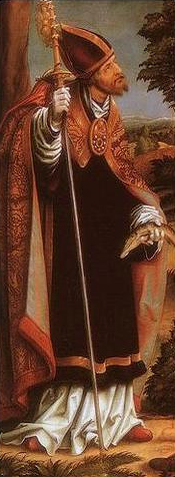
3. Saint Ulrich
4. Family and Marriage
5. Articles and notices
Dear Reader:
What does one believe in? That is what faith is. How does one live one’s faith, that is his religion. As Catholics we believe in God, Whose essence is Life, Goodness, Truth, Charity, Wisdom, etc. That is, we believe in Life, Goodness, Truth, Charity, Wisdom, etc. And our religion is living a life of goodness, truth, charity, wisdom, etc. But faith for Catholics includes what God has revealed, so Catholics also believe in Divine Revelation, the Word of God.
This is in Tradition, both written (Sacred Scripture) and oral (by word of mouth). Sacred Scripture is clear, oral tradition is what has been proved to be held as divine teaching since at least the time of the Apostles: The first day of the week being the Holy Day in the New Testament, institution of the Seven Sacraments, celebration of Holy Mass, constitution of the Church, etc. Since these are the Word of God, they cannot be changed—to do so would be to not believe in the Word of God, but to make it the words of men—therefore, not faith but an opinion and not religion but human sociology. The Church holds to Saint Paul’s words, faith is the substance of things to be hoped for, the evidence of things that appear not. (Heb 11:1) And points to Saint James the practical living, Religion clean and undefiled before God and the Father, is this: to visit the fatherless and widows in their tribulation: and to keep one’s self unspotted from this world (James 1:27).
In contrast, the following definitions are how the world considers faith and religion and why there can never be a discussion on the same plane about a topic concerning the Catholic Church because they are obviously talking of something different than what we Catholics are speaking of:
Faith is religion taken down to street level, where it bumps up against sinners and their sins and where the challenge of doing right in a confounding world can be as frustrating as trying to step into a rainbow.
Religion makes judgments about who’s worthy enough to walk through the church doors. It makes note of who has paid their tithes and who has curried favor with the minister or the priest. Faith flings open the doors and offers love without judgment. (https://www.washingtonpost.com/nation/2021/06/22/faith-silence/)
This was in defense of Mr Joseph Biden and Kamala Harris that they have faith but not religion. Obviously backwards and empty—but accepted. This is what is promoted as faith and religion today among the Woke and our youth and therefore in what to believe and how to live faith while divorcing oneself from God.
The same necessity of a clear definition is needed regarding the Person of Jesus Christ. Dr Eberhard Heller presents a series of writings on the Incarnate Word because if Jesus Christ is God, what Christ teaches is absolute Truth and must be held as unchangeable—unlike opinion. If Jesus Christ is God He performed miracles of Himself, not through God. And if Jesus Christ is God, God did not use Jesus Christ to reveal Himself or to perform miracles. God revealed Himself and God performed miracles. And God, Our Lord Jesus Christ in the Flesh, founded a Church to which all must belong in order to be saved—not man. Let’s read what Dr Eberhard Heller has to say.
As always, enjoy the readings provided for your benefit.—The Editor
—————-________________
The Incarnate Word
Information of the editorial office
Beuerberg, August 31st, 2015
Dear Readers,
When I started to analyze the main errors of Vatican II in the EINSICHT of September 2013, it soon became clear to me that a religious and theological revival would only be started if the possibility of a sound conviction could be found for a revival. For what had happened? The faith in Jesus Christ and His institution, the Church which should preserve His inheritance, had given way to an indistinct relativism. The idea of Christ being the Son of God had begun to vacillate. This relativism did not stay limited to the people who had once been Catholic. The claim of absoluteness of the Son of God had been given up. I am thinking of the doctrine of subsistit in, according to which the Catholic Church is no longer the Church of Jesus Christ but only takes part in it – I add: like other religious communities (sects) which have thus been elevated to the level of church communities with the same rights and authority. I had formulated it as follows: If everything is of the same value, everything becomes unimportant, arbitrary. A new Arianism began to triumph; the matter of concern was not primarily the theological conception but above all the loss of a basic conviction with immediate consequences for religious life. In the Bavarian villages, where traditions continue in the hearts of people, the world seemed to be still o. k. But if one took a closer look and analyzed their religious traditions, a moral framework still remained but without any knowledge of Jesus Christ being the Son of God.
Even among traditionalists – and here I simply include indistinctly all people pretending to want to maintain the pre-conciliar faith – it becomes clearly evident that there are also enormous deficits in faith among these people; this can be seen by the fact that the extent of the crisis is hardly seen correctly and that there are no efforts made for the restitution of the Church. After this description of a general disaster the question arises as to what one can do in the face of such a situation. Back to the sources, ad fontes! in order to decide again about how to go further. Ad fontes concretely means to show the way to Christ as the Son of God in order to regain once again a Christian belief.
I can get such a belief by intuitive meditation by referring among others to the biblical statements. The person who has thus achieved belief cannot, however, convey his intuition to others. It is different if I try to get a conviction by reflection by taking the others with me into my reflections. The question is: How do I learn that Christ is the Son of God? Respectively, how can I recognize Christ as the Son of God? In the information to the issue of December 2013 I had written: “Without a clarification of this question, which has until now been neglected, we would lack the reflective insight into our faith from which could also rise to a strong faith. Here the maxim of St. Anselm of Canterbury: Credo ut intelligam – I believe in order to understand – is valid as also the other way round: Intelligo ut credam – I understand in order to believe.” (Proslogion, Chapter 1)
The immediately understood, that is that which immediately reveals itself to me in faith is the basis to which my thinking refers. But I need to understand this faith in order to keep it. I have tried to answer the question of the recognizability of Christ as the Son of God gradually in several articles. However, by the distribution through several issues the heart of the context has continued to be at a loss for many. After several reflections I therefore decided to unite the single essays into one copy. The previous articles are amplified by a discourse about the effects which an acquired recognition of God could have on the structuring of our religious lives. As an appendix I have added the thoughts from the Sermons about “having God in us” of St. Bernard (Dec. 2014, no. 4, p. 108-110) and my reflections about the “Meaning of Art in the Religious Realm” (Dec. 2013, no. 4, p. 122-125).
I would like to add a personal remark. In this series of essays about the recognition of God I see my most important articles which I have edited in all the years of my work as an editor for the EINSICHT. Unfortunately I do not know any living theological author who applied himself to this subject in this thorough way. This problem has been completely reflected here for the first time after I had discussed this subject with a few persons.
Eberhard Heller
The Errors of Vatican II and their defeat by Recognizing Christ as Son of God
by Eberhard Heller; translation: Elisabeth Meurer
The purpose of the following discourse is to critically analyse the decisions of Vatican II and their translation into action in order to get through to the comprehensive principle of these reforms. Should the results show not to be corresponding to what the Church has taught until now – that is, what we have always stated until now – then I will try to present possibilities how to basically face this present crisis. So an offer for therapy is to follow a diagnosis – if necessary.
I received the incentive for this examination by an essay by the deceased Prof. Leo Scheffczyk, a witness who is surely unsuspicious, who did not see himself as our follower but judged quite a lot of phenomena in a similar way as we do. So he is right when seeing in the gnosticism of the IInd century parallels to developments now present today. In the UNA VOCE KORRESPONDENZ of Nov./Dec. 1982, p. 381, he wrote: “In history there is a classical example of the overcoming of a life-threatining crisis whose kinship in style and spirit with present day religious need is eye-catching. The gnosticism which started in the second century was about to melt the Christian doctrine of salvation with the world’s wisdom of that time in order to supposedly put it on the same level. Then and now faith was propagated to be translated into a supposed higher reason. The synchretic glossing over of revelation with elements of the philosophy of that time was dominating (. . . ). The Church countered this suggestion of progress with three simple principles: it countered the fascination of the intellectually stimulating gnostic literature with establishing the canon of Biblical Scriptures; it countered the arbitrary reference to subjective revelations and special teachings with emphasizing the objective principle of tradition; it countered the spiritualistic zealotism with the ‘monarchic’ episcopate. However, by doing so it might have survived, but it also fell into the depths of the ancient world concepts.”
So – besides analysis of the crisis – one has to show principles by which the present day crisis cannot only be fought but – as stated above – also be defeated.
We will also show that the question of the task and the nature of the Church play the decisive part. We had already brought the question of the main error of Vatican II up for discussion exactly ten years ago (cf. EINSICHT of Sept. 2003, no. 7). The different authors – Ohnheiser, Kabath, Lang, De Moustier and myself – have more or less agreed on discovering that the relativation, that is, the falsification of the concept of the Church is the error on which all other errors are based. The problem of overcoming the crisis was not picked out as a central theme at that time.
But in order to find better access to our problem and to get to a balanced judgment of which we say it is theologically founded, I need to go a bit further ahead. The decisions as they were then composed and put into action, can only be understood, if one also describes the situation when they were made.
Since Luther there are – not only in the German-speaking countries but worldwide – religious communities which established themselves and thus were and still are in competition with the Catholic Church (today even more religions have sprung up which also present themselves as ways to salvation).
The shock of the doctrinal system which at that time had been caused by Luther’s revolution did not only concern singular dogmatic positions but the whole doctrine of the Church. If one goes through a controversial Catechism, he will find that, besides the sentence “Christ is the Son of God” all other questions of faith are answered differently. The mere question of the foundation on which the Church is based shows that the two positions are incompatible. According to Catholic doctrine the Church is based on the pillars of Tradition and Scripture, according to Luther there is only Scripture as a base (sola scriptura). If one further shows that Scripture is the product of Tradition – the Holy Scripture was written by the evangelists and apostles after the Ascension of Christ with the help of the Holy Spirit (there is no record of this doctrine by Christ himself) – then it will very soon show that Luther’s doctrine of sola scriptura is untenable.
The Church had to react to Luther’s provocation and it did so at the Council of Trent. The Tridentine Council countered these concentrated Lutheran errors with precise dogmatic layouts which amazingly outdid the previous Thomistic apparatus of terms by far. The canons formulated in Trent concerned above all doctrines for areas dealing with the sacraments. A decision from the Fathers about the essence of the Church was not found at that time because of the diverging opinions. “By the fact that its decrees as norms of rights and faith formed the life of the Church through three centuries, the Council of Trent had introduced a ‘Tridentine era of the Church’”. (Hubert Jedin: “Kleine Konzilsgeschichte – mit einem Bericht über das Zweite Vatikanische Konzil”, Herder, Freiburg im Breisgau 1969, p. 127.)
(To be continued)
————————–
The Sunday Sermons of the Great Fathers
M. F. Toal
THE GOSPEL OF THE SUNDAY
MARK viii. 1-9
At that time: when there was a great multitude with Jesus, and they had nothing to eat; calling his disciples together, he saith to them: I have compassion on the multitude, for behold they have now been with me three days, and have nothing to eat. And if I shall send them away fasting to their home, they will faint in the way; for some of them came from afar off.
And his disciples answered him: From whence can any one fill them with bread here in the wilderness? And he asked them: How many loaves have ye? Who said: Seven. And he commanded the multitude to sit down upon the ground. And taking the seven loaves, giving thanks, he broke, and gave to his disciples to set before them; and they set them before the people. And they had a few little fishes; and he blessed them, and commanded them to be set before them.
And they did eat and were filled; and they took up that which was left of the fragments, seven baskets. And they that had eaten were about four thousand; and he sent them away.
I. ST JOHN CHRYSOSTOM, BISHOP AND DOCTOR
The Second Multiplication of the Loaves2
When, on the first occasion, the Lord was about to work this miracle, He first cured those who suffered from illness of the body. Here He does the same. For after He had healed the blind and the lame, He goes on to work the same miracle. But why did the Disciples on that occasion say to Him: Send away the multitudes (Mt. xiv. 15), while on this occasion, though three days had now passed, they do not say it? It was either because they were now wiser men, or else because they saw that the people did not seem greatly troubled by hunger: for they were praising and glorifying God for what had taken place amongst them.
But see how on this occasion also He does not simply proceed at once to the miracle, but calls His Disciples to Him for this purpose. For the multitudes came to Him for healing; they did not dare to ask for bread. But He, kind and foreseeing, gives it to them even though they do not ask, and says to His Disciples: I have compassion on the multitude, and shall not send them away fasting. And lest they say that the people had come with food for the way, He says: They have now been with me three days; so that even had they brought some, it would now be consumed. He did not do this on the first day, or the second, but when everything was gone; so that when they were reduced by want they would acclaim the miracle with greater good will. And so He says, Lest they faint in the way, confirming that they were far from home, and that they had nothing.
But if you do not wish to send them away fasting, why do You not work a miracle? That by means of this question, and by the answer that followed, He might make His Disciples more alert; that they might show more faith; that they might come to Him and say: Make loaves. But they had not even seen the need of the question. Because of this, later, He said to them, as Mark tells us: Are your hearts still so blinded; having eyes do you not see, and having ears do you hear not? And if this were not the case, for what reason did He say these words to the Disciples, and show them that the multitudes were deserving of such a kindness, and add also that He was Himself moved with compassion for them? Matthew however says that a little afterwards He rebuked them sharply, in these words: O ye of little faith. Do you not yet understand; neither do you remember the five loaves among the five thousand men, and how many baskets you took up, nor the seven loaves among four thousand men, and how many baskets you took up? (xvi. 8, 9). So the Evangelists are in accord with one another.
What then do the Disciples say? They are still crawling along the ground, though the Lord had done endless things to fix in their mind the remembrance of the first miracle, by question and by answer, by making them the ministers in what He did, by distributing the baskets among them; and they were still backward. Grasping nothing, the Disciples say: Where should we have so many loaves in the desert? For they thought He said this as though telling them to buy loaves. And quite foolishly. For the same reason had He said to them not so long ago: Give you them to eat (Mt. xiv. 16): to give them an opportunity of asking Himself for this favour. Now however He does not say, Give you them to eat; but what? I have compassion on the multitude and will not send them away hungry; actually moving them, and prompting them, to see that this food was to be sought from Himself For the very words make this plain; that He was able not to send them away; and they also show His power. For the words, I will not, signify this.
And because they make mention of a multitude, and of the place, and the wilderness (for they say: From whence can anyone fill them with bread in the wilderness?), and since they had not grasped the meaning of Christ’s words, He then goes on with His purpose, and says to them: How many loaves have you? But they said: Seven, and a few little fishes. This time they do not say: But what are these among so many (Jn. vi. 9), as they said before. And so, though they had not begun to grasp the whole matter, their minds are now a little more elevated. And He too, uplifting their minds by this, put the question in the same way as on the other occasion, that this might remind them of what He had done then.
And you, as you have seen their backwardness, now note here also their just spirit, and admire their truth, and how when writing of themselves afterwards they did not try to conceal their own stupidity, however great it was. For it was no light matter for them to have forgotten so speedily such a miracle, performed just a little while before; and it was for this they were rebuked. And I would like you to keep in mind their own personal austerity; how poorly they provided for the stomach, how they disciplined themselves to pay little attention to what they ate. For though they were in the desert, and were there for three days, they possessed but seven loaves.
The other things Christ ordered as on the former occasion. He bade them be seated, on the ground, and He multiplied the bread in the hands of the Disciples. And he commanded the multitude to sit down upon the ground, and taking the seven loaves and the fishes, and giving thanks, he brake, and gave to his disciples; and the disciples gave to the people. But the end of this miracle was not the same as the ending of the first. And they did all eat, it says, and had their fill. And they took up seven baskets full of what remained of the fragments. And they that did eat, were four thousand men, beside women and children. Why were there twelve basketfuls left when there were five thousand, while here, where there were four thousand, only seven basketfuls of fragments remained over? Why are the fragments now so much fewer when the number of people was not so much less?
We must answer that either the baskets used this time were larger than before or else, lest the sameness of the miracle should cause the Disciples to forget it again, in order to stir up their memory by a difference, so that by this variation the memory of both this and the former miracle would remain in their minds. So the first time He made the number of baskets of fragments the same as the number of Disciples; and this time He made them equal to the number of the loaves, and in this reveals His ineffable power, and the ease with which He could use that power, in that He could both in this way and in the other way work miracles. For it was a matter of no small power to keep to the number exactly, both then and now; since there five thousand men ate, now four thousand: and leave neither more nor less fragments than the baskets would hold, though the number of the guests was unequal.
And what followed was like what followed on the previous occasion. For then, leaving the multitude, He withdrew by ship; and now He does the same; and John also speaks of this (vi. 17). For no other miracle had so roused the people to follow Him as the miracle of the loaves; and not alone to follow Him, but they also wished to make Him King. And to avoid all suspicion of desiring to be made King, immediately after the miracle, He quickly departs; and not on foot, lest they follow Him, but by boat.
And the Gospel goes on to tell us that, when his disciples were come over the water, they had forgotten to take bread. Who said to them: Take heed and beware of the leaven of the Pharisees and Sadducees. Why did He not say openly: ‘Beware of their teaching’? He wishes of course to bring back to their mind the miracle that had taken place; for He knew they had already forgotten it. But it did not seem opportune to censure them openly then; though, as they gave Him occasion to do so, He made the reproof tolerable. And why did He not reprove them when they said, Whence should we have so many loaves in the wilderness? For then seemed a good time to correct them. He did not do so that He might not seem to be as it were rushing at the miracle. And besides He did not wish to correct them before the people, or make a display of His own authority. Now correction was more called for: that they should be so forgetful after two such miracles.
And so, after another miracle, He rebukes them; for He laid before them the thoughts they were thinking in their hearts. And what were they thinking? They were thinking: He says this because we have taken no bread. For they were still concerned about Judaic purifications, and about observances with regard to food. And so because of this He upbraids them very sharply, saying to them: Why do ye think within yourselves, O ye of little faith, for that you have no bread. Do you not yet understand; neither do you remember? Your heart is still blind; having eyes you see not; having ears you hear not. Do you not remember the five loaves among five thousand men, and how many baskets you took up? Nor the seven loaves among four thousand men, and how many baskets you took up?
You see here displeasure stretched to the utmost. In no other place is He seen to rebuke them in this manner. Why did He act so? That once again He might drive out of their minds their notions regarding foods. So, on the previous occasion, He said only: Are you yet without understanding? Do you not understand? But here, rebuking them fiercely, He says: O ye of little faith. For not everywhere is mildness to be used. As He allowed them to speak freely, so He corrects them in the same way; and in this change of manner He is seeking their welfare. For you see here both severity and great mildness. For, almost excusing Himself for correcting them, He says: Do you not recall to mind the five loaves among five thousand men, and how many baskets you filled? And the seven loaves among four thousand, and how many baskets you filled? He reminds them of the number who ate, as well as of how much remained; that at the same time He might both make them mindful of past events, and more attentive to future ones.
And to show us how efficacious His rebuke was, how it sharpened their torpid minds, hear what the Evangelist says. For when Jesus had finished speaking, and after rebuking them had added: Why do you not understand that it was not concerning bread I said to you: Beware of the leaven of the Pharisees and Sadducees, the Evangelist notes: Then they understood that he said not that they should beware of the leaven of bread, but of the doctrine of the Pharisees and Sadducees; although the Lord had not so interpreted these words. But see the good His rebuke did. It led them away from the Jewish observances, and from being heedless, as they were before, they became attentive to what He said to them. And He took them out of their littleness of faith, so that they were not afraid, nor apprehensive, when they had but a few loaves, nor concerned about hunger, but indifferent to all things.
And neither should we be always yielding to those subject to us; nor wish to be sheltered by those placed over us. For the human mind has need of either remedy. And it is in this way God orders all things, and now does this and now does that; and allows neither good things nor bad to continue permanently. For as it is now day, and now night, and now winter, and now summer; so within us we have now pleasure, now pain, now sickness, now health. And we should not wonder if we are sick; since we ought rather wonder that we are well. Nor let us be troubled should sorrow come; for since we are given happiness, it is reasonable that we should also have sorrow. For all things come to us in accord with nature, and with the order of things. Let us keep all these things in our mind, so that we may escape final punishment, and attain to everlasting blessings, through the grace and mercy of our Lord Jesus Christ, with Whom be there glory to the Father and to the Holy and Life-giving Spirit, for ever and ever. Amen.
———————–
JULY 4
St. Ulrich, Bishop
1. At the Synod of Rome in 993, Luitbold, Bishop of Augsburg, asked Pope John XV and the assembled cardinals and bishops for permission to speak. He told them about the life and work of his predecessor, Bishop Ulrich, and asked them to say whether it were right to honor this man as a saint. The clergy unanimously agreed that Bishop Ulrich was a saint worthy of veneration and thus enacted the first solemn canonization.
Ulrich was born at Augsburg in 890, to a noble Swabian family. As an infant he was lean and weak, failing to respond to his mother’s ardent care; by an unmistakable miracle he suddenly became healthy and strong. Later he was sent for his education to the monastery of St. Gall in Switzerland. At the age of eighteen Ulrich returned to Augsburg and entered the service of Bishop Adalbero there. The news of this bishop’s death in 909 forced Ulrich to interrupt a pilgrimage and to return at once to Rome. Shortly after, his father died, and Ulrich went to Dillingen to solace his mother and to manage the family estate. Back in St. Gall in 920, Ulrich asked the recluse Wiborada whether he ought to become a monk there, but was told that God had other work for him. Soon afterward he was elected bishop of Augsburg and was consecrated on the feast of the Holy Innocents, in 923. Being a prince of the realm, he had important duties to the kingdom as well as to the diocese. Accordingly, he spent some time in faithful service at the court of Henry I. Eventually Ulrich suggested that his court and army duties be turned over to his nephew, Adalbero; the king agreed, and Ulrich was then free to devote his time to his episcopate.
The city and diocese of Augsburg had suffered heavily from the raids of the Slavs and Hungarians. It was no easy task to relieve the misery and restore religious living. The first object of Ulrich’s solicitude was the cathedral school, in which the clergy were to be formed. Then he worked at reviving monasteries and renovating churches in order to foster divine services. In the meantime he cared for the poor and sick with touching charity and devoted all available free time to prayer. At the age of eighty, after returning from a pilgrimage to Rome, he exchanged his purple robes for a monk’s habit and asked King Otto to accept his resignation of the bishopric, The king refused. A year later, on July 4, 973, Bishop Ulrich died, having governed his diocese for fifty years. He was buried by St. Wolfgang, the bishop of Regensburg, in the Augsburg church now bearing his name.
2. “Well done, my good and faithful servant; since thou hast been faithful over little things, I have great things to commit to thy charge” (Gospel; Mass Statuit). St. Ulrich gave himself generously to the care of his diocese, to prayer, and to charitable causes. Year by year he would visit some part of his extensive territory by ox-cart, gathering the parishioners around him to scrutinize their lives. Particularly concerned about the young, he labored to provide schools and good teachers. The oppressed found a kind father in him. He would invite strangers to his table and serve them himself. His love of neighbor would not permit him to send any needy person away without relief. In spite of all this activity, however, St. Ulrich was a man of deep prayer and interior life, often celebrating Mass two or three times a day. When in Augsburg he always joined the canons in their recitation of the Divine Office. Truly was St. Ulrich a “good and faithful servant.”
“Here was a great priest whose life was acceptable to God. . . . The Lord gave him the blessing which should extend to all nations, renewing the covenant in his person . . . such grace he found in the eyes of the Lord” (Lesson). In the year 955 the Hungarian hordes had reappeared, devastating the land. From the country, people fled to Augsburg, and the enemy surrounded the city. Taking recourse to divine weapons, the bishop ordered prayers and a solemn procession of petition. Then, calling the people to arms, St. Ulrich encouraged them “to trust God and led them into battle, wearing a stole and spurring his horse where help was needed, with a total disregard for flying arrows. Faced with this, and hearing that Otto was approaching, the Hungarians raised the siege and withdrew to the Lech River to prepare for battle. On August 10, St. Ulrich celebrated the Mass of St. Laurence for the success of the venture, distributed Holy Communion to the king and all his warriors, and sent them off to battle with his blessing. The furious fighting lasted all day, but toward evening the Hungarians took to flight, losing many men in the swollen river. The victory was attributed primarily to St. Ulrich.
3. Chaplain Gerhard, who wrote the Saint’s life immediately after it ended, concludes his account with the following words: “To everyone who reads this biography in the love of Christ, the grace of God will be at hand, for the Servant of God will be a strong support to him in this life and will help him to attain to eternal joys.”
Joyfully we sing in the Communion song: “He was a faithful and wise servant, one whom his master entrusted with the care of his household, to give them their allowance of food at the appointed time” (Luke 12:42). We thank God for this savior of Europe, and we beg St. Ulrich to obtain the divine protection for us against the enemy that now threatens from the East.
Collect: O God, Thou seest that we are unable to stand steadfast by our own strength; grant us, then, this favor, that the intercession of Thy holy confessor and Bishop St. Ulrich may protect us from all evil. Amen.
(Benedict Baur)
_____________________
PLAIN TALKS ON MARRIAGE
FULGENCE MEYER , O.F.M.
(1954)
CHAPTER VIII.
Husband and Wife
“Let everyone of you in particular love his wife as himself: and let the wife fear her husband“
(Eph., 5, 33).
Caresses and Abuses
A young man came to a monastery and requested the superior to admit him as a member of the order. After looking him over carefully, the superior conducted him into the inner court of the cloister, led him up to a statue of a youth that was standing near by, and bade him to praise, pet and fondle the statue for ten minutes and then to come and report to him in his office. When the young man reported, the superior asked him how the statue behaved. He replied that it showed no signs either of approval or disapproval. Then the superior bade the youth to take a whip which he handed him, and to lash the statue viciously for ten minutes, and again to report to him. When he returned, the superior asked him how the statue acted under the lashes, he answered that it behaved exactly as it did whilst it was being caressed. The superior rejoined: “If you can do the same in the convent; if you can suffer both praise and blame, reward and punishment with similar equanimity as the statue even though in a different, namely a rational manner, then you are a fit subject for the monastery: otherwise I should advise you not to enter.” The point of this story is as applicable to candidates for marriage as it is to postulants for the Religious life.
Love Is Everything
Another inference we draw from all that has been said is the all-importance of love in married life. What the sun is in the physical life of the world, love is in the sphere of married life. Of it should be verified in every Christian marriage the words of the Apostle: “Charity (love) never falleth away: whether prophecies shall be made void, or tongues shall cease, or knowledge shall be destroyed” (I Cor., I, 13, 8). Youth will cease; beauty will fade; health will fail; friends will drop away; fame will vanish: just so love endures, strong, deep, devoted and sweet between husband and wife, the disappearance of all else can easily be suffered: whereas if love dies away, no matter what else remains, married life is but a sad and pitiable spectre of what it pretends and professes to be. “Love is strong as death” (Cant., 8, 6).
Every Catholic home, whatever may be its financial status, or its material conditions and appointments, can be, and always is, one of three things: it is either a paradise, a purgatory or a hell, dependently upon the love that prevails or is lacking in it. Are you doing what you can to make a paradise of your home?
He Fell In the Creek
In conclusion I shall tell a story from the life of the great Catholic German parliamentarian, Ludwig Windthorst. It is hardly an exaggeration to say that he did as much for the Catholic Church in Germany, in the last century, by fighting for and safeguarding its rights, than any other layman, priest, bishop or cardinal. It was he particularly who successfully resisted and duly humiliated the powerful Bismarck, the Iron Chancellor. Windthorst was puny of stature and ungainly of figure; hence in his youth the girls were not especially interested in and fond of him. He had fallen in love with the charming daughter of a good Catholic family and, strong of will as he was, he was determined to win her for his wife, cost what it might. At first she gave him no encouragement. He persisted in his advances, however, hoping against hope, that her heart would gradually soften towards him. One evening he was standing under the window of her room, which was in the second story in the rear of her home, and he serenaded her feelingly and intensely. Going backwards to look up and see if she was nodding approval, he forgot about the creek behind him, when he presently lost his footing and fell helpless into the water. As she saw him sprawling and splashing in the water, the young woman took pity on him. She came down from her room and asked him in the house to recover himself. Whilst he was there they conversed, and ere long the girl took quite a fancy to him and soon reciprocated his love fully, and in due time they were married.
Credit to Whom It is Due
When, after a half a century, they celebrated the golden jubilee of their marriage, all Catholic Germany gathered in its representatives to do honor to the Great Little Man who for many years was their captain and leader in the fierce struggle for their rights as citizens and Catholics. It was a grand demonstration of homage, recognition, reverence and love. The aged warrior of Christ was visibly touched. He was asked to make a speech. Even in his old age the marvelous and thrilling eloquence of his youth had not forsaken him. As he and his wife stood before the cheering and applauding audience, he motioned for silence and attention and said with much feeling and great earnestness: “My friends, you are not going to expect of me, that I tell you how much I appreciate and how deeply I am impressed by the grand and whole-hearted exhibition of your love, gratitude and respect for me on this occasion. But I want to say and bring home to you this one thing: If in my life I have succeeded in doing something worth while for my God, my Church and my country, I owe the achievement of it, after to God, to this noble woman at my side, whom God gave me as my helpmate. But for her encouragement, stimulation and inspiration I should not be worthy of your plaudits and encomiums today. If you feel you must honor me, you must honor her as well, for she has made me what I am.” The whole crowd broke into loud and endless applause at this fine and noble admission of the great man.
“So Say We All of Us”
I am satisfied that many of our Catholic men have made a success in life: not financially perhaps, or politically, or professionally: but, what counts infinitely more, morally and religiously. They have been and are fine Catholic men, devoted husbands, good fathers and loyal citizens. They have kept the faith and have handed it down to their children and their children’s children, pure, staunch and dynamic. Greater and more substantial success than this there is none in life. If these men were called upon to account for their success, most of them would have to give the credit of it to the noble women whom God gave to them as their helpmates. And no doubt the women in their turn would have to admit that their husbands helped them, too, to lead a better and purer life, to get closer to God and surer of heaven from day to day. This is what the Lord had in view when He made woman as a helpmate to man.
Mary and Joseph: the Ideal Couple
Besides exhibiting to Christian married couples, as an inspiring model of their mutual love, devotion and fidelity, His own union with His Church, our Lord also gives them another wondrous example in the marriage of His Blessed Mother and St. Joseph. They were poor and hard-working people. They had serious misfortunes and troubles, for instance: their failure to obtain suitable lodgings at the birth of Christ, their flight into Egypt, and the loss of the divine Child. But, thanks to their fear of the Lord and their mutual love, all their trials were easily borne, and tended rather to cement than slacken their sweet conjugal union.
There was a time, indeed, when Joseph, yet unacquainted with the mystery of the incarnation, “was minded to put her (Mary) away privately” (Matt., l, 19). But an angel of God warned him against it. ‘What a terrible mistake would Joseph have made in jeopardy of his own best interests, had he separated from Mary! For one thing, he might never have died in the loving arms of Jesus and Mary. Even so Catholic married people will ordinarily consult their welfare best if, instead of hastily deciding upon a rupture and a separation, when things of a mysterious or unpleasant nature develop, they man themselves to rise above all their difficulties and tribulations, with the help of their conjugal love, and their fear of and trust in the Lord. The sequel will as a rule distinctly justify and amply reward their self-control and wise sacrifice of personal bents and preferences.
All Aboard for God’s Home and Ours
In the end I say once more, this life is a stage, on which you, as married Christian men and women, as fathers and mothers, play a noble and difficult part. Soon the curtain will ring down on your play. If you are faithful to your part to the end—and with the grace of God this will not be hard—your death, in the language of one of the Holy Fathers, will not be a sad, but a glad day; a holy day, in fact. Your soul will be invited to its heavenly reward, while your body will be deposited in consecrated ground. The mound on your grave will long have sunk, and the inscription on your tombstone will have been rendered illegible through the years: but even then your memory will be held in benediction, and the germs of virtue which you spread about you will still be bearing fruit in your descendants, who in their time, when their little day is over, will follow you to their reward; and soon your earthly family will be housed, member for member, let us hope without a single exception, in the bright and happy home of God, Who is all love, and on Whose entrancing feast, prepared for His elect, the curtain will not ring down forevermore.
(Concluded)
————————-
Father Krier will be in Pahrump (Our Lady of the Snows) on July 8. He will be in Albuquerque, New Mexico, (Saint Joseph Cupertino) on July 16 and then in Eureka, Nevada (Saint Joseph, Patron of Families), July 22.
————————-
The topics of Faith and Morals will correspond to the Roman Catholic Faith in Tradition and the Magisterium. The News will be of interest. The commentaries are for the reader to ponder and consider. The e-mail address will be for you to provide thought for consideration. The donations will be to support the continuation of this undertaking.
While the Newsletter is free of charge it is not free of cost. Please consider supporting St Joseph’s Catholic Church with a tax – deductible donation by clicking the secure link: Donate
Or if you prefer send a check to
Catholic Tradition Newsletter
c/o St Joseph’s Catholic Church
131 N. 9th St
Las Vegas, NV 89101
Visit us on the Worldwide Web: http://stjosephlv.org
e-mail news and comments to: tcatholicn@yahoo.comTo unsubscribe, please type, “unsubscribe”‚ in subject line.…
[Message clipped] View entire message