Vol 14 Issue 23 ~ Editor: Rev. Fr. Courtney Edward KrierJune 5, 20210 ~ Saint Boniface, opn!
1. What is the Holy Eucharist
2. Second Sunday after Pentecost
3. Saint Norbert
4. Family and Marriage
5. Articles and notices
Dear Reader:
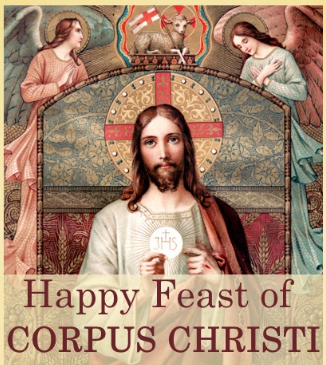
On June 3 we celebrated the Feast of Corpus Christi. If we are at a large parish or religious institute we may have had the privilege of celebrating this Feast honoring Our Lord present in the Blessed Sacrament with a procession and benediction. Otherwise, the day passes and the intention, to inspire greater devotion and acknowledgement that Christ is present as Emmanuel, God with us (Isa. 7:14). It was Christ Himself Who said, behold I am with you all days, even to the consummation of the world (Matt. 28:20) to which John the Apostle references when he says: Wheresoever the body shall be, there shall the eagles also be gathered together. (Apoc. 24:28) That is, the true faithful recognize the Body and Blood of Christ (cf. 1 Cor. 11:29) and, like the disciples at Emmaus, constrain him; saying: Stay with us, because it is towards evening, and the day is now far spent. And he went in with them. And it came to pass, whilst he was at table with them, he took bread, and blessed, and brake, and gave to them. (Luke 24:29-30) And they said one to the other: Was not our heart burning within us, whilst he spoke in this way, and opened to us the scriptures? (ibid. 32) It is sad that Christ is present in Tabernacles throughout the world but Catholics lack the faith to go to Him in their needs, to uphold a relationship they promised to keep on their First Communion Day, to receive the Bread of Heaven that sustains the soul through this earthly life being it provides eternal life.
In the Gospel on Sunday the explanation is provided by Our Divine Saviour why: the cares of this world hold more importance. I have bought a farm, and I needs must go out and see it: I pray thee, hold me excused. And another said: I have bought five yoke of oxen, and I go to try them: I pray thee, hold me excused. And another said: I have married a wife, and therefore I cannot come. (Luke 14:18-20) But one reads that none of these excuses were acceptable, there was an obligation and that commitment was set aside. One should know a relationship and the sacrifice needed to hold on to a relationship cannot be taken lightly or the relationship will end. As Our Lord said to the Jews: The queen of the south shall rise in judgment with this generation, and shall condemn it: because she came from the ends of the earth to hear the wisdom of Solomon, and behold a greater than Solomon here. (Matt. 12:42) Are we, then, the ones John the Baptist speaks to when he says: There hath stood one in the midst of you, whom you know not. (John 1:26) If Our Lord is waiting in the Tabernacle in our Church may we be found before Him frequently like Mary Magdalen, who hath chosen the best part, which shall not be taken away from her. (Luke 10:42)
As always, enjoy the readings provided for your benefit.—The Editor
________________
WHAT IS THE HOLY EUCHARIST
By Rev. Courtney Edward Krier
II
The Holy Eucharist is a True Sacrifice
An Explanation of Holy Mass
Part 2
The Mass of the Faithful
COMMUNION
The Canon of the Mass completed, the third part of the integrity of the Mass is entered into. It is the partaking of the Body and Blood of Christ, the participation in the Sacrifice by making oneself one with the Sacrifice.
Holy Communion is a partaking of the Victim that has been offered up in sacrifice upon the altar. In return for the supreme honour we have rendered to God by offering up to Him in sacrifice the Body and Blood of Jesus Christ, God invites us to His Holy Table, to the Lord’s Supper, and gives us as the food of our soul the very Body and Blood of Jesus Christ—the Victim which we in union with the priest have offered up in sacrifice (cf. Kramp).
As the sacrificial repast follows upon the Sacrifice of the Victim, what is necessary in order that the faithful should participate most actively and most fully in the liturgy of the Mass? Since the faithful unite with the priest in offering up the Holy Sacrifice, they should, like him, partake of the Victim offered up. (MacMahon, 142)
Joseph Putz explains it in the following passage from his book, The Mass:
We must understand that Communion is part of the Mass. It is not an isolated and independent action. It is not simply union with Christ, it is a sacrificial meal, i.e., the eating of the victim offered to God, and therefore the continuation and conclusion of the action of the Mass. It belongs to the Mass, which it completes and from which in turn it receives its full meaning.
In certain sacrifices of the Old Law, the worshippers partook of the victim after it had been offered to God. God was supposed to have accepted the sacrifice, and to invite the offerers to His table as a sign of His favour and friendship. The sacrificial meal was so to speak God’s answer to the offering, in that it sealed the union with God which was the end of the offering.
Those meals were but symbols of union. In Holy Communion we are truly and really united with God. Yet the union is effected by a symbolic action or sacrament, and the action which Christ has chosen for this purpose has the form of a sacrificial meal: it is the eating of the Eucharist, and the Eucharist is not simply the living Christ, but Christ as offered up for our redemption, Christ under the symbol of His sacrificial death. Communion is a partaking of the Victim offered up to God, a sharing in the sacrifice of the Cross. All the sacraments, no doubt, remind us of that sacrifice; all apply the fruits of the Cross. But Communion, the crown of the sacraments, directly signifies the connection between our life and Christ’s sacrificial death. “The bread that I will give is my flesh (offered up) for the salvation of the world. He that eateth my flesh. hath everlasting life.” “Take ye and eat: this is my body given up for you … this is my blood which is shed for you.” Our Communion is related not only to Christ’s sacrifice on the Cross, but also and more immediately to our reoffering of the Victim in the sacrifice of the Mass. The eucharistic Christ, before being received in Communion, has first been offered to God; for the Consecration by which the bread is changed into His Body is necessarily and at the same time the Church’s offering of Him to God. The Host we receive is the Victim of the Cross that has been offered in the Mass and has therefore carried our self-oblation to God. It is the fruit of our sacrifice. In the sacrifice we have offered Christ, and ourselves through Christ; it is a movement starting from our hearts (Act I) and going up to heaven through Christ (Act II). Communion is God’s answer to our action: having accepted our offering through Christ, He now-communicates Himself to us through Christ. That Victim, which we have offered to God as the bearer of our love and self-surrender, we now receive back from God as the bearer of God’s friendship and God’s surrender to us. In the sacrifice, we seek union with God through Christ: in Communion, God unites Himself to us through Christ. (81-82)
The Communion Prayers, as they are sometimes called, are to prepare the priest and the faithful for that moment when they will enter that union with Christ and express the unity of the Mystical Body of Christ. It is required by the priest to receive the Body and Blood of Christ under the appearances of the consecrated Bread and Wine. The faithful need not communicate; but if they do, they also enter the union receiving only the Body of Christ under the appearance of the consecrated Bread, for concomitant is the Blood, Soul and Divinity of Christ.
The most prominent of prayers and one that directs the faithful toward the reception of Holy Communion is the Lord’s Prayer, called here the Pater Noster as one does not want to simply consider as a general prayer, but in asking for the Bread Christ promised in the sixth chapter of Saint John: My Father giveth you the true bread from heaven. For the bread of God is that which cometh down from heaven, and giveth life to the world. They said therefore unto him: Lord, give us always this bread. (John 6:32-34) The Sacrifice of the Mass is the fulfillment: If any man eat of this bread, he shall live for ever; and the bread that I will give, is my flesh, for the life of the world (Ibid. v. 52)
The priest then folds hands and continues: Let us pray: Admonished by salutary precepts and following divine directions, we presume say:
Jesus Christ admonished his listeners: Thus therefore shall you pray: Our Father . . . (Matt. 6:19) And Saint Luke gives this account:
As he was in a certain place praying, when he ceased, one of his disciples said to him: Lord, teach us to pray, as John also taught his disciples. And he said to them: When you pray, say: Father, hallowed be thy name. Thy kingdom come. Give us this day our daily bread. . . . (Luke 11:1-3)
[To those who would point out discrepancies, keep in mind that two different accounts are given under different circumstances that are not contradictory: One, speaking to His disciples; the other speaking to the crowds. Also, one must always keep in mind, as mentioned before, Holy Mass was being said before the Gospels were written and is not based on the Gospels, but substantiated by the Gospels—all liturgies possessing the Pater Noster as integral.]
Now the priest outstretches his arms and hands, praying as the Hebrews were accustomed at the time of Christ, but looking at the Host. In this one is reminded of the words of Christ to Philip, when Philip asked to see the Father, Philip, he that seeth me seeth the Father also. How sayest thou, shew us the Father? Do you not believe, that I am in the Father, and the Father in me? (cf. John 14:8-10):
Our Father, who art in heaven, hallowed be Thy name; Thy kingdom come; Thy will be done on earth as it is in heaven. Give us this day our daily bread; and forgive us our trespasses, as we forgive those who trespass against us. And lead us not into temptation.
The server continues in the name of the faithful: But deliver us from evil. The priest says in a low voice: Amen. Here, as at the Sanctus, the rubrics called for all to pray, but this is now retained only in some nations and rites—but the Amen to the server’s response is followed by what one is asking in this last phrase when the priest continues in these words or Embolism (Greek meaning addition or insertion):
Deliver us, we beseech Thee, O Lord, from all evils, past, present, and to come; and by the intercession of the blessed and glorious ever Virgin Mary, Mother of God, together with Thy blessed apostles Peter and Paul, and Andrew, and all Thy saints, graciously give peace in our days, that aided by the help of Thy mercy, we may be always free from sin and secure from all disturbance. Through the same our Lord Jesus Christ, Thy Son. Who with Thee lives and reigns in the unity of the Holy Ghost God.
It is a formative prayer of the priest’s thoughts while he is now taking the paten, wipes it with the purificator and holds it straight up on the altar. At the words, graciously . . . , he signs himself with the paten and then kisses it as he says: that aided . . . . He then places the paten under the Host, uncovers the Chalice and genuflects before the Body and Blood of Christ. Taking the Body of Christ he breaks the Host in half and places the right portion on the paten while saying, Through the same our Lord . . . . He then takes the left portion and breaks off a particle, placing the remaining portion on the paten but holding the particle, while saying, Who with Thee lives . . . God. This is the Fractio Panis that fulfills the action at the First Mass said by Jesus, Who took bread, and blessed, and broke: and gave to his disciples. . . . (Cf. Matt. 26:26) Saint Paul points to this part of Holy Mass when he writes to the Corinthians: The chalice of benediction, which we bless, is it not the communion of the blood of Christ? And the bread, which we break, is it not the partaking of the body of the Lord? (1 Cor. 10:16)
The breaking of the Host with the prayer expresses that even though one undergoes suffering in that of a broken body, in reality one is whole in Christ who said: The bruised reed he shall not break: and smoking flax he shall not extinguish: till he send forth judgment unto victory. (Matt. 12:20) For these things were done, that the scripture might be fulfilled: You shall not break a bone of him. (John 19:36) Nicholas Gihr has this beautiful reflection:
The infinitely holy and just God often permits painful sufferings and tribulations to befall us, not merely for our trial and purification from all inordinate attachment to the world, but also as a chastisement for our sins and imperfections. Therefore we earnestly beseech the Lord not to chastise us in His wrath and indignation (Ps. 6: 2), but to regard us with the eyes of His favor and be propitious to us, and to give us true peace in our days. We here pray in the first place for interior peace of soul, which consists in this, that by the powerful assistance (ope) of the divine mercy we may ever keep ourselves free from sin and thus persevere in the blessed love and friendship of God and rejoice in the sweet consolations of His grace. Then we pray for exterior peace of life, which consists in this, that by God’s help and merciful protection we may be ever secure from all disturbances, disorders, and persecutions, by which in our frailty we are easily drawn from the right path of salvation and led into evil. If the days of our life are not darkened by fears from within and combats from without (II Cor. 7:5), that is, by the bitterness of sin and the misery of contention, then we enjoy the blessings of interior and exterior peace, whereby we taste already beforehand some drops from the fountain of heavenly, eternal peace. To obtain the inestimable gift of this desirable peace the more easily and in greater abundance, we have recourse to the intercession “of the glorious ever Virgin Mary, Mother of God, together with the blessed apostles Peter and Paul, and Andrew, and all the saints.” For the sake of such intercessors, our supplications will be answered, and the superabundant riches of the divine mercy will be imparted to us. (Gihr, 735-36)
Nicolas Gihr further explains:
The host is broken in order more vividly to represent in a liturgical manner the Eucharist’s character as a sacrifice; for the breaking symbolizes in an expressive way Christ’s violent and bloody death on the cross, inasmuch as it indicates that wounding and lacerating that caused the separation of His soul from His body, which resulted in His sacrificial death. [S. Thom., IIIa, q.77, a. 7] In the breaking of the host, Christ is figured as the Lamb that was slain and bruised for our sins (Isa. 53: 5). The breaking of the host, therefore, expresses the same mystery that is represented by the separate consecration of the two species. The host, moreover, is broken over the chalice. This rite may be founded especially on great reverence towards the Blessed Sacrament, so that any loose particles may fall into the precious blood; but nevertheless the breaking has a mystical signification. [S. Germanus, Expositio brevis antiquae Liturgiae Gallicanae] The breaking of the Eucharistic bread over the chalice is intended to indicate that the blood contained in the chalice proceeds from the broken (wounded and mangled) body of Christ, and therefore belongs to it and with it constitutes but one sacrifice and one sacrificial gift.
That the Fraction of the Eucharistic species has also a connection with Communion, as a preparation and introduction to it, is universally acknowledged; for “to break bread” means the same as to prepare it for food, to present or distribute it for participation. [St. Chrysostom, Homilies on I Cor.] (Gihr, 739-40)
The paten becomes the tomb where Christ is laid. That blessed place that once received Christ’s dead body is kissed symbolically by the priest kissing the paten and then gently slides it under the Body of Christ.
While the priest prays, “Graciously give peace in our days,” he makes the sign of the cross on himself with the paten to express symbolically the desire of participating in that peace which Christ brought us by His cross and by the sacrifice of His body; for in a few moments the host is placed on the paten. The kissing of the paten is a sign of love and reverence toward this “new sepulchre” of the holy body of Christ. (Gihr, 736-37)
(To be continued)
————————–
The Sunday Sermons of the Great Fathers
M. F. Toal
THE GOSPEL OF THE SUNDAY
LUKE xiv. 16-24
At that time Jesus spoke this parable to the Pharisees: A certain man made a great supper, and invited many. And he sent his servant at the hour of supper to say to them that were invited, that they should come, for now all things are ready. And they began all at once to make excuse. The first said to him: I have bought a farm, and I needs must go out and see it: I pray thee, hold me excused. And another said: I have bought five yoke of oxen, and I go to try them: I pray thee, hold me excused. And another said: I have married a wife, and therefore I cannot come.
And the servant returning, told these things to his lord. Then the master of the house, being angry, said to his servant: Go out quickly into the streets and lanes of the city, and bring in hither the poor, and the feeble, and the blind, and the lame. And the servant said: Lord, it is done as thou hast commanded, and yet there is room. And the Lord said to the servant: Go out into the highways and hedges, and compel them to come in, that my house may be filled. But I say unto you, that none of these men that were invited, shall taste of my supper.
CLEMENT OF ALEXANDRIA
The Christian Use of Food
There are some who live to eat; which is no doubt also true of the dumb beasts, ‘for whom life is but a stomach’. But the Master has taught us that we are to eat to live. For us eating is not a necessity, neither is pleasure our end. But because of our sojourn here below, we whom the Word is leading on to immortality, we choose to eat. It is simple and natural our food, not rare in kind, but such as is prepared for simple incurious children, adapted rather to maintain life than to provide pleasure.
For life depends on two things; namely, health and strength, and plain food contributes to this; as being good for the digestion, and also for the liveliness of the body. From this comes health, and reasonable strength; not strength beyond measure, excessive, painful, like the athletes’; because of their necessity to eat. There are very many detestable kinds of foods, which cause a variety of troubles: they weaken health, they upset the stomach, the sense of taste is spoiled by an evil skill in cooking, as well as by the useless art of pastry making.
And some men presume to call eating the refinement of delight; which then slips down into hurtful pleasures. Antiphanes, the physician of Delios, said that this is the sole cause of disease: the variety of dishes. For those who cannot endure truth reject, for I know not what vanity, a plain and moderate way of living, and make a great fuss over foreign foods. To me this folly is deplorable; but they are not ashamed to sing about their delights. They seek anxiously for eels from the Straits of Sicily, and other kinds of eels from the Meander, and for kids from Melos, and mullet from Sciathos, shellfish from Pelorus, oysters from Abydenus, Daphinian turtles, and Chelidonian figs; because of which the unhappy Persian with a countless host invaded Attica. And they buy birds from Phasis, Egyptian waterfowl, peacocks from Thrace. Exchanging these delicacies the gluttons open wide their mouths with relish; and whatsoever the earth provides, or the depths of Pontus, or the vast spread of the heavens, exists but to serve their gluttony.
To me it seems that a man of this kind is nothing more than a mouth. Be not desirous of the food of rich men, says the Scriptures (Prov. xxiii. 3 Sept.), for this goes with a life that is false and shameless. For they are devoted to dainties; which soon change into excrement. But we who seek the food of heaven have need to control our earthly stomach, and especially the things that are pleasing to it; since God shall destroy both it and them (I Cor. vi. 13), says the Apostle, justly execrating those given to gluttony. For meats are for the belly, on which this carnal and deadly life depends; which some with unbridled tongue dare to call agapes: these festive convivialities reeking of soup and the steam of cooking, dishonouring the sacred agape, beautiful and salutary work of the Word, with I know not what sort of stew, and going on to disgrace the name with the flow of wine, with carousals, with wantonness, and the reek of smoke. They are deceived in their notion if they expect what God has promised from such suppers as these.
Christian Frugality. But those gatherings which take place through joyfulness, and which we, following the example of our Lord, would call a gathering, a dinner, or also a supper, these the Lord did not call agapes. He says in one place: When thou art invited to a wedding, sit not down in the first place. But when thou art invited, go sit down in the lowest place (Lk. xiv. 8-10). And in another place He says: When thou makest a dinner or a supper, call the poor: for whom the meal is especially to be prepared. And later: A certain man made a great supper.
But I think I know from what source this beautiful name for such suppers has come. From the gluttons, and from gluttony, and ‘from those infatuated with the love of such repasts’, as the Comic says. But it is true to say that, ‘the most of the dinner is dear to the most’; for they have not yet learned, that it is God Who has prepared for His masterpiece, which is man, both food and drink: for his life, not for his delight. For it is not in accord with the nature of our bodies that they are helped by luxuries. On the contrary they who eat the plainest food are the most robust, the healthiest, and superior to the rest; like servants as compared with their masters, labourers compared with the owners of the soil. And not alone are they stronger, but they have a better understanding; like philosophers as compared with rich men. For they do not bury their mind in nourishment, nor soften it with delights.
But the food that comes from heaven is charity, the rational feast. It beareth all things, believeth all things, hopeth all things; charity never falleth away (I Cor. xiii. 7, 8). And, Blessed is he that shall eat bread in the kingdom of heaven (Lk. xiv. 15). But it is the gravest misfortune should charity, which cannot fall away, be thrown down into the midst of earthly messes. And would you wish me to think that this supper is brought to an end? If I should distribute all my goods to feed the poor, and have not charity, I am nothing (I Cor. xiii. 3). On this charity depends all the law and the prophets (Mt. xxii. 40 ). If you love the Lord thy God and thy neighbour you shall have this celestial banquet in heaven; on earth it is called a supper, as we see from the Scripture. The supper takes place because of charity; but the supper is not charity; only a token of common good will, lightly bestowed. Let not then our good be evil spoken of For the kingdom of God is not meat and drink (Rom. xiv. 16, 17), says the Apostle; lest it be thought to be but a casual meal, and not justice and peace, and joy in the Holy Ghost. He who eats of this supper, the most perfect of all, shall obtain the Kingdom of God, beholding there the company of charity, the heavenly Church.
Charity therefore is something pure, worthy of God, and its mission a communion one with another. The thought that moves us in the care of the child is love, says holy Wisdom (vi. 19), and love is the keeping of her laws. These festive gatherings have some glimmer of charity, from a common way of life, a disposing together towards the delight that is forever. The supper therefore is not charity (agape); the festivity may prepare the way for charity. May thy children, whom thou hast loved, learn, O Lord, that not bread alone doth nourish man, but thy word that cherishes those who believe in thee (Deut. viii. 6 Sept.). For not in bread alone doth the just man live.
Let our supper then be light and digestible, suited to keeping vigil, not mingled with a variety of flavours; nor is this something outside the scope of the Pedagogue. For charity is the nurse of fraternal love, being plentifully endowed, giving out in due measure, healthfully ministering to the body, sharing its goods with its neighbours. Food that exceeds a just measure is harmful to man, and makes the soul dull, the body unhealthy and prone to disease. And the voluptuaries who torment themselves and grieve and even utter blasphemies over sauces are branded with names such as, greedy, glutton, voracious, insatiable and such like. Rightly are they also called gadflies, weasels, parasites, gladiators in contests of voracity, selling their honour, friendships, even life itself, for the gratification of their stomach, crawling on their bellies, beasts in the likeness of men, and made in the likeness of their father, a devouring wild beast.
And those whom they call ‘the abandoned’ (άσωτους) seem to me to show clearly what their end will be; those who shall not be saved (with the letter s omitted). For are they not of those who are absorbed in pots, and in the manifold and precise use of condiments, of low and abject soul, children indeed of earth, who seek food day after day, and yet shall not be fed? Does not the Holy Scripture grieve over them by the mouth of Isaias, withholding from them the name love-feast (αγάπη), as their feasting was not in accord with reason? They however gave themselves to joy and gladness, killing calves and slaying rams, saying: Let us eat and drink; for tomorrow we shall die (xxii. 13). And that He holds such revelling sinful is then revealed. This iniquity shall not be forgiven you till you die, meaning, not that that death which takes from us all feeling brings us forgiveness of sin, but brings rather the death of salvation, as a consequence of sin. Take no pleasure in their wanton revellings, says Wisdom, be they ever so small (Ecclus. xviii. 32 ).
Things Sacrificed to Idols. Here we must also speak of things sacrificed to idols, since we are told that we must abstain from them (I Cor. viii). To me they seem foul and abominable, whose blood flies ‘Towards souls in Erebos now void of light.’ I would not that you should be partakers with devils, says the Apostle (I Cor. x. 20 ). Diverse is the food of those who are saved from those who perish. From this last we must abstain; not that we greatly fear them (for they are without power), but because of our own conscience which is holy, and out of detestation of the demons, whom we abhor, and to whom this food has been sacrificed; and also because of the weak character of those who are easily led astray, and their conscience, being weak, is defiled. But meat doth not commend us to God. For, says the Gospel, Not that which goeth into the mouth defileth a man, but that which cometh out of the mouth (Mt. xv.11). The natural use of food is in itself an indifferent thing: For neither, if we eat, shall we have the more; nor if we eat not, shall we have the less. But it is not fitting that those who are held worthy of divine food should be partakers with devils. For, says the Apostle, Have we not the power to eat and to drink, and to carry about a woman, but yet, keeping power over pleasures, let us keep our desires under control. But, he says, take heed lest perhaps this your liberty become a stumbling block to the weak (v. 9).
It is not becoming that, living wantonly and prodigally, we should, like the figure of the son in the Gospel, waste the gifts of the Father, but should rather use them worthily, as we are commanded; since we have received power to use them as we will, not to be slaves to them. It is therefore an admirable thing, and one to be striven for, raising our eyes upwards to the Truth, to keep to that Divine Food which is from above, and be filled with Its truly inexhaustible Vision, tasting of this unchanging, abiding and unclouded delight. For the food of Christ shows us that this is the agape we are to look for.
It is abhorrent to reason, and useless, and not even human, that we should be fattened like the beasts for slaughter, with our eyes ever towards the earth, like those who spend their time reclining at tables, pursuing a life dedicated to gluttony, burying what is good in this life which soon shall be no more, concerned only with the enticements of eating, because of which cooks are held in greater regard than those who till the earth.
———————–
JUNE 6
St. Norbert, Bishop and Confessor
1. At Xanthus, in Asia Minor, [actually Xanten, Germany] Norbert was born in 1080. He possessed a cheerful disposition and extraordinary gifts of mind, but when a deacon he found himself still so fond of the pleasures of the world that he hesitated to take the holy orders of priesthood. One dark day, when he and a group of pleasure bent young men were riding to a celebration, a flash of lightning frightened his horse, and he was thrown to the ground. He lay unconscious for an hour, and when he came to his senses frivolity had vanished from his nature. Like St. Paul he asked: “Lord, what wilt thou have me do?” (Acts 9:6.) The answer came: “Avoid evil, do good, seek peace.” From that moment on Norbert devoted his life to prayer and penance. Ordained at the age of thirty, he preached against the worldliness of the clergy, and as a result was slandered, cursed, persecuted, and condemned by verdict of ecclesiastical authority; but he accepted the correction humbly. Soon after this his innocence became apparent, and he was thus free to dispose of all his possessions and give the proceeds to the poor. He then began to labor zealously for the salvation of souls, at the same time undertaking many sacrifices and works of penance. In the hope of being able to preach the gospel more effectively and to devote himself wholly to the saving of souls, Norbert founded the Order of Premonstratensians, which spread quickly over all of Europe. On a journey to the city of Speyer in 1126, he was named Bishop of Magdeburg by King Lothar II. By the humility of his own priestly life, he greatly bettered the lives of both priests and laity in this diocese. He died on June 6, 1134, and was canonized in 1582.
2. “Here was a great priest, whose life was acceptable to God, and proved ever faithful; to him; when the day of retribution came he made amends for all. Where shall we find another to keep the law of the Most High as he kept it? So it was the Lord took an oath that he should be the father of his chosen people. The Lord gave him the blessing which should extend to all nations . . . ratified the blessings he uttered and singled him out for favor, such grace he found in the eyes of the Lord. . . . He made a covenant with him, entrusting him with the great office of the priesthood and enriching him with high honor” (Lesson: Ecclus. 44:16-45:20). This description fits St. Norbert after divine grace turned him from a life filled with vanities and made him a great preacher of penance, the founder of an Order, and a zealous priest and bishop. He was snatched from perdition and claimed for Christ, led by the way of repentance through solitude and prayer, and by his severe penitential practices in a Cologne monastery, until he had atoned for past sins and obtained God’s pardon.
By these proofs of a sincere conversion, St. Norbert prepared the ground on which the grace of God would erect an edifice of sanctity. At his first Mass he preached, with tears flowing, about the shortness of life, the emptiness of worldly pleasures, and the consequence of a sinful life. The next day, at Xanthus [Xanten], he addressed the canons so forcefully, pointing out the abuses prevailing among them, that some began to lead a new, more perfect life. Upon receiving from Pope Gelasius II a commission to preach the gospel of penance everywhere, he promptly set out clad in a coarse, penitential garb, and traveled about France, undaunted by severe weather, fatiguing labors, and numerous sacrifices. In Orleans he was joined by three companions, but they bore only briefly the rigors of his way of life. His path became a stream of blessings: enemies were reconciled, ill-gotten goods restored, and hardened sinners set on the path of virtue. Here, truly, was a “great priest,” fruit of the grace of God.
3. St. Norbert’s conversion is a shining miracle of God’s mercy which pursues men’s souls, devising numberless means of rescuing them and preserving them, and leading them to eternal salvation. In some cases, God grants consolations and special lights; in others, He employs spiritual darkness and remorse of conscience; sometimes, a happy experience; very often it is a misfortune, sickness, or accident that He sends; finally, He may show His hand plainly by means of mysterious circumstances, as He did in the case of St. Norbert, in which a seemingly blind action of nature served. Norbert understood, and reaped grace and salvation from the experience—for his own soul and countless others.
Equally effective graces would come to each of us, in all the trials, hardships, misfortunes, humiliations, and ailments of our daily lives, as well as in the routine problems and ordinary events, if we learned to recognize in them the merciful love of Him who came to seek and to save those who were lost. In so doing, we would take a much more correct and calm view of life; we would treasure the sufferings that assail us as a rich source of blessing, just as St. Norbert did. May he intercede for us!
Collect: God, who didst make Thy blessed bishop and confessor Norbert an outstanding preacher of Thy word, and through him didst cause Thy Church to bring forth a new offspring; grant, that by Thy help and with his merits pleading for us, we may be enabled to practice what he taught by word and deed. Amen.
(Benedict Baur)
_____________________
PLAIN TALKS ON MARRIAGE
FULGENCE MEYER , O.F.M.
(1954)
CHAPTER VII.
The Education of Children
“Suffer the little children to come unto Me, and forbid them not; for of such is the kingdom of God” (Mark, 10, 14).
Mean Parents
Parents who, from a selfish love of ease and comfort, or even from a motive of egotistical jealousy, which prompts them to keep their children for themselves rather than surrender them to another, forbid their home to the friends or company of their children either directly or indirectly, by treating them coldly and rudely, have much to answer for if the children strike out for themselves, and in impatient self-assertion meet their friends stealthily, and contract obnoxious alliances in or out of marriage. The children have a right to a reasonable share of the parental home and its amenities, and autocratically to deprive them of the use of this right, bespeaks neither piety, charity nor justice on the part of their unfeeling and inhuman parents.
Wise Parents
Wise parents exercise a tactful, considerate, yet close vigilance over their children in the period of courtship. Whilst they may be convinced that their sons and daughters are trustworthy, they will yet remember, that they are made of flesh and blood; that they are young and inexperienced; that they have more sentiment than good sense; and that they are often unaware of the catastrophe resulting from unrestrained love. The parents will therefore act as sympathetic guides and moderators of their children who are in love. They will not allow their courting to become passionate. For this reason they will not allow the visits to be too frequent, nor to be prolonged too far into the night, nor to be carried on without due protection and supervision. If there is to be any excess here, it will preferably be on the side of severity rather than indulgence; this will safeguard the wellbeing of the lovers more: although the golden mean, as in all other things, is the best here, too. The more the company keeping can be done in the family circle, the better for all involved. Sometimes, of course, the young people want to be alone to exchange sentiments that are too sacred for the ears of others. But as a rule, the less they are alone before marriage, the more and the longer they will likely enjoy being alone after marriage.
The Lethal Engine
Here a word may be in order regarding the automobile and its use by young people. A secular judge of considerable prominence has expressed it as his conviction, that the automobile is a stronger and a more baneful factor of immorality than the saloon in its worst days ever was. The saloon could not be frequented by girls whose reputation still meant something to them: whereas the automobile carries a certain air of respectability which, alas, is in many cases but the merest veneer of the grossest depravity, yet which is sufficient justification for girls of the best families to entrust to it their innocence, virtue and reputation, often to have them all ruined, and their happiness blasted for life, through a single ride. Parents can therefore not be too vigilant regarding the rides their children take, and how, with whom, when and where they take them. A prudent chaperonage is their best protection, physically as well as morally.
Obedience Ceases: Love Goes On
When children marry, they establish a household of their own, and are automatically withdrawn from parental authority. Yet, if a married child no longer owes obedience to its parents, the duty of exhibiting love, reverence, gratitude and devotion to parents never ceases. It is a matter of sad observation that children, who before their marriage were invariably dutiful, loving and obsequious to their parents, after their marriage often grow very selfish, hard and cruel towards their parents or parents-in-law. They turn against them somehow, and refuse them the ordinary marks of Christian charity, let alone the tokens of filial respect, gratitude and homage. For this there is never any excuse, and it will be visited by God in His own way and manner sooner or later; and usually the punishment is meted out after the manner of the sin; these ungrateful children will ere long feel the sting of ingratitude and indifference from their own offspring.
Jealous Parents
On the other hand parents sin, too, when they mar, and sometimes ruin entirely the happiness of their married children by their jealous, selfish and meddlesome manner. They poison and turn the minds of their children against their mates by certain slurs, insinuations and accusations of a vile nature, inspired by a vicious motive. These parents lose sight of the words of the Bible: “Wherefore a man shall leave father and mother, and shall cleave to his wife” (Gen., 2:24). According to this inspired utterance a married child belongs more to its mate than to its parents; and every parental conduct that aims to disturb or overthrow this divine arrangement is godless and reprehensible. The parents embitter their own lives by it every time.
It is usually advisable for married children to live apart from the parents and relatives of both sides. This will help to prevent a serious rupture that may have the saddest consequences. Amicable and agreeable relations can and ought to be maintained to the benefit and pleasure of all parties concerned. This maintenance is easier at a certain distance, when visits will not be too frequent, and uncalled-for interference in one another’s business not so tempting. Instead of that there will likely be a sound love for one another, a desire and an eagerness for one another’s company, together with a great deal of mutual sympathy, helpful counsel, and valuable assistance in case of need. Mothers-in-law have got to be a considerable joke among all nations. Yet most mothers-in-law are good and sensible women, who know their place and keep it, who are sincerely loved by their children-in-law as well as by their own children as long as they live, and whose departure from this life is keenly felt and bitterly deplored by both, in consequence of their truly motherly love, unselfish solicitude, and tactful prudence.
Give and Take
Not infrequently parents have to live with their married children or vice versa. Here, too, if both parties have and exercise good sense and unselfish love, conditions can be made not only tolerable but quite agreeable and sweet. This will be effected best if both parties carry out the injunction of the Apostle: “Bear ye one another’s burdens; and so you shall fulfill the law of Christ” (Gal., 6, 2). Old people have different views, tastes and sentiments than young people. If both insist on the prevalence of their own views, there can be no harmonious and happy life. But if both are ready to make allowance for the views of the other party, there will be much room for the practice of genuine virtue as well as for the enjoyment of substantial peace. If the one is more ready to yield to the other than to force his own pleasure, there will be much mutual good-will and consequent bliss. But concessions should be equally apportioned, and not always made by the same party and enjoyed by the other. Both will then derive the benefit from this arrangement in the exchange of reciprocal help: their pains will be divided and diminished, while their joys will be shared and multiplied.
Young people must particularly remember, that old age has its infirmities of the mind as well as of the body. Not without reason is it called the second childhood. But whilst aged people usually disclose the troublesomeness, fretfulness and vexatiousness of children in a reinforced degree, they never offer the cuteness, the dearness and affectionateness of children in compensation. The bearing with them patiently requires considerable virtue and self-control. Yet no conduct will please God more and call for a higher reward in this life and in the next, so it is cheerfully and consistently rendered: whereas rudeness, coldness and hardness to aging parents prepare a very hard way for the offender. On their part senescent or aging people should try to ward off the mental and temperamental weaknesses of age as much and as long as possible, by maintaining an optimistic and cheerful outlook upon life in general and their own in particular; by keeping themselves from getting oversensitive, suspicious and jealous; by eschewing all imaginations of being ill-treated, considered in the way and a burden, and desired off the stage of life by the younger element. These and similar thoughts are often the merest fictions of a morbid or aging mind, and have no foundation whatever in the facts of the case. As a rule, old parents are very welcome, as long as they themselves do not become strangers to virtue and good sense.
Ruth and Noemi
What wonderful and helpful companions mothers and mothers-in-law can be to their married daughters and daughters-in-law; and what a great blessing is attached by God to the piety and love exhibited to these mothers by their respective daughters—and the same holds good relatively to the male sex, of course—is prettily illustrated by the story of Ruth in the Bible.
When Ruth’s husband died, her widowed mother-in-law Noemi suggested to her to return to her own kin, among whom she would feel more at home. Ruth answered: “Be not against me, to desire that I should leave thee and depart: for whithersoever thou shalt go, I will go: and where thou shalt dwell, I also will dwell. Thy people shall be my people, and thy God my God. The land that shall receive thee dying, in the same will I die; and there will I be buried. The Lord do so and so to me, and add more also, if aught but death part me and thee” (Ruth, 1, 16, 17).
As a result of this filial attachment and Noemi’s response to it Ruth, with the aid and guidance of her mother-in-law, became one of the foremothers of the Messias. Orpha, on the contrary, who was another daughter-in-law of Noemi, and who had lost her husband about the same time as Ruth, but who parted company with her mother-in-law after giving her a farewell kiss, was never heard of again. There is much wholesome solace in this episode for those married men and women who observe the fourth commandment after their marriage; and a salutary caution for those who ignore it by shirking their sacred duty to their parents, and by unfairly leaving their whole support and care to one of their more conscientious brothers or sisters. “Honor thy father and thy mother, that thou mayest be long-lived upon the land which the Lord thy God will give thee” (Exod., 20, 12).
————————-
Father Krier will be in Pahrump (Our Lady of the Snows) on June 10. On June 15 he will be in Albuquerque, New Mexico (Saint Joseph Cupertino). He will be in Eureka, Nevada (Saint Joseph, Patron of Families), June 22.
————————-
The topics of Faith and Morals will correspond to the Roman Catholic Faith in Tradition and the Magisterium. The News will be of interest. The commentaries are for the reader to ponder and consider. The e-mail address will be for you to provide thought for consideration. The donations will be to support the continuation of this undertaking.
While the Newsletter is free of charge it is not free of cost. Please consider supporting St Joseph’s Catholic Church with a tax – deductible donation by clicking the secure link: Donate
Or if you prefer send a check to
Catholic Tradition Newsletter
c/o St Joseph’s Catholic Church
131 N. 9th St
Las Vegas, NV 89101
Visit us on the Worldwide Web: http://stjosephlv.org
e-mail news and comments to: tcatholicn@yahoo.com