Vol 14 Issue 20 ~ Editor: Rev. Fr. Courtney Edward Krier
May 15, 2021 ~ Saint John Baptist de la Salle, opn!
1. What is the Holy Eucharist
2. Sunday after the Ascension
3. Saint Ubaldus
4. Family and Marriage
5. Articles and notices
Dear Reader:
This week the Church is praying for the Holy Ghost to come into the hearts of the faithful with His Sevenfold Gifts of wisdom, knowledge, understanding, counsel, fortitude, piety and fear of the Lord. We know that the Church has kept this novena in her preparation for the Feast of Pentecost from time immemorial if not since the first Novena which we read, in the Acts of the Apostles, that Mary and the Apostles along with the faithful numbering 120 were awaiting in Jerusalem in the Upper Room for the promised coming of the Holy Ghost. It is during this time of year that the Sacrament of Confirmation is generally administered by the successor to the Apostles, the bishop. The Sacrament of Confirmation is to be received by all Catholics and all Catholics should take the precept seriously, that is, they should tell their pastor that if they have not received the Sacrament, what must they do now in order to receive it. Times are such that a pastor over a parish does not have absolute control due to the fracture in the governance as a result of the apostasy caused by Vatican II and the collapse of jurisdictional authority. In the ensuing chaos the laity have adopted the anti-clerical attitude promoted by the secular society around them. One finds oneself in the same condition as Moses when Moses led the Israelites out of Egypt—the murmuring and insisting on retaining the Egyptian (pagan) way of life or threatening to return to Egypt—in which they were enslaved but were now free. In the end Moses, knowing their hardened hearts, told them (that is, their future offspring) to listen to Christ. We know through Scripture that they refused to believe even in Christ. This is the lot of all pastors today in leading their flocks through the wilderness of sin that too many Catholics insist on following the world and threaten to leave the Church whenever the pastor insists that they live a Catholic life though he lets them drink from the Rock (baptism) and provides them with the Bread from Heaven (Holy Eucharist). Tell them they must go to Mass—you just want money in the collection and the Church has enough money, it is my time to be with the family (Why not the family together at Mass so one is a family?). Tell them to dress appropriately—are you looking at me? Judging me? Tell them they must marry in the Church—since when does the Church decide who, when and where I must marry? (Actually always has!) Baptize their children—when we are ready not you! That they must fast and abstain—I can’t is the reply as they then continue their discussion of their latest fad diet they are following for losing weight. When society was Catholic and one was within parochial boundaries and there were sufficient priests to visit each family yearly and see that they were living their Catholic lives the excuses would be more difficult to raise. The laity have placed upon their own shoulders the obligation to fulfill the Commandments and Church Precepts; they did this by not defending the Church against her enemies—rather joining forces to be free from Church authority. Yet, the laity must know it is at the peril of their salvation to neglect their salvation.
The Sacrament of Confirmation is a Sacrament that all Catholics are obligated to receive and each and everyone who has not received should, therefore, seek to receive it right away—which means registering for the requisite instruction, knowing the requisite prayers and taking the necessary time to be present when the Sacrament is administered by the Bishop. It is only if we attach ourselves to the Mystical Body of Christ and receive the Spirit of Christ that we will have the grace to submit to the guiding hand of our pastor who leads us to the green pastures (cf. Ps. 22) that nourish our souls, including the Sacrament of Confirmation.
If you judged that I am concerned about the salvation of souls you would be right because that is why a priest is addressed generally as Father: He not only begets your spiritual life (through Baptism), but is to nourish and sustain, protect and guide your spiritual life.
As always, enjoy the readings provided for your benefit.—The Editor
________________
WHAT IS THE HOLY EUCHARIST
By Rev. Courtney Edward Krier
II
The Holy Eucharist is a True Sacrifice
An Explanation of Holy Mass
Part 2
The Mass of the Faithful
THE CANON OF THE MASS
At the ending words [of the Hanc Igitur], through Christ our Lord, Amen, the priest folds his hands. The prophecy fulfilled, with the priest casting the guilt of the people upon the Victim, the priest turns to that act of Christ being Crucified in a mystical way by signing, in the Quam Oblationem, the Host and Chalice with the five crosses saying:
Which oblation do Thou, O God, we beseech Thee, vouchsafe to make in all things blessed +, approved +, ratified +, reasonable, and acceptable: that it may become for us the body + and blood + of Thy most beloved Son, our Lord Jesus Christ.
Here, Stapper comments:
In the prayer Quam oblationem, the priest prays for an acceptance of the elements which is perfect and complete in every respect. He expresses this idea by means of five adjectives which are borrowed in part from the language of ancient Roman law: “in omnibus”—”in every respect”; “benedictam”—”blessed”; “adscriptam”—”formally appropriated”; “ratam”—”of full value”; “rationabilem,” corresponding with the idea and the will of God (cf. “rationale obsequium,” Rom. 12, 1); “acceptabilem”—”pleasing.” In reciting this prayer, the priest blesses the bread and wine by tracing five crosses over them, the last two over the separate elements at the mention of the body and blood of Jesus Christ. (Stapper, 276)
And Saint Thomas Aquinas writes:
[T]he priest does not seem to pray . . . for the consecration to be fulfilled, but that it may be fruitful in our regard, hence he says expressively: “That it may become ‘to us’ the body and the blood.” Again, the words preceding these have that meaning, when he says: “Vouchsafe to make this oblation blessed,” i.e. according to Augustine (Paschasius, De Corp. et Sang. Dom. xii), “that we may receive a blessing,” namely, through grace; “‘enrolled,’ i.e. that we may be enrolled in heaven; ‘ratified,’ i.e. that we may be incorporated in Christ; ‘reasonable,’ i.e. that we may be stripped of our animal sense; ‘acceptable,’ i.e. that we who in ourselves are displeasing, may, by its means, be made acceptable to His only Son.” (Summa Theol. III, Q. 83, Art. 4)
Consecratory Prayers
Mass was being said before the Gospels were written, therefore one cannot expect the Mass to come from the Gospels, though one could expect a resemblance of the words of the Gospel to correspond to the words of holy Mass. They are in different context: One is a liturgical rite instituted by Christ; the other is an account of the event.
The priest begins the words:
Who, the day before He suffered, took bread into His holy and venerable hands, and with eyes lifted up toward heaven, unto Thee, O God, His almighty Father, giving thanks to Thee, did bless, + break, and give to His disciples, saying: Take ye all and eat of this:
For this is My body.
The priest imitates Christ not simply that the priest imitates, but the priest, as an alter Christus, repeats the acts and words of the first Mass in the Upper Room as the instrument Christ uses to repeat His words and actions of His first offering of His Body and Blood in the Upper Room. The priest, therefore, is not merely narrating what happened, but fulfilling what happened in a re-presentation that is consummated on Calvary, and thereby renewing the Sacrifice of Calvary.
That this may be manifest, he is directed by the Church to imitate as faithfully as possible by word and deed Christ’s model act of consecration. The Church’s liturgical act of consecration is nothing else than the repetition and re-enactment of the first celebration of the Lord’s Supper in the Cenaculum at Jerusalem. The priest narrates the first offering and institution of the unbloody sacrifice by Jesus Christ, and while relating this, he performs the corresponding actions: he imitates the Lord as far as possible, and does the same as Christ did. He pronounces over the bread and wine the effective words of consecration in the person of Christ (quasi ex persona ipsius Christi loquentis) with the intention of changing the gifts at present lying on the altar and thereby of offering up in sacrifice the body and blood of Christ. Plain and simple are the words of the liturgical text, as is best suited for a thing that is ineffably sublime and divine. (Gihr, 667-68)
The priest therefore, after rubbing his fingers on the corporal to make sure nothing is on the tips of his thumbs and forefingers which will momentarily be touching the Body of Christ, the priest takes the Host into his hands, lifts his eyes upward and then casts them back onto the Host in His fingers, bows as a sign of giving thanks, makes a sign of the cross over the Host with his right hand—but does not yet break the Host, the Fractio Panis, for breaking of the Bread is always done before Communion—bends and says over the Host: This is My Body. He then genuflects to adore Christ Jesus now present under the appearance of bread. Rising, the priest lifts the Host with both hands so the faithful may see and adore, and repeat silently the words of Saint Thomas the Apostle, My Lord and my God. (cf. John 20:28)
The priest places the Body of Christ on the Corporal, then continues (with his thumbs and forefingers now pressed together lest if there were any particles of the consecrated Host clinging they would not be dropped), saying:
In like manner, after He had supped, taking also this excellent chalice into His holy and venerable hands, and giving thanks to Thee, He blessed + and gave it to His disciples, saying: Take, and drink ye all of it:
For this is the Chalice of My Blood of the new and eternal covenant; the mystery of faith, which shall be shed for you and for many for the remission of sins.
As often as you do these things, you shall do them in remembrance of Me.
The priest acts in the same manner as when consecrating the Host, but now with the contents of the Chalice. He takes the Chalice into his hands lifts it a little, then bows in thanksgiving afterwards resting it on the corporal and holding it with his left hand he blesses it with his right hand, takes it with both hands again, followed by bending over the chalice still resting on the corporal but tilted slightly toward him while saying over it the words: For this is the Chalice of My Blood of the new and eternal covenant; the mystery of faith, which shall be shed for you and for many for the remission of sins. He sets the Chalice firmly on the corporal while saying: As often as you do these things, you shall do them in remembrance of Me. Genuflecting to adore the Precious Blood of Jesus, he rises and takes the Chalice and lifts up the Chalice with Christ’s Blood for the faithful to adore the Precious Blood. He sets the Chalice once more on the corporal and genuflects.
In the twelfth century the adoration was added during the Consecration due to the Berengarians denying that Christ was truly and substantially present under the appearances of bread and wine once the words of Consecration were pronounced. It became a public profession of faith. Pope Pius X renewed the call for Catholics to enunciate silently their belief in the Real Presence by granting an indulgence of seven years.
Now the Paschal Lamb is on the altar, immolated by the two-edged sword of the consecratory words. The separate consecrations of the Host and Chalice express a mystical shedding of blood and places before the eyes in a dramatic way the bloody death of Christ on the Cross, for the blood of a sacrificed victim was collected in a chalice to be poured out on the altar.
The following words that have always been part of the Consecratory words deserve consideration as they are not in Scripture and/or are disputed by heretics:
Of the . . . eternal covenant
These words are not in the Gospel account, but most authorities agree that they were added to the Consecration by the Apostles in order to proclaim that the sacred Priesthood of our Divine Saviour would continue forever in fulfilment of the prophecy: “Thou art a Priest forever according to the order of Melchisedech.” By contrast, this phrase reminds us of the Old Testament, which was ratified by the blood of animals, and possessed only the imperfect sacrifices which we have already studied. Now that the Perfect Sacrifice is here, it is to continue for all time.
The Mystery of Faith
The phrase, “the mystery of faith,” is an interesting and appropriate addition to the words of the Bible narrative. As we know, the catechumens were excluded from the Mass of the Faithful: the faithful were reminded by this phrase that only those who had been baptized could share the mysteries of faith. The Holy Eucharist is called the “mystery of faith” because its real greatness is hidden from the senses. We have nothing in our material makeup by which to observe or judge the remarkable change which has been accomplished. Pure faith alone enables us to accept the wonder which has been wrought before us. Saint Thomas Aquinas, the Angelic Doctor, has expressed this thought effectively and beautifully in his “Lauda Sion,” the Sequence sung on the feast of Corpus Christi:
“Hear what Holy Church maintaineth,
That the bread its substance changeth
Into Flesh, the wine to Blood.
Doth it pass thy comprehending?
Faith, the law of sight transcending,
Leaps to things not understood.
“Here beneath these signs are hidden
Priceless things, to sense forbidden;
Signs, not things, are all we see:
Flesh from bread, and Blood from wine,
Yet is Christ in either sign,
All entire, confessed to be.”
“The mystery of faith” is that Jesus Christ, true God and true man, becomes present under the appearances of bread and wine in the Holy Sacrifice of the Mass. This is a necessary part of every Catholic’s belief. For a thousand years of Our Church’s history no heretic ever denied it. In later centuries people wandered from the teachings of Jesus Christ and challenged this “mystery of faith.” But the true Catholic accepts this mystery as unhesitatingly as he does the fact that summer comes, the sun shines and birds sing. (CCD, 199-200)
For you and for many
When, therefore, our Lord said: “for you,” he meant either those who were present, or those whom he had chosen from amongst the Jews, amongst whom were, with the exception of Judas, all his disciples with whom he then conversed; but when he adds, “for many,” he would include the remainder of the elect from amongst the Jews and Gentiles. With great propriety therefore, were the words, for all, omitted, because here the fruit of the passion is alone spoken of, and to the elect only did his passion bring the fruit of salvation. This the words of the Apostle declare, when he says, that Christ was offered once, to take away the sins of many; (Heb. ix. 26) and the same truth is conveyed in these words of our Lord recorded by St. John (17:9.): “I pray for them, I pray not for the world; but for them whom thou hast given me, because they are thine.” (Catechism Council of Trent, II, 3)
(To be continued)
————————–
The Sunday Sermons of the Great Fathers
M. F. Toal
THE GOSPEL OF THE SUNDAY
John xv. 20-xvi. 4
At that time: Jesus said to His Disciples: When the Paraclete cometh, whom I will send you from the Father, the Spirit of Truth, who proceedeth from the Father, he shall give testimony of me. And you shall give testimony, because you are with me from the beginning. These things have I spoken to you that you may not be scandalized. They will put you out of the synagogues: yea, the hour cometh, that whosoever killeth you, will think that he doth a service to God. And these things will they do to you; because they have not known the Father, nor me. But these things I have told you, that when the hour shall come, you may remember that I told you of them.
I. ST GAUDENTIUS, BISHOP OF BRESCIA
On the Promised Coming of the Paraclete
In His ineffable wisdom the Son of God deigned to communicate step by step to His Disciples an understanding of the truths of His saving faith; for their human hearts could not grasp it all at once. And in the discourses He had already spoken to them He had, as I showed you in my last sermon, made known to them many things concerning the Oneness of His own divinity with that of the Father; making clear that there was no separation between Them; so that even the words He spoke to them were not, He declared, His but the Father’s: And the word which you have heard, is not mine; but the Father’s who sent me (Jn. xiv. 14). In this sentence He makes it abundantly clear that all who reject the teaching of His Only-Begotten Son reject the teaching of the Father also; since the Son says that the words He spoke are not His but the Father’s; and from this it follows that if they are the words of the Father, they are also the words of the Son; for He declares: All things whatsoever the Father hath are mine (Jn. xvi. 15). And in another place He says to the Father: And all things are thine, and thine are mine; and I am glorified in them (Jn. xvii. 10); and this manifestly because of the Oneness of the divine substance; which recognizes nothing as part of it which does not belong to the divine nature.
Now however following on this He immediately lays down that we must believe that the Holy Ghost also shares in this same Oneness, when He foretells that the fulness of His teaching shall be perfected in them by the same Paraclete, declaring: These things have I spoken to you, abiding with you. But the Paraclete, the Holy Ghost, whom the Father will send in my name, he will teach you all things, and bring all things to your mind, whatsoever I shall have said to you (Jn. xiv. 25, 26). He deigned by these words to the Blessed Apostles to forewarn them both of His own ascent into heaven after the Passion He was to suffer, and of the descent upon them from heaven of the Holy Spirit, when He said, These things have I spoken to you, abiding with you. But the Paraclete, the Holy Ghost, whom the Father will send.
But the Holy Spirit was not in heaven only, and not upon earth; and neither would the Son so ascend into heaven as to forsake the earth; neither did the Father alone possess the throne of Heaven, whither the Son is said to return, and whence the Holy Ghost is said to come. For the most blessed prophet makes this acknowledgement to the Father: Whither shall I go from thy spirit? Or whither shall I flee from thy face? lf I ascend into heaven, thou art there; if I descend into hell, thou art present. lf I take my wings early in the morning, and dwell in the uttermost parts of the sea (Ps. cxxxviii).
If I take wings in the morning, he says, etc. It is well that he has wings, and that taking them he may reach whither he wills. Yet, since he dwelt in a body, in what manner could the prophet ascend into heaven or descend into hell, or reach to the farthest parts of the sea? What manner then of wings has he? The soul of the believer takes to itself wings of faith, so that raised above earthly things, and dwelling wholly in the spirit, it can comprehend, with all the saints, what is the breadth, and length, and height, and depth of the knowledge of God (Eph. iii. 18, 19).
But heretics, not possessing these wings of faith, dispute concerning God, and have in mind only the things of earth; and weighed down by the burden of earthly considerations, they are led away from the loftiness of the knowledge of divine things towards that which is carnal and fleeting. Neither can they come to the understanding of that boundless divinity where only the believing soul has access, which perceives, believes, confesses, and proclaims the Unity of the adorable Trinity; and since it cannot fittingly express this in words, in this also is it worthy of praise.
Whither then shall I go, he says, from thy spirit? Or where shall I flee from thy face? If I ascend into heaven, thou art there: if I descend into hell, thou art present. If I take my wings early in the morning, and dwell in the uttermost parts of the sea: even there also thy hand shall lead me; and thy right hand shall hold me. This confession likewise proclaims the undivided nature of the Trinity. Whither shall I go, he says, from Thy Spirit? From Thy Paraclete, that is, Whose fulness the Apostles receiving made known through the mouth of Peter the fulfilment of the divine promise, proclaiming: This is what was spoken of by the prophet Joel: and in the last days I shall pour out my spirit upon all flesh (Acts ii. 16, 17).
And whither shall I flee from thy face? From the Son, therefore, Who is the Face of the Father; since the Father is seen in the Son, according to the words of Our Lord and Saviour Himself, Who when Philip besought Him, Lord, show us the Father, and it is enough for us, so answered: Have I been so long a time with you; and have you not known me? Philip, he that seeth me seeth the Father also. How sayest thou, Show us the Father? Do you not believe that I am in the Father, and the Father in me? (Jn. xiv. 9).
Neither must the Holy Spirit be regarded as separated from the Father, Whose Spirit He is, nor the Son be believed to be separated from Him Whose Face He is, and Right Hand, and Power, and Wisdom. He does not say: If I ascend into heaven Thy Spirit is there, or Thy Face and Thy Spirit are there, but Thou, He says, art present; and with Thy Son and with the Holy Ghost; for one and the same everywhere and forever is the divinity of the ever adorable Trinity. But so that a clear faith and separate belief in the Father, Son, and Holy Ghost might be given to those who believe, it is accordingly written that the Father sends both the Son and the Holy Ghost; since neither He Who sends nor He Who is sent can be believed to be God, if there is a place where He is, and a place where He is not.
Let us believe in the Son speaking to us; since He is the Truth: I am not alone, He says, because the Father is with me (Jn. viii. 16, 29). And again, speaking of the Holy Spirit: But, He says, if I by the Spirit of God cast out devils (Mt. ii. 28). And the Evangelist Luke speaking: But Jesus being full of the Holy Ghost returned from the Jordan (Lk. iv. I). Accordingly, since nowhere is the divinity of the Trinity not present, it is part of the divine plan for the redemption of mankind that It is spoken of as both sending and being sent. For otherwise the human mind could not grasp the Father is the Father, and the Son is the Son, and the Holy Ghost is the Holy Ghost, unless it should learn their separateness by the naming of One as sent and One as sending.
And again Faith could not acknowledge the One Divinity of the Father, and of the Son, and of the Holy Ghost, unless it had read that He that was sent was in no way separate from Him Who sent Him. For the Father (as has been said) did not forsake the Son Whom He sent; nor is the Holy Ghost, Who was to guide the Apostles, ever shown as not present with the Father and the Son, so that only the Son of God has become Incarnate. For, as we read, The Word was made Flesh; not the Father or the Holy Ghost. Just as the Son of God has fulfilled the mystery of the Incarnation without detracting from the Oneness of the Trinity, this wondrous Omnipotence is witness how the same Son of God has so ascended into heaven with the Body He assumed from among men, that He would remain with His Disciples till the end of the world. For, says He, behold I am with you all days, even to the consummation of the world (Mt. xxviii. 20); not alone with His Apostles, but also with His Disciples and all whosoever should believe in Him.
We must therefore believe that God exists in no way other than He by His own words proposes Himself to our belief. Now should we regard His works with a disobedient spirit, but honour them with earnest faith, for the word of the Lord is right, and all his works are done with faithfulness (Ps. xxxii. 4). If all His works are done with faithfulness, how much more the wondrous work of His most sacred Incarnation? Let us then cease from submitting the Divine Mystery to insulting investigations, while faith is neglected. For the doubtings of the disbelieving, with their idle speculation, leads to no understanding of the works of God, but loses rather the faith that is known to be the guide to salvation and eternal life.
That this excessive probing destroys faith can readily be understood from one kind of divine action: And God said: be light made. And light was made. Since I do not come to know that the Creator made it out of nothing unless I believe and confess that He made it, by impious deliberation I call God a liar. Therefore the mind of each single person who believes should accept with love and faith all the works of the Lord, and above all this supreme work of the Incarnation of the Son of God (as the Sacred Scriptures teach us) and proclaim by the loyal obedience of the tongue what it believes with an unwavering heart. For with the heart we believe unto justice; but, with the mouth, confession is made unto salvation (Rom. x. 10).
By this that He promised that the fulness of His Teaching would be bestowed by the Holy Spirit He desired that He should be believed equal with Himself in omnipotence. For in the Trinity there is no master and there is no servant; God and an angel; the Creator and the creature. There is that in which they differ, and that in which they are the same: in Person they differ, in Nature they are the same. And yet they are not Gods, but God; for the Oneness of God does not admit of any division.
Lastly Christ says of the Holy Spirit in this same place (John xiv. 25, 26): Whom the Father will send in my name; that is, in the Name of God, to proclaim God, namely, as the Son. And for this reason the Son also says of Himself: I am come in the name of the Father (Jn. v. 43); and this the Prophet had already foretold of Him; and the children praising Him in the Gospel confirmed it when they cried out: Blessed is He Who cometh in the name of the Lord (Ps. cxvii. 26; Mt. xxix. 9). And rightly does He come in the Name of the Lord, not in the name of a servant, for He is God. Not in His own Name: for He is the Son and coming as Son, His Name is that of the Father.
The Son accordingly, I repeat proclaims of Himself: I am come in the name of my Father. But of the Holy Ghost He says: Whom the Father will send in my name. And when He decreed that Baptism should be conferred in the Name of the Trinity, He did not say in the Names of, but in the Name of. For he Father is God, and the Son is God, and the Holy Ghost is God, as I have often made clear to Your Charity from the testimonies of Sacred Scripture; and so One is the Name of the Trinity, One is the Power, and One the Divinity, Which shall endure for ever and ever. Amen.
———————–
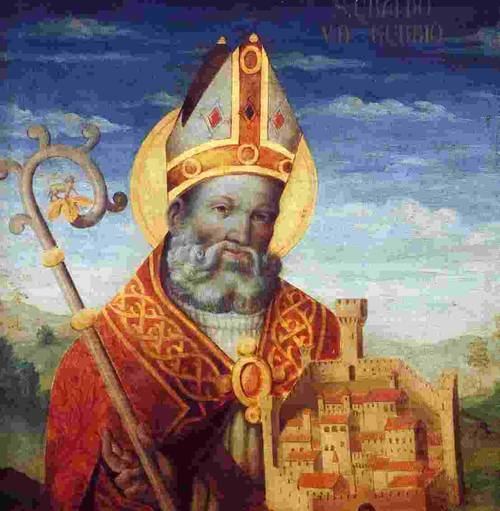
May 16th – St. Ubald, Bishop of Gubbio (b. 1100 d. 1160)
WE are fortunate in possessing an excellent and reliable biography of Ubald Baldassini, bishop of Gubbio, compiled by Theobald, his immediate successor. The saint, descended from a noble family in Gubbio, became an orphan at an early age and was educated by his uncle, also bishop of the same see, in the cathedral school. Having completed his studies, he was ordained priest and appointed dean of the cathedral, young though he was, that he might reform the canons amongst whom grave irregularities were rampant. The task was no easy one, but he succeeded before long in persuading three of the canons to join him in a common life. Then, that he might obtain experience in the management of a well-conducted household, he resided for 3 months with a community of regular canons which had been established by Peter de Honestis in the territory of Ravenna. The rule which they followed he brought back to Gubbio, and within a short time it was accepted by the whole chapter. A few years later, after their house and cloisters had been burnt down, Ubald thought it a favourable moment to retire from his post into some solitude. With this object in view he made his way to Fonte Avellano where he communicated his intention to Peter of Rimini. That great servant of God, however, regarded the plan as a dangerous temptation and exhorted him to return to the post in which God had placed him for the benefit of others. The saint accordingly returned to Gubbio, and rendered his chapter more flourishing than it had ever been before. In 1126 St. Ubald was chosen bishop of Perugia; but he hid himself so that the deputies from that city could not find him; then he went to Rome, threw himself at the feet of Pope Honorius II and begged that he might be excused. His request was granted but when, two years later, the see of Gubbio fell vacant, the pope himself directed that the clergy should elect Ubald.
In his new office the saint displayed all the virtues of a true successor to the apostles, but perhaps his most distinguishing characteristic was a mildness and patience which made him appear insensible to injuries and affronts. On one occasion workmen repairing the city wall encroached upon his vineyard and were injuring his vines. He gently drew their attention to this. Thereupon the foreman, who probably did not recognize him, became abusive and pushed him so roughly that he fell into a pool of liquid mortar, he rose up, splashed all over with lime and dirt, and without a word of expostulation returned to his house. Eyewitnesses, however, reported the incident and the citizens clamoured loudly that the foreman should be punished. So great was the popular indignation that a severe sentence seemed a foregone conclusion, when St. Ubald appeared in court and claimed that, since the offence had been committed against an ecclesiastic, it came under his jurisdiction as bishop. Then, turning to the culprit, he bade him give him the kiss of peace in token of reconciliation, and, after a prayer that God would forgive him that and all his other trespasses, he directed that the man should be set at liberty.
The saint often defended his people in public dangers. The Emperor Frederick Barbarossa during his wars in Italy had sacked the city of Spoleto and threatened to subject Gubbio to a similar fate. Ubald met the emperor on the road and diverted the tyrant from his purpose.
During the last two years of his life, the holy bishop suffered from a complication of painful diseases which he bore with heroic patience. On Easter day 1160, although very ill, he rose to celebrate Mass, and, that he might not disappoint his people, preached and gave them his blessing. He was carried back to bed, from which he never rose again. At Pentecost, as he lay dying, the whole population of Gubbio filed past his couch, anxious to take a last farewell of one whom each individual regarded as his dear father in God. Ubald died on May 16, 1160, and the people who flocked to his funeral from far and wide were eye-witnesses of the many miracles God performed at his tomb.
(Butler’s Lives of the Saints)
_____________________
PLAIN TALKS ON MARRIAGE
FULGENCE MEYER , O.F.M.
(1954)
CHAPTER VII.
The Education of Children
“Suffer the little children to co me unto Me, and forbid them not; for of such is the kingdom of God” (Mark, 10, 14).
IT IS now time to treat of a most important duty of married people: the education of their children. Perhaps you have no children, and have never had any. You and your wife are eager to have children, and you would welcome them with warm thanksgiving. But for some reason or other, you say, God is not hearing your fervent prayers in this regard, and your home appears more empty and incomplete from day to day. Whilst children are a great blessing, the greatest earthly blessing, in fact, which God bestows upon married people, still they are at the same time a great responsibility, and often prove to be a heavy cross. If God, therefore, deems it best to withhold children from you, thank Him in humble and loving resignation. Even without children God-loving people can be perfectly satisfied and happy with each other, and they can ward off all loneliness from their home by the practice of charity and piety in an intense degree.
A Grand Charity
Maybe by mutual consent you can adopt a child or two and educate them in the fear of the Lord. This is a splendid and usually a most grateful act of charity. Adoptive parents often conceive for their adopted children so strong and delightful a love that they could hardly have any greater love for their own children, or derive more gratification out of their rearing. It is God’s reward for their goodness. I know that sometimes adopted children are ungrateful; but natural or carnal children are ungrateful, too; and it is not easy to say who of the two form the higher percentage in ingratitude. At any rate, if you adopt a child from good motives, the result will not affect the merit of your act in the sight of God, nor interfere with its grand reward in eternity. Jesus says invitingly: “He that shall receive one such little child in My Name, receiveth Me” (Matt., 18, 5).
If you do not know how to go about adopting a child, go to your pastor or some other priest for information and direction. In the meanwhile keep on praying with confidence for offspring of your own. Some of the greatest saints in history, such as our Blessed Mother Mary, St. John the Baptist, the prophet Samuel of old, and a number of others were the reward of trustful and persevering prayers on the part of their parents who received them when already quite advanced in years. It may be remarked, too, that childlessness of couples is at times due to a certain ignorance as to the proper performance of the marriage duty, or to some physical fault which a visit to a physician may succeed in remedying.
Education: When Does It Start?
But most of you have been blessed by God with offspring. Merely to have children is not a great credit; but to bring them up carefully in the knowledge, love and service of God is a credit. To effect this abidingly all the good sense, virtue and tact of both father and mother are required. When is the education of the child to begin? As soon as it is conceived, or, rather, at the very conception. A child that is conceived whilst both its parents are in proper physical and moral condition starts with a better chance for a good and fruitful life than one at whose conception its parents are not in a condition fit for generation. The nine months of gestation mean a great deal to the future life of the child. It draws the gradual formation of its body from the mother, on whose actual condition the state of the child’s body very much depends. Between body and soul there is a close interrelation of influence and condition. Consequently the condition of the expectant mother is very material to the child’s fate.
The Effects of Heredity
One must not stress the burden of heredity too far: yet there seems to be ground to believe, that many convicts who are in our prisons and penitentiaries today, women as well as men, would not be there, had their parents been in a more favorable state at their conception and gestation. The mother, of course, plays the more important role here. She should therefore be attentive to herself in this sacred period of pregnancy. She must avoid every undue agitation and worry of mind, and eschew anything smacking of excessive or passionate indulgence. This has reference not only to drunkenness or lust, but also to violent anger, jealousy, envy, revenge, and to inordinate anxiety, fear, depression, despondency and melancholy. All these and similar sentiments, when freely pursued, are likely to affect the mind and body of the mother in a sinister manner, and to have a disastrous influence on the child that is forming under her heart.
It will behoove both mother and child, if the pregnant mother keeps herself well, easy and happy as much as possible in body and soul, and nurses feelings of the love of God and her neighbor, of trust and confidence in God’s sweet providence, and of virtuous resignation to His holy will in all things. She will foster these feelings by the regular attendance at Holy Mass and by the frequent reception of the sacraments. On his part her husband will assist her towards this disposition of body and mind by behaving towards her, in the season of pregnancy, with more than ordinary love, tenderness, devotion, attachment, respect and consideration, which prompt him to anticipate her every want and to meet her most silent desires as much as his circumstances will allow.
Expectant Mothers and Sunday Mass
As to hearing the obligatory Mass on Sundays and holydays, some expectant mothers are exempt or dispensed early in their sacred period because of peculiar personal conditions: with the best will in the world they can not attend Mass, for fear of nausea or some kindred indisposition. Others again keep on assisting at Mass until almost immediately before the day of their delivery. In case of doubt as to the obligation, the pastor will gladly give a dispensation, or the confessor a declaration in the matter. To discontinue going to Mass merely from embarrassment at the appearances and the consequent comment of others is hardly commendable, as a rule. It is certainly no dishonor, but rather an honor and a sign of God’s favor and blessing to be an expectant mother, and something of which a good woman has every reason to be justly proud. Of course, an innate feeling of delicacy will prompt a woman not to parade her condition unnecessarily before the world. For very good reasons God desired that the origin of human life should be veiled by a certain mysteriousness that shrinks from notice and publicity.
As the pregnancy progresses to the fifth or sixth month, the mother must be especially cautious not to exert herself unduly in a physical way. She will avoid heavy lifting, high reaching or jumping, and every other unusual tax on her bodily condition, in order to avoid a miscarriage. The husband will see to it that his wife is then excused from all manner of work that is likely to jeopardize her health and the life of her blessed charge.
Involuntary Miscarriage
It happens not infrequently that, without any fault at all of the parents, a miscarriage ensues. This is deplorable, of course; but it calls for nothing else than conformity to the holy will of God, Who arranges everything sweetly and wisely. In case baptism can be administered to the prematurely ejected foetus, it should not be neglected. The mother, taking notice of it, opens the involucrum or sack, and pours water over the contents whilst saying the words: “If you are living, I baptize you in the Name of the Father, and of the Son, and of the Holy Ghost.” Life may still be there; if so, the baptism will open the gates of heaven to the child’s soul. In case the administration of baptism is out of question, the soul of the child will not go to heaven, it is true; but it will neither go to a place of torments; it will go to what is called the limbo of infants, where it will enjoy natural happiness in a high degree: in a higher degree than is tasted by children or men in general on this earth. This is an opinion quite commonly held by theologians, and not at all frowned upon by the. Church. At all events such a child is immensely better off in being as it is than if it had never been conceived at all: hence its parents who, as we suppose, had no guilt whatever in regard to the miscarriage, have no cause for worry or regret.
”In God We Trust”
When the time for the delivery approaches, the mother will not grow over-anxious, but she will entrust herself unreservedly to the goodness and providence of God. The less timid and nervous she is, the more natural and easy will the birth prove to be. On the other hand she will be prepared against every possible eventuality, both spiritually and materially. Statistics tell us that the mortality of parturient mothers in the United States is about at the rate of one out of one-hundred and fifty. The proportion is lower than it used to be, thanks to the progress of medicine and surgery; but it is still far too high, and we hope it will continue to be reduced until it is at its minimum.
All other things being equal, it is advisable to have a Catholic doctor and a Catholic midwife or nurse at the birth. Often baptism must be administered before or during the birth; and a Catholic may be counted on for doing this more reliably than a non-Catholic.
Do Not Delay Baptism
After the birth provision should at once be made to bring the child to church for baptism as soon as possible. A delay of over eight or ten days usually bespeaks gross neglect in the parents. The life of a newborn infant is very precarious, and baptism is so momentous a sacrament for the child’s eternal fate, that no risk as to its possible loss should be taken by the parents of the child. If through their neglect the child’s soul passes unbaptized into eternity, they will never get over the bitter remorse of it. In a case of necessity, when baptism has to be administered urgently, and a priest is not available, the parents should only perform the baptism when there is no other reliable person at hand to do it. Care must be taken that the water—not holy water, but ordinary clean and fresh water—be poured on the head of the infant—not merely sprinkled—whilst the one who pours the water says distinctly and entirely the words: “I baptize thee in the Name of the Father, and of the Son, and of the Holy Ghost.” In case the child survives, it should in due time be taken to church, so the priest can supply the other ceremonies of holy baptism. But every time baptism has been administered or only attempted at home, mention of this must be made to the priest when the child is brought to the church, so the priest does not confer baptism a second time, supposing that the, first administration was valid.
————————-
Father Krier will be in Eureka, Nevada (Saint Joseph) on May 27. He will be in Pahrump (Our Lady of the Snows) on June 10.
————————-
The topics of Faith and Morals will correspond to the Roman Catholic Faith in Tradition and the Magisterium. The News will be of interest. The commentaries are for the reader to ponder and consider. The e-mail address will be for you to provide thought for consideration. The donations will be to support the continuation of this undertaking.
While the Newsletter is free of charge it is not free of cost. Please consider supporting St Joseph’s Catholic Church with a tax – deductible donation by clicking the secure link: Donate
Or if you prefer send a check to
Catholic Tradition Newsletter
c/o St Joseph’s Catholic Church
131 N. 9th St
Las Vegas, NV 89101
Visit us on the Worldwide Web: http://stjosephlv.org
e-mail news and comments to: tcatholicn@yahoo.comTo unsubscribe, please type, “unsubscribe”‚ in subject line.…
[Message clipped] View entire message