Vol 13 Issue 36 ~ Editor: Rev. Fr. Courtney Edward Krier
September 5, 2020 ~ Saint Lawrence Justinian, opn!
1. What is the Holy Eucharist
2. Fourteenth Sunday after Pentecost
3. Saint Eleutherius
4. Family and Marriage
5. Articles and notices
Dear Reader:
As Catholics, that is as faithful Roman Catholics, sometimes it is necessary to remind ourselves that we are in the world but not of the world. Scripture repeatedly reminds us: If you had been of the world, the world would love its own: but because you are not of the world, but I have chosen you out of the world, therefore the world hateth you (John 15:19); That you may be blameless, and sincere children of God, without reproof, in the midst of a crooked and perverse generation; among whom you shine as lights in the world (Philip. 2:15); And they that use this world, as if they used it not: for the fashion of this world passeth away. (1 Cor. 7:31) These are but a few examples. We do not do things to make ourselves stand out, but it is obvious that we are going to stand out. Someone who is over 6.6 ft tall is going to stand out in a crowd not that he wants to, but it is inherent because he is taller. It is also inherent for Catholics living their faith to stand out because Catholics are placed as a light in the darkness, as a city seated on a mountain (cf. Matt. 5:14). We possess the truth and the truth makes us free (cf. John 8:32). But we hide the truth, we cover the light, we destroy the city when we become just like the world—just as the tall man bends down so as not to be seen.
What am I saying? That if we are like the Israelites in Egypt, wearing the same clothing, speaking the same language, attending the same events which are contrary to the spirit of God as given in the Ten Commandments, then even in the desert we find ourselves wanting to go back to the fleshpots of Egypt—we do not want to accept God’s will in our lives. Here, I want to focus on the Eighth Commandment: Thou shalt not bear false witness against Thy neighbor. (Exod. 20:16; Deut. 5:20; cf. Matt. 19:18, Luke 18:20) We don’t want to look at the letter of the Law, we want to find the spirit, and Christ brings this out when He says: But I say to you, that whosoever is angry with his brother, shall be in danger of the judgment. And whosoever shall say to his brother, Raca, shall be in danger of the council. And whosoever shall say, Thou Fool, shall be in danger of hell fire. (Matt. 5:22)
Most of us live in the United States of America and therefore have been raised with the principle that one has the freedom to say whatever one wants to say, even if it makes the other angry, even if it is just an opinion, even if it is derogatory. But this excludes charity, this excludes all the virtues that flow from charity: justice, respect, piety, temperance, prudence, modesty. It gives rise to slander and talebearing, detraction and revealing of secrets. It gives rise to anger and hatred and why Christ said such words bring judgment. We cannot excuse ourselves and say the world does it. We are supposed to set the example. We become Pharisees when we condemn the other for their abuses if at the same time we are also engaging in an abuse of words. Discussions and Debates should be civilized so that the substance of the argument is able to be considered not the shock of the epithet, an ad hominem attack.
Again, what am I saying? Unfortunately even in publications that should be models of Catholic thought and moral standards there is the propensity to adopt a freedom of expression that deprecates the opponent instead of making clear Catholic arguments. We should acknowledge that emotions arouse us and stimulate us, whereas rational arguments seem tiring because we have to think—freethinkers don’t think they react upon their emotions and why therefore we cannot be freethinkers—and our thinking must be according to Catholic faith and morals. The name of a person is sacred to us, we must keep our name inviolate, we must respect the names of others just as they must respect our name. Tragically we no longer address one another as Mr. and Mrs. and Miss to remind us of the respect due. But despite the world tearing apart the names of each other, we must revert and stress the principles: We must support the defense of innocent life, including the unborn and oppose anyone who would condemn or murder the innocent, including the unborn. We must support those who would allow us to practice our faith publicly and oppose those who would silence us and close our Churches. We must oppose those who would oppose the nuclear family of a husband and wife with the full responsibility of their children and support those who do everything to keep the nuclear family intact by providing resources and giving the hardworking father of the family a decent wage, not taking it away by giving it to liberated women and not encouraging life styles that cause children to be born out of wedlock. We must oppose those who would allow anarchy to reign and support those who would promote security and peace. These are the topics that should decide our choices and not promises that the government will assure us that all our needs will be taken care of: health, housing, children, that deprive us of our responsibility and obligation and deny us that quality which makes us human: Persons possessing understanding and freewill. Our reply should be: You advocate abortion, you advocate closing churches, you advocate life styles that are opposed to morality and punish families, you advocate women replacing men in the work force, you advocate anarchy, you advocate denying citizens the ability to understand (know and remember—and why the cancellation culture [1984/Animal Farm]) and choose and therefore I cannot support you. Not because of how you talk, not because of how you look, not because of mannerisms, but because you are wrong—period. The same reason for why one supports: because they are right—period. Personalities are always a challenge as we know in our own personal relationships, but charity imposes upon us patience (cf. I Cor. 13:4)—after all we want people to be patient with us.
As always, enjoy the readings provided for your benefit.—The Editor
________________
WHAT IS THE HOLY EUCHARIST
By Rev. Courtney Edward Krier
Part III
The Real Presence
1. Christ Remains Present as Long as the Accidents of Bread and Wine are Present
With the words of Our Lord, Take ye, and eat: This is my body, (Matt. 26:26) Christ indicates that what He is holding in His hand is His Body. If it was not His Body before the Apostles received, only when they ate the bread then the words of Christ were not true. Christ would have to say: This will be My Body when you eat the bread. It is the same argument when it comes to the words of Christ, Drink ye all of this, for this is my blood. (Matt. 26:27,28) Knowing that Jesus Christ is present under the species of bread and present under the species of wine, particles (or Hosts) and drops in the chalice that remain after the reception during the Mass must continue to be the Body and Blood of Christ.
As Mass is a sacrificial meal, that is, a sacrifice in which those participating in the sacrifice partake of that which is offered, that which is offered must be present at the time it is offered and must continue to be when it is consumed, and what remains must still be that which was offered and consumed (Christ) if there is something that remains. This can be referenced in the treatment of the Holy Eucharist when one considers three of the Biblical accounts related to the Eucharist.
The first relates to institution of the Passover Sacrifice of a Lamb, which speaks of the whole to be consummated—but, then that which remains is to be burned: Exodus 12:9-10: . . . You shall eat the head with the feet and entrails thereof. Neither shall there remain any thing of it until morning. If there be any thing left, you shall burn it with fire. The second relates to the manna that provided sustenance to the Israelites in the desert, which also speaks of it remaining, not to be kept beyond, or it would corrupt, but would remain the same on the Lord’s day:
And Moses said to them: This is the bread, which the Lord hath given you to eat. . . . Let every one gather of it as much as is enough to eat: a gomor for every man, according to the number of your souls that dwell in a tent, so shall you take of it. And the children of Israel did so: and they gathered, one more, another less. And they measured by the measure of a gomor: neither had he more that had gathered more: nor did he find less that had provided less: but every one had gathered, according to what they were able to eat. And Moses said to them: Let no man leave thereof till the morning. . . . But on the sixth day they gathered twice as much, that is, two gomors every man: . . . Tomorrow is the rest of the sabbath sanctified to the Lord. Whatsoever work is to be done, do it: and the meats that are to be dressed, dress them: and whatsoever shall remain, lay it up until the morning. And they did so as Moses had commanded, and it did not putrify, neither was there worm found in it. And Moses said: Eat it today, because it is the sabbath of the Lord: today it shall not be found in the field. Gather it six days: but on the seventh day is the sabbath of the Lord, therefore it shall not be found. (Exod. 16:15ff)
The third is found in the multiplication of the loaves and fishes related in chapter six of St. John’s Gospel:
And Jesus took the loaves: and when he had given thanks, he distributed to them that were set down. In like manner also of the fishes, as much as they would. And when they were filled, he said to his disciples: Gather up the fragments that remain, lest they be lost. They gathered up therefore, and filled twelve baskets with the fragments of the five barley loaves, which remained over and above to them that had eaten. (John 6:11-13)
In all three there is presented the wholeness that is kept from the beginning and ending only when there is nothing left (or it is burned/corrupted)—seeming to express also that it must not be allowed to corrupt. There is also the preservation—from the beginning to the end—and the retaining its reality with the command to the Disciples to gather up the fragments for further consumption.
The Church teaches, according to the Council of Trent, the following on the Holy Eucharist, Chapter 3, The Excellence of the Most Holy Eucharist Over the Other Sacraments:
This, indeed, the most Holy Eucharist has in common with the other sacraments, that it is a “symbol of a sacred thing and a visible form of an invisible grace”; but this excellent and peculiar thing is found in it, that the other sacraments first have the power of sanctifying, when one uses them, but in the Eucharist there is the Author of sanctity Himself before it is used. For the apostles had not yet received the Eucharist from the hand of the Lord [Matt. 26:26; Mark 14:22] when He Himself truly said that what He was offering was His body; and this belief has always been in the Church of God, that immediately after the consecration the true body of our Lord and His true blood together with His soul and divinity exist under the species of bread and wine; but the body indeed under the species of bread, and the blood under the species of wine by the force of the words, but the body itself under both by force of that natural connection and concomitance by which the parts of Christ the Lord, “who hath now risen from the dead to die no more” [Rom. 6:9], are mutually united, the divinity also because of that admirable hypostatic union with His body and soul. Therefore, it is very true that as much is contained under either species as under both. For Christ whole and entire exists under the species of bread and under any part whatsoever of that species, likewise the whole (Christ) is present under the species of wine and under its parts. (Sess. XIII, On the Most Holy Eucharist; cf. DB 876)
This is again found in the subsequent Canon as follows:
Canon 4. If anyone says that after the completion of the consecration that the body and blood of our Lord Jesus Christ is not in the marvelous sacrament of the Eucharist, but only in use, while it is taken, not however before or after, and that in the hosts or consecrated particles, which are reserved or remain after communion, the true body of the Lord does not remain: let him be anathema. (Cf. DB 886)
The proof that the Church always believed this is found in the examples of the early Christians being brought the Holy Eucharist while in prison. One reads in Butler’s Lives of the Saints, under August 15:
ST TARSICIUS, MARTYR (THIRD CENTURY)
“At Rome, on the Appian Way, the passion of St Tarsicius the acolyte, whom the heathen met bearing the sacrament of the Body of Christ and asked him what it was that he carried. He judged it a shameful thing to cast pearls before swine, and so was attacked by them for a long time with sticks and stones, until he gave up the ghost. When they turned over his body the sacrilegious assailants could find no trace of Christ’s sacrament either in his hands or among his clothing. The Christians took up the body of the martyr and buried it with honour in the cemetery of Callistus.” Thus the Roman Martyrology sums up the later form of the story of St Tarsicius, “the boy martyr of the holy Eucharist”, which is derived from the fourth-century poem of Pope St Damasus, wherein it is stated that one Tarsicius, like another St Stephen stoned by the Jews, suffered a violent death at the hands of a mob rather than give up “the divine Body to raging dogs”.
Tarcisium sanctum Christi sacramenta gerentem,
Cum male sana manus peteret vulgare profanis;
Ipse animam potius voluit dimittere caesus
Prodere quam canibus rabidis caelestia membra.
Tarcisius, carrying the holy sacrament of Christ,
When evil people tried to take away from [his] pure [hands] into [their] profane hands,
Willed rather to give his own soul to blows
Than to betray the divine body to raging dogs.
This bare fact is certainly true, but we do not know that Tarsicius was a boy or an acolyte. It may be, especially having regard to the reference of St Damasus to the deacon St Stephen, that he was a deacon, for it was the deacon’s special office to administer holy communion in certain circumstances and to carry the Blessed Sacrament from one place to another when necessary, e.g. that part of the consecrated Host, called Fermentum, which the pope sent from his Mass to the presbyters of the principal Roman churches, symbolizing the unity of the holy Sacrifice and the union subsisting between the bishop and his flock. . . .
[N.B. The question may arrive whether he was made a deacon, but truly abuses are thus indicated in this verse and practices that were not sanctioned were quickly removed, such as laity, especially—if ever—women handling the Holy Eucharist.]
St. Cyril of Alexandria (+444) writes of the permanence in his Epistle to Calosyrium regarding the errors of the Anthropomorphytes:
I hear that there are others who assert that the Eulogy profits nothing for sanctification if a portion thereof remains over for the following day. But they who speak thus, speak foolishly; for neither is Christ altered, nor His sacred Body changed, but the virtue of the blessing as well as the life-giving grace remain permanently therein. (Porro alios etiam esse audio, qui mysticam benedictionem nihil ad sanctificationem juvare dicant, si quid ex ea fiat reliqui in alium diero. Insaniunt vero, qui haec asserunt : neque enim alteratur Christus, neque sanctum ejus corpus immutatur; sed benedictionis vis ac facultas, et vivificans gratia, perpetua in ipso exsistit.—Ep. ad Calosyr. Migne, P. G., LXXVI, 1075)
The Church has, then, in its beginning of offering special acknowledgement to the permanence of Christ’s Presence, such as the sending of a particle of the Host to the priests under a bishop to show ecclesiastical. The same rite, found in the fractio panis, of declaring the particle from the previous Mass of yesterday was a sign of the continuance of the same Mass today. This expresses Christ’s continual presence and the continual offering of the Sacrifice of His Body and Blood.
As the hosts were much larger, one of these three parts was subdivided into several particles and used in different ways: distributed to those present, sent to the absent, or put into the chalice at the next sacrificial celebration. [A particle previously consecrated was preserved and united to the precious blood at the following sacrifice, to represent, in all probability, the continual succession of the sacrifice, as well as the unity of the last with the present celebration.] Participation in the same Holy Sacrifice was regarded as a sign and pledge of ecclesiastical Communion; hence popes and bishops sent to other bishops, or priests too, parts of consecrated hosts, which the recipients dropped into the chalice and consumed. This division of the host into three parts was symbolically interpreted in various ways. The three parts were, for example, referred to the Holy Trinity, or to the earthly life, the sacrificial death, and the eternal glory of Christ; but generally and principally to the mystical body of Christ, the Church: the three parts of the host were interpreted to refer to the Church militant, suffering, and triumphant; and there were other interpretations. (Gihr, 741-42)
————————–
The Sunday Sermons of the Great Fathers
M. F. Toal
THE GOSPEL OF THE SUNDAY
MATTHEW vi. 24-33
At that time: Jesus said to his disciples: No man can serve two masters. For either he will hate the one and love the other; or he will sustain the one and despise the other. You cannot serve God and mammon. Therefore, I say to you, be not solicitous for your life, what you shall eat, nor for your body, what you shall put on. Is not the life more than the meat and the body more than the raiment? Behold the birds of the air, for they neither sow nor do they reap nor gather into barns; and your heavenly Father feedeth them. Are not you of much more value than they? And which of you by taking thought can add to his stature one cubit? And for raiment why are you solicitous? Consider the lilies of the field, how they grow; they labour not, neither do they spin. But I say to you that not even Solomon in all his glory was arrayed as one of these. And, if the grass of the field, which is today and tomorrow is cast into the oven, God doth so clothe; how much more you, O ye of little faith? Be not solicitous therefore, saying: What shall we eat; or, What shall we drink; or, Wherewith shall we be clothed? For after all these things do the heathens seek. For your Father knoweth that you have need of all these things. Seek ye therefore first the Kingdom of God and his justice; and all these things shall be added unto you.
EXPOSITION FROM THE CATENA AUREA
REMIGIUS: Spiritually, by the birds of the air, holy men are signified, who are born again of the water of sacred baptism, and who in their devotion reject earthly things and seek those of heaven; of these is it said that the Apostles are of more value: for they are the princes of all the saints. By the lilies we may understand the holy men who, without the forms of the ritual of the law, pleased God by faith alone; of whom it was said: My beloved to me, who feedeth among the lilies (Cant. ii. 16). Holy Church is also signified by the lilies; because of the purity of its faith and the good odour of its life; of which it was said: As the lily among thorns. By the grass unbelievers are signified; of whom it was said: The grass is withered and the flower is fallen (Is. xl. 7). By the oven, eternal damnation; so that its meaning is: if God bestows the good things of this world on the unbelieving, how much more will He not give us those of eternity?
———————–
September 6
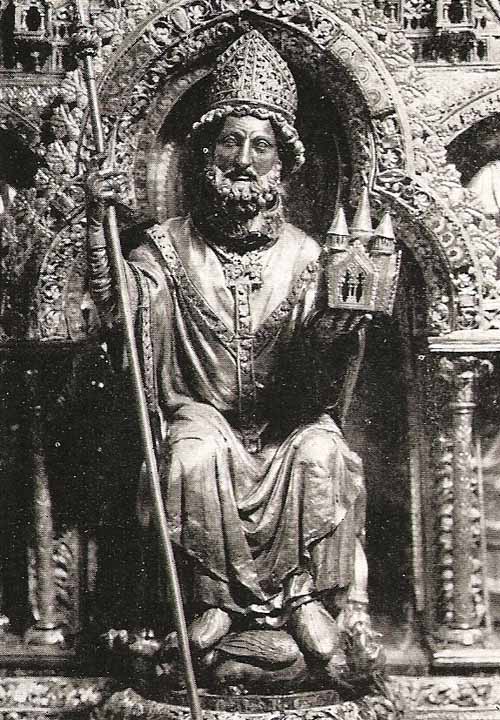
ST ELEUTHERIUS, ABBOT (SIXTH CENTURY)
“THE holy man, old father Eleutherius”, is spoken of several times in the Dialogues of St Gregory, wherein are chronicled certain miracles reported of him by his monks. He was abbot of the monastery of St Mark, near Spoleto, and once when lodging at a convent of nuns he was asked to take over the care of a boy who was nightly troubled by an evil spirit. St Eleutherius did so, and for long nothing untoward happened to the boy, so that the abbot said, “The Devil is having a game with those sisters; but now that he has to deal with the servants of God he daren’t come near the child”. As if in rebuke of a speech that certainly savoured of boasting, the boy was at once afflicted by his former trouble. Eleutherius was conscious-stricken, and said to the brethren that stood by, “None of us shall eat food to-day until this boy is dispossessed”. All fell to prayer, and did not cease until the child was cured.
One Holy Saturday St Gregory was ill and could not fast, whereat, he tells us, he was considerably disturbed. “When I found on this sacred vigil, when not only adults but even children fast, that I could not refrain from eating, I was more grieved thereby than troubled by my illness.” So he asked Eleutherius to pray for him that he might join the people in their penance, and soon by virtue of that prayer Gregory found himself enabled to abstain from food. St Eleutherius lived for many years in Gregory’s monastery at Rome, and died there. (Butler’s Lives of the Saints)
_____________________
Good Morning,
Boys and Girls!
REV. THOMAS J. HOSTY, M.A., S.T.B.
(1952)
THANKS A MILLION!
GOOD MORNING, BOYS AND GIRLS!
Well, school is over at last, and your summer vacation has begun1 I’ll bet you thought that last week was never going to come to an end! To be honest with you, I can hardly blame you. When I was your age, the time before school ended seemed just as long. It seemed as though the last day of school would never arrive! What a glorious feeling it was, though, when it finally did come, and we started out for home, with our promotion card in our pocket. The sun never shone more brightly, and the birds never sang more sweetly, than they did on that last day of school. As we trooped through the streets, thrilled by the fact that the long summer months of vacation lay ahead of us, we used to chant a little ditty at the top of our lungs. I’ll bet some of you still yell it, too. Here’s the way it ran:
“No more pencils, no more books;
No more Sisters’ dirty looks!”
Now that I am older and have a little more sense, and a little more knowledge, I realize how unfair that corny verse was! I wonder if any of you boys and girls have an idea of how hard the nuns work for you. Let me tell you a little about them. I know what I’m talking about, not only because some of my best friends are nuns, but also because one of my own sisters is one.
They start every day by getting up at about five o’clock in the morning. (That isn’t too bad in the summer, but in the cold winter months it’s really murder!) They say their morning prayers and then spend a special half hour thinking and praying. (We call that meditating.) Their daily Mass is said at either six or six-thirty and, after attending Mass and receiving Holy Communion, they have their breakfast. When breakfast is over, they do their housework. The bigger the convent is; the more housework they have to do. Each nun has a special job of housework, for which she is responsible. When she finishes her housework, she starts getting ready for her morning’s classwork. At 8:30, she goes over to school, and she stays there until 11:30. At that time (unless she has to watch over the lunchroom), she comes back to the convent, washes up for lunch, and then spends the next fifteen minutes in the chapel, examining her conscience. Among the points she examines herself upon are the faults she may have been guilty of in her morning’s teaching. After lunch, she has a few minutes (very few!) to herself, before she dashes back to the classroom again. She is there all afternoon, until three o’clock. If she is lucky, she is out of school a little after three. Back to the convent she goes, for more work and a few minutes of recreation. At five o’clock she is back in the chapel for prayers and for spiritual reading. Her dinner is served around six o’clock. After dinner, she has about one hour of recreation. Then it’s time for study again, and she works on her classes for the following day, until the bell rings for night prayers at about 8:45. By 9:30 she is just about able to drag her weary bones to bed. That is a quick picture of an ordinary day in the life of an ordinary nun.
When the school year is over, do you think the Sisters have the whole summer off, just like you? Oh, no! They go back to their headquarters (they call it their mother house), and they spend almost all of the summer in either going to summer school or teaching summer school or teaching catechism in little towns which have no Catholic school. When summer draws to a close, they make their yearly retreat. They spend eight full days in perfect silence, while they examine their conscience on how well they are serving God, and how well they have been teaching you—by word and example.
Believe me, the nuns have a very hard job. And remember, they don’t get any money for doing it. They don’t get paid extra for working overtime. In fact, they take a vow never to have any money of their own. I don’t want you to get the idea, though, that a nun’s life is a terrible one—it isn’t. It’s a hard life, but it’s a happy one, because everything which they do, they do out of love for God. And when you love a person, it makes your work a great deal easier.
Is it any wonder, after hearing how hard a nun works, that you sometimes run into a nun who gets a little cross or crabby? It’s a wonder to me that a nun doesn’t get off base oftener than she does. I think I would quickly end up in a padded cell, at some insane asylum, if I had to teach fifty or sixty youngsters, five hours every day!
You children owe the Sisters a debt which is almost impossible to pay. What are you going to do about it? Don’t think that by bringing Sister two handkerchiefs at Christmas time you pay your debt to her. The very least that you can do for her is to say a little prayer for her, and for all the Sisters, every day. Ask the good Lord to give them the grace and the strength to serve Him faithfully. Ask Him, too, to give them the grace to use their sense of humor at all times, when they are teaching. An active sense of humor is one of the greatest assets any Sister can have. If it weren’t for the nuns’ sense of humor, I don’t know how they could possibly teach characters like you and me!
————————-
Father Krier will be in Albuquerque September 11 and Los Angeles September 12. He will be in Eureka September 17 and Pahrump September 21.
————————-
For those who purchase through Amazon, please help support the work here at Saint Joseph’s by going through this link: http://smile.amazon.com/ch/94-2855162
————————-
The topics of Faith and Morals will correspond to the Roman Catholic Faith in Tradition and the Magisterium. The News will be of interest. The commentaries are for the reader to ponder and consider. The e-mail address will be for you to provide thought for consideration. The donations will be to support the continuation of this undertaking.
While the Newsletter is free of charge it is not free of cost. Please consider supporting St Joseph’s Catholic Church with a tax – deductible donation by clicking the secure link: Donate
Or if you prefer send a check to
Catholic Tradition Newsletter
c/o St Joseph’s Catholic Church
131 N. 9th St
Las Vegas, NV 89101
Visit us on the Worldwide Web: http://stjosephlv.org
e-mail news and comments to: tcatholicn@yahoo.com