Vol 13 Issue 23 ~ Editor: Rev. Fr. Courtney Edward Krier
June 6, 2020 ~ Ember Saturday in Pentecost Week
1. What is the Holy Eucharist
2. Trinity Sunday
3. Saint Paul, Bishop
4. Family and Marriage
5. Articles and notices
Dear Reader:
As we begin the Month of the Sacred Heart the call for reparation is urgently needed. One may simply place the blame of the present riots on the bad deeds of a rogue policeman, but it is an effect of sin and our turning away from God to the extent that God leaves us to our own fallen nature—which quickly is overcome by the sevenfold vices in opposition to the sevenfold Gifts of the Holy Ghost. Here, in Las Vegas, being in the center of the downtown, I am having to deal with the protestors. There is no BLM chapter here, so members are brought in from outside (mainly California). There are a few Antifa members here—but they, too, come mainly from outside (mainly California—I watch the motel across the street and the ones going in and out are with the head gear and obscene signs for the protest—and the signs have nothing to do with the unfortunate death of George Floyd). I have stayed late to protect the Church property—but even that has not stopped them from smashing one of the property windows (so far) to break in and vandalize and throw rocks. We probably all heard of the historic church in Washington, DC, that was set on fire, so it is clear that there is no consideration—just opportunity and inspiration from the wicked one. The government officials tell us that we cannot gather more than ten but these can gather in the thousands with state approval—because if you disapprove you are politically incorrect. The progressive state has upset the social order because it decides what is right and wrong not upholding what is truly right and wrong. Now we might not think that we can do something—but this is a loss of faith because every act we do to draw down God’s mercy and grace helps as God intervenes or provides the help (as we ought to believe) for us to do good and avoid evil as also present the opportunity to others to do good and avoid evil. The powerhouses of the Church were always prayer and sacrifice which is seen in the blood of the martyrs sacrificing their lives and obtaining the conversion of the world and in the prayers of the first Christians when we think of the release of Saint Peter from prison. It is why the convents were always considered essential and the Religious Orders flourished when they were fervent in prayer and sacrifice. This is what we must do, become fervent once again in our prayers and sacrifices. The devotion to the Sacred Heart of Jesus should instill in us that desire to return human love for divine love, to offer our personal sacrifices with the Divine Sacrifice, to pray so that our prayer is heard like St. Stephen’s in obtaining the conversion of St. Paul or St. Monica’s achieving the conversion of St Augustine. It cannot happen unless there is a deep love for Our Lord Jesus Christ and it is enkindled by the Love of His Sacred Heart. May we use this Month to once more increase our devotion to the Sacred Heart of Jesus.
In addition, Mr Eberhard Heller wrote several articles concerning the Incarnation and Jesus Christ being the Son of God with its implications—they were just translated from the German into English. I would recommend going to this site http://www.einsicht-aktuell.de/ to read the articles. We will soon publish them in this Newsletter for the benefit of our readers.
As always, enjoy the readings provided for your benefit.—The Editor
________________
WHAT IS THE HOLY EUCHARIST
By Rev. Courtney Edward Krier
PART II
Institution
The Institution of the Holy Eucharist
For many commentators, the words of Saint Paul indicate that Christ used the fourth cup for the consecration of the chalice: The chalice of benediction, which we bless, is it not the communion of the blood of Christ? And the bread, which we break, is it not the partaking of the body of the Lord? (1 Cor. 10:16.) That Matthew and Mark place the statement of Christ after the consecration, And I say to you, I will not drink from henceforth of this fruit of the vine, until that day when I shall drink it with you new in the kingdom of my Father (Matt. 26:29; Mark 14:25)
This seems to be the fourth cup, but a blessing is said over each cup during the Passover meal and Luke continues without indicating a blessing over the chalice—nor does Paul—Paul knowing the final cup is termed the cup of benediction (thanksgiving). One must remember that in the Holy Eucharist there is only one chalice and Paul is possibly referring to that chalice blessed in the Eucharistic Sacrifice now offered and in reference to that of the Passover cup—for one must recognize that the Corinthians would not be familiar with the Passover ritual. Therefore, also it would seem that a separate chalice of wine was poured and why all three Evangelists are indicating Jesus Christ did not drink from indicating that He did not drink from this chalice of His blood but He was to drink from the chalice of His passion: My Father, if it be possible, let this chalice pass from me. Nevertheless not as I will, but as thou wilt. (Matt. 26:39; cf. Mark 14:36; Luke 22:42; John 18:11.) He had already used the expression to the Sons of Zebedee: Can you drink the chalice that I shall drink? (Matt. 20:22f; cf. Mark 10:38f.)
Giving thanks: this word in Greek, εὐχαριστήσας, separates the consecration of the bread from the consecration of the chalice for Matthew and Mark. As pointed to above, Matthew uses blessed (εὐλογήσας) before the consecration of the bread. Regarding this word Thomas of Aquin writes:
It was for two things, for a sign and for something signified. He gave thanks for a sign, because He gave thanks for the effect; He gave thanks for something signified, because He gave thanks for His Passion. In doing which, it is signified that we not only ought to give thanks for good things, but also for bad or adverse things; “Giving thanks in all things” (I Thess. 5, 18); “To them that love God all things work together unto good” (Rom. 8, 28). Moreover, He gave thanks for the institution of this Sacrament, because He was doing this by divine power; hence, it is said in John 5, 30: “I cannot of myself do any thing.” Thus, He gave thanks to God the Father; “I give thee thanks that thou hast heard me” (Jn. 11, 41). In which an example is given to us that if Christ gave thanks, who is equal to the Father, then we ourselves ought to give thanks. Likewise, He gave thanks for the effect, because the effect is the salvation of the whole world. And He was only able to do this by His divinity; “It is the spirit that quickeneth: the flesh profiteth nothing” (Jn. 6, 64). Commentary on Matthew, 869)
In this sense, one must refer to the words which follow: and gave to them, saying: Drink ye all of this. For they were all to partake in the Passion of Christ, and they were all to partake in the ministry of the Sacrament of the Eucharist. The Angelic Doctor, therefore, comments on these words:
So that they might receive the Sacrament. And by this, He signifies that the fruit of His Passion ought to be ministered by some men to others. Hence, the Apostles can be compared the offspring of an eagle, concerning whom it is said: “As the eagle enticing her young to fly, and hovering over them” (Deut. 32, 11). Then He enjoins the use of the Sacrament. Firstly, He relates its use; secondly, He relates the words of consecration; and thirdly, He foretells His Resurrection. He says, therefore: Drink ye all of this; “Drink, and be inebriated, my dearly beloved” (Cant. 5, 1). Hence, it is signified that Christians can communicate in the appropriate place and time. (Ibid.)
And here one may further read the explanation of Saint Thomas:
And taking the chalice, etc.; by which is signified that it was not instituted that the Sacrament be performed under one species, but under two species.
And what is the reason for this? One reason is that there are three things in this Sacrament. One is that which is the sacrament only, another is the reality only, and still another is the sacrament and the reality. The sacrament only is the species of bread and wine. The reality only is the spiritual effect; the reality and the sacrament is Christ’s Body contained in this Sacrament. If, therefore, we consider the sacrament only, it is very fitting that the Body be signified by the species of bread, and that the Blood be signified by the species of wine, because they are signified as indicating spiritual refreshment; but refreshment properly consists in food and drink. . . . Likewise, if the Sacrament be considered as a reality and a sacrament, it is fitting in that this Sacrament is rememorative of the Lord’s Passion. And it cannot signify this better than in this way, as the Blood is signified as poured out and separated from the Body. Likewise, the Sacrament is very fitting when it be considered as the reality only, because blood pertains to soul, not because the blood is the soul, but that by blood life is preserved: hence, it is signified that although this Sacrament is for the salvation of the faithful, the Body is offered for the health of the body, but the Blood is offered for the health of the soul. “Come, eat my bread, and drink the wine which I have mingled for you” (Prov. 9, 5), because this refreshment is in the bread and wine. Similarly, another reason is that the entire Christ is contained under the species of the bread. What is, therefore, the necessity that the blood is by itself? Wherefore, what was said above must be taken in the sense that one thing is directly there by the power of the sacrament, and another thing is there from natural concomitance. Christ’s body is contained under the species of bread by the power of the sacrament, but the blood is there by concomitance. But as to the blood, it is the contrary, because Christ’s blood is there directly by power of the sacrament, but His body is there by concomitance. Hence, if, at the time when Christ’s blood was poured out on to the ground, the sacrament was celebrated, the blood would only have been there apart from the body. Thus, because certain men did not understand these things, they said that the forms of consecration of the bread and wine are connected. Hence, they say that when the body is consecrated, the blood is not there until the wine will have been consecrated. But this is not so, because if a priest were to die before he were to consecrate the wine, both Christ’s body and blood would be in the host.
Likewise, the Evangelist says, Taking the chalice, and he does not say, “Taking the wine”; for that reason, some have said that it ought to be done with water. And this is excluded, because Christ continues by saying: I will not drink of this fruit of the vine, etc. Secondly, it is evident that there was wine mixed with water. And the reason for this is on the part of the Sacrament, because it must be celebrated as the Lord instituted it. But in hot climates it is customary that wine is not drunk except with water; wherefore, it must not be believed that He confected the Sacrament with pure wine. It is also fitting as to what is contained in the chalice, because this Sacrament is rememorative of the Lord’s Passion; but from Christ’s side went out blood and water, as it is stated in John 19.26 Moreover, there is water and wine to signify the effect of the Sacrament, and this is done in two ways: therefore, it produces in us the effect of Christ’s Passion. Now the effect of Christ’s Passion is twofold, to wash and to redeem. He redeems us by His Blood; “Thou hast redeemed us to God, in thy blood” (Apoc. 5, 9). Likewise He washes away our stains of sin; “He washed us from our sins in his own blood” (Apoc. 1, 5). And these things were necessary so that He might wash and redeem us. And the washing is signified by the water, and the redemption is signified by wine. Likewise, by water the people are signified: “Many waters, many people” (Apoc. 17, 1 & 15). And by this Sacrament the people are united to Christ; therefore, by this admixture, the people being united to Christ is signified. (Ibid. 867-69)
For this is my blood: Matthew adds for and the Words of Consecration retain this conjunction. The word for, in Latin enim, and in Greek γὰρ, affirms what is stated, thereby removing any doubt that Christ’s words could be interpreted other then as they were: This is my blood. One may reference Strong’s Greek Concordance:
NT 1063: γὰρ gar: for, indeed (a conjunc. used to express cause, explanation, inference or continuation)
And Thayer’s Greek Lexicon:
γάρ, a conjunction, which according to its composition, γέ and ἄρα (equivalent to ἀρ), is properly a particle of affirmation and conclusion, denoting truly therefore, verily as the case stands, “the thing is first affirmed by the particle γέ, and then is referred to what precedes by the force of the particle ἄρα (Klotz ad Devar. ii. 1, p. 232; cf. Kühner, ii., p. 724; (Jelf, § 786; Winers Grammar, 445f (415f))). Now since by a new affirmation not infrequently the reason and nature of something previously mentioned are set forth, it comes to pass that, by the use of this particle, either the reason and cause of a foregoing statement is added, whence arises the causal or argumentative force of the particle, for (Latin nam, enim; German denn); or some previous declaration is explained, whence γάρ takes on an explicative force: for, the fact is, namely (Latin videlicet, German nämlich). Thus the force of the particle is either conclusive, or demonstrative, or explicative and declaratory; cf. Rost in Passow’s Lexicon, i., p. 535ff; Kühner, ii., pp. 724ff, 852ff; (cf. Liddell and Scott, under the word). The use of the particle in the N[ew] T[estament] does not differ from that in the classics.
Therefore, that which the apostles are drinking is the Blood of Christ.
————————–
The Sunday Sermons of the Great Fathers
M. F. Toal
THE GOSPEL OF THE SUNDAY
MATTHEW
xxviii. 18-20
At that time: Jesus said to his disciples: All power is given to me in heaven and on earth. Going therefore, teach ye all nations; baptizing them in the name of the Father, and of the Son, and of the Holy Ghost.
Teaching them to observe all things whatsoever I have commanded you: and behold I am with you all days, even to the consummation of the world.
EXPOSITION FROM THE CATENA AUREA
V. 18. And Jesus coming, spoke to them, saying: All power is given.
BEDE: After the blessed Matthew had stated that an angel had announced the Lord’s Resurrection, he then relates the vision of the Lord seen by the Disciples, telling us that the eleven Disciples went into Galilee, unto the mountains where Jesus had appointed them. For when going towards His Passion the Lord had said to His Disciples, But after I shall be risen again, I will go before you into Galilee (xxvi. 23). This the angels also told the holy women. And so the Disciples obey the command of the Master. But only eleven go to adore Him. For one had perished: he who had betrayed his Lord and Master.
JEROME: And so after His Resurrection Jesus is seen on the mountain in Galilee, and there adored; and though some were doubting, their doubt but increases our faith: And seeing him they adored: but some doubted.
REMIGIUS: The Evangelist Luke relates this more fully. For he tells us how when the Lord, rising from the dead, appeared to His Disciples, they were terrified and believed they were seeing a ghost.
RHABANUS MAURUS (or BEDE): The Lord appeared to them upon the mountain to signify that the Body which in His birth He had taken from the common earth of the human race, He had now in His Resurrection exalted above all earthly things. And that He might teach the faithful that if they desired to see the supreme glory of the Resurrection they must be earnest in passing from earthly delights to heavenly ones. And Jesus goes before His Disciples into Galilee, because Christ is now risen from the dead, the first fruits of them that sleep (I Cor. xv. 20). And they who are Christ’s follow Him and in their order pass over from death to life; to behold the Divinity in visible form. And that Galilee is interpreted to mean, revelation, fittingly agrees with this.
AUGUSTINE, Harmony of the Four Gospels 3, 25, 81: Let us consider in what manner the Lord was seen bodily in Galilee. For it is evident that He was not seen on the day of His resurrection. For on that day He was seen in Jerusalem at nightfall, as Luke and John plainly agree. Neither was it during the eight
following days, after which, John tells us, the Lord appeared to His Disciples when Thomas, who had not seen Him on the day of the Resurrection, saw Him for the first time.
Unless it be said that these were not the eleven (who were now spoken of as the Apostles) but eleven out of the great number of His Disciples. But (par. 82) there is another difficulty against this. For when John had related that the Lord was seen, not by the eleven on the mountain, but by seven of them who were fishing by the lake of Tiberias, he adds: This is now the third time that Jesus was manifested to his disciples, after he was risen from the dead (xxi. 14). We must here understand him as referring to the number of days, not to the number of manifestations. If however we take it that the Lord was seen by the eleven within those eight days before Thomas had seen Him, this manifestation by the lake of Galilee will be the fourth, not the third. Because of this we are forced to believe that He was seen last by the eleven on the mountain in Galilee.
We find therefore (par. 82) in the four Evangelists, that there were ten separate manifestations of the Lord after His Resurrection.
1. To the women by the sepulchre.
2. To the same women as they are returning from the sepulchre.
3. To Peter.
4. To the two Disciples going to the village.
5. To many in Jerusalem when Thomas was not there.
6. When Thomas saw Him.
7. By the lake of Tiberias.
8. On the mountain of Galilee of which Matthew speaks.
9. To the eleven as they were at table, as told by Mark; as they were not again to eat with Him on earth.
10. On the same day, no longer upon the earth, but lifted up in a cloud as He was taken up to heaven, which Mark and Luke relate (par. 84). But as John confesses all were not written down (xxi. 25). For He had frequent conversations with them throughout the forty days which preceded His Ascension into heaven (Acts i. 3).
REMIGIUS: The Disciples seeing Him knew it was the Lord, and casting themselves with their faces to the ground they adored Him. And for this their kind and tender Master, to take all doubt from their hearts, draws near and confirms them in their belief. Hence there follows: And Jesus coming, spoke to them, saying: All power is given to me in heaven and on earth.
JEROME: Power is given to Him Who a little while before was crucified and buried in the sepulchre; Who afterwards rose again. RHABANUS (or BEDE): He does not say this of His Divinity Co-eternal with the Father, but of the humanity He assumed, in which he was made a little lower than the angels (Heb. ii. 9).
CHRYSOLOGUS, Serm. 80: The Son of God brought to the son of the Virgin, God brought to man, Divinity to flesh, that which He possessed forever with the Father. JEROME: Power is given in heaven and on earth, so that He Who before reigned in heaven might now reign on earth through the faith of those who believed in Him.
REMIGIUS: That which the psalmist says of the Lord rising again from the dead: Thou hast set him over all the works of thy hands (viii. 7), this the Lord now says of Himself: All power is given to me in heaven and on earth. And here we should note, that even before His Resurrection the angels knew they were the subjects of the Man Christ. Willing therefore that it should be known to all men, that He was given all power in heaven and on earth, He sent preachers who would make known the Word of Life to all nations. Hence follows:
V. 19. Going therefore, teach ye all nations; baptizing them in the . . .
BEDE: He Who before His Passion had said: Go ye not into the way of the Gentiles (Mt. x. 5), now risen from the dead, says: Go teach all nations. By this the Jews are confounded, who say that the Christ is to come for their salvation only. And let the Donatists blush for shame who, wishing to limit Christ to one locality, assert that He is only in Africa, and not in any other places.
JEROME: Therefore, they first teach all nations, and when they are taught they are baptized in water. For it may not happen that the body receives baptism before the soul has received the truth of faith. In the name of the Father, and of the Son, and of the Holy Ghost; so that one shall be Their gift Whose Divinity is one; and the name of the Trinity is One God.
CHRYSOLOGUS: Therefore, the One and the Same Power who made them re-creates all nations unto salvation. DIDYMUS, on the Holy Spirit, 1, 2 (in Jerome): And though there may be someone of so perverted soul that he will attempt to baptize omitting one or other of these Names, and this in disobedience to Christ who laid down the law of baptism; nevertheless he will baptize without effect; or rather, he could not deliver from their sins those he thinks he has baptized.
From these words we may understand how undivided is the nature of the Trinity, that the Father is truly the Father of the Son, and the Son indeed the Son of the Father, and that the Holy Ghost is in truth the Spirit of both the Father and of the Son of God; and that He is also the Spirit of Wisdom and Truth, that is, of the Son of God. This then is the baptism of believers, and in this Trinity the divine plan of the Church’s obedience is perfected.
HILARY: For what that relates to human salvation is not contained within this mystery? In it all things are complete and perfect as uttered by Him Who is complete and perfect. For the basis of Their relationship is in the name Father. But He is the sole Father; He has not as among men derived from yet another source that He is a Father: for He is Unbegotten, Eternal, possessing ever within Himself the source of His own Being; known only to the Son etc. The Son is the Offspring of the Un-begotten, One of the One, The True from the True, the Living from the Living, the Perfect from the Perfect, the Strength of Strength, Wisdom of Wisdom, Glory of Glory, the Image of the Invisible God, the Form of the Un-begotten Father.
Nor can we separate the Holy Spirit from our confession of the Father and the Son. And this Consolation of our expectation is nowhere wanting. In the fruits of His gifts is the pledge of our hope. He is the Light of our minds; the Brightness of our souls. And since the heretics cannot change things, they place their own interpretation on them; like Sabellius, who would have it that Father and Son are one, separate one from the other in name only, not in reality,and proposing the Father and the Son as one and the same Person. Like Ebion, who contending that He began with Mary, had dared to assert that He was not Man from God, but God made from man. Like the Arians, who would bring forth the wisdom and power and form of God from nothing, and in time. What wonder men hold such varying beliefs of the Holy Ghost, when they are thus the presumptuous authors of the Son, creating and altering Him Who bestows the Spirit?
JEROME: Consider the order there is here commanded. First He commands the Apostles to teach all nations; then to baptize them in the sacrament of faith, and after faith and baptism to teach them what they must do.
V. 20. Teaching them to observe all things whatsoever I have commanded . . .
RHABANUS (or BEDE): For as the body without the spirit is dead, so also faith without good works is dead (I John ii. 26).
CHRYSOSTOM: And because He had imposed a great task upon them, to raise their spirits, He says: And behold I am with you all days, even to the consummation of the world; as though to say: Do not say that the task laid on you is difficult, for I Who can make all things light am with you. He did not say that He would be with these alone, but with all who believe after them; for the Apostles were not to live until the consummation of the world: but He is speaking to all who shall believe, as though to one body.
RHABANUS: From this we may understand that, until the end of the world, there shall not be wanting those who are worthy of being a divine abode and place of habitation.
CHRYSOSTOM: He places before them the end of the world, that He may draw them onwards, and lest they too should look only to the things of the present, and not rather towards the good things to come, which shall last without end. As though to say: The afflictions you will endure will pass with this present life, since the whole world will come to a consummation. But the good things which you shall enjoy will be without end.
BEDE: It may be asked: Why did He say those words: I am with you, since we read elsewhere that He said: I go to him that sent me (John xvi. 5)? But what is spoken of His humanity is one thing; what is spoken of His Divinity another. In His humanity he will go to the Father; He will abide with His Disciples in the form in which He is equal to the Father. When He said: Unto the consummation of the world, He makes use of the finite for the infinite. For He Who remains with His elect in this world, protecting them, the Same will continue with them after the end of the world, rewarding them.
JEROME: He therefore Who promises He will be with His Disciples unto the end of the world, reveals to them that He will live for ever, and likewise that He will never abandon those who believe in Him.
LEO THE GREAT, Sermon on the Passion: Ascending into heaven He does not abandon His adopted, but from above strengthens those to endure whom He is inviting upwards to glory; of which glory may He make us partakers Who is Christ the King of Glory, God Blessed for ever. Amen.
———————–
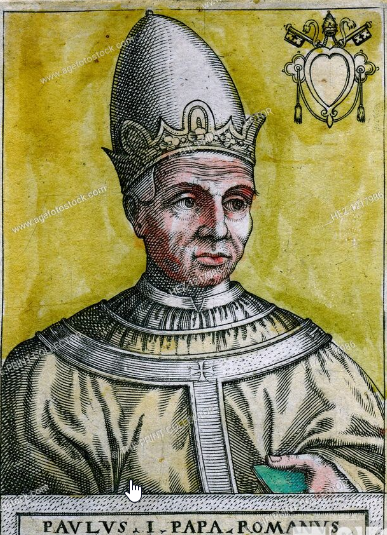
7: ST PAUL I, BISHOP OF CONSTANTINOPLE (A.D. 350 OR 351)
ST PAUL was a native of Thessalonica, but from his boyhood he had been secretary to Bishop Alexander by whom he was afterwards promoted to be a deacon in the church of Constantinople. When the aged hierarch lay on his death-bed—apparently in the year 336—he recommended St Paul as his successor and the electors endorsed his choice. Paul was accordingly consecrated by several orthodox bishops, and practically all that is known of himself and his life is the record of an episcopate made stormy by the heretical Arians, who had supported the candidature of an older deacon called Macedonius. At their instigation the Emperor Constantius summoned a council of Arian bishops, by whom Paul was deposed and banished. The vacant see was bestowed, not upon Macedonius, but upon the neighbouring metropolitan Eusebius of Nicomedia. St Paul took shelter in the west, and could not regain possession of the see until after the death of his powerful antagonist, which, however, took place soon afterwards. He was then reinstated amid popular rejoicings. The Arians, who still refused to acknowledge him, set up a rival bishop in the person of Macedonius, and soon the opposing factions came into open conflict and the city became a prey to violence and tumult. Constantius therefore ordered his general Hermogenes to eject Paul from Constantinople. But the populace, infuriated at the prospect of losing their bishop, set fire to the general’s house, killed him, and dragged his body through the streets. This outrage brought Constantius himself to Constantinople. He pardoned the people, but he sent St Paul into exile. On the other hand he refused to confirm the election of Macedonius which, like that of his rival, had taken place without the imperial sanction.
We find St Paul once more at Constantinople in 344, and Constantius then consented to re-establish him for fear of incurring the hostility of his brother Constans, who with Pope St Julius I supported Paul. But on the death of the Western emperor in 350 Constantius sent the praetorian prefect Philip to Constantinople with instructions to expel Paul and to install Macedonius in his place. Too astute to risk incurring the fate of Hermogenes, Philip had recourse to a stratagem. He invited St Paul to meet him at the public baths of Zeuxippus and, whilst the people, suspicious of his designs, were gathered outside, he hustled Paul out of a side window and got him away by sea. The unfortunate bishop was exiled to Singara, in Mesopotamia, and from thence was removed to Emesa in Syria and finally to Cucusus in Armenia. [* Fifty-four years later another bishop of Constantinople, St. John Chrysostom, was banished to the same place.] There he was left for six days and nights without food in a gloomy dungeon, and then strangled. This, at any rate, was the account given by Philagrius, an official who was stationed at Cucusus at the time.
(Butler’s Lives of the Saints)
_____________________
Good Morning,
Boys and Girls!
REV. THOMAS J. HOSTY, M.A., S.T.B.
(1952)
THE PRICE OF SIN
GOOD AFTERNOON, BOYS AND GIRLS!
You have every reason to ask me, ”What’s good about it?” Well, I must admit that there are a great many things about it which are bad. Everything around the sanctuary looks so cold and bare—all the statues are covered—there are no flowers on the altar—there are no cloths on the altar table—all that you can see are six candles, which are not even lit, and the crucifix hanging above the altar. But that is not the most terrible thing about the sanctuary today. There is something about the altar itself which really should make us feel sad. Who can tell me what it is that I am referring to?
Yes, it is the empty tabernacle. The doors of our Lord’s little home on earth are wide open, and He is not in His house. That is why you do not even see the sanctuary lamp lit today. What a difference there is between the way the church looks today, and the way it looked yesterday! Do you remember how we had a big parade, and how the priest carried our Lord around the church and put Him on a special altar where there were all kinds of beautiful flowers and where there were so many candles burning? We were very happy yesterday, and we should have been, because it was the birthday of our Lord in the Blessed Sacrament.
But today, everything is changed—and I’m sure every one of you knows why. Today we recall our Lord’s death on the cross. The Church has a strange name for today; she calls it, “Good Friday.” Wouldn’t you think that it would be called “Bad Friday”? I’d say “yes,” if it weren’t for the wonderful thing which our Lord’s death did for all of us. By all of us, I mean every man, woman, or child who was ever born or who will ever be born, in the history of the world. Do you know what that glorious thing was which He accomplished by His death on the cross? He made it possible for Adam and Eve and all their descendants to get to heaven! The doors to heaven were shut by Adam’s sin, but Christ, by his death, gave each one of us a key, by means of which we can open those doors.
As our Lord hangs on the cross before us today, there are many things I could talk to you about. I could tell you about the terrible sufferings He endured before He died. But I am not going to, because, no matter how hard I, or anyone else, tried, I couldn’t really picture the agony He went through. Only God Himself would be able to give a complete description of that suffering. But there is another reason why I’m not going to speak to you about the Passion of Christ. (By the way, “Passion” is the word which is used to sum up all the sufferings of our Lord before He died.)
That reason is this—I honestly believe that it is not knowledge which we lack with regard to Christ’s sufferings, but it is conviction. I realize that “conviction” is a big word, but, since it is also a very important word, let me explain it. When you believe something is true, and you act according to the way you believe, then you are said to be following your conviction. For example, if you do not curse because you know that God has forbidden it, and therefore it is wrong, you have a conviction about cursing. On the other hand, if you know that cursing is wrong because God has forbidden it, but you curse anyway because you’re angry or because you want to show the other boys in your gang how tough you are, you have knowledge, but you don’t have conviction.
The trouble with most of us, both grownups and children, is not that we don’t have enough knowledge of the sufferings of our blessed Lord, but that we don’t have conviction! You and I know that Christ died on the cross to make up to God for our sins. Does the thought of Him hanging on the cross keep you from lying, or stealing, or swearing, or laziness, or disobedience, or impurity in word or action? If it doesn’t, make no mistake about it—you do not have conviction with regard to Christ’s sufferings. I wish I had the power to stamp one truth upon your soul, and that one truth is this—our Lord did not die on the cross simply to make us feel sorry for Him! He died on the cross, after terrible agony, to teach us what God thinks of sin, and to make up to God for our sins. What a horrible thing sin must be in God’s eyes, since our dear Lord went through such awful suffering to make up for sin!
That is why I am going to ask each one of you to pray to our Lord today, not that you may know more about His sufferings, but that you may profit by what you do know. Pray, too, not that you may suffer more for your sins, but that you may understand more clearly why you do suffer. Ask our blessed Lord to help you to learn from His sufferings on the cross, what He and His heavenly Father think of sin. Ask Him to help you to convince yourself, with a conviction which neither time nor eternity will be able to wipe away, that sin is a terrible thing, and that the greatest evil which can possibly befall you is to commit a serious sin. No matter what honors the world may heap upon you, no matter how much money you may make, no matter how many schools or churches you may give to the Catholic Church, no matter if the Pope himself preaches your funeral sermon, if you die with one unforgiven serious sin upon your soul, your life has been a terrible failure! Only if you succeed in getting and hanging on to that conviction will Good Friday become for you what Christ intended it to be for you—not a day to make you feel sad, but a good, strong lesson to help you stay away from sin.
In a few minutes, just like Mary Magdalen, you will be coming forward to kneel at the altar, so that you may kiss the cross. As your lips touch the feet of our dear Lord, fastened with nails, try to remember this little prayer: “Jesus, I love you! I am sorry I ever offended You! Never allow me to sin again! Help me to love You always, and then do what You want with me!”
WHAT A DAY!
HAPPY EASTER, BOYS AND GIRLS!
My, you certainly look grand! I only hope that you keep your clothes as nice and clean looking all day! Seeing all of you so happy reminds me of what a wonderful day Easter Sunday always was for me, when I was your age.
To begin with, I was always delighted when Easter Sunday came, because it meant that Lent was finally over. I’ll never forget how long Lent used to seem. Instead of forty days, it seemed more like forty years. I found life very difficult without movies and candy and the other things which I gave up for Lent. To tell you the truth, though, I didn’t have much of a chance to break any good resolutions, even if I wanted to, because my Mother and Father wouldn’t give me any “Sunday money.” I always felt a little hungrier during Lent, too, because my Mother used to cut down on desserts, and things like that.
Finally, though, after what seemed like an eternity, Easter Sunday would arrive, together with a holiday from school. What a day that was, not only for me, but for my brothers and sisters, and for all the kids in our school! We strutted to church, in our new Easter outfits, vainer than any peacock, even though the only thing new about the outfit might have been the hat or cap. The church was always filled with gorgeous flowers, and Holy Mass was never more beautiful. We sang the Easter hymns so loudly that it was a wonder we didn’t break the windows or knock off the roof, After Mass, we hurried home to look for Easter eggs, and to wait impatiently for what we knew would be a delicious dinner. As the sweet flavor of the food drifted into the living room, from the kitchen, we thought we would die of hunger before the meal would ever be served. At last, however, after we had been pushed out of the kitchen for about the tenth time, Mother would proudly announce that dinner was ready. Believe me, no one had to be called a second time that day! If I live to be a thousand years old, I shall never forget how good that food used to taste. Despite my Father’s usual solemn warning before any big feast-day meal, not to let our eyes be bigger than our stomachs, we always ate a lot. After dinner, we bought ourselves some candy, and then spent a good part of the afternoon at the movies. In the evening, after a very tasty supper, we were allowed to sit up with the company, way past our usual bedtime, until we actually fell asleep.
Could you blame me, or any other boy or girl, for thinking that Easter Sunday was a wonderful day? But let me tell you something which you may not realize yet. Some grownups claim that the only people who are really happy, at Easter time, are the children. They say that when you grow up, you don’t have any real reason to be happy on that day. These people do a lot of talking about Easter eggs and bunnies and all those things, but they only do it for the sake of the children. They wish other people a “Happy Easter,” but that’s because they don’t know anything else to say on that day.
How many of you think that those people are right? Well, maybe I shouldn’t have asked you that question. After all, if you’re not a grownup, it’s pretty hard for you to say whether they are correct or not. So I think I’d better answer that question for you. And the answer is this—those people are completely wrong if they believe in the teachings of our Lord. Even if they don’t believe in His teachings, they are still wrong, but they are not as much to blame, because they don’t know any better.
Let me explain what I mean by that. Jesus Christ, our Lord, promised His followers that some day, after they died, their bodies would be joined to their souls again, and they would be taken to heaven with Him. Then they would be perfectly happy there with Him, forever. Of course, that was on condition that they would try to serve Him on this earth, and that they would not have any “serious sins on their souls when they died. If they did have serious sins on their souls when they died, they would be sent to hell, where they would suffer forever. As a proof that He really meant what He said, and that He could do what He said, He told His Apostles that He would be put to death, but that three days later He would rise from the dead. If He rose from the dead, then we could be absolutely certain that He was sent by God and that He would keep His other promises. Why? Because God would not work a miracle and raise Him from the dead in order to prove a lie.
Did Christ actually rise from the dead? Yes, He did! It is a fact which we can prove from history that He kept His word, and came back to life, three days after He had been put to death on a cross. Because Christ kept His word on that first Easter Sunday morning, we can be sure that He will keep His other promises, too. That is the real reason why grownups who believe in Christ are happy today.
Sure, your Mother and Father are happy for other reasons, too. They’re happy because they don’t have to fast any more, and because they can eat meat more than once a day. They’re happy because they’ve finished some of the penances which they freely took upon themselves for Lent, They’re happy because they love to see you dressed up in your new clothes. They’re happy because you make them happy, just watching you today. But none of these is the really important reason why they are happy today. I repeat, their greatest reason for happiness today is the fact that they are reminded that they are another step closer to the everlasting joys which will be theirs some day in heaven.
Your Mother and Father have a great number of cares and worries and problems which you don’t even know about. Some day, when you are quite a bit older than you are now, you will realize that very clearly. At times, your parents have a very hard time feeding you and clothing you and paying for all of your bills. But when Easter Sunday comes along, their hearts are very happy. They are reminded by our blessed Lord that some bright and glorious Easter morning, if they continue to trust in Him and do His will, they (and you with them!) will rise from the dead—glorious and immortal, like Christ Himself—with no more sickness, worries, or sorrow, forever!
—————————-
Father Krier will be in Pahrump on June 11 and Eureka June 18.
————————-
For those who purchase through Amazon, please help support the work here at Saint Joseph’s by going through this link: http://smile.amazon.com/ch/94-2855162
—————————–
The topics of Faith and Morals will correspond to the Roman Catholic Faith in Tradition and the Magisterium. The News will be of interest. The commentaries are for the reader to ponder and consider. The e-mail address will be for you to provide thought for consideration. The donations will be to support the continuation of this undertaking.
While the Newsletter is free of charge it is not free of cost. Please consider supporting St Joseph’s Catholic Church with a tax – deductible donation by clicking the secure link: Donate
Or if you prefer send a check to
Catholic Tradition Newsletter
c/o St Joseph’s Catholic Church
131 N. 9th St
Las Vegas, NV 89101
Visit us on the Worldwide Web: http://stjosephlv.org
e-mail news and comments to: tcatholicn@yahoo.comTo unsubscribe, please type, “unsubscribe”‚ in subject line.…
[Message clipped] View entire message