Vol 13 Issue 18 ~ Editor: Rev. Fr. Courtney Edward Krier
May 2, 2020 ~ Saint Athanasius, opn!
1. What is the Holy Eucharist
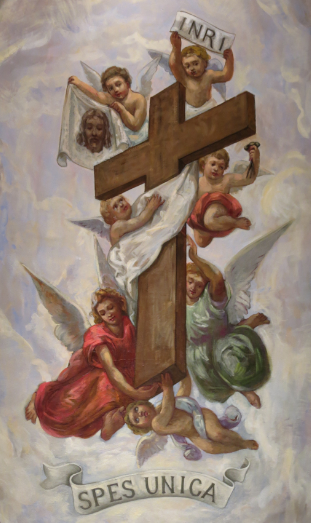
2. Third Sunday after Easter
3. Finding of the Holy Cross
4. Family and Marriage
5. Articles and notices
Dear Reader:
I want to thank all who responded to my inquiry about the possibility of having to receive a vaccination to travel.
Last week Robert Barron, a Conciliar Bishop, wrote the following:
FRIDAY OF THE SECOND WEEK OF EASTER
JOHN 6:1-15
Friends, today’s Gospel tells of the feeding of the five thousand, which is a type of the Mass. Jesus is interested not only in instructing the crowds but also in feeding them. Copying this rhythm, the Mass moves from the Liturgy of the Word to the Liturgy of the Eucharist.
The disciples supply a poor pittance—five barley loaves and two fish. Jesus makes the customary Eucharistic moves in regard to the bread: taking, giving thanks, and distributing. And everyone is fed.
During the sacred liturgy, the priest, on behalf of the people, offers to God a small pittance: some wafers of bread and some wine and water. But because God has no need of these gifts, they come back infinitely multiplied for the benefit of the people.
Through the power of Christ’s word, those gifts become his very Body and Blood, the only food capable of feeding the deepest hunger of the human heart. This liturgical rhythm is beautifully conveyed by the laconic lines: “Jesus took the bread, gave thanks to God, and distributed it to the people who were sitting there . . . and they all had as much as they wanted.”
I provided the full text so no one may say I took it out of context. But the question arises: Does the priest, at Mass, offer bread and wine? I repeat here part of a chapter from What is the Holy Eucharist:
Bread and Wine
Though bread and wine are the material matter of the Eucharistic Sacrifice, the words, bread and wine, used simultaneously are not to be found during Mass.
In the words of institution and consecration, the priest says, regarding the host [Under the Article, Host, in the Catholic Encyclopedia, one reads: It (Host) was applied to Christ, the Immolated Victim, and, by way of anticipation, to the still unconsecrated bread destined to become Christ’s Body.]:
Who, the day before He suffered, took bread into His holy and venerable hands, and having raised His eyes to heaven, unto Thee, O God, His Almighty Father, giving thanks to Thee, He blessed it, broke it, and gave it to His disciples, saying: Take ye all and eat of this: For this is My Body.
Afterwards, the priest speaks of Christ in the Eucharists as the holy Bread of life eternal and the Bread of Heaven. This references that scene of Moses: And the Lord said to Moses: Behold I will rain bread from heaven for you: let the people go forth, and gather what is sufficient for every day: that I may prove them whether they will walk in my law, or not. (Exodus 16:4) And whose fulfilment is now accomplished in Holy Mass as testified in John’s Gospel: I am the living bread which came down from heaven. If any man eat of this bread, he shall live for ever; and the bread that I will give, is my flesh, for the life of the world. (6:51-52)
Besides, then, addressing the matter as bread in the words of institution as taken from Scripture, the unconsecrated bread is addressed previously in the Offertory as spotless host and both the bread and wine as gifts, sacrifice and oblations.
The wine, too, is not referred to simply as wine except in the words of the mixing of wine and water during the Offertory to express the union of humanity with the divinity:
O God, Who hast established the nature of man in wondrous dignity, and still more admirably restored it, grant that through the mystery of this water and wine [united in one], we may be made partakers of His Divinity, Who has condescended to become partaker of our humanity, Jesus Christ, Thy Son, our Lord.
Afterwards one only reads chalice of salvation. At the words of institution and consecration:
In like manner, when the supper was done, taking also this goodly chalice into His holy and venerable hands, again giving thanks to Thee, He blessed it, and gave it to His disciples, saying: Take ye all, and drink of this: For this is the Chalice of My Blood of the new and eternal covenant; the mystery of faith, which shall be shed for you and for many unto the forgiveness of sins.
Though one may not consider it of importance, the meaning is brought to light if one again identifies the types of the Eucharistic Sacrifice in the Old Testament. Here one must start with the Sacrifices of Cain and Abel.
And it came to pass after many days, that Cain offered, of the fruits of the earth, gifts to the Lord. Abel also offered of the firstlings of his flock, and of their fat: and the Lord had respect to Abel, and to his offerings. But to Cain and his offerings he had no respect (Gen. 4:3-5)
The fruits of the earth—grain (bread) and grapes (wine)—as such, were not acceptable of themselves. Except as type, how else would one literally interpret God’s rejection of Cain’s offering? Therefore, the Offertory does not refer to the fruits of the earth, but to the Lamb of God that will be offered, to the Body and Blood of Christ—which alone is an acceptable sacrifice and only united with that sacrifice, any other sacrifice. In the Novus Ordo Missae Liturgy of the Eucharist the rejection of this concept places the stress, in the offertory that only bread and wine are offered: the fruits of the earth. (Cf. Ambrose, Cain and Abel, Bk. 1, ch. 7, 25)
Priest: Blessed are you, Lord, God of all creation. Through your goodness we have this bread to offer, which earth has given and human hands have made. It will become for us the bread of life.
All: Blessed be God for ever.
Priest: Blessed are you, Lord, God of all creation. Through your goodness we have this wine to offer, fruit of the vine and work of human hands. It will become our spiritual drink.
All: Blessed be God for ever.
It is based on the simple blessing of food according to Jewish custom:
Blessed are You, Lord our God, Ruler of the universe, who brings forth bread from the earth.
Blessed are You, Lord our God, Ruler of the universe, who creates the fruit of the vine.
Therefore, seeing that it was first the fruits of the earth that were offered and were not accepted, the liturgy does not offer bread and wine of itself, but only in view that what is being offered is to become the spotless host, gifts, sacrifice and oblations which are the Body and Blood of the Lamb of God. It typifies also that at first there are the fruits of the earth (Cain), but only when they are the lamb (Abel) does God accept.
N. Gihr, in his work, The Holy Sacrifice of the Mass, writes:
Yet the Offertory has not exclusively for its object the mere elements of bread and wine, but also the real object of the sacrifice of the New Law: the body and blood of Christ, which by Consecration take the place of the former substances of bread and wine, and thus become present on the altar. The Church, therefore, does not wait until the change of substance has taken place to offer the victim; already in the Offertory she offers the divine victim to the divine Majesty, regarding, as it were, the approaching Consecration of the sacrificial elements as having already taken place. The offering (oblatio) of the sacrificial gifts may precede and follow the accomplishment of the actual sacrificial act (immolatio, sacrificatio), as in our Mass rite, in which a similar oblation repeatedly takes place for the glorification of the divine name and for the salvation of the living and of the dead. From this point of view it can be explained why the Church already designates her oblation by such names as: immaculata hostia, calix salutaris, sancta sacrificia illibata, sacrificium laudis, which in their full sense are applicable only to Christ’s sacrificial body and blood.
From the liturgical prayers of the Offertory, therefore, we may by no means conclude that the offering of the elements of bread and wine is a real sacrifice or constitutes a part of the Eucharistic sacrifice. Only Jesus Christ, present on our altars under both species as symbols of His death, is the perpetual sacrifice of the Catholic Church, our real and true sacrifice. (Gihr, 536-38)
In conclusion, it should be clear that the offering of the people that is accepted, is not the same as what the priest offers—for though in past ages the people offered bread and wine to the priest, the priest changes and offers the Body and Blood of Christ. In this sense one can then understand the simple explanation of the Baltimore Catechism, The chief supernatural powers of the priest are: change bread and wine into the body and blood of Christ in the Holy Sacrifice of the Mass, and forgive sins in the sacrament of Penance. (q. 454) This is found in Canon 1 of Session XXIII of the Council of Trent The Doctrine on the Sacrament of Orders: If anyone says that there is not in the New Testament a visible and external priesthood, or that there is no power of consecrating and offering the true body and blood of the Lord, and of forgiving and retaining sins, but only the office and bare ministry of preaching the Gospel, or that those who do not preach are not priests at all: let him be anathema. (cf. DB. 961)
As always, enjoy the readings provided for your benefit.—The Editor
________________
WHAT IS THE HOLY EUCHARIST
By Rev. Courtney Edward Krier
PART II
Institution
The Institution of the Holy Eucharist
The Passover was an obligation that every Israelite had to celebrate. If, because of some ritual impurity—such as a death—, the Israelite could not celebrate it on the prescribed date, they would have to celebrate it the next month.
But behold some who were unclean by occasion of the soul of a man, who could not make the phase on that day, coming to Moses and Aaron, said to them: We are unclean by occasion of the soul of a man. Why are we kept back that we may not offer in its season the offering to the Lord among the children of Israel? And Moses answered them: Stay that I may consult the Lord what he will ordain concerning you. And the Lord spoke to Moses, saying: Say to the children of Israel: The man that shall be unclean by occasion of one that is dead, or shall be in a journey afar off in your nation, let him make the phase to the Lord. In the second month, on the fourteenth day of the month in the evening, they shall eat it with unleavened bread and wild lettuce: They shall not leave any thing thereof until morning, nor break a bone thereof, they shall observe all the ceremonies of the phase. (Num. 9:6-12)
The passage from Luke, And his parents went every year to Jerusalem, at the solemn day of the pasch (2:41) indicates their understanding that it was prescribed Law and never failed to observe once they returned to Nazareth. Luke does not mention the Pasch again until the days leading up to the Passion and Death of Christ—nor do the other Evangelists except John, who also, as explained previously, introduced the Holy Eucharist in chapter six of his Gospel, but does not provide the scene of the institution of the Holy Eucharist—though the celebration of the last Pasch is given considerable attention.
John the Evangelist begins the public ministry of Christ—after the miracle of Cana—as Christ going up to Jerusalem for the Pasch: And the pasch of the Jews was at hand, and Jesus went up to Jerusalem. (John 2:13) It was the time of the Pasch that Jesus multiplied the loaves and the fishes and then promises to give His Body and Blood as food: Now the pasch, the festival day of the Jews, was near at hand. (John 6:4) And, it is at the time of the Pasch that he goes to Bethany to raise Lazarus from the dead and then enter Jerusalem for His Passion and Death:
But one of them, named Caiphas, being the high priest that year, said to them: You know nothing. Neither do you consider that it is expedient for you that one man should die for the people, and that the whole nation perish not. And this he spoke not of himself: but being the high priest of that year, he prophesied that Jesus should die for the nation. And not only for the nation, but to gather together in one the children of God, that were dispersed. From that day therefore they devised to put him to death. Wherefore Jesus walked no more openly among the Jews; but he went into a country near the desert, unto a city that is called Ephrem, and there he abode with his disciples. And the pasch of the Jews was at hand; and many from the country went up to Jerusalem, before the pasch to purify themselves. They sought therefore for Jesus; and they discoursed one with another, standing in the temple: What think you that he is not come to the festival day? And the chief priests and Pharisees had given a commandment, that if any man knew where he was, he should tell, that they might apprehend him. (John 11:49-56)
Christ enters the city of Jerusalem on Palm Sunday as King, as the Gospel of Matthew prescribed for the liturgical procession announces:
And when they drew nigh to Jerusalem, and were come to Bethphage, unto mount Olivet, then Jesus sent two disciples, Saying to them: Go ye into the village that is over against you, and immediately you shall find an ass tied, and a colt with her: loose them and bring them to me. And if any man shall say anything to you, say ye, that the Lord hath need of them: and forthwith he will let them go. Now all this was done that it might be fulfilled which was spoken by the prophet, saying: Tell ye the daughter of Sion: Behold thy king cometh to thee, meek, and sitting upon an ass, and a colt the foal of her that is used to the yoke. And the disciples going, did as Jesus commanded them. And they brought the ass and the colt, and laid their garments upon them, and made him sit thereon. And a very great multitude spread their garments in the way: and others cut boughs from the trees, and strewed them in the way: And the multitudes that went before and that followed, cried, saying: Hosanna to the son of David: Blessed is he that cometh in the name of the Lord: Hosanna in the highest. (21:1-9; cf. Zach. 9:9: Rejoice greatly, O daughter of Sion, shout for joy, O daughter of Jerusalem: BEHOLD THY KING will come to thee, the just and saviour: he is poor, and riding upon an ass, and upon a colt the foal of an ass.)
He is acknowledged as Prophet: And the people said: This is Jesus the prophet, from Nazareth of Galilee. (v. 10) He then enters the Temple as Priest:
And Jesus went into the temple of God, and cast out all them that sold and bought in the temple, and overthrew the tables of the money changers, and the chairs of them that sold doves: And he saith to them: It is written, My house shall be called the house of prayer; but you have made it a den of thieves. (vv. 11-13)
Is this house then, in which my name hath been called upon, in your eyes become a den of robbers? I, I am he: I have seen it, saith the Lord. (Jer. 7:11)
And the children of the stranger that adhere to the Lord, to worship him, and to love his name, to be his servants: every one that keepeth the sabbath from profaning it, and that holdeth fast my covenant: I will bring them into my holy mount, and will make them joyful in my house of prayer: their holocausts, and their victims shall please me upon my altar: for my house shall be called the house of prayer, for all nations. (Isa. 6-7)
On Monday, the tenth day of the month of Nisan, when the Israelites were choosing their lamb, Christ returns to the Temple to be chosen:
Jesus saith to them: Have you never read in the Scriptures: The stone which the builders rejected, the same is become the head of the corner? By the Lord this has been done; and it is wonderful in our eyes. Therefore I say to you, that the kingdom of God shall be taken from you, and shall be given to a nation yielding the fruits thereof. And whosoever shall fall on this stone, shall be broken: but on whomsoever it shall fall, it shall grind him to powder. And when the chief priests and Pharisees had heard his parables, they knew that he spoke of them. And seeking to lay hands on him, they feared the multitudes: because they held him as a prophet. (Matt. 21:42-46)
Meagher writes in contrasting the week of the Passion of Christ with the week of preparation for the Passover among the Jews:
On the tenth day of the month of Nisan, the Hebrews were to select the lamb, for on this day Christ was condemned to death by the Sandhedrin at Jerusalem. [Exod. 12.8.] They were told to choose a little ram and keep it till the fourteenth day of the same month, in the evening, for at midnight, following that day, 1300 years later, Christ was arrested. The paschal festival lasted a week, because during Passion week, Christ was sacrificed, lay in the tomb and rose from the dead. [Exod. xii. 6.] (Meagher, 126)
The great throngs were very busy that Monday; all was turmoil, talk and excitement, for that day they selected the lambs for the Passover. The men of the bands first bought and washed the lamb, and called it “The Lamb of God” as they condemned it to death.
First they washed the victim to image the Passover bath the Lord took with his apostles before the Last Supper. They scented the animal with costly perfume,[Edersheim, Life of Christ, i. 343.] to foretell the perfume of holiness and good works performed by Jesus. Then they tied the little victim to a colored stake [ emblematic of Jesus fastened to his bloody cross. This was the way the lamb was prepared from Moses’ day to prophesy the future Passion of the” Lamb of God,” who was to take away the sins of the world.3 A hundred and forty times the Old Testament mentions the lamb as a type of Christ, and thirty-four times calls the Lord “the Lamb.” (Meagher, 320)
And it came to pass, when Jesus had ended all these words, he said to his disciples: You know that after two days shall be the pasch, and the son of man shall be delivered up to be crucified: Then were gathered together the chief priests and ancients of the people into the court of the high priest, who was called Caiphas: And they consulted together, that by subtilty they might apprehend Jesus, and put him to death. But they said: Not on the festival day, lest perhaps there should be a tumult among the people. (Matt. 26:1-5; cf. Mark 14:1)
The chief priests therefore, and the Pharisees, gathered a council, and said: What do we, for this man doth many miracles? If we let him alone so, all will believe in him; and the Romans will come, and take away our place and nation. But one of them, named Caiphas, being the high priest that year, said to them: You know nothing. Neither do you consider that it is expedient for you that one man should die for the people, and that the whole nation perish not. And this he spoke not of himself: but being the high priest of that year, he prophesied that Jesus should die for the nation. And not only for the nation, but to gather together in one the children of God, that were dispersed. From that day therefore they devised to put him to death. (John 11:47-53; cf. Luke 22:1f)
Christ then announces His being sacrificed: You know that after two days shall be the pasch, and the son of man shall be delivered up to be crucified (Matt. 26:2) Now the reference to the feast of the Passover was known as the Pasch and the Azymes. Although originally distinct, the Feast of Azymes and the Feast of the Passover are often treated as one and the same [Deuteronomy 16:16; Matthew 24:17; Mark 14:12; Luke 22:1, 7] (Albert, Azymes in CE) Azymes is unleavened bread, that is, grounded wheat flour and water only, mixed and baked into bread. It was commanded to the Israelites: Seven days shall you eat unleavened bread: in the first day there shall be no leaven in your houses: whosoever shall eat any thing leavened, from the first day until the seventh day, that soul shall perish out of Israel. (Exod. 12:15) Therefore, two events that tied together were happening: the paschal lamb and the unleavened bread.
————————–
The Sunday Sermons of the Great Fathers
M. F. Toal
THE GOSPEL OF THE SUNDAY
John xvi. 16-22
At that time: Jesus said to his disciples: A little while, and now you shall not see me; and again a little while, and you shall see me: because I go to the Father. Then some of his disciples said one to another: What is this that he saith to us: A little while, and you shall not see me; and again a little while, and you shall see me, and, because I go to the Father? They said therefore: What is this that he saith, a little while? we know not what he speaketh. And Jesus knew that they had a mind to ask him; and he said to them: of this do you inquire among yourselves, because I said: A little while, and you shall not see me; and again a little while, and you shall see me? Amen, amen, I say to you, that you shall lament and weep, but the world shall rejoice; and you shall be made sorrowful, but your sorrow shall be turned into joy. A woman, when she is in labour, hath sorrow, because her hour is come; but when she hath brought forth the child, she remembereth no more the anguish, for joy that a man is born into the world. So also you now indeed have sorrow; but I will see you again, and your heart shall rejoice; and your joy no man shall take from you.
EXPOSITION FROM THE CATENA AUREA
V. 16. A little while, and now you shall not see me.
CHRYSOSTOM, 79 in John: After the Lord had encouraged the Disciples, because of what He had promised them through the Holy Spirit, He again saddens their spirits by saying: A little while etc. This He does that He may as it were harden their spirits to the hearing of painful things, so that they shall bear up well against the coming separation from Him; for nothing is so wont to calm a soul which grieves, and which is held fast by sorrow as to repeat again and again the words which cause the sorrow.1
BEDE: For He says: A little while, and now you shall not see me. For that night He was taken by the Jews, and the next day He was crucified, and on that evening He was buried, and shut away from human eyes.
CHRYSOSTOM: If any one should carefully consider them, these are words of consolation: because I go to the Father. For they are meant to show that He will not perish; but that His death is but a (translatio) removal from earth to heaven. And He adds another consolation when He says: And again a little while, and you shall see me; showing that, since He will return again, the separation will be but for a little while, and that their meeting again shall be without end.
AUGUSTINE, Tr. 101 in John: But these words of the Lord were obscure to the Disciples, prior to the fulfilment of what was said in them; so there follows:
V. 17. Then some of his disciples said one to another: what is this . . .
CHRYSOSTOM: They did not understand what He said, either because of their grief, which pushed out of their minds the significance of what He was saying, or because of the obscurity of what He said; and thus He seemed to utter contrary things, which were not in reality contradictory. For, they say, if we shall see Thee, how then is it that you are going away? And if you do go, how then shall we see Thee? So they say to Him:
V. 18. What is this that he saith, a little while? We know not . . .
AUGUSTINE, as above: Because, a little while before—verse 10—He had said, not, a little while, but merely: I go to the Father, He had seemed to speak in simple terms to them. What was then obscure to them, and presently explained, is now made clear to us also. For after a little while He suffered, and they did not see Him; and then after a little while He rose again, and they saw Him. He said: And you shall see me no longer; meaning that they never again would see the mortal Christ.
ALCUIN: Or, for a little while you shall not see me; that is, for the three days in which He lay in the sepulchre and again it will be another little while until you shall see me; that is, these forty days, from His Passion to His Ascension, in which He frequently appeared to them. And so for that little while you shall see me; for I go to the Father: I shall not always remain bodily upon the earth, but shall, in this humanity I have assumed, ascend to heaven.
V. 19. And Jesus knew that they had a mind to ask him; and he said . . .
The kind Master, knowing their ignorance, answers them according to their doubts, as it were explaining what He had said.
V. 20. Amen, amen, I say to you, that you shall lament and weep:
AUGUSTINE, as above: This can be taken to mean that the Disciples were grief stricken because of Christ’s death; and then made joyful by His Resurrection. But the world, and by this I mean the enemies who had slain Christ, then indeed rejoiced, at Christ’s death, while the Disciples sorrowed. So we have: But the world shall rejoice: and you shall be made sorrowful, but your sorrow shall be turned into joy.
ALCUIN: These words of Christ are meant for all the faithful, who amid the trials and afflictions of this present life strive to reach to the joy of heaven. But while the just now weep, the world rejoices: for it takes its joy in the present, having no hope of the joys of the life to come. CHRYSOSTOM: Then showing that grief will bring forth joy, and that sorrow is but fleeting, while their happiness will be without end, He puts before them an example from our own nature.
V. 21. A woman, when she is in labour, hath sorrow, because . . .
AUGUSTINE, as above: This parable does not seem difficult to understand, for its application is known to us; and He has Himself explained to us why He used it. For there follows: So also you now indeed have sorrow; but I will see you again, and your heart shall rejoice. Sadness is compared to travail, joy to actual birth; which is always greater when a manchild, not a female child, is born. In saying: And your joy no man shall take from you, He means that to which the Apostle refers: Christ rising again from the dead, dieth now no more (Rom. vi. 19), for Jesus is Himself their joy.
CHRYSOSTOM, as above: Here He also hints at some mystery, that He has Himself also eased the pangs of death, causing a new man to be born of them. And He also said that the woman would not alone have no more anguish, but that she will not even remember the anguish she had: so great is the joy that comes. So shall it be with the blessed. And the woman rejoices, not because a man has come into the world, but because she has brought forth a child. He did not say a child is born, but that a man is born again into the world; obscurely referring to His own Resurrection.
AUGUSTINE: I think that the words: A little while and you shall not see me, and again a little while and you shall see me, are best understood of the vision and glory to come: of which we have spoken earlier. For the little while is this whole span of time in which this present world revolves. When He added: Because I go to the Father, He is referring to the first part of the previous sentence, namely: A little while and you shall not see me; and not to the other half of it where He says: And again a little while, and you shall see me. For His going to the Father would mean they would not see Him. And so to those who were then seeing Him in the Body He says: A little while and you shall not see me: for He was about to go to His Father, and from thence forward they would not again see Him as the mortal man they were seeing while He spoke these words. What He added here, namely: And again a little while, and you shall see me, He promises to the whole Church. This little while seems long while it is endured by us; but when it is over, then we shall see how little it was.
BEDE: The woman spoken of is the Holy Church; fruitful in all good works, and bearing spiritual children to God. This woman, while she is bringing forth; that is, while in this world she keeps steadfast in the ways of virtue, though tried and afflicted on every side, sorrows for this reason, that her hour is come; for no one hates their own flesh (Eph. v. 29).
AUGUSTINE: But neither let us be joyless in the bringing forth of this object of our desire; but let us be as the Apostle says, rejoicing in hope; for even the woman in labour, to whom we are compared, is more joyful over the child now coming to her, than grieving over her present pain.
BEDE: But when she hath brought forth the child; that is, when she has overcome pain in the contest of her travail and attained the palm of victory, she remembereth no more the anguish, that went before, for joy of the reward received, that man is born into the world. For as the woman rejoices that a man child is born into this world, so is the Church filled with exultation at the multitude of the faithful born to eternal life.
BEDE: Nor should it appear to you strange that he is called born who has departed from this life. For as a man is said to be born when coming forth from his mother’s womb he enters into the light of day, so may he be said to be born who from the bonds of the flesh is uplifted to that light which is eternal. So the commemorations of the saints are not called funeral ceremonies, but birth day festivities (Natalitia).
V. 22. So also you now indeed have sorrow; but I shall see you again.
ALCUIN: That He said, I will see you again means, I shall take you to myself. Or, I will see you again; that is, I shall appear again for you to see Me; and your heart shall rejoice.
AUGUSTINE: The Church is now in labour, longing for this fruit of all her labour; then shall She bring forth, beholding It. And therefore a Man-child: since it is towards this Fruit of her eager longing that all her actions are directed. For He alone is free; because He is desired in Himself, and not in relation to some other end. To Him her actions are directed. To this end is directed whatsoever good she does. For there is the end which contents us: and which therefore shall be eternal. For there is no end that can content us, save that of which there is no end. Of this Object then, which alone fulfils all our desiring, rightly are we told: Your joy no man shall take from you (here again, possibly, referring to the Mystical Body of Christ, born of the Church, the woman in labour. Ed.).
———————–
MAY 3
Finding of the Holy Cross
1. In the year 313 Emperor Constantine defeated the rival Emperor Maxentius by the power of the Cross of Christ miraculously exhibited in the heavens. “In this sign thou wilt conquer” was the inscription he read. Then Constantine’s mother, Helena, journeyed to Jerusalem in the hope of finding the true Cross of Christ in its material form. Deep in the earth three crosses were found. To determine which was the one on which the Redeemer died, all three were brought into contact with a sick woman. The third cross cured her instantly and was therefore understood to be the true Cross. Helena caused a basilica to be built over the spot where the crosses were found. She carried a part of the true Cross to the Emperor, and it is still venerated in the church of the “Holy Cross of Jerusalem,” which he had built in Rome. Today’s feast commemorates the finding of the Cross on which Christ died for our salvation.
2. “Ours to make our boast in the cross of our Lord Jesus Christ” (Introit). This is a challenge; but how few Christians there are who glory in the Cross and who consider it a distinction and an honor to carry the cross of suffering. The Cross of Christ separates men into two classes: those who look upon the doctrine of a crucified Savior as foolishness, and those who see, beneath the repulsive appearance, the saving power of the Redeemer’s death. St. Paul says: “What we preach is Christ Crucified; to the Jews, a discouragement, to the Gentiles, mere folly; but to us who have been called, Jew and Gentile alike, Christ the power of God, Christ the wisdom of God” (I Cor. 1:23).
The mystery of the Cross is revealed only to faith; an earthy, natural way of thinking cannot fathom it. The more firmly we believe; the more we see things as God sees them, and judge them by God’s standards, the better we shall understand the Cross and learn to “make our boast” in it; the better we shall realize that our redemption was accomplished on the Cross and that all salvation, all life, all grace, come from the Cross alone. St. Paul assures us that our Lord Himself was exalted precisely because “He lowered his own dignity, accepted an obedience which brought him to death, death on a cross. That is why God has raised him to such height, given him that name which is greater than any other name; so that everything in heaven and on earth and under the earth must bend the knee” (Epistle). Only to the extent that we become crucified with Christ and allow ourselves to be crucified, shall we be partakers of His Glory (cf. Rom. 8:15 H,). Thus, it was God’s plan that the salvation of mankind should be accomplished on the wood of the Cross (Preface). Hence, to us who believe, a cross is not a misfortune—something to flee from; rather, “ours to make our boast in the cross”; it is for us the way to salvation, to life, to resurrection; it is the “tree of life.”
“And this Son of man must be lifted up, as the serpent was lifted up by Moses in the wilderness; so that those who believe in him may not perish but have eternal life” (Gospel). When the Israelites were being led through the desert they murmured against God and against Moses: “We have neither bread nor water here; we are sick. . . of the unsatisfactory food thou givest us. Upon this, the Lord sent serpents among them, with fire in their fangs, that struck at many and killed many of them.” Then God commanded Moses to “fashion a serpent of bronze, and set it upon a staff, bringing life to all who should look toward it as they lay wounded. And so it proved; when Moses had made a brazen serpent and set it up on a staff, the wounded men had but to look towards it, and they were healed” (cf. Num. 21:5 ff.). The brazen serpent is a figure of the Crucified. Whoever looks up—with faith—to the Crucified Savior will be saved. There is no other way to salvation. No other power—not talent, not knowledge, not ability—can bring man true happiness, except the Cross of Christ. It was only by way of the Cross that the Redeemer came to his glorious Resurrection. We must follow His example if we desire resurrection and life. Looking up to the image of the Crucified we sing at the Offertory: “The power of the Lord has triumphed: I am reprieved from death to live on and proclaim what the Lord has done for me” (Ps. 117: 16-17). “Yes, if only I am lifted up from the earth, I will attract all men to myself” (John 12:32). We believe; we are confident that Christ saves by means of His Cross.
3. In the Offertory of the Mass we have a living re-enactment of the sacrifice on the Cross: the same gift being offered; the same Priest, that is, Christ, who offers the Sacrifice together with the participating congregation and with the identical intention that He had on the Cross. We enter into His intention and permit ourselves to be drawn aloft by Him to His Cross. The more we offer ourselves in union with Jesus on the Cross and allow ourselves to be identified with Him, the more fully shall we experience the fruit of the Cross, which is life and salvation. “I am reprieved from death, to live on and proclaim what the Lord has done for me” (Offertory).
St. Paul of the Cross…
[Message clipped] View entire message

| Ginger Snaps | May 2, 2020, 4:55 PM (3 days ago) |
| Catholic Tradition Newsletter St. Paul of the Cross says: “What a great honor God bestows on us by allowing us to walk the same road that He prepared for His So |

| JOSEPH SARACENO | May 3, 2020, 8:51 PM (2 days ago) | |
| to me |
O.K.
On Saturday, May 2, 2020, 01:55:51 PM PDT, Ginger Snaps <heavenshocking@gmail.com> wrote:
———- Forwarded message ———
From: Fr Courtney E Krier <tcatholicn@yahoo.com>
Date: Fri, May 1, 2020 at 9:31 AM
Subject: Catholic Tradition News Letter B18: Holy Eucharist, Third Sunday after Easter Finding of Cross, Family
To: Fr Courtney Edward Krier <in_his_service@att.net>
Catholic Tradition Newsletter
A weeklypresentation of News, Information, Readings and Commentary for traditional RomanCatholics and Catholic Families remaining faithful to the teaching Magisteriumas held by all faithful Catholics through the centuries.
Vol 13Issue 18 Editor: Rev.Fr. Courtney Edward Krier
May 2, 2020
SaintAthanasius, opn!
1. What is the HolyEucharist
2. Third Sunday afterEaster
3. Finding of the HolyCross
4. Family and Marriage
5. Articles and notices
DearReader:
Iwant to thank all who responded to my inquiry about the possibility of havingto receive a vaccination to travel.
Lastweek Robert Barron, a Conciliar Bishop, wrote the following:
FRIDAY OF THE SECOND WEEK OF EASTER
JOHN 6:1-15
Friends,today’s Gospel tells of the feeding of the five thousand, which is a type ofthe Mass. Jesus is interested not only in instructing the crowds but also infeeding them. Copying this rhythm, the Mass moves from the Liturgy of the Wordto the Liturgy of the Eucharist.
Thedisciples supply a poor pittance—five barley loaves and two fish. Jesus makesthe customary Eucharistic moves in regard to the bread: taking, giving thanks,and distributing. And everyone is fed.
Duringthe sacred liturgy, the priest, on behalf of the people, offers to God asmall pittance: some wafers of bread and some wine and water. But becauseGod has no need of these gifts, they come back infinitely multiplied for thebenefit of the people.
Throughthe power of Christ’s word, those gifts become his very Body and Blood, theonly food capable of feeding the deepest hunger of the human heart. Thisliturgical rhythm is beautifully conveyed by the laconic lines: “Jesustook the bread, gave thanks to God, and distributed it to the people who weresitting there . . . and they all had as much as they wanted.”
I providedthe full text so no one may say I took it out of context. But the questionarises: Does the priest, at Mass, offer bread and wine? I repeat here part of achapter from What is the Holy Eucharist:
Bread andWine
Though bread and wine are the material matter of theEucharistic Sacrifice, the words, bread and wine, used simultaneouslyare not to be found during Mass.
In the words of institution and consecration, thepriest says, regarding the host [Under the Article, Host, in the CatholicEncyclopedia, one reads: It (Host) was applied to Christ, theImmolated Victim, and, by way of anticipation, to the still unconsecratedbread destined to become Christ’s Body.]:
Who, the daybefore He suffered, took bread into His holy and venerable hands, andhaving raised His eyes to heaven, unto Thee, O God, His Almighty Father, givingthanks to Thee, He blessed it, broke it, and gave it to His disciples, saying:Take ye all and eat of this: For this is My Body.
Afterwards, the priest speaks of Christ in theEucharists as the holy Bread of life eternal and the Bread of Heaven. This references that scene of Moses: Andthe Lord said to Moses: Behold I will rain bread from heaven for you: let thepeople go forth, and gather what is sufficient for every day: that I may provethem whether they will walk in my law, or not. (Exodus 16:4) And whosefulfilment is now accomplished in Holy Mass as testified in John’s Gospel: Iam the living bread which came down from heaven. If any man eat of this bread,he shall live for ever; and the bread that I will give, is my flesh, for thelife of the world. (6:51-52)
Besides, then, addressing the matter as bread in thewords of institution as taken from Scripture, the unconsecrated bread isaddressed previously in the Offertory as spotless host and both thebread and wine as gifts, sacrifice and oblations.
The wine, too, is not referred to simply as wineexcept in the words of the mixing of wine and water during the Offertory toexpress the union of humanity with the divinity:
O God, Whohast established the nature of man in wondrous dignity, and still moreadmirably restored it, grant that through the mystery of this water and wine [united in one],we may be made partakers of His Divinity, Who has condescended to becomepartaker of our humanity, Jesus Christ, Thy Son, our Lord.
Afterwards one only reads chalice of salvation.At the words of institution and consecration:
In likemanner, when the supper was done, taking also this goodly chalice intoHis holy and venerable hands, again giving thanks to Thee, He blessed it, andgave it to His disciples, saying: Take ye all, and drink of this: For this isthe Chalice of My Blood of the new and eternal covenant; the mystery offaith, which shall be shed for you and for many unto the forgiveness of sins.
Though one may not consider it of importance, the meaningis brought to light if one again identifies the types of the EucharisticSacrifice in the Old Testament. Here one must start with the Sacrifices of Cainand Abel.
And it cameto pass after many days, that Cain offered, of the fruits of the earth, giftsto the Lord. Abel also offered of the firstlings of his flock, and of theirfat: and the Lord had respect to Abel, and to his offerings. But to Cain andhis offerings he had no respect (Gen. 4:3-5)
The fruits of the earth—grain (bread) and grapes(wine)—as such, were not acceptable of themselves. Except as type, how elsewould one literally interpret God’s rejection of Cain’s offering? Therefore,the Offertory does not refer to the fruits of the earth, but to the Lamb of Godthat will be offered, to the Body and Blood of Christ—which alone is anacceptable sacrifice and only united with that sacrifice, any other sacrifice.In the Novus Ordo Missae Liturgy of the Eucharist the rejection of thisconcept places the stress, in the offertory that only bread and wine areoffered: the fruits of the earth. (Cf. Ambrose, Cain and Abel, Bk. 1,ch. 7, 25)
Priest: Blessed are you, Lord, God of all creation.Through your goodness we have this bread to offer, which earth has given andhuman hands have made. It will become for us the bread of life.
All: Blessed be God for ever.
Priest: Blessed are you, Lord, God of all creation.Through your goodness we have this wine to offer, fruit of the vine and work ofhuman hands. It will become our spiritual drink.
All: Blessed be God for ever.
It is based onthe simple blessing of food according to Jewish custom:
Blessed are You, Lord our God, Ruler of the universe,who brings forth bread from the earth.
Blessed are You, Lord our God, Ruler of the universe,who creates the fruit of the vine.
Therefore, seeing that it was first the fruits of theearth that were offered and were not accepted, the liturgy does not offer breadand wine of itself, but only in view that what is being offered is to becomethe spotless host, gifts, sacrifice and oblations which are the Body andBlood of the Lamb of God. It typifies also that at first there are the fruitsof the earth (Cain), but only when they are the lamb (Abel) does God accept.
N.Gihr, in his work, The Holy Sacrifice of the Mass, writes:
Yetthe Offertory has not exclusively for its object the mere elements of bread andwine, but also the real object of the sacrifice of the New Law: the body andblood of Christ, which by Consecration take the place of the former substancesof bread and wine, and thus become present on the altar. The Church, therefore,does not wait until the change of substance has taken place to offer thevictim; already in the Offertory she offers the divine victim to the divineMajesty, regarding, as it were, the approaching Consecration of the sacrificialelements as having already taken place. The offering (oblatio) of thesacrificial gifts may precede and follow the accomplishment of the actualsacrificial act (immolatio, sacrificatio), as in our Mass rite, in which asimilar oblation repeatedly takes place for the glorification of the divinename and for the salvation of the living and of the dead. From this point ofview it can be explained why the Church already designates her oblation by suchnames as: immaculata hostia, calix salutaris, sancta sacrificia illibata,sacrificium laudis, which in their full sense are applicable only to Christ’ssacrificial body and blood.
Fromthe liturgical prayers of the Offertory, therefore, we may by no means concludethat the offering of the elements of bread and wine is a real sacrifice orconstitutes a part of the Eucharistic sacrifice. Only Jesus Christ, present onour altars under both species as symbols of His death, is the perpetualsacrifice of the Catholic Church, our real and true sacrifice. (Gihr, 536-38)
Inconclusion, it should be clear that the offering of the people that is accepted,is not the same as what the priest offers—for though in past ages the peopleoffered bread and wine to the priest, the priest changes and offers the Body andBlood of Christ. In this sense one can then understand the simple explanationof the Baltimore Catechism, The chief supernatural powers of the priest are:change bread and wine into the body and blood of Christ in the Holy Sacrificeof the Mass, and forgive sins in the sacrament of Penance. (q. 454) This isfound in Canon 1 of Session XXIII of the Council of Trent The Doctrine onthe Sacrament of Orders: If anyone says that there is not in the NewTestament a visible and external priesthood, or that there is no power of consecratingand offering the true body and blood of the Lord, and of forgivingand retaining sins, but only the office and bare ministry of preaching theGospel, or that those who do not preach are not priests at all: let him beanathema. (cf. DB. 961)
Asalways, enjoy the readings provided for your benefit.—The Editor
________________
WHAT IS THE HOLY EUCHARIST
By Rev. Courtney EdwardKrier
PART II
Institution
TheInstitution of the Holy Eucharist
The Passover wasan obligation that every Israelite had to celebrate. If, because of some ritualimpurity—such as a death—, the Israelite could not celebrate it on theprescribed date, they would have to celebrate it the next month.
But beholdsome who were unclean by occasion of the soul of a man, who could not make thephase on that day, coming to Moses and Aaron, said to them: We are unclean byoccasion of the soul of a man. Why are we kept back that we may not offer inits season the offering to the Lord among the children of Israel? And Mosesanswered them: Stay that I may consult the Lord what he will ordain concerningyou. And the Lord spoke to Moses, saying: Say to the children of Israel: Theman that shall be unclean by occasion of one that is dead, or shall be in ajourney afar off in your nation, let him make the phase to the Lord. In thesecond month, on the fourteenth day of the month in the evening, they shall eatit with unleavened bread and wild lettuce: They shall not leave any thingthereof until morning, nor break a bone thereof, they shall observe all theceremonies of the phase. (Num. 9:6-12)
The passage fromLuke, And his parents went every year to Jerusalem, at the solemn day of thepasch (2:41) indicates their understanding that it was prescribed Law andnever failed to observe once they returned to Nazareth. Luke does not mentionthe Pasch again until the days leading up to the Passion and Death ofChrist—nor do the other Evangelists except John, who also, as explainedpreviously, introduced the Holy Eucharist in chapter six of his Gospel, butdoes not provide the scene of the institution of the Holy Eucharist—though thecelebration of the last Pasch is given considerable attention.
John theEvangelist begins the public ministry of Christ—after the miracle of Cana—asChrist going up to Jerusalem for the Pasch: And the pasch of the Jews wasat hand, and Jesus went up to Jerusalem. (John 2:13) It was thetime of the Pasch that Jesus multiplied the loaves and the fishes and thenpromises to give His Body and Blood as food: Now the pasch,the festival day of the Jews, was near at hand. (John 6:4) And, itis at the time of the Pasch that he goes to Bethany to raise Lazarus from thedead and then enter Jerusalem for His Passion and Death:
But one ofthem, named Caiphas, being the high priest that year, said to them: You knownothing. Neither do you consider that it is expedient for you that one manshould die for the people, and that the whole nation perish not. And this hespoke not of himself: but being the high priest of that year, he prophesiedthat Jesus should die for the nation. And not only for the nation, but togather together in one the children of God, that were dispersed. From that daytherefore they devised to put him to death. Wherefore Jesus walked no moreopenly among the Jews; but he went into a country near the desert, unto a citythat is called Ephrem, and there he abode with his disciples. And the paschof the Jews was at hand; and many from the country went up to Jerusalem,before the pasch to purify themselves. They sought therefore for Jesus; andthey discoursed one with another, standing in the temple: What think you thathe is not come to the festival day? And the chief priests and Pharisees hadgiven a commandment, that if any man knew where he was, he should tell, thatthey might apprehend him. (John 11:49-56)
Christ enters the city of Jerusalem on Palm Sunday asKing, as the Gospel of Matthew prescribed for the liturgical processionannounces:
And when theydrew nigh to Jerusalem, and were come to Bethphage, unto mount Olivet, thenJesus sent two disciples, Saying to them: Go ye into the village that is overagainst you, and immediately you shall find an ass tied, and a colt with her:loose them and bring them to me. And if any man shall say anything to you, sayye, that the Lord hath need of them: and forthwith he will let them go. Now allthis was done that it might be fulfilled which was spoken by the prophet,saying: Tell ye the daughter of Sion: Behold thy king cometh to thee, meek,and sitting upon an ass, and a colt the foal of her that is used to the yoke.And the disciples going, did as Jesus commanded them. And they brought the assand the colt, and laid their garments upon them, and made him sit thereon. Anda very great multitude spread their garments in the way: and others cut boughsfrom the trees, and strewed them in the way: And the multitudes that wentbefore and that followed, cried, saying: Hosanna to the son of David: Blessedis he that cometh in the name of the Lord: Hosanna in the highest. (21:1-9; cf. Zach. 9:9: Rejoice greatly, Odaughter of Sion, shout for joy, O daughter of Jerusalem: BEHOLD THY KING willcome to thee, the just and saviour: he is poor, and riding upon an ass, andupon a colt the foal of an ass.)
He isacknowledged as Prophet: And the people said: This is Jesus the prophet,from Nazareth of Galilee. (v. 10) He then enters the Temple as Priest:
And Jesus wentinto the temple of God, and cast out all them that sold and bought in thetemple, and overthrew the tables of the money changers, and the chairs of themthat sold doves: And he saith to them: It is written, My house shall be calledthe house of prayer; but you have made it a den of thieves. (vv. 11-13)
Is this housethen, in which my name hath been called upon, in your eyes become a den ofrobbers? I, I am he: I have seen it, saith the Lord. (Jer. 7:11)
And thechildren of the stranger that adhere to the Lord, to worship him, and to lovehis name, to be his servants: every one that keepeth the sabbath from profaningit, and that holdeth fast my covenant: I will bring them into my holy mount,and will make them joyful in my house of prayer: their holocausts, and theirvictims shall please me upon my altar: for my house shall be called the houseof prayer, for all nations. (Isa. 6-7)
On Monday, thetenth day of the month of Nisan, when the Israelites were choosing their lamb,Christ returns to the Temple to be chosen:
Jesus saith tothem: Have you never read in the Scriptures: The stone which the buildersrejected, the same is become the head of the corner? By the Lord this has beendone; and it is wonderful in our eyes. Therefore I say to you, that the kingdomof God shall be taken from you, and shall be given to a nation yielding thefruits thereof. And whosoever shall fall on this stone, shall be broken: but onwhomsoever it shall fall, it shall grind him to powder. And when the chiefpriests and Pharisees had heard his parables, they knew that he spoke of them.And seeking to lay hands on him, they feared the multitudes: because they heldhim as a prophet. (Matt. 21:42-46)
Meagher writes incontrasting the week of the Passion of Christ with the week of preparation forthe Passover among the Jews:
On the tenthday of the month of Nisan, the Hebrews were to select the lamb, for on this dayChrist was condemned to death by the Sandhedrin at Jerusalem. [Exod. 12.8.]They were told to choose a little ram and keep it till the fourteenth day ofthe same month, in the evening, for at midnight, following that day, 1300 yearslater, Christ was arrested. The paschal festival lasted a week, because duringPassion week, Christ was sacrificed, lay in the tomb and rose from the dead. [Exod. xii. 6.] (Meagher, 126)
The greatthrongs were very busy that Monday; all was turmoil, talk and excitement, forthat day they selected the lambs for the Passover. The men of the bands firstbought and washed the lamb, and called it “The Lamb of God” as theycondemned it to death.
First theywashed the victim to image the Passover bath the Lord took with his apostlesbefore the Last Supper. They scented the animal with costly perfume,[Edersheim, Life of Christ, i. 343.] to foretell the perfume of holiness and goodworks performed by Jesus. Then they tied the little victim to a colored stake [emblematic of Jesus fastened to his bloody cross. This was the way the lamb wasprepared from Moses’ day to prophesy the future Passion of the” Lamb ofGod,” who was to take away the sins of the world.3 A hundred and fortytimes the Old Testament mentions the lamb as a type of Christ, and thirty-fourtimes calls the Lord “the Lamb.” (Meagher, 320)
And it came topass, when Jesus had ended all these words, he said to his disciples: You knowthat after two days shall be the pasch, and the son of man shall be deliveredup to be crucified: Then were gathered together the chief priests and ancientsof the people into the court of the high priest, who was called Caiphas: Andthey consulted together, that by subtilty they might apprehend Jesus, and puthim to death. But they said: Not on the festival day, lest perhaps there shouldbe a tumult among the people. (Matt. 26:1-5; cf. Mark 14:1)
The chiefpriests therefore, and the Pharisees, gathered a council, and said: What do we,for this man doth many miracles? If we let him alone so, all will believe inhim; and the Romans will come, and take away our place and nation. But one ofthem, named Caiphas, being the high priest that year, said to them: You knownothing. Neither do you consider that it is expedient for you that one manshould die for the people, and that the whole nation perish not. And this hespoke not of himself: but being the high priest of that year, he prophesiedthat Jesus should die for the nation. And not only for the nation, but togather together in one the children of God, that were dispersed. From that daytherefore they devised to put him to death. (John 11:47-53; cf. Luke 22:1f)
Christ thenannounces His being sacrificed: You know that after two days shall be thepasch, and the son of man shall be delivered up to be crucified (Matt.26:2) Now the reference to the feast of the Passover was known as the Paschand the Azymes. Although originally distinct, the Feast of Azymes andthe Feast of the Passover are often treated as one and the same [Deuteronomy16:16; Matthew 24:17; Mark 14:12; Luke 22:1, 7] (Albert, Azymes inCE) Azymes is unleavened bread, that is, grounded wheat flour and wateronly, mixed and baked into bread. It was commanded to the Israelites: Sevendays shall you eat unleavened bread: in the first day there shall be no leavenin your houses: whosoever shall eat any thing leavened, from the first dayuntil the seventh day, that soul shall perish out of Israel. (Exod. 12:15)Therefore, two events that tied together were happening: the paschal lamb andthe unleavened bread.
————————–
The Sunday Sermonsof the Great Fathers
M. F. Toal
THE GOSPEL OF THE SUNDAY
John xvi. 16-22
At that time:Jesus said to his disciples: A little while, and now you shall not see me; andagain a little while, and you shall see me: because I go to the Father. Thensome of his disciples said one to another: What is this that he saith to us: Alittle while, and you shall not see me; and again a little while, and you shallsee me, and, because I go to the Father? They said therefore: What is this thathe saith, a little while? we know not what he speaketh. And Jesus knew thatthey had a mind to ask him; and he said to them: of this do you inquire amongyourselves, because I said: A little while, and you shall not see me; and againa little while, and you shall see me? Amen, amen, I say to you, that you shalllament and weep, but the world shall rejoice; and you shall be made sorrowful,but your sorrow shall be turned into joy. A woman, when she is in labour, hathsorrow, because her hour is come; but when she hath brought forth the child,she remembereth no more the anguish, for joy that a man is born into the world.So also you now indeed have sorrow; but I will see you again, and your heartshall rejoice; and your joy no man shall take from you.
EXPOSITIONFROM THE CATENA AUREA
V. 16. A little while, and now you shall not seeme.
CHRYSOSTOM, 79 inJohn: After the Lord had encouraged the Disciples, because of what He hadpromised them through the Holy Spirit, He again saddens their spirits bysaying: A little while etc. This Hedoes that He may as it were harden their spirits to the hearing of painful things,so that they shall bear up well against the coming separation from Him; fornothing is so wont to calm a soul which grieves, and which is held fast bysorrow as to repeat again and again the words which cause the sorrow.1
BEDE: For He says: A little while, and now you shallnot see me. For that night He was taken by the Jews, and the next day He wascrucified, and on that evening He was buried, and shut away from human eyes.
CHRYSOSTOM: Ifany one should carefully consider them, these are words of consolation: becauseI go to the Father. For they are meant to show that He will not perish; butthat His death is but a (translatio)removal from earth to heaven. And He adds another consolation when He says: Andagain a little while, and you shall see me; showing that, since He will returnagain, the separation will be but for a little while, and that their meetingagain shall be without end.
AUGUSTINE, Tr. 101 in John: But these words of theLord were obscure to the Disciples, prior to the fulfilment of what was said inthem; so there follows:
V. 17. Then someof his disciples said one to another: what is this . . .
CHRYSOSTOM: Theydid not understand what He said, either because of their grief, which pushedout of their minds the significance of what He was saying, or because of theobscurity of what He said; and thus He seemed to utter contrary things, whichwere not in reality contradictory. For, they say, if we shall see Thee, howthen is it that you are going away? And if you do go, how then shall we seeThee? So they say to Him:
V. 18. What isthis that he saith, a little while? We know not . . .
AUGUSTINE, asabove: Because, a little while before—verse 10—He had said, not, a little while, but merely: I go to theFather, He had seemed to speak in simple terms to them. What was then obscureto them, and presently explained, is now made clear to us also. For after alittle while He suffered, and they did not see Him; and then after a little whileHe rose again, and they saw Him. He said: And you shall see me no longer;meaning that they never again would see the mortal Christ.
ALCUIN: Or, for alittle while you shall not see me; that is, for the three days in which He layin the sepulchre and again it will be another little while until you shall seeme; that is, these forty days, from His Passion to His Ascension, in which Hefrequently appeared to them. And so for that little while you shall see me; forI go to the Father: I shall not always remain bodily upon the earth, but shall,in this humanity I have assumed, ascend to heaven.
V. 19. And Jesus knew that they had a mind to ask him;and he said . . .
The kind Master,knowing their ignorance, answers them according to their doubts, as it wereexplaining what He had said.
V. 20. Amen, amen, I say to you, that you shalllament and weep:
AUGUSTINE, asabove: This can be taken to mean that the Disciples were grief stricken becauseof Christ’s death; and then made joyful by His Resurrection. But the world, andby this I mean the enemies who had slain Christ, then indeed rejoiced, atChrist’s death, while the Disciples sorrowed. So we have: But the world shall rejoice: and you shall be made sorrowful, but yoursorrow shall be turned into joy.
ALCUIN: Thesewords of Christ are meant for all the faithful, who amid the trials andafflictions of this present life strive to reach to the joy of heaven. Butwhile the just now weep, the world rejoices: for it takes its joy in thepresent, having no hope of the joys of the life to come. CHRYSOSTOM: Thenshowing that grief will bring forth joy, and that sorrow is but fleeting, whiletheir happiness will be without end, He puts before them an example from ourown nature.
V. 21. A woman, when she is in labour, hath sorrow,because . . .
AUGUSTINE, asabove: This parable does not seem difficult to understand, for its applicationis known to us; and He has Himself explained to us why He used it. For therefollows: So also you now indeed have sorrow; but I will see you again, and yourheart shall rejoice. Sadness is compared to travail, joy to actual birth; whichis always greater when a manchild, not a female child, is born. In saying: Andyour joy no man shall take from you, He means that to which the Apostle refers:Christ rising again from the dead, diethnow no more (Rom. vi. 19), for Jesus is Himself their joy.
CHRYSOSTOM, asabove: Here He also hints at some mystery, that He has Himself also eased thepangs of death, causing a new man to be born of them. And He also said that thewoman would not alone have no more anguish, but that she will not even rememberthe anguish she had: so great is the joy that comes. So shall it be with theblessed. And the woman rejoices, not because a man has come into the world, butbecause she has brought forth a child. He did not say a child is born, but thata man is born again into the world; obscurely referring to His ownResurrection.
AUGUSTINE: Ithink that the words: A little while andyou shall not see me, and again a little while and you shall see me, arebest understood of the vision and glory to come: of which we have spokenearlier. For the little while is this whole span of time in which this presentworld revolves. When He added: Because Igo to the Father, He is referring to the first part of the previoussentence, namely: A little while and youshall not see me; and not to the other half of it where He says: And again a little while, and you shall seeme. For His going to the Father would mean they would not see Him. And soto those who were then seeing Him in the Body He says: A little while and you shall not see me: for He was about to go toHis Father, and from thence forward they would not again see Him as the mortalman they were seeing while He spoke these words. What He added here, namely: And again a little while, and you shall seeme, He promises to the whole Church. This little while seems long while itis endured by us; but when it is over, then we shall see how little it was.
BEDE: The womanspoken of is the Holy Church; fruitful in all good works, and bearing spiritualchildren to God. This woman, while she is bringing forth; that is, while inthis world she keeps steadfast in the ways of virtue, though tried andafflicted on every side, sorrows for this reason, that her hour is come; for noone hates their own flesh (Eph. v. 29).
AUGUSTINE: Butneither let us be joyless in the bringing forth of this object of our desire;but let us be as the Apostle says, rejoicing in hope; for even the woman inlabour, to whom we are compared, is more joyful over the child now coming toher, than grieving over her present pain.
BEDE: But whenshe hath brought forth the child; that is, when she has overcome pain in thecontest of her travail and attained the palm of victory, she remembereth nomore the anguish, that went before, for joy of the reward received, that man isborn into the world. For as the woman rejoices that a man child is born intothis world, so is the Church filled with exultation at the multitude of thefaithful born to eternal life.
BEDE: Nor shouldit appear to you strange that he is called born who has departed from thislife. For as a man is said to be born when coming forth from his mother’s womb heenters into the light of day, so may he be said to be born who from the bondsof the flesh is uplifted to that light which is eternal. So the commemorationsof the saints are not called funeral ceremonies, but birth day festivities (Natalitia).
V. 22. So also you now indeed have sorrow; but Ishall see you again.
ALCUIN: That Hesaid, I will see you again means, Ishall take you to myself. Or, I will seeyou again; that is, I shall appear again for you to see Me; and your heart shall rejoice.
AUGUSTINE: TheChurch is now in labour, longing for this fruit of all her labour; then shallShe bring forth, beholding It. And therefore a Man-child: since it is towardsthis Fruit of her eager longing that all her actions are directed. For He aloneis free; because He is desired in Himself, and not in relation to some otherend. To Him her actions are directed. To this end is directed whatsoever goodshe does. For there is the end which contents us: and which therefore shall beeternal. For there is no end that can content us, save that of which there isno end. Of this Object then, which alone fulfils all our desiring, rightly arewe told: Your joy no man shall take fromyou (here again, possibly, referring to the Mystical Body of Christ, bornof the Church, the woman in labour. Ed.).
———————–
MAY 3
Finding of the Holy Cross
1. In the year 313 EmperorConstantine defeated the rival Emperor Maxentius by the power of the Cross ofChrist miraculously exhibited in the heavens. “In this sign thou wiltconquer” was the inscription he read. Then Constantine’s mother, Helena,journeyed to Jerusalem in the hope of finding the true Cross of Christ in itsmaterial form. Deep in the earth three crosses were found. To determine whichwas the one on which the Redeemer died, all three were brought into contactwith a sick woman. The third cross cured her instantly and was thereforeunderstood to be the true Cross. Helena caused a basilica to be built over thespot where the crosses were found. She carried a part of the true Cross to theEmperor, and it is still venerated in the church of the “Holy Cross ofJerusalem,” which he had built in Rome. Today’s feast commemorates the findingof the Cross on which Christ died for our salvation.
2. “Ours to make our boast in the crossof our Lord Jesus Christ” (Introit). This is a challenge; but how fewChristians there are who glory in the Cross and who consider it a distinctionand an honor to carry the cross of suffering. The Cross of Christ separates meninto two classes: those who look upon the doctrine of a crucified Savior asfoolishness, and those who see, beneath the repulsive appearance, the savingpower of the Redeemer’s death. St. Paul says: “What we preach is ChristCrucified; to the Jews, a discouragement, to the Gentiles, mere folly; but tous who have been called, Jew and Gentile alike, Christ the power of God, Christthe wisdom of God” (I Cor. 1:23).
The mystery of the Cross isrevealed only to faith; an earthy, natural way of thinking cannot fathom it.The more firmly we believe; the more we see things as God sees them, and judgethem by God’s standards, the better we shall understand the Cross and learn to“make our boast” in it; the better we shall realize that our redemption wasaccomplished on the Cross and that all salvation, all life, all grace, comefrom the Cross alone. St. Paul assures us that our Lord Himself was exaltedprecisely because “He lowered his own dignity, accepted an obedience whichbrought him to death, death on a cross. That is why God has raised him to suchheight, given him that name which is greater than any other name; so thateverything in heaven and on earth and under the earth must bend the knee”(Epistle). Only to the extent that we become crucified with Christ and allowourselves to be crucified, shall we be partakers of His Glory (cf. Rom. 8:15H,). Thus, it was God’s plan that the salvation of mankind should beaccomplished on the wood of the Cross (Preface). Hence, to us who believe, across is not a misfortune—something to flee from; rather, “ours to make ourboast in the cross”; it is for us the way to salvation, to life, toresurrection; it is the “tree of life.”
“And this Son of man must be liftedup, as the serpent was lifted up by Moses in the wilderness; so that those whobelieve in him may not perish but have eternal life” (Gospel). When theIsraelites were being led through the desert they murmured against God andagainst Moses: “We have neither bread nor water here; we are sick. . . of theunsatisfactory food thou givest us. Upon this, the Lord sent serpents amongthem, with fire in their fangs, that struck at many and killed many of them.”Then God commanded Moses to “fashion a serpent of bronze, and set it upon astaff, bringing life to all who should look toward it as they lay wounded. Andso it proved; when Moses had made a brazen serpent and set it up on a staff,the wounded men had but to look towards it, and they were healed” (cf. Num.21:5 ff.). The brazen serpent is a figure of the Crucified. Whoever looksup—with faith—to the Crucified Savior will be saved. There is no other way tosalvation. No other power—not talent, not knowledge, not ability—can bring mantrue happiness, except the Cross of Christ. It was only by way of the Crossthat the Redeemer came to his glorious Resurrection. We must follow His exampleif we desire resurrection and life. Looking up to the image of the Crucified wesing at the Offertory: “The power of the Lord has triumphed: I am reprievedfrom death to live on and proclaim what the Lord has done for me” (Ps. 117:16-17). “Yes, if only I am lifted up from the earth, I will attract all men tomyself” (John 12:32). We believe; we are confident that Christ saves by meansof His Cross.
3. In the Offertory of the Mass wehave a living re-enactment of the sacrifice on the Cross: the same gift beingoffered; the same Priest, that is, Christ, who offers the Sacrifice togetherwith the participating congregation and with the identical intention that Hehad on the Cross. We enter into His intention and permit ourselves to be drawnaloft by Him to His Cross. The more we offer ourselves in union with Jesus onthe Cross and allow ourselves to be identified with Him, the more fully shallwe experience the fruit of the Cross, which is life and salvation. “I am reprievedfrom death, to live on and proclaim what the Lord has done for me” (Offertory).
St. Paul of the Cross says: “What agreat honor God bestows on us by allowing us to walk the same road that Heprepared for His Son. If the cross becomes heavy and life seems to be plottingagainst us, then we have come into closer union with God.”
With grateful hearts we kneelbefore the crucifix and pray with the Church: “We adore Thee, O Christ, and webless Thee, because by thy holy Cross Thou hast redeemed the world.” And weponder the words of the Imitation of Christ: “In the cross is salvation; in thecross is life; in the cross is protection from enemies. In the cross isinfusion of heavenly sweetness; in the cross is strength of mind; in the crossis joy of spirit. In the cross is height of virtue; in the cross is perfectionof sanctity. There is no health of soul, nor hope of eternal life, but in thecross” (Bk. II, chap. 12). Therefore, “Ours to make our boast in the cross ofour Lord Jesus Christ: in whom is our salvation, our life, our resurrection: bywhom we are saved and set free” (Introit).
Collect: O God, who in the marvelous finding of the Cross of salvationdidst renew the wonders of Thy Passion, grant that through the ransom paid onthat Life-giving wood we may gain election to eternal life. Amen.
(BenedictBaur)
_____________________
Good Morning,
Boys and Girls!
REV. THOMAS J. HOSTY, M.A., S.T.B.
(1952)
CHRISTMASPRESENTS
MERRY CHRISTMAS, BOYS AND GIRLS!
In my Mass this morning, as my Christmas present toyou, I’m going to ask our blessed Lord that every one of you may experience allthe true joys of this great day. Christmas should be the happiest day in thewhole year for you. It certainly was for me, when I was in grammar school. WhenI was your age, I could hardly wait for the great day. The last few days beforeChristmas always dragged by on feet of lead. But when Christmas day itselfarrived—Oh Boy! It seemed to go by like lightning….
[Message clipped] View entire message