Vol 13 Issue 11 ~ Editor: Rev. Fr. Courtney Edward Krier
March 14, 2020 ~ Lenten Feria
1. What is the Holy Eucharist
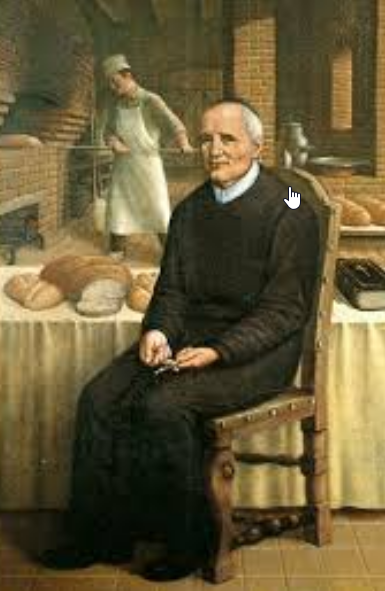
2. Third Sunday in Lent
3. Saint Clement Mary Hofbauer
4. Family and Marriage
5. Articles and notices
Dear Reader:
As we are in the midst of Lent and considering our penances and sufferings, one aspect of Catholics is the suffering found in kneeling. I remember someone commenting on a woman of important rank and, noting her callused knees, announced that she had to be Catholic. Yes, Catholics kneel when they pray. Catholics kneel when they receive a blessing from a priest. Modernists and Protestants turn to modern Jewish customs and reject this manner of praying, claiming it is a medieval (Dark Age) novelty introduced in the Catholic Church as a sign of subjection. Of course, we know this is not true. So one must ask, have Jews always prayed standing? Did the Catholic Church introduce the custom of kneeling?
If one turns to the Old Testament, there are several examples of kneeling in prayer to God. In 3 Kings 8:54, one reads: And it came to pass, when Solomon had made an end of praying all this prayer and supplication to the Lord, that he rose from before the altar of the Lord: for he had fixed both knees on the ground, and had spread his hands towards heaven. And Esdras is found praying on his knees: And at the evening sacrifice I rose up from my affliction, and having rent my mantle and my garment, I fell upon my knees, and spread out my hands to the Lord my God. (1 Esdras 9:5) King Ezechias has the Levites adoring God on their knees after purifying the Temple: And Ezechias and the princes commanded the Levites to praise the Lord with the words of David, and Asaph the seer: and they praised him with great joy, and bowing the knee adored. (2 Paral. 29:30) The text of Isaias, For every knee shall be bowed to me, and every tongue shall swear, (Isaias 45:24) is repeated by Paul in his Epistle to the Romans: For it is written: As I live, saith the Lord, every knee shall bow to me, and every tongue shall confess to God. (Rom. 14:11); in his Letter to the Ephesians: For this cause I bow my knees to the Father of our Lord Jesus Christ (Eph. 3:14); and, again, to the Philippians in that absolute acknowledgement that Jesus Christ is God: That in the name of Jesus every knee should bow, of those that are in heaven, on earth, and under the earth. (Phil. 2:10)
Daniel is found kneeling in prayer, as one reads: Now when Daniel knew this, that is to say, that the law was made, he went into his house: and opening the windows in his upper chamber towards Jerusalem, he knelt down three times a day, and adored, and gave thanks before his God, as he had been accustomed to do before. (Dan. 6:10) Further, one reads: And I heard the voice of his words: and when I heard, I lay in a consternation, upon my face, and my face was close to the ground; And behold a hand touched me, and lifted me up upon my knees, and upon the joints of my hands. (Dan. 10:9-10). The Prophet Micheas brings out the same practice of kneeling in supplication before God with these words: What shall I offer to the Lord that is worthy? wherewith shall I kneel before the high God? shall I offer holocausts unto him, and calves of a year old? (Micheas 6:6)
As a Hebrew commentary tells us: The Hebrew word for “blessing” braha (ברכה) has an interesting etymology. The traditional explanation is that it derives from the root berech (ברך), “knee.” Since one has to kneel to receive a blessing, one needs humility to be blessed. One needs to recognize and admit to not being completely self-sufficient, that he needs God’s help, that he needs His blessing. And, in these passages, as also seen in the life of Joseph (cf. Genesis 37ff.) there is that meaning of humbling (bringing one to one’s knees) before obtaining a blessing (set over all Egypt). This is seen also in the New Testament, in which one observes the leper: And there came a leper to him, beseeching him, and kneeling down said to him: If thou wilt, thou canst make me clean. And Jesus having compassion on him, stretched forth his hand; and touching him, saith to him: I will. Be thou made clean. And when he had spoken, immediately the leprosy departed from him, and he was made clean. (Mark 1:40-42)
So also in the early Church Saint Stephen kneels in prayer: And falling on his knees, he cried with a loud voice, saying: Lord, lay not this sin to their charge. And when he had said this, he fell asleep in the Lord. And Saul was consenting to his death.(Acts 7:59) And Stephen receives the blessing in Saul’s conversion into Paul, the Apostle to the Gentiles. (cf. Acts 9.) Saint Peter kneels down and prays and receives the blessing to his prayer: And they all being put forth, Peter kneeling down prayed, and turning to the body, he said: Tabitha, arise. And she opened her eyes; and seeing Peter, she sat up. (Acts 9:40) Saint Paul kneels in prayer after mentioning the word blessing: I have shewed you all things, how that so labouring you ought to support the weak, and to remember the word of the Lord Jesus, how he said: It is a more blessed thing to give, rather than to receive. And when he had said these things, kneeling down, he prayed with them all. (Acts 20:36) And Saint Luke prays with Saint Paul and the faithful in Tyre kneeling: departing we went forward, they all bringing us on our way, with their wives and children, till we were out of the city: and we kneeled down on the shore, and we prayed. (Acts 21:5)
Finally, Jesus Christ, facing His passion and death, is found kneeling in prayer: And he was withdrawn away from them [disciples] a stone’s cast; and kneeling down, he prayed, saying: Father, if thou wilt, remove this chalice from me: but yet not my will, but thine be done; And there appeared to him an angel from heaven, strengthening him (Luke 41, 42)—(to be continued)
As always, enjoy the readings provided for your benefit.—The Editor
________________
WHAT IS THE HOLY EUCHARIST
By Rev. Courtney Edward Krier
PART II
Institution
Christ Prepares the Apostles for the Sacrament of His Body and Blood
Examining the portent of Chapter Six, there are these following points to take into consideration:
John gives the name for the Sea of Galilee as also the Sea of Tiberias, as it designates that Christ had gone to a wilderness near the city of Tiberias, a town named to honor the second Roman Emperor Tiberias in 20 B.C. According to the Fathers and Doctors of the Church (cf. Catena Aurea, IV, vi. 125f.; Orchard, 991f) John (the Evangelist) has, after the death of John the Baptist, Christ leaving Judea and the territory of Herod because He is now going to start separating His followers from the Old Covenant by more clearly doing away with the laws of Moses, and preparing them for a New Covenant and what participation in that New Covenant would mean. Within a year, that is by the next Passover, Christ will have instituted the Sacrifice of the New Testament and suffered His Passion and Death, ending the Old Testament and beginning the New. First, Christ is going to perform miracles that are greater than Moses and Elias or Eliseus. They will be evident to those present and those Israelites reading the Gospel.
Moses took the Israelites into the desert, where they were fed with manna (Exod. 16:1f). Moses parted the Red Sea so the Israelites could walk through the waters (Exod. 14:16f). Moses divided the people in the desert into groups of fifties and tens (Deut. 1:15; cf. Exod. 18:21). Moses numbered the men over the age of twenty (Num. 1:2,3). Moses promised the Prophet (Deut. 18:15f) in whom all he foretold would come to pass. Elias fed the household of the widow of Sarephta with a handful of meal until the end of the famine (3 Kings 17:11f). Elias divided the waters of the Jordan to walk with Eliseus on dry land (4 Kings 2:8f). Eliseus, too, divides the water to walk on dry land (ibid. 2:14). Eliseus multiplies the twenty loaves of barley to feed one hundred men (ibid. 4:42ff). Christ had to perform miracles greater to show that He was greater than Moses, Elias and Eliseus. He thereby sets the scene to bring to cause those following Him to remember those deeds. Likewise, John brings out to those reading his Gospel—the works that show He is the Prophet, the Christ. John writes how Christ did this first through the multiplication of the five barley loaves and two fishes and then the insertion of Christ walking on water.
Noticeably Jesus is not in Jerusalem for the Feast of the Passover, but He is here in the wilderness now the Pasch, the festival day of the Jews, was near at hand (John 6:4). Within this section John, in understanding the will of Christ, is presenting to his listeners (remembering the faithful hear this read to them) the scene of the Passover, the crossing of the Red Sea and the feeding with Manna to that of demonstrating that the types of the Old Testament would soon be replaced with the reality of the New Testament—of which this series of miracles and teachings would be with the non-observance of the types because something greater was going to be given of which the types under Moses prefigured and only had value in signifying: The Prophet, the Messias, the True Bread from Heaven, the Son of God. With these series of miracles and instructions Christ is already replacing the law of Moses—not the laws of God—with the Gospel precepts.
The whole scene is a reversal of the scene in the desert of Sinai:
And all the congregation of the children of Israel murmured against Moses and Aaron in the wilderness. And the children of Israel said to them: Would to God we had died by the hand of the Lord in the land of Egypt, when we sat over the flesh pots, and ate bread to the full. Why have you brought us into this desert, that you might destroy all the multitude with famine? (Exod. 16:2-3)
Of course it was God who promised bread from heaven, not Moses (cf. Exod. 16:4). And Christ continues from the point when God did promise bread from heaven. He asks His Apostles because it was necessary to show without doubt the astounding miracle Christ performed since the Apostles testify they could not feed the people and all the food that was found was the five barely loaves and two fishes. Secondly, it wasn’t at the request of the people that they be fed, Christ chooses to feed them. The people do not have to labor; they are to be given the bread and prepared fish. The five barley loaves are representative of the Torah (five books of Moses) and the two fishes the Prophets and Writings of the Old Testament by which the Israelites were spiritually fed. The Hebrews divide the Old Testament in three parts: Torah (five books of Moses), Prophets (major and minor) and the remaining books are called The Writings. Reclining indicates the foretaste of heaven, of rest that those who eat the Bread of Life will have. They are gathered into groups just as all the nations will be gathered. When all is ready, everything is accomplished, Jesus took the loaves, and when he had given thanks, he distributed to those who were sitting: in like manner of the fishes, as much as they wanted (John 6:11). These same words took, gave thanks, distributed are used by the Synoptics and Paul at the institution of the Holy Eucharist, John knowing this miracle would point to the Holy Eucharist. The loaves and fishes were given to the Apostles, for they would be the ministers of the Sacraments and they would gather the remnants, twelve baskets, because it was not perishable food, but to be always available to give to those asking as much as they wanted. Saint Thomas in his commentary (6, 1, 860) on this passage says, he multiplied bread that already existed, implying by this that he is the one who fulfills the law and brings it to perfection: I have not come to destroy the law, but to fulfill it (Matt 5:17). The same five barley loaves and two fishes were given to a great multitude to show that Christ’s same body and blood will be given to all who approach the holy altar. Too, the priest gathers up all the particles lest they be lost (cf. John 6:12). Crumbs that fall from the table are for the dogs (cf. Matt 15:27; Mark 7:28), but certainly what Christ was to give could not be given to dogs (cf. Matt. 7:6).
Leonard writes:
The miracles that precede the Promise prepare the way for belief in it, for he who fed more than 5,000 miraculously can feed the world eucharistically, and he who walked on water as on solid ground can command and suspend other conditions of matter, in order to be sacramentally present to feed the souls of men. (Orchard, 991)
After such an astonishing miracle the impulse of the people was to follow Him and this they justified by accepting Him as the Prophet. Repeatedly John points out that Christ knew what was in the mind of those He spoke with and addresses them before they speak. Here, Christ knows that they want to make Him King not because they believe in Him, but because they believed He, like Moses, would take care of their material needs—Moses failed to bring the Israelites into the Promised Land because the Israelites would not accept the spirituality of Moses’ mission, but desired the flesh pots and bread of Egypt (cf. Exod. 16:3). Only Josue (Jesus) could bring the descendants into the Promised Land. Jesus sends the Apostles away perhaps lest they lose the spiritual significance and be influenced by the crowd. Before the crowd can react unanimously, Our Lord dismisses them and leaves them. He seeks solitude and prayer as an example that one must not seek honor and recognition that is misdirected. He also knows the next day many will no longer walk with Him (cf. John 6:61). Just as the Christ sent away His Apostles, here also He does not want the people to be misled that the miracle was to encourage them to proclaim Him their earthly king, but to separate them from such a concept by denying them the opportunity. It is in sharp contrast to that of His entrance into Jerusalem a year later. The angelic Doctor writes in his Commentary on John: They are no longer concerned about his breaking the Sabbath; they are no longer zealous for God. All these things are set in the background now that their bellies are full. Now he is regarded as a prophet among them, and they want to set him on the royal throne as their king. (6, 2, 870)
The next miracle, which was to be greater than the stopping of the Jordan or the parting of the Red Sea, was occasioned by the separation of Our Lord and His Apostles. They had waited, but He had not come. They seemed to know they were to move on to Capharnaum and needed to depart—the reason not important to the narrative but one which would give rise to three further miracles that would confirm all the apostles in accepting the words of Jesus without question.
It is only possible to speculate about the disposition of Judas Iscariot that he alone did not believe, but had some ulterior motive to remain with the other eleven. The words of Our Lord, But there are some of you that believe not (John 6:65) give credence to this, as John continues: For Jesus knew from the beginning, who they were that did not believe, and who he was, that would betray him. (Ibid.) At the Last Supper, too, Our Lord points to the betrayal of Judas.
When the Israelites were fleeing the army of Pharaoh (Exod. 14:16ff), God had a dry wind separate the waters of the Red Sea and dry the land so they could pass through. The miracle was to have the Israelites return back to God. Now, Christ was coming to the Twelve, representative of the twelve tribes of Israel (cf. Matt. 19:28) walking upon the waters. A wind, too, was blowing that was not allowing the Apostles to pass through the waters. Only when Christ entered the boat did the wind cease and, with this second miracle came the third: and presently the ship was at the land to which they were going. (John 6:21)
The people also perceived that something extraordinary must have occurred because Christ slipped through them and was in Capharnaum before them. Those on the boats may have told them that Jesus was in Capharnaum, and why they asked to be taken there. The enthusiasm to pursue making Jesus their ruler was still strong enough for them to seek Him, but doubt now lingered as to what it might mean. Still, they wanted to take their chance and asked, Rabbi, when did you come here? (John 6:25) The day before they called Him a Prophet, now He is addressed merely as a Rabbi. But Jesus takes their word, Rabbi, or my teacher, and uses it to instruct them rather than rebuke them. He uses it as the opportunity to begin His discourse on the holy Eucharist.
Amen, amen I say to you, you seek me, not because you have seen miracles, but because you did eat of the loaves, and were filled. Labour not for the meat which perisheth, but for that which endureth unto life everlasting, which the Son of man will give you. For him hath God, the Father, sealed. (John 6:26, 27)
————————–
The Sunday Sermons of the Great Fathers
M. F. Toal
THE GOSPEL OF THE SUNDAY
Luke xi. 14-28
At that time Jesus was casting out a devil, and the same was dumb: and when he had cast out the devil, the dumb spoke: and the multitudes were in admiration at it: But some of them said: He casteth out devils by Beelzebub, the prince of devils. And others tempting, asked of him a sign from heaven. But he seeing their thoughts, said to them: every kingdom divided against itself, shall be brought to desolation, and house upon house shall fall. And if Satan also be divided against himself, how shall his kingdom stand? because you say, that through Beelzebub I cast out devils. Now if I cast out devils by Beelzebub; by whom do your children cast them out? Therefore they shall be your judges. But if I by the finger of God cast out devils; doubtless the kingdom of God is come upon you. When a strong man armed keepeth his court, those things are in peace which he possesseth. But if a stronger than he come upon him, and overcome him; he will take away all his armour wherein he trusted, and will distribute his spoils. He that is not with me, is against me; and he that gathereth not with me, scattereth. When the unclean spirit is gone out of a man, he walketh through places without water, seeking rest; and not finding, he saith: I will return into my house whence I came out. And when he is come, he findeth it swept and garnished. Then he goeth and taketh with him seven other spirits more wicked than himself, and entering in they dwell there. And the last state of that man becomes worse than the first. And it came to pass, as he spoke these things, a certain woman from the crowd, lifting up her voice, said to him: Blessed is the womb that bore thee, and the paps that gave thee suck. But he said: Yea rather, blessed are they who hear the word of God, and keep it.
EXPOSITION FROM THE CATENA AUREA
V. 22: But if a stronger than he come upon him, and overcome him; he . . .
CYRIL: And when the Word of the Most High, the Giver of all strength, and the Lord of all power, was made man, He attacked him, and took away his armour. BEDE: The deceits and frauds of incorporeal evil are therefore his armour; his spoils, the souls he deceives. CYRIL: For those he had long held in error and in ignorance of God were now by His Apostles brought to the knowledge of truth, and led to God through believing in His Son. BASIL, Catena G.P: He also distributed his spoils by handing the faithful over to the care of the angels, so that men may be saved (cf. Is. 18). BEDE: Christ as Victor also distributes His spoils, in sign of His victory; for leading captivity captive He gave gifts to men: appointing some Apostles, some Evangelists, others Prophets, and others Pastors and Doctors (Eph. iv. 11).
V. 23. He that is not with me, is against me . . .
CHRYSOSTOM: Then He puts forward a fourth explanation when He adds: He that is not with me, is against me. As much as to say: I desire to bring men to God; Satan desires the opposite. How then does he who does not work with me, but scatters what I do, become so helpful to Me, that together with Me he casts out demons? Then follows: He that gathereth not with me, scattereth.
CYRIL, Hom. 44 in Matt.: As though He says: I come that I may gather together the scattered children of God; and this Satan, since he is opposed to Me, seeks to scatter what I come to gather together and save. How then can he who seeks to undo my work be giving me help? CHRYSOSTOM: And if he who does not work with Me is an adversary, how much more so is he who opposes Me? To me He seems to refer here in a veiled manner to the Jews themselves, classifying them with the demons: for they had begun to work against Him, striving to disperse those He was bringing together.
V. 24. When the unclean spirit is gone out of a man . . .
CYRIL: After saying these things the Lord then shows how it came about that the Jews fell into such errors concerning Christ, saying: When etc. That this refers to the Jews Matthew shows when he says: So shall it be also to this wicked generation (Mt. xii. 45). For while they were in Egypt, living after the manner of the Egyptians, an unclean spirit dwelt in them, which was driven out of them when they sacrificed a lamb, a figure of Christ; and sprinkled with its blood they escaped the Destroying Angel.
AMBROSE: So the whole Jewish nation is likened to one man, from whom, because of the Law, an unclean spirit had gone forth. But because the devil could find no rest among the Gentiles: whose hearts which before were dry and hard, but after baptism had begun to soften from the dew of the Spirit, because of faith in Christ (for Christ is the undoing of unclean spirits): he then returns to the Jewish people. So there follows: And not finding, he saith: I will return into my house whence I came out. ORIGEN: That is, to those who are of Israel; whom he sees have now retained nothing of God within them, having forsaken, and no longer dwelling, in His house. Hence:
V. 25. And when he is come, he findeth it swept and garnished . . .
AMBROSE: Garnished with a superficial, legalistic cleanness, but more than ever stained of heart. For it has neither restrained nor washed away its fierceness in the stream of the sacred spring: so deservedly did the unclean return to it, bringing with it seven wickeder spirits.
V. 26. Then he goeth and taketh with him seven other spirits more wicked.
For with evil mind it has sinned against the week of the Law, and the mystery of the eighth day (Dan. xix. 27).2 And so as the grace of the sevenfold Spirit is multiplied in us, on them is heaped every injury of the spirits of evil. For the whole, or totality, is often signified by this number. (For on the seventh day God ended His work and rested: Gen. ii. 2.)
CHRYSOSTOM: The evil spirits that now dwell in the souls of the Jews are worse than in former times. For then they raged against the Prophets, now they insult the very Lord of the Prophets. And so they suffered greater afflictions from Titus and Vespasian than they had endured in Egypt and Babylon. So there follows: And the last state of that man becomes worse than the first. For then they were still protected by Providence, and received the grace of the Holy Spirit; they are now deprived of this also. And be-cause of this virtue is rarer among them and their suffering is more intense, and the tyranny of the demons more cruel. CYRIL: And so their last state is worse than the first, in accordance with the saying of the Apostle: It had been better for them not to have known the way of justice, than after they had known it, to turn back (II Pet. ii. 2 ).
BEDE: This can also be understood of any heretic or schismatic, or even of a bad Catholic, out of whom the unclean spirit had gone at baptism, and had walked through places without water; that is, the insidious Betrayer searches the hearts of the believing faithful, which have been purified of the corruption of evil thoughts, to find if there be any among them he may lead into the ways of evil. He says: I will return into my house whence I came out, and from this we learn that we must be very careful, lest through our own neglect the fault we thought dead within us return unawares.
But he finds—the faithful—swept and garnished; that is, purified by the grace of baptism from the stains of sin, yet without any great eagerness in good works. By the seven more wicked spirits he takes with him He means all the vices. They are said to be more wicked because he will bring with him not alone these seven vices, which are opposed to the seven virtues, but he will pretend in his hypocrisy to possess these seven virtues also.
CHRYSOSTOM: Let us accept as said to us as well as to them the words which follow: And the last state of that man becomes worse than the first. For if we who have been given light, and delivered from our former miseries, return again to the same iniquity, then more grievous shall be the guilt of the sins that follow.
BEDE: This may also be taken to mean simply that the Lord added this to distinguish the works of Satan from His own; namely, that He seeks ever to make clean what was defiled, while Satan is ever seeking to soil what has been made clean; and by yet greater impurities.
V. 27. And it came to pass, as he spoke these things, a certain woman . . .
BEDE: In the midst of the provocation and the blaspheming of the Scribes and Pharisees a certain woman with wondrous faith proclaimed the Lord’s Incarnation. And it came to pass . . . a certain woman lifting up her voice, said to him: Blessed is the womb that bore thee . . . In this she put to shame both the calumny of those who stood about her, and the unbelief of future heretics. For as the Jews, blaspheming the works of the Holy Spirit, denied He was the true Son of God and consubstantial with the Father, so later heretics, denying that the Blessed Mary ever Virgin gave the substance of His Flesh to the Only Begotten God, Who by the power of the Holy Spirit was about to come into the world, said that we ought not to confess that He was true Son of man and consubstantial with His Mother.
But if the Body of the Word of God, born of the flesh of a Virgin Mother, is said to be a stranger to her, then there is no reason for proclaiming blessed the womb that bore Him and the breasts that gave Him suck. For why should He be believed to be nourished by her milk from whose seed it is denied He was conceived, since, according to the physicians, either fluid is said to flow from the same source? But He called blessed, not alone Her who had merited to give birth bodily to the Word of God, but likewise all those who, from the hearing that is of faith, spiritually conceive the. same Word, and are in labour through good works to bring it forth, and nourish it as it were, either in their own hearts, or in the hearts of their neighbour. For there follows:
V. 28. But he said: Yea, rather, blessed are they who hear the word of . . .
CHRYSOSTOM: He did not say this as repudiating His Mother, but to show that His Birth would have been no gain to her unless she were also good and faithful in all things. Certainly if it would have been no gain to her that, though not possessing virtue, Christ should be born of her, much less will it avail us that we have a virtuous father or brother or son but are ourselves far from virtue.
BEDE: But this same Mother of God, and for this also Blessed, that she became instrument of the incarnation of the Word, was yet more Blessed in this, that she remained an undying keeper of the ever to beloved Word. In this saying He strikes at the wise ones among the Jews; who sought neither to hear nor to keep the Word of God, but rather to deny it, and to blaspheme it.
———————–
MARCH 15
St. Clement Mary Hofbauer, Confessor
1. On a Sunday in 1780 three women were about to leave the cathedral of St. Stephen, when a sudden shower compelled them to stop in the entrance. A young man offered to secure a conveyance for them, and they invited him to ride with them. They soon found out that the youth had a longing to become a priest but entirely lacked the necessary means. The women decided to help him. This young man was John Hofbauer, a native of Moravia. He was born December 26, 1751, ninth of the twelve children of a Czech meat cutter and a German mother. His father died six years later. At sixteen he was employed as baker’s apprentice in the Premonstratensian monastery. Before long his desire to become a priest took him to Rome. In nearby Tivoli he tried a hermit’s life, along with a friend, and then the bishop gave him the name Clement; but, within six months he was back in the monastery.
This time, however, he was permitted to begin the study of Latin, and spent four years alongside boys much younger than himself. Then he returned to Vienna and to his bakery job. It was at this time that the three women entered the picture and promised him the means to study theology at the University of Vienna. But John did not like the rationalistic flavor of the lectures there and went to Rome to complete his studies. One morning, in the Eternal City, he and his friend agreed to enter the first Church whose bells they heard. It happened to be that of the Redemptorists, near St. Mary Major. Clement asked a server to what order the priests belonged. The name evidently attracted both of the young men, for they at once applied for admission to the society. They were received and, on completion of the novitiate, both pronounced vows in 1785, and were ordained priests shortly after.
In the same year both new priests were sent across the Alps to make the Redemptorists known in other countries. Two other young men joined them and Clement acted as superior of the group. Circumstances were unfavorable to them in Vienna, and in 1797, they went to Warsaw. In the church of St. Benno there Clement developed a very active parish, but the Polish government put a stop to his work. After a number of other attempts he settled in Vienna, in 1808. There he died on May 15, 1820. On that same day Emperor Francis issued a decree approving the admission of the Redemptorists into Austria. Pope Leo XIII beatified Clement in 1898 and Pope Pius X canonized him in 1909. His body is venerated in a church of Our Lady, in Vienna.
2. “God, thou didst endow St. Clement with wonderful strength of faith and unflinching firmness” (Collect). It is significant that St. Clement rejected the spirit of “Enlightenment” prevailing among the theology professors of the University of Vienna. It was their claim that the most sacred mysteries of the Christian religion could be explained by the natural reason of men. Clement had an instinctive sense of what was truly Catholic, and on one occasion he interrupted a lecture by calling out: “Professor, what you are saying is not Catholic truth.” After his expulsion from Warsaw Clement tried to find a location in the diocese of Constance, but he was opposed by the Vicar General, who favored the “Enlightenment” movement and a state Church. The Saint would not submit, and soon after he left the diocese.
On coming to Vienna he found a fertile field for his labors. Emperor Francis provided him with a house and he soon had a large following. In 1813 he became spiritual director of the Ursuline nuns and rector of the Church of St. Ursula. It was a modest beginning, but, from this nucleus the great work of Catholic renewal spread to such an extent that Clement was called the Apostle of Vienna. How account for his success? What attracted people and converted them was his genuinely Catholic, uncompromising, sincere, unadulterated teaching, such as one could hear nowhere else in the city any more. This impressed his hearers deeply.
The deep faith of the Saint made him zealous for devotion to the Holy Eucharist, for Holy Mass, and for the reception of Holy Communion. Thus, he became the outspoken opponent of the prevailing Jansenism which, under the guise of reverence for the Blessed Sacrament, almost extinguished Eucharistic life. His spirit of faith also made Clement a fervent admirer of the Mother of God and a strong advocate of her Rosary. It was in his unwavering dedication to the work of saving and sanctifying souls that the strength of his faith shone most brightly. Little by little, especially after the wars of independence, the hearts of many people were filled with a more or less conscious longing for the Faith. St. Clement provided this important trend with solid doctrine and clear goal.
“With unflinching firmness” (Collect). As a young man Hofbauer clung tenaciously to his desire to become a priest, in spite of his lack of means. As a priest he never lost his fire or fervor, no matter how strenuous or how apparently futile his labor for souls became; poverty, absence of helpers, opposition, all through the years from 1785 to 1808—none of these could dampen his zeal. But then the storm of antagonism grew even more violent: “The Jacobins are spreading evil rumors about us everywhere. In the theater we are ridiculed. Publicly we are threatened with the gallows.” Lampoons were scattered about; moral breaches and political intrigues were laid at their door. It was a trumped-up charge that induced Napoleon to expel him from Warsaw in 1808. Hardly had they set foot in southern Germany when Wessenberg opposed them and forced them to abandon their houses, one after the other. At the Congress of Vienna (1814) Wessenberg again appeared, trying to force his un-Catholic, rationalistic view and principle upon the princes and diplomats. Clement remained in the background, praying and making sacrifices for the welfare of the people. Wessenberg was unable to influence the Congress; but the work and success of Hofbauer exasperated him.
In September of 1815 the zealous priest was forbidden to preach. It was, above all, his apostolate among students that his enemies wanted to stop. Police followed him and spied upon him; his house was searched. Finally, he was given the alternative of leaving his Order or leaving Austria. Now, it seemed that all his work was doomed; but God stepped in at this point. The affair was reported to Emperor Francis, and he hesitated to confirm the order issued against the Saint. Then, in an audience with Pius VII, the Emperor was induced to change his attitude and admit the Redemptorists into Austria. Thus the fervent wish of St. Clement was fulfilled, the fruit, no doubt, of his firm and fearless conduct.
3. In the Mass for this feast (Justus ut palma) St. Paul enumerates some of the hardships he and his helpers had to endure. Our Saint might have described his life in the same words: “We have been made a spectacle to the whole creation, men and angels alike. We are fools for Christ’s sake . . . we go hungry and thirsty . . . we have no home . . . working with our own hands. Men revile us, and we make the best of it, speak ill of us and we fall to entreaty. We are still the world’s refuse . . .” (Epistle; I Cor. 4:9 ff.). What firmness of faith! What unswerving constancy! It was only by such means that St. Clement, the Apostle of Vienna, could have fulfilled his mission to renew Christian faith and life.
“Do not be afraid, my little flock. Your father has determined to give you his kingdom. Sell what you have and give alms, so providing yourselves with a purse that time cannot wear holes in, an inexhaustible treasure laid up in heaven . . .” (Gospel). St. Clement vividly exemplified these words of our Lord.
Young Hofbauer persevered in his longing to become a priest. For years it appeared that all of his struggling, seeking, and suffering were to no purpose. But that very simple bit of courtesy and Christian charity toward the three women turned the seemingly impossible into actuality. The realization of his holy dream was, in the providence of God both the reward and the crown of his steadfast striving for the goal of the priesthood. This vocation is well worth all the sacrifices it costs.
Collect: God, Thou didst endow St. Clement Mary with wonderful strength of faith and unflinching firmness of purpose; we beg Thee, make us strong in faith and so ardent in love that we, too, shall obtain an eternal reward. Amen.
(Benedict Baur)
_____________________
THE YEAR
AND OUR CHILDREN
Planning the Family Activities for Christian Feasts and Seasons
By Mary Reed Newland (1956)
9
ST. PATRICK’S TESTIMONY
March 17
43. Therefore, even if I should wish to depart from them, and thus proceeding to Britain—and gladly ready was I to do so—as to my fatherland and kindred; and not that only, but to go as far as Gaul [France], to visit the brethren and behold the face of the saints of my Lord [one of his kindred is thought to be St. Martin of Tours, and perhaps the saints he wished to see were those thought to have been his teachers, St. Honoratus of Lerins, St. Amator, and St. Germanus of Auxerre]—God knows that I used to yearn deeply for it—yet I am bound in the Spirit, who witnesses to me that if I should do this he would mark me as guilty; and I fear to lose the labour which I have started off—no, not I but Christ the Lord, Who bade me come and be with them for the rest of my life, if the Lord so will, and if he should guard me from every evil way, so that I may not sin in his sight.
[Then he writes of how careful he has always been to be impeccably honest with these “gentiles among whom I dwell” for fear of blaspheming the name of God.]
49. . . . Though I be rude [perhaps he means clumsy?] in all things, still I have sought in some degree to keep watch over myself, both for the Christian brethren and the virgins of Christ and the devout women who used of their own free will present me with their little gifts and threw on the altars various of their adornments, which I delivered back to them. And they were scandalized against me because I acted thus. But I did it out of my hope of immortality, that I might keep myself cautiously in all things, that the heathen for one reason or another might accept me or the ministry of my service, and that I should not, even in the smallest detail, give pretext to the unbelievers to defame and disparage.
50. Maybe, then, when I baptized so many thousands of men, I hoped from any one of them even as much as the half of scruple? [A scruple is the smallest Roman unit of weight.] Tell me and I shall restore it to you. Or when my trivial self had been the Lord’s instrument for the ordaining of clergy on all sides, and I gave them my ministrations for nothing, if I required from any one of them even the price of my shoe, tell it against me and I shall restore you the price and more.
51. I spent for you that they might receive me; and both among you and wherever I travelled for your sake, through many dangers, even to outlying regions beyond which no man, and where nobody had ever come to baptize or ordain clergy or confirm the folk, I have, by God’s bounty, done everything diligently and joyfully for your salvation.
52. At times I used to give presents to the kings besides the wages I paid their sons, who went round with me; and yet they seized me once with my companions. And on that day they most eagerly desired to slaughter me; but the time was not yet come. Everything which they found upon us they plundered, and myself they bound with irons; and on the fourteenth day the Lord freed me from their power; and whatever was our property was restored to us for God’s sake and the sake of the near friends whom we had provided beforehand.
53. You know also from your own experience how much I paid out to those who were Judges throughout all the districts which I more regularly visited; for I calculate that I distributed to them not less than the price of fifteen men, so that you might enjoy me and I might enjoy you ever in God. I do not regret it, nor consider it enough. Still I spend and will spend more. The Lord is mighty to grant me afterwards to be myself spent for your souls.
55. But I see that already in this present world I am exalted beyond measure by the Lord. And I was not worthy, nor am I such that he should grant me this gift, since I know with full certainty that poverty and affliction become me better than riches and luxuries. Why, Christ the Lord was a poor man for our sakes. But I, wretched and stricken, possess no wealth even if I should wish for it; nor do I judge mine own self, for every day I expect either a violent death or to be defrauded or to be reduced into slavery, or some such disaster. But none of these things move me, on account of the promises of heaven. I have cast myself into the hands of Almighty God, for he rules everywhere, as the prophet says. “Cast thy care upon God, and he shall sustain thee.”
59. And if I ever accomplished aught in the cause of my God whom I love, I beseech him to grant me that I may shed my blood with those strangers and captives for his name’s sake, even though I should lack burial itself, even though the dogs and the wild beasts most wretchedly should rend my corpse limb by limb or the fowls of the air should devour it. With perfect certitude, I think, if it should be my fate, I have gained a soul as profit with my body. For beyond all doubt we shall rise on that day in the crystal brightness of the sun; that is, in the Glory of Christ Jesus our Redeemer, as sons of the living God and joint-heirs with Christ, conformed to his image which is to be. For of him and through him and in him we shall reign.
62. But I pray those who believe and fear God, whosoever has deigned to scan and to take this writing which Patrick the Sinner, verily of no education, composed in Ireland, that none shall ever say it was my ignorance which achieved whatsoever tiny success was mine or whatever I showed in accordance with God’s will; but make your judgment, and let it be most truly believed that it was the Gift of God.
And this is my Confession before I die.
There is nothing more sure to cut through the inadequacy of the green crepe paper, the top hats, the clay pipes, the golden harps, the potted clovers, the sugar shamrocks, the kelly-green cakes, than these fresh, beautiful, earnest words of St. Patrick himself.
SOME GAELIC PRAYERS
As soon as we discovered The Prayers of the Gael, a small volume of Irish prayers, we set about learning some. They are marvelously suited to children—and of course to grownups. Here is one to try for a change from your usual Grace before Meals:
Food
May the blessing of five loaves and two fishes which God divided amongst the five thousand men, be ours; and may the King who made the division put luck on our food and on our portion. Amen.
And here is a prayer for the family to help them keep a sanctified Sunday. It is a lovely prayer to say in the car on the way to Mass:
Prayer for Sunday
A thousand welcomes to thee, Blessed Sunday,
Now coming to help us after the week:
My feet guide early to holy Mass,
Part my lips with blessed words,
Out of my heart banish wicked thoughts,
That I may look upon the Son of the Nurse.
Since it was the Son of God Who bought us,
I rely for my soul’s protection on Thee, O Jesus,
May God establish Thee within my heart,
Mayst Thou clear the stain and soil of sin from me
And fill mine eyes with tears of repentance. Amen.
Here is another to be said by all together in the kitchen of a morning, before setting off to work or school:
Prayer for the Day
The grace of God and the blessing of Patrick
On all I see and all I undertake,
From the time I arise in the morning
Till I go to sleep at night. Amen.
And this beautiful one for going to bed. First for the children, and later for the mothers and fathers:
Prayer on Lying Down
May I lie down with God and may God lie down with me,
May I not lie with evil, nor evil lie with me.
Brigid’s girdle around me,
Mary’s mantle beneath me;
O Blessed Michael, hold my hand,
And make my peace with the Son of Grace.
If any evil thing pursue me,
May the Son of God protect me
For a year from this night,
And this night itself, and ever,
And always. Amen.
There are many more, too many to include more here. Best of all the things in it, for us, is the ancient St. Patrick’s Lorica, or Corslet, or as it is more commonly called, “The Breastplate of St. Patrick.” We have used this for our family prayer on his feast day, with a grownup reading one line and the family repeating it, then another line read and repeated. Carefully and distinctly recited, with a thought for what each line means, it is one of the most magnificent prayers in all the world. (We use it on other days, too.) The entire prayer is longer than this, but this excerpt is quite enough to tear your heart.
The Breastplate of St. Patrick
(composed by St. Patrick in the year 433)
I rise up today
Thro’ a mighty strength,
Thro’ my invocation of the Trinity,
Thro’ my belief in its threeness,
Thro’ my avowal of its oneness
To the only Creator . . . .
I arise today,
God’s strength guiding me,
God’s might sustaining me,
God’s wisdom directing me,
God’s eye looking before me,
God’s ear listening to me,
God’s word speaking for me,
God’s hand protecting me:
The way of God stretching out before me,
The shield of God as my shelter,
The hosts of God guarding me against the snares of the demons,
Against the temptings of my evil desire,
Against the evil inclination of my will,
Against everyone who plots against me,
Anear or afar, alone or in a multitude . . . .
Christ with me,
Christ before me,
Christ after me,
Christ within me,
Christ beneath me,
Christ above me,
Christ at my right hand,
Christ at my left hand,
Christ in my breadth,
Christ in my length,
Christ in my height,
Christ in the heart of everyone who thinks of me,
Christ in the mouth of everyone who speaks to me,
Christ in every eye that sees me,
Christ in every ear that hears me . . . .
As a last treat, there is this marvelous bit from Mr. Gogarty’s I Follow St. Patrick to be read aloud. First, show the children the Gratias agamus in the Preface of the Mass, and its translation, “Let us give thanks.” Otherwise they will miss the point.
He was a “steadfast and unchanging man.” That is the verdict of a contemporary witness—and the same a king—on him. The story arises from the fact that the Saint had set his heart on founding what was to be the headquarters of all his church organization on the Height of Macha, the present Armagh. Not far from his own dwelling at the eastern foot of the hill King Daire granted him a little holding, on which a circular space was marked out one hundred and forty feet in diameter, and ramparted round with an earthen wall. Within were erected a Great House, a kitchen and a little oratory, according to what seems to have been the plan of the primitive establishments of the Saint and his company. But the Saint wanted the site of what was to be his chief ecclesiastical city on the heights. At first the King refused to grant a space on the summit. He fell ill, but was restored to health by holy water which the Saint had blessed. Then the King paid a visit to the lowly settlement and presented the Saint with a bronze cauldron brought from over the sea. “Gratias agamus,” said the Bishop; but he said it rapidly (a man of his temperament must have spoken rapidly), in the Latin of the colonies, and it sounded in the way it has been preserved for us phonetically, “Gratzacham.” This was not enough for Daire. His three-gallon cauldron acknowledged by but one word, and that unintelligible! He sent his servants to bring back that which the Bishop apparently could not appreciate. And these reported that all the Saint said as it was being taken away was “Gratzacham.”
“What?” said the King, “Gratzacham? He said that when it was being given and he says it when it is being taken. It is a strong spell that is used for getting and losing. I will give him back his cauldron.” And the King came with it and presented it in person:
“Keep the cauldron, for you are a steadfast and unchanging man.” And he gave him the land which was his heart’s desire.
Ah, St. Patrick, steadfast and unchanging man, pray for us!
—————————-
Father Krier will be in Eureka March 26.
————————-
For those who purchase through Amazon, please help support the work here at Saint Joseph’s by going through this link: http://smile.amazon.com/ch/94-2855162
—————————–
The topics of Faith and Morals will correspond to the Roman Catholic Faith in Tradition and the Magisterium. The News will be of interest. The commentaries are for the reader to ponder and consider. The e-mail address will be for you to provide thought for consideration. The donations will be to support the continuation of this undertaking.
While the Newsletter is free of charge it is not free of cost. Please consider supporting St Joseph’s Catholic Church with a tax – deductible donation by clicking the secure link: Donate
Or if you prefer send a check to
Catholic Tradition Newsletter
c/o St Joseph’s Catholic Church
131 N. 9th St
Las Vegas, NV 89101
Visit us on the Worldwide Web: http://stjosephlv.org
e-mail news and comments to: tcatholicn@yahoo.com