Vol 13 Issue 5 ~ Editor: Rev. Fr. Courtney Edward KrierFebruary 1, 2020Saint Ignatius, opn!
1. What is the Holy Eucharist
2. Fourth Sunday after Epiphany
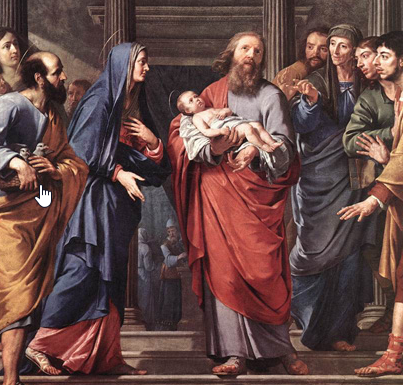
3. Presentation in the Temple
4. Family and Marriage
5. Articles and notices
Dear Reader:
The month of February is dedicated by the Church to the Passion of Our Lord Jesus Christ. Usually Lent begins in this month (this year Ash Wednesday is on February 26) and it is appropriate that one’s attention is directed toward the sufferings of Jesus Christ. Somehow, in today’s society, the mindset has been convinced to believe suffering should not exist. Society, therefore, tries to eliminate suffering as an anomaly—offering a remedy for any type of suffering, a panacea. It has reached the point in which suffering cannot be taken away, the life is itself an error to be taken away through euthanasia: killing—and this logically follows the acceptance that a child in the womb that will enter life suffering should be terminated as an aberration. This cultural attitude is one reason why only an empty cross or a resurrected Christ is more prevalent among modern Christians then a Christ hanging on the cross in a display of suffering—though even the cross is a sign of suffering and is itself not always tolerated. Society wants to do away with suffering instead of embracing it for what it is: A sign of Love and Redemption. Suffering is not to be embraced as an end in itself; but, when suffering, it should be embraced as a means of loving another or of redeeming oneself.
In previous generations—and still in some undeveloped cultures—suffering would be more tolerated because the means of avoiding suffering was less available. Today parents sterilize the lives of their children in the hope that they never suffer, but this results in raising children who are unable to endure suffering. These children also cannot grasp the suffering they cause others because they cannot acknowledge suffering in their own lives.
Imagine, for a moment—because it would help to understand the attitude of many of the converts to Christianity in the early Church—the condition of mankind in the first century. The majority of peoples at that time were subjected to slavery, beaten and whipped if they failed to fulfill the slightest whim of their master or mistress. The food they ate was bland. The Roman citizens could have baths, but the common folk would have to wash themselves with buckets of water or in the streams and rivers (cold water). The common person would have to walk wherever he or she went, thereby being confined to the locale of one’s birth. Disease usually brought epidemics as the sanitary conditions were very poor. There were no bathrooms—you carried a paddle to dig a hole, or used a bucket. There were no anti-biotics and no pain medication other than wine or strong liquor (for the well to do). In other words, the people only knew suffering and endured suffering because there were no alternatives. They could not see life other than suffering and suicide was frequent because there was seemingly no purpose. They felt no pity for the sufferings of others, and had no remorse in killing others or watching others kill and be killed in public (consider the Colosseums and gladiators and the martyrdom of the early Christians). But when Christ came on earth—yes, He cured the sick and suffering who came to Him—but greater still, He showed that suffering should not be accepted as fate, but as a choice to show the other that one loved and that one accepted suffering because it atoned for the wrong one inflicted on God and on others. Christ showed that He loved mankind and suffered for them because of that love. Christ accepted suffering not because He needed to atone, but that man needed to atone for the wrong inflicted on God. Every Catholic today, in accepting suffering, unites with the sufferings of Christ and demonstrates the love one should give to the other and to make atonement for one’s sins and the sins of others. This makes it easier to suffer when one chooses suffering for a reason. The slaves who became Christians became free, for they chose now not to be slaves by force, but to serve the cruel master, that is, to suffer the oppression of their bondage (cf. Eph. 6:5ff). They found themselves now expressing love: love to God and love to neighbor. They realized they would merit to be seated immediately in heaven in eternal glory, that they would rise with Christ because they had atoned for their sins—and the sins of others. This is why the Crucifix became a universal fixture in the home of the Christian: so Catholics could look upon Him Who was nailed to the cross, Who took upon Himself the burdens of mankind, and find consolation in their own sufferings because He loved first. During Lent the Stations of the Cross are made to assist one in joining the sufferings of one’s life with Christ, knowing that what one suffers is never comparable to the sufferings of Christ—but sin only increases suffering. Our children need to learn to suffer patiently—not that one makes them suffer, but that when they do suffer they know they must bear it.
As always, enjoy the readings provided for your benefit.—The Editor
________________
WHAT IS THE HOLY EUCHARIST
By Rev. Courtney Edward Krier
PART II
Institution
Old Testament Prefigurements of the Holy Eucharist
Old Testament Sacrifices
Bread and Wine
Though bread and wine are the material matter of the Eucharistic Sacrifice, the words, bread and wine, used simultaneously are not to be found during Mass.
In the words of institution and consecration, the priest says, regarding the host:
Who, the day before He suffered, took bread into His holy and venerable hands, and having raised His eyes to heaven, unto Thee, O God, His Almighty Father, giving thanks to Thee, He blessed it, broke it, and gave it to His disciples, saying: Take ye all and eat of this: For this is My Body.
Afterwards, the priests speaks of Christ in the Eucharists as the holy Bread of life eternal and the Bread of Heaven. And the Lord said to Moses: Behold I will rain bread from heaven for you: let the people go forth, and gather what is sufficient for every day: that I may prove them whether they will walk in my law, or not. (Exodus 16:4)
Besides, then, addressing the matter in the words of institution as taken from Scripture as bread, the unconsecrated bread is addressed in the Offertory as spotless host and both the bread and wine as gifts, sacrifice and oblations.
The wine, too is not referred simply as wine except in the words of the mixing of wine and water during the Offertory to express the union of humanity with the divinity:
O God, Who hast established the nature of man in wondrous dignity, and still more admirably restored it, grant that through the mystery of this water and wine, we may be made partakers of His Divinity, Who has condescended to become partaker of our humanity, Jesus Christ, Thy Son, our Lord.
Afterwards one only reads chalice of salvation. At the words of institution and consecration:
In like manner, when the supper was done, taking also this goodly chalice into His holy and venerable hands, again giving thanks to Thee, He blessed it, and gave it to His disciples, saying: Take ye all, and drink of this: For this is the Chalice of My Blood of the new and eternal covenant; the mystery of faith, which shall be shed for you and for many unto the forgiveness of sins.
Though one may not consider it of importance, the understanding is brought to light if one again identifies the types of the Eucharistic Sacrifice in the Old Testament. Here one must start with the Sacrifices of Cain and Abel.
And it came to pass after many days, that Cain offered, of the fruits of the earth, gifts to the Lord. Abel also offered of the firstlings of his flock, and of their fat: and the Lord had respect to Abel, and to his offerings. But to Cain and his offerings he had no respect (Gen. 4:3-5)
The fruits of the earth—grain (bread) and grapes (wine)—as such, were not acceptable of themselves. Except as type, how else would one literally interpret God’s rejection of Cain’s offering? Therefore, the Offertory does not refer to the fruits of the earth, but to the Lamb of God that will be offered, to the Body and Blood of Christ—which alone is an acceptable sacrifice and only united with that sacrifice, any other sacrifice. In the Novus Ordo Missae Liturgy of the Eucharist the rejection of this concept places the stress, in the offertory that only bread and wine are offered: the fruits of the earth. (Cf. Ambrose, Cain and Abel, Bk. 1, ch. 7, 25)
Priest: Blessed are you, Lord, God of all creation. Through your goodness we have this bread to offer, which earth has given and human hands have made. It will become for us the bread of life.
All: Blessed be God for ever.
Priest: Blessed are you, Lord, God of all creation. Through your goodness we have this wine to offer, fruit of the vine and work of human hands. It will become our spiritual drink.
All: Blessed be God for ever.
It is based on the simple blessing of food according to Jewish custom:
Blessed are You, Lord our God, Ruler of the universe, who brings forth bread from the earth.
Blessed are You, Lord our God, Ruler of the universe, who creates the fruit of the vine.
Therefore, seeing that it was first the fruits of the earth that were offered and were not accepted, the liturgy does not offer bread and wine of itself, but only in view that what is being offered is to become the spotless host, gifts, sacrifice and oblations which are the Body and Blood of the Lamb of God. It typifies also that at first there are the fruits of the earth (Cain), but only when they are the lamb (Abel) does God accept.
Saint Ambrose looks, also, to the word, first (firstling) and first-born to show what precedes is not what is desired by God, but what is promised or sanctified:
Again, first-fruits become sanctified, not by time, but by devotion. The produce does not itself alone constitute sanctity. Hence, if the produce of the soil comes forth speedily without an accompanying fulfilment of a vow, an offence is committed. Not all first-born are therefore sanctified, but everything sanctified is also first-born. Hence, Cain was first-born, but not sanctified. Sanctified, too, was Israel, God’s people, but they were not first in time. Yet Israel is called first-born, as it is written in the books of the Prophets: ‘Israel is my first-born.’ [Exod. 4.22.] And Levi was sanctified, but he was not first-born, for we hear that he was Lia’s third son. [Cf. Gen. 29.54.] Furthermore, the Levites were called first-born. Their name is derived from that fact, as it is written in Numbers: ‘Behold, I have taken the Levites from the children of Israel, for every first-born that openeth the womb among the children of Israel and the Levites shall be mine, for every first-born in mine.
(Ambrose, Cain and Abel, Bk. 2, ch. 2, 7)
More clearly then, perhaps the sacrifices of Cain and Abel, the bread and wine offered by Melchisedech has been universally upheld as typifying the Eucharistic Sacrifice. Clement of Alexandria (+215) already writes: Melchisedech, who offered bread and wine, the consecrated food as a figure of the Eucharist (Strom. IV, 25). Later, Cyprian of Carthage (+258) penned a letter to Cæcilis:
Also in the priest Melchizedek we see prefigured the sacrament of the sacrifice of the Lord, according to what divine Scripture testifies, and says, And Melchizedek, king of Salem, brought forth bread and wine. Genesis 14:18 Now he was a priest of the most high God, and blessed Abraham. And that Melchizedek bore a type of Christ, the Holy Spirit declares in the Psalms, saying from the person of the Father to the Son: Before the morning star I begot You; You are a priest for ever, after the order of Melchizedek; which order is assuredly this coming from that sacrifice and thence descending; that Melchizedek was a priest of the most high God; that he offered wine and bread; that he blessed Abraham. For who is more a priest of the most high God than our Lord Jesus Christ, who offered a sacrifice to God the Father, and offered that very same thing which Melchizedek had offered, that is, bread and wine, to wit, His body and blood? (Letter 62/63, 4)
This Letter of Cyprian provides a document of Scriptural texts that reference the prefigures of the Holy Eucharist, particular the use of wine. There were some in his time who had—through ignorance—filled the chalice with just water. His confirmation that wine was necessary for validity was to point to the signs that showed the reality.
Christ says, I am the true vine. (John 15:1) The blood of Christ is assuredly not water, but wine; neither can His blood by which we are redeemed and quickened appear to be in the cup, when in the cup there is no wine whereby the blood of Christ is shown forth, which is declared by the sacrament and testimony of all the Scriptures. (Ibid. 62/63, 2)
Regarding the sacrifice of Cain and Abel, the words may apply as Cyprian applies to Melchisedech:
In Genesis, therefore, that the benediction, in respect of Abraham by Melchizedek the priest, might be duly celebrated, the figure of Christ’s sacrifice precedes, namely, as ordained in bread and wine; which thing the Lord, completing and fulfilling, offered bread and the cup mixed with wine, and so He who is the fullness of truth fulfilled the truth of the image prefigured. (Ibid., 4)
In his work, The Sacraments, Saint Ambrose continues the Sacrament of the Eucharist with Melchisedech’s prefigurement of Christ’s priesthood. Then he writes: We have said, then, that the chalice and bread are placed on the altar. What is put in the chalice? Wine. And what else? Water. But you say to me: “How, then, did Melchisedech offer wine and bread?” (V, 2) And in Book IV, 10 and following (quoted above in the section on Melchisedech), Ambrose stresses that it is Christ in the person of Melchisedech who offers bread and wine that was to become His Body and Blood. Christ chose the appearances of bread and wine to be the visible sacrifice of the New Testament, to have His presence amongst the faithful on earth, to unite Himself to His members in a Sacramental communion.
Corresponding of bread and wine being offered before the lamb, even with Abraham there is the above-mentioned offering by Melchisedech—but also his offering bread to the Lord, who appears as the Three Persons (Angels):
And when he had lifted up his eyes, there appeared to him three men standing near him: and as soon as he saw them he ran to meet them from the door of his tent, and adored down to the ground. And he said: Lord, if I have found favour in thy sight, pass not away from thy servant: But I will fetch a little water, and wash ye your feet, and rest ye under the tree. And I will set a morsel of bread, and strengthen ye your heart, afterwards you shall pass on: for therefore are you come aside to your servant. (Gen. 18:2-5)
(To be continued)
————————–
The Sunday Sermons of the Great Fathers
M. F. Toal
THE GOSPEL OF THE SUNDAY
MATTHEW viii. 23-27
At that time: When Jesus entered into the boat, His disciples followed Him: and behold a great tempest arose in the sea, so that the boat was covered with waves, but He was asleep. And they came to Him, and awaked Him, saying: Lord, save us, we perish. And Jesus saith to them: Why are you fearful, O ye of little faith? Then rising up He commanded the winds, and the sea, and there came a great calm. But the men wondered, saying: What manner of man is this, for the winds and the sea obey Him?
EXPOSITION FROM THE CATENA AUREA
23. And when he entered into the boat, his disciples followed him . . .
ORIGEN, Hom. 6 Ex. Var. locis: When Christ had performed many and wondrous miracles upon the land, He crossed over the sea that there also He might reveal the wonders of His works, whereby He showed to all He was Lord of both land and sea. Hence there is written: And when He entered into the boat His Disciples followed Him; and they were not weak men, but robust, and firm of faith. They follow Him not so much walking in His footsteps as keeping close to Him in holiness.
CHRYSOSTOM, Hom. 29 in Matt.: He took His Disciples with Him, and in a ship, to prepare them for two things: one, that they might learn not to let themselves be carried away by fear in dangers, and next that they should learn that when honoured they should comport themselves with modesty. And so that they would not think highly of themselves for this that having sent all others away He took them with Him, He permits them to be buffeted by the sea. When there was a manifestation of miracles He allowed the people to be present, but when terror and dangers are approaching He takes with Him only His Disciples, they who had to combat the world, whom He now wished to exercise in fortitude.
24. And behold a great tempest arose in the sea, so that the boat was . . .
ORIGEN, as above: Having gone up into the ship, He caused the sea to become stormy. Hence: And behold a great tempest arose in the sea, so that the boat was covered with waves. This storm did not arise of itself, but in obedience to the power Who had commanded it, Who bringeth forth winds out of his stores (Ps. cxxxiv. 7). A great storm arose so that a great sign might be given; and the more the waves beat against the little ship, the more did fear assail the hearts of His Disciples, and consequently the greater was their desire to be delivered through the power of the Saviour.
CHRYSOSTOM, as above: For though they had seen others receive favours from Christ, yet no one regards in the same way things done in the persons of others and those done to themselves, so it was necessary that through personal experience they should receive a clear understanding of the benefits which Christ had conferred on others. Accordingly He wills that this storm arise, so that being delivered from it they might have a clear sense of benefit received.
The storm was a foreshadowing of their future trials, of which Paul says: For we would not have you ignorant, brethren, of our tribulation, that we were pressed out of measure above our strength (II Cor. i. 8). And to give time for their fear to grow, /315/ there follows: But He was asleep. Had He been awake while the storm was on, either they would not have been afraid, or they might not have besought His help, or it might not have occurred to them that He could work such a wonder.
25. And they came to him, and awakened him, saying: Lord, save us.
ORIGEN: It is an astonishing thing, that He Who never sleeps nor grows weary, is here said to sleep. He slept in His Body, but in the Godhead He keeps watch: showing that He bore a true human body, that He had clothed Himself with what was perishable. In His Body therefore He slept, to make the Apostles keep watch, and lest we should also slumber in our souls. The Disciples were fearful, and so nearly out of their senses that they rushed upon Him; they did not beseech Him modestly or quietly, but rather awakened Him violently; hence follows: And they came to him, and awakened him, saying: Lord, save us, we perish.
26. And Jesus saith to them: Why are you fearful?
JEROME: In Jonah we read of a figure of this kind; while the others are in peril he is safe, and sleeps, and is awakened. ORIGEN: O trustful Disciples, you have with you the Saviour, and you are fearful of danger? With you is Life, and you are apprehensive of death? But hear them answering: We are as children, and we are still weak; and so we are fearful. Hence follows: And Jesus saith to them: why are ye fearful, O ye of little faith? As if He said to them: Since you have known me upon the land as possessing power, why do you not believe I have power also upon the sea? And though death assail you, ought you not meet it courageously? He that is of little faith, let him be reproved; he that is without faith, let him be despised.
CHRYSOSTOM, as above: Should anyone say that it was not an indication of little faith to come and waken Him, I say that this was a sign that they had not a fitting belief regarding Him. For they knew that being wakened He could command the sea, but that this He could do also while sleeping they did not yet know. For this reason also He did not perform this sign in the presence of the multitude, lest they be accused of little faith, but taking only the Disciples with Him, He first corrects them, and then calms the tempest of the waters. Hence follows: Then rising up He commanded the winds and the sea, and there came a great calm.
JEROME: From this occasion we learn that all creatures hearken to the voice of the Creator. For they that here were commanded heard Him commanding; not in the sense of those heretics who believe that all things are living, but, by reason of the Majesty of the Creator, the things which to us appear unperceiving, are to Him perceiving.
ORIGEN: He commanded the wind and the sea, and from a great tempest there came a great calm. It is fitting that He that is mighty should do great things; and so He Who a while before had stirred the deeps of the sea, now orders that there shall be a great calm: so that the Disciples, who had been grievously troubled, will now be wondrously made glad.
27. But the men wondered, saying: What manner of man is this?
CHRYSOSTOM: In this recital it is also shown that the entire storm was at once put to rest: no trace of its violence remaining, which was unusual. For when a storm comes naturally to its end, the waves continue for some time to be disturbed: but here at once all is made calm. What before was spoken of the Father: He said the word and there arose a storm of wind (Ps. cvi. 25) Christ fulfils in this miracle: and by His word and command alone He calms and restrains the sea. From His appearance, and from His sleeping, and because He makes use of the ship, those that were present regarded Him as a man; now they are astonished, and so we have: But the men wondered, saying: what manner of man is this? For the winds and the sea obey him?
GLOSS: Chrysostom cites the comment: what manner of man is this? For sleep, and His outward appearance, showed Him to be man: but the sea and the calm proclaim Him God.
ORIGEN: But what men wondered? You do not think that the Apostles are here referred to? For nowhere do we find the Lord’s Disciples spoken of without due respect; but always referred to either as the Apostles or as the Disciples. The men therefore who wondered are they who owned the boat and were sailing it for Him.
JEROME: If anyone, contentiously, will have it that those who were wondering were the Disciples, we shall reply that they are rightly referred to as men, since they knew not as yet the power of their Saviour.
ORIGEN: Not as questioning do they say, what manner of man is this, but as asserting that He is so great that the winds and the seas obey Him. What manner therefore of man is this, signifies, how great, how strong, how wonderful? He commands all creatures and they pass not one step beyond His command. Only men disobey Him, and so they are condemned in judgement. Mystically, all we who are united with the Lord in the bark of Holy Church float above this stormy world. The Lord however sleeps quietly, lovingly awakening our fearfulness, and our turning to Him from evil.
HILARY, Ch. 7 in Matt: Or He sleeps in the sense that in our sleeping He is put to sleep in us. It especially happens that in time of danger we hope for help from God. Would that serene and tranquil hope should ever confide in the power of Christ watching within us to deliver us from danger!
ORIGEN: Let us turn quickly to the Lord, saying with the prophet: Arise, why sleepest thou, O Lord? (Ps. xliii. 23). And He will command the winds, that is, the demons who stir up the waves; that is, the princes of this world who persecute the saints, and He will make a great calm round about body and soul, and He will give peace to the Church, and tranquillity to the world.
RABANUS: Or again: The sea is the unrest of the world; the little boat into which Christ ascends signifies the tree of the Cross, by whose aid the faithful in Christ, crossing the waves of the world, reach to the heavenly city as to a safe shore, on which with Christ they land; whence later He says: If any man will come after me, let him deny himself, and take up his cross, and follow me (Mt. xvi. 24).
When therefore Christ was placed upon the Cross, a great storm arose: because His Disciples were fearful by reason of His passion, and the little boat was covered with waves; for the whole fury of the persecution was around the Cross of Christ, where He slept in death; hence is it said: But He was asleep. His sleep was His death. The Disciples awakened the Lord when, terrified at His death, they plead in earnest prayer for His resurrection, saying: Save us, by rising again, for we perish, by reason of the tempest of Your dying. He rising up reproves the hardness of their hearts, as is elsewhere read. But He commanded the winds, for He laid low the power of the devil; He commanded the sea, because He brought to nothing the rage of the Jews; and there came a great calm, when the minds of His Disciples were comforted by the vision of His resurrection.
GLOSS: Or, the little boat is the Church on earth, in which Christ with His own crosses the sea of this world, and calms the waves of persecutions. Whence we wonder, and we give thanks.
———————–
FEBRUARY 2
Candlemas, or The Purification of Our Lady
I. Thoughts on the Mystery of this Feast
1. We accompany Mary, the Mother of God, from Bethlehem up to the temple at Jerusalem. She carried her Child in her arms, to offer Him to the Lord.
2. Jesus offers. The law that required a mother to take her first-born male child to the temple and consecrate him to the Lord (Luke 2:23; Exod. 13:2) did not bind in the case of Jesus. Jesus was Himself, as God, the very Lawgiver; His birth was, in addition, entirely holy. Jesus was, moreover, the Firstborn of the Father; He who was God did not need to be consecrated. In spite of all this, He permitted Himself to be brought to the temple by His Mother and Joseph. Now the great event which the prophet had foretold occurred: “Behold, I mean to send one of my angels [the Forerunner] to make the way ready for my coming. All at once the Lord will visit his temple; that Lord, for whose presence you are ever longing” (Lesson). Into “His” temple: the temple belongs to Him. All offerings must, by right, be presented to Him there. Yet He came as a Child in the arms of His Mother, silent, unnoticed, unknown. Nothing betrayed the glory of His divinity. Here in His temple, Jesus renewed that consecration to His Father which He had accomplished in the womb of His Mother at the moment of the Incarnation: “I am coming to fulfill what is written of me. . . to do thy will, O my God” (Heb. 10:7).
Christ prayed on this day, as it were, the Offertory of that great holy Mass which was to be consummated on Calvary. He presented Himself as an offering of adoration, of thanksgiving, of atonement, and of petition, the first sacrifice truly worthy of God that the temple at Jerusalem had seen. The former offerings of bulls and rams were now allowed to disappear; the only true offering worthy of God was presented in the temple on this day. “Sheltered in thy temple, O God, we have sought and found deliverance. . . . The Lord is great, and great honor is his due in the city where he, our God, dwells, here on his holy mountain” (Introit). This was the figure and the beginning of that which we are permitted to experience daily in the offering of the holy Mass.
Mary offers. The offering of Jesus in the temple was accomplished at the hands of Mary. Filled with the light of the Holy Ghost, Mary realized the deeper significance of this moment. She understood the meaning and the worth of the Gift she was presenting. She entered with exactly the same dispositions as her Son, who was offering Himself; and she consecrated Jesus to the Father with the same disposition as that which He bore in His heart. She brought her only Child, her dearest and most loved One, to be offered, with a noble, complete, and unconditional “fiat” in her heart and upon her lips. And this she did in the name of, and as mediatrix of, mankind as a whole, as well as in the name of each of us and for our salvation. What a great moment in the life of Mary, in the life of mankind, and of every single one of us! When Mary presented her Child to God, as it were, the first-fruit of the future sacrifice on Golgotha, she was cooperating in the work of our Redemption. We are astonished to see Mary offer Him whom she loved above life itself. We are amazed to see her consecrate herself as one sacrifice with her Child to the Father, in a most intimate communion of soul and will with Jesus. As offering, and at the same time jointly offered, she began on this day her official task of offering. Simeon reminded her of her calling to be offered together with Christ when he said, “This child is destined . . . to be a sign which men will refuse to acknowledge . . . as for thy own soul, it shall have a sword to pierce it” (Luke 2:34-35). Mary uttered her “fiat”: she wished to be a victim. The day would soon come when she could consummate, under the Cross, the sacrifice which she had begun with Jesus on this day: “Let it be unto me according to thy word!”
3. Our Savior daily offers Himself in our midst in the Holy Sacrifice. Candlemas is an ever-present reality. He offers Himself through the hands of Mary, i.e., of the holy Church. By our membership in the Church we too take the holy Victim into our hands: His heart, His blood, His prayers and merits; and we bring them as a gift of our own to the Father, a holy sacrifice of adoration, thanksgiving, atonement, and petition that is worthy of God. Along with our Gift, Christ, we offer ourselves. We earnestly wish to be a sacrificial gift to God, by our love for Him and by our fidelity to His commands and to His holy will.
“Sheltered in thy temple, O God, we have sought and found deliverance.” We wish, like Mary, to offer and to be offered.
Collect: Almighty, everliving God, we humbly beseech Thy majesty that as Thy only-begotten Son, having taken flesh like ours, was bodily presented this day in the temple, so by Thy doing we may be presented to Thee with souls made clean: through the same Christ our Lord. Amen.
II. Thoughts on the Mystery of this Feast
1. Holy Church puts a burning candle into our hand on the feast of the Purification. In this way she appoints us to the task of being Christ-bearers, to bear Christ in our soul and in our will.
2. We hear Christ in our soul, i.e., in our thoughts, judgments, and principles of action. We know that we are filled with the light and spirit of Christ. Therefore, we view life no more with the eyes of the earthly-minded, merely natural man, but with the eyes of Jesus. We look at great and little events in world history, as well as in our daily lives, no longer from an external viewpoint, but from within, that is, in their relationship to the will of God, or as manifestations of His wisdom, power, and love. We see everywhere and in everything, with the eyes of Jesus, the hand of the ever-active Father. We look beyond the outer appearances and contingencies of things, beyond the trials and tempests of life; and we direct our gaze upwards to the Father and to His eternally benevolent activity, to his designs and decrees. He and His plans become for us, just as they were for Christ, the primary reality, the hidden meaning of all things and all happenings-the true reality. With the eyes of Jesus, we look out beyond the present to the future world; we stand honestly and faithfully by the principles of the beatitudes: Blessed are the poor in spirit, the patient, those who mourn, those who hunger and thirst for holiness, the clean of heart, those who suffer persecution in the cause of right (cf. Matt. 5:3). We are glad and lighthearted, because we believe that a rich reward awaits us in heaven. There is an eternity, and there is a justice. Everyone will receive what he deserves. Before every decision, we will ask ourselves: “How is a man the better for it, if he gains the whole world at the cost of losing his own soul?” (Matt. 16:26); we will live according to the principle, “Only one thing is necessary” (Luke 10:42). Thus do we bear Christ as a light in our soul.
We bear Christ in our will, in our heart, in our deeds and omissions, in our life. We live for Him, mindful of the word, the example, and the living union with us, of Him who lives and works in us as head of His members. “Nothing is beyond my powers, thanks to the strength God gives me” (Phil. 4: 13). He works in me; He upholds and permeates me with His power. We live for Him and bear Him in our hearts with the holy passion of a glowing, enthusiastic love. On the strength of this love, we joyfully offer our sacrifices and troubles; we overcome the force of sin and of evil passions. We live for Him with a steadfast trust in His love, in His guidance, in His government of, and operations in us. In the face of every task, we say with St. Peter: “Master, . . . at thy word” (Luke 5:5).
It is our vocation to be apostles of Christ, each after his own fashion. This is what the candle which we carry in our hand on Candlemas means for us. We have so much to give!
If only we ourselves were upright, true Christians! Here we have been found wanting! Our Christianity is so often a Christianity of anxiety, doubts, fear, and slavish attachment to formulas and methods. There is so great a lack of freedom, so much narrowness and restraint! We are Christians of learning, rules, formulas, activity, calculations, anxiety, and pedantry; Christians of accounts and records. There are all too few Christians with glowing hearts, with great, compelling, kindling ideas, with a burning passion for Christ; too few Christians of the stature of St. Paul. “So may the peace of Christ . . . reign in your hearts. May all the wealth of Christ’s inspiration [the Gospel] have its shrine among you: now there will be psalms, . . . and hymns, and spiritual music, as you sing with gratitude in your hearts to God” (Col. 3:15, 16). This thankful, psalm singing, jubilant Christianity has become unfamiliar to us!
Let us pray: Send down upon me, O Lord, Thy light and Thy truth, so that they might direct me to Thy holy mount and lead me into Thy dwelling. Amen.
III. Thoughts on the Mystery of this Feast
1. “Ruler of all, now dost Thou let thy servant go in peace, according to Thy word; for my own eyes have seen that saving power of Thine.” The Church puts these words on the lips of her priest in the liturgical evening-prayer.
The day approaches its conclusion. We thankfully look back over the morning, the midday, and the quiet afternoon and evening hours; over the hours of prayer, of the celebration of, and the participation in holy Mass, and of the reception of Holy Communion; over the hours of work, effort, and weariness; over the privations, renunciations, and conquests which the day has brought; over the many joys which we have experienced, alone or in the company of others; over difficulties, crosses, disappointments, struggles, and sufferings. We look at everything in a spirit of faith with the eyes of the holy liturgy, and we give voice to a heartfelt, grateful, “My own eyes have seen that saving power of thine.” This day has brought the grace, love, help, and mercy of my God and Savior. “Everything helps to secure the good of those who love God” (Rom. 8:28): the manifold failings, involuntary and partly voluntary mistakes, transgressions; even the sins, which we have immediately repented of, which we hate, and from which we wish to preserve ourselves—all these have been turned into graces, into a means to self-knowledge, to self accusation, to humility, to pleading for pardon, and to an ever truer devotedness toward Him for whom we live. “My own eyes have seen that saving power of thine.”
Our life approaches its evening. Mindful of the certainty and the nearness of death, we frequently indulge in a backward glance. The years of childhood, youth, middle life, and full maturity pass before our gaze. We perceive blemishes, voids, sins, mistakes, follies, deficiencies, as numerous as the sands of the sea. Then, rising to a supernatural view, we see how, with unspeakable mercy and love, the Lord has woven the glittering, precious garment of salvation into the ugly, poor product of our hands. Our entire life, from the first gilt of holy baptism to the most recent favor, is nothing other than the operation of the Lord’s work of salvation and grace. He has daily, hourly, viewed our sinfulness and weakness, our unfaithfulness and unworthiness, with divine patience and paternal mercy, just like the father in the parable of the prodigal son. Happily, He has led us, altogether unworthy of such care, past a thousand precipices into which we would surely have plunged; He has preserved us from numberless dangers. He has bestowed upon us the holy sacraments, the priesthood, and the society of holy Church. He has given us the prayers, satisfactions, and sacrifices of so many holy souls in heaven and on earth for our very own. He has accompanied our steps with the graces of His assistance and has led us in a wonderful manner along the road to salvation. We glance back upon our life with a thankful heart and our “own eyes have seen that saving power of thine,” which He has poured into our lives. “His be the thanks if we are not extinguished, his mercies never weary” (Lam. 3:22). Our prayer is a Miserere, a petition for mercy and grace. The Miserere itself, however, stems from the joyful prayer of the aged Simeon: “Ruler of all, now dost thou let thy servant go in peace.”
3. “My own eyes have seen that saving power of thine.” Indeed, Lord, teach us to see Thy salvation—Thy merciful, loving, holy and sanctifying action in us and upon us! Cure us of the bad habit of always looking at ourselves, our deeds and efforts, our exercises and tasks, our sins and perversities, our misery and unworthiness. Free us from the mistaken notion that combat against sin is our foremost task and that perfection in virtue is for us unattainable. Give us eyes, that we may see that saving power of Thine; that we may see Thee, our Savior!
Prayer at the Blessing of Candles
Lord Jesus Christ, true light, who enlightenest every soul born into this world, pour forth thy blessing upon these candles, and hallow them with the light of thy grace. Be pleased to grant that as these lights, kindled with visible fire, dispel the darkness of night, so may our hearts, enlightened by that invisible fire, the radiance of the Holy Spirit, be free from all blindness of sin. May our mind’s eye be purified, enabling us to discern those things which are pleasing to thee and of use for our salvation. May we thereby be counted worthy, after the murky hazards of this life, to reach the light that never fails: through thee, Christ Jesus, Savior of the world, who art God, living and reigning in perfect Trinity, world without end. Amen.
(Benedict Baur)
_____________________
THE YEAR
AND OUR CHILDREN
Planning the Family Activities for Christian Feasts and Seasons
By Mary Reed Newland (1956)
7
CANDLEMAS AND CHURCHING—
ST. BLAISE
February 2 and 3
A MOTHER’S THANKSGIVING
The Churching of Women or Blessing after Childbirth is often confused as a modern version of Our Lady’s Purification, but it has no such meaning. The Church intends this blessing as a thanksgiving (as indeed one of the ceremonies over Our Lady that day was a thanksgiving) for the safe delivery of the mother and the precious new life brought forth from her. A beautiful and ancient blessing, it fell into disuse for a while but is rapidly growing popular again. There is, however, another blessing which should precede this—the Blessing before Childbirth. These together surround the mother with heavenly protection both before and after her delivery.
The Blessing before Childbirth is given shortly before delivery, or if the mother is ill and in danger, and of course always by a priest. It contains such comforting petitions as these for the expectant mother:
. . . Receive the sacrifice of the contrite heart and the ardent desire of Thy servant, who humbly asks Thee for the welfare of the child which Thou didst grant her to conceive. Guard the work which is Thine and defend it from all the deceit and harm of our bitter Enemy, so that the hand of Thy mercy may assist her delivery and her child may come to the light of day without harm, be kept safe for the holy birth of Baptism, serve Thee always in all things, and attain to everlasting life. . . .
Visit, we pray Thee, O Lord, this house, and drive far from it and from this Thy servant, the Enemy with all his plots. May Thy holy angels dwell here to keep her and her child in peace, and may Thy blessing be always upon her. Save them, O almighty God, and grant them Thy unfailing light . . . .
The blessing can be given at home or in church. If you have never had it and are expecting a new little one, do ask at your rectory if you might have the blessing. The prayers are available in leaflet form.
The Blessing after Childbirth, or “Churching,” is given as soon as the mother is able to attend Mass again or any time thereafter; in some parishes it is given publicly for all the new mothers of the parish on Candlemas or the Sunday within its octave. The gathering together for blessing of those who have borne new life in the year impresses all the parish with the dignity of the vocation of motherhood and the love and reverence in which Mother Church holds her mothers. This blessing is also available in leaflet form.
After reading the Magnificat of the Blessed Virgin Mary, the priest prays:
Almighty, everlasting God, who by the childbearing of the Blessed Virgin Mary, has for Thy faithful turned the pains of childbearing into joy, look with kindness on chis Thy servant, who comes rejoicing to Thy holy temple to give thanks to Thee, and grant that after this life she and her child may, by the merits and intercession of the Blessed Virgin Mary, attain to joys of everlasting life. Through Christ Our Lord.
If the mother has her infant with her, there is also at this time a blessing for the infant. It is like the prayer used for the Blessing of Children mentioned in the fifth chapter, feast of Holy Innocents.
ST. BLAISE AND BLESSING THROATS
The feast of St. Blaise, February 3, is the day to receive the Blessing of Throats.
St. Blaise was a physician who was made Bishop of Sebaste in Armenia. Bishop or not, he withdrew to a cave and soon had a reputation for curing both men and beasts. It is told that if the animals found him at prayer they would wait patiently for him to finish. Under the Emperor Licinius, Agricola, governor of Cappadocia, came to Sebaste to persecute the Christians. Sending his hunters out in quest of wild beasts for the arena, they were startled to find at the mouth of the cave on Mount Argeus, wolves, tigers, bears and lions waiting for Blaise to finish his prayers. They promptly arrested him and tried without success to make him apostatize.
While he was in prison the poor and the sick and the lame continued to come to him. The most familiar of the events surrounding him appear to have happened at this time. He returned to a poor woman the pig which a wolf had stolen, and he cured the little child with the fish bone caught in his throat from which miracle grew his great reputation as a healer of throats. According to the Acts of his martyrdom (considered somewhat legendary), after horrible torments he was thrown into a lake upon which he proceeded to walk, inviting his tormentors to join him. I wish I could have seen that. They took up the challenge and were drowned to the last man, ha-ha! Told by an angel to return to dry land and receive martyrdom, he did, and was promptly beheaded on the shore. Went right to Heaven.
Special candles are blessed to be used for the Blessing of Throats. In this blessing of candles we find mention of his power of healing throats, granted him at his request as he was dying, it is said. . . .
. . . In virtue of which, among other gifts, thou didst bestow on him this prerogative—of healing all ailments of the throat. Thus we beg thy Majesty that, overlooking our guilt, and considering only his merits and intercession, thou wouldst deign to bless and sanctify and bestow thy grace on these candles. Let all Christians of good faith whose necks are touched with them be healed of every malady of the throat, and being restored in health and cheer, let them return thanks in thy holy Church, and give praise to thy wondrous name which is blessed forever. Through our Lord Jesus Christ, thy Son, Who liveth and reigneth with thee in unity of the Holy Spirit, God, eternally. Amen.
When we go to church to have our throats blessed, this is what the priest says as he touches our throats with the crossed candles:
Through the intercession of Saint Blaise, Bishop and Martyr, may God deliver you from sickness of the throat, and from every other evil; in the name of the Father, and of the Son, and of the Holy Spirit.
St. Blaise is one of the Fourteen Holy Helpers or Auxiliary Saints, the others being St. George, St. Erasmus, St. Pantaleon, St. Vitus, St. Christopher, St. Denis, St. Cyriac, St. Achatius, St. Eustache, St. Giles, St. Margaret, St. Barbara, and St. Catherine. So we greet him on his feast day and give thanks to God for his blessing. And I don’t suppose he’d be cross if we said that really and truly this Blessing of Throats might well be termed the liturgical antibiotic.
(To be continued)
—————————-
Father Krier will be in Los Angeles February 4 and Pahrump on February 13. He will be in Albuquerque February 17 and Eureka February 18.
————————-
For those who purchase through Amazon, please help support the work here at Saint Joseph’s by going through this link: http://smile.amazon.com/ch/94-2855162
—————————–
The topics of Faith and Morals will correspond to the Roman Catholic Faith in Tradition and the Magisterium. The News will be of interest. The commentaries are for the reader to ponder and consider. The e-mail address will be for you to provide thought for consideration. The donations will be to support the continuation of this undertaking.
While the Newsletter is free of charge it is not free of cost. Please consider supporting St Joseph’s Catholic Church with a tax – deductible donation by clicking the secure link: Donate
Or if you prefer send a check to
Catholic Tradition Newsletter
c/o St Joseph’s Catholic Church
131 N. 9th St
Las Vegas, NV 89101
Visit us on the Worldwide Web: http://stjosephlv.org
e-mail news and comments to: tcatholicn@yahoo.com
To unsubscribe, please type, “unsubscribe”‚ in subject line.