Editor: Rev. Fr. Courtney Edward Krier
December 14, 2019 ~ Saint Nicasius, opn!
1. What is the Holy Eucharist
2. Third Sunday in Advent
3. Saint Paul of Latros
4. Family and Marriage
5. Articles and notices
Dear Reader:
One of the problems that was introduced with Roncalli and Montini was the end of censorship. The Bishop would assign a priest to review Catholic periodicals and books before publication to ensure that what was written reflected Catholic faith, or at least, did not teach something contrary to Catholic faith. Now everyone writes their opinions—many contrary to faith, many confusing as they use Catholic terminology in an incorrect manner, many making dogma what is not even Church doctrine, but a mere opinion. I imagine one who claims something is doctrine or church teaching feels empowered—but that one is a pseudo-prophet and there are plenty today. The problem also is that many errors that were condemned have resurfaced in the Conciliar theologians that have been installed in Catholic Universities. Raymond Brown (+1998) was one such, who wrote: the Roman Catholic Church does not change her official stance in a blunt way. Past statements are not rejected but are requoted with praise and then reinterpreted at the same time. . . . What was really going on [at Vatican II] was an attempt gracefully to retain what was salvageable from the past and to move in a new direction at the same time. (The Critical Meaning of the Bible, Paulist Press (1981), 18.) His works were to present (in a true Modernist fashion) the New Testament as a collective belief of Christians developed through time and not written by the Evangelists nor historically true. This places Scripture as just something people believe but not really true, and definitely not inspired by God, Who is absolute Truth Itself. This is seen in the following article propagated in an online Blog devoted to Catholics in order to teach them the Conciliar faith, not the true Catholic Faith:
Historical or True?—Jesus Birth Stories
DECEMBER 2, 2019 BY FELLOW DYING INMATE
Historical or truthful?—there are reasons for thinking that the biblical stories of Jesus’ birth are not historical in many details.
Historical? Or true? Aren’t they one and the same? Alas, 21st century Americans have a hard time making distinctions between truth and facts. We are so science-obsessed, so fact-precise we mistake truth and facts constantly. The West is the only culture that cannot distinguish truth and facts.
All facts are true, but not all truths are facts. Thus Truth is not reducible to historical truth. As far as the “historical” goes, not all cultures tell “history” with obsession for “just the facts” as we Americans do. Our Bible is Mediterranean, not American. Therefore the Scriptures are all true and some of it actually happened. That’s also so for the Gospels and their Infancy Narratives.
What Are You Saying??
I can anticipate what many reading this are thinking. Wait! Are you saying that the stories of Jesus’ birth found in “Matthew” and “Luke” are not historical?
Well maybe in addition to being true they also present some historical truth. But if that is so, in what way and to what extent are they?
It is reasonable to consider that these two stories, from whence the core of our Christmas traditions come, are historical in some way. But we American Christians should be cautious here. Even in the way they present some historical truth, that does not mean the Infancy Narratives are historical in how 21st century Americans think and do “history.”
The way a scholar like Raymond Brown would phrase the issue is that there are reasons for thinking that the birth stories, which are found in the first two chapters of “Matthew” and the first two chapters of “Luke,” are not historical in many details.
Two facts should be kept in mind in relation to that judgment.
Fundamentalistic Obsessions
First, a growing number of Catholics assume that questioning the historicity of the birth narratives means questioning official Church Teaching. The claim is made by Catholic fundamentalists that the ancient and traditional Teaching of the Church was that the Scriptures were dictated by God and therefore completely inerrant. Many hold that the Church from 33 AD held that unless they obviously present metaphors, biblical passages must be interpreted as literally. Hence, Matthew 1—2 and Luke 1—2 present narratives of historical facts.
That is not true—there is no official church statement in force that the birth narratives are literally historical. Fundamentalism, Catholic or otherwise, is recent—it is a reaction to modernity. Christian fundamentalism wasn’t born until the early 20th century United States, mothered by late 19th century American Protestant reactions to Darwin and higher criticism of the Scriptures. Biblical literalism, older, has roots mainly in the third generation of the Reformers who stressed plenary inspiration. Consequently, Biblical literalism is just three centuries old. Think about that.
Concerning Catholic Teaching and the historicity of the Gospels, the Pontifical Biblical Commission explains matters in their 1964 document, “The Historical Truth of the Gospels.” Fascinating insights are presented there. But that document very clearly deals only with what the disciples heard and saw of Jesus during his public ministry.
Sometime after, an attempt was mounted to have the Commission issue a statement on the historicity of the birth narratives. This was abandoned in the late 1960s. Why? Raymond Brown explained that it was probably because any such statement would have been overly complicated and nuanced.
No Apostolic Witness
Brown gives a second fact for regarding Matthew 1—2 and Luke 1—2 as unhistorical in many details. To get to it, Brown asks why do we possess a tradition about what Jesus did and said in the first place? Isn’t it because people who had accompanied Jesus were capable of reporting his deeds and sayings? We are talking, of course, about the Twelve and the other followers a part of the Jesus Movement in the late 20s, first century.
But were any of those people present at Jesus’ birth? No way. Therefore Brown says that we cannot claim that we have apostolic witness to the events surrounding Jesus’ birth. Matthew 1—2 and Luke 1—2 being inspired does not change that, folks.
. . . . An invitation: familiarize yourselves with these separate and very different stories. Let’s set our Rosaries down, turn off our favorite Christmas-time Jesus-movies, and read each narrative by itself. We should keep a notepad and pen handy and jot down details particular to each. We might just be surprised what we find!
If we are old enough, we already heard this rejection of Jesus Christ as presented in the Gospels and we kept our Rosaries because we understand that meditation on the Mysteries of the Faith is not based on the Criticism of Scripture, but the acceptance of Scripture. The Gospels are the Word of God, God Who can neither deceive nor be deceived. Are the presentations of the Nativity different? Yes, because the Evangelists are telling it from different perspectives, but all are historically true and not contradictory because each gives details—not all—that stress to the reader in what context the Evangelist is writing: His humanity, His kingship, His priesthood, and His divinity. Were they present at the Nativity? Probably not, but Mary was, and the Shepherds and Wisemen were, as also Simeon and Anna, the Prophetess—and the Holy Ghost, the Spirit of Truth, cannot err. Let us pray the Joyful Mysteries of the Rosary, not throw them out!
As always, enjoy the readings and commentaries provided for your benefit.—The Editor
________________
WHAT IS THE HOLY EUCHARIST
By Rev. Courtney Edward Krier
The Novus Ordo Missae
The majority of the Vatican Council II Cardinals and Bishops believed that the document they approved on December 4, 1963, was, concerning the Mass, fulfilled in the 1964 Missal. But, as a master of deceit, Giovanni Montini left the majority of bishops, priests and faithful in the dark about his true desire to completely Modernize the Catholic Church. Already, on January 3, 1964, he chose Anibale Bugnini to develop a new service that could be substituted for the Holy Sacrifice of the Mass.
On the morning of January 3, 1964, Cardinal Amleto G. Cicognani, Secretary of State, summoned Father Bugnini and told him that the Holy Father had appointed him secretary of the commission that was to implement the Constitution. The message was only verbal. The official appointment came in a letter from the Secretariat of State, dated January 13. It read:
The Holy Father has graciously deigned to establish a “Council for the Implementation of the Constitution on the Sacred Liturgy” and at the same time is pleased to number among its members Their Eminences Cardinals Giacomo Lercaro, Archbishop of Bologna, Paolo Giobbe, and Arcadio Larraona, and to appoint the Reverend Annibale Bugnini, of the Congregation of the Mission, as its secretary. (Bugnini, 49-50)
Seven liberal Protestant ministers were consultors to assure that the final product would not reek of Catholicism, that is, that they would not be able to say this Novus Ordo Missae was in any way the same Mass that their Protestant founders rejected or would have rejected. L’Osservatore Romano, March 19, 1965, quotes Bugnini as saying: We must strip from our Catholic prayers and from the Catholic liturgy everything which can be the shadow of a stumbling block for our separated brethren, that is, for the Protestants. What was produced was a Protestant service combining the Lutheran and Anglican services flavored with a touch of Catholicism. It was the same thing Mohammed did to produce the Muslim religion, take a little from everyone and everyone will see something recognizable and accept it. [Of course not everyone accepted Islam, so Mohammed had recourse to force. The same in the Conciliar Church, those who did not accept it willingly were forced by threat of excommunication, suspension, loss of pension or position—left out in the cold.] In neo-Modernist and Progressivist fashion, the Novus Ordo Mass had to be formulated such that it could evolve and express the ever-changing beliefs of the weltgeist. It had to be fluid, adaptable, and empty of any dogmatism (unchanging teachings). Various experiments, to the scandal of the faithful, were initiated in select parishes: total vernacular Masses read, tables replacing altars, removal of communion rails, and new churches being built as auditoriums or in the round.
One need only read the Ottaviani Intervention, where the author speaks of the definition of the Novus Ordo Mass:
Let us begin with the definition of the Mass given in No. 7 of the “Institutio Generalis” at the beginning of the second chapter on the Novus Ordo: “De structura Missae”:
“The Lord’s Supper or Mass is a sacred meeting or assembly of the People of God, met together under the presidency of the priest, to celebrate the memorial of the Lord. Thus the promise of Christ, “where two or three are gathered together in my name, there am I in the midst of them”, is eminently true of the local community in the Church (Mt. xviii, 20)”.
The definition of the Mass is thus limited to that of the “supper”, and this term is found constantly repeated (nos. 8, 48, 55d, 56). This supper is further characterized as an assembly presided over by the priest and held as a memorial of the Lord, recalling what He did on the first Maundy Thursday. None of this in the very least implies either the Real Presence, or the reality of sacrifice, or the Sacramental function of the consecrating priest, or the intrinsic value of the Eucharistic Sacrifice independently of the people’s presence. It does not, in a word, imply any of the essential dogmatic values of the Mass which together provide its true definition. Here, the deliberate omission of these dogmatic values amounts to their having been superseded and therefore, at least in practice, to their denial.
In the second part of this paragraph 7 it is asserted, aggravating the already serious equivocation, that there holds good, “eminently”, for this assembly Christ’s promise that “Where two or three are gathered together in my name, there am I in the midst of them” (Matt. xviii, 20). This promise which refers only to the spiritual presence of Christ with His grace, is thus put on the same qualitative plane, save for the greater intensity, as the substantial and physical reality of the Sacramental Eucharistic Presence.
In no. 8 a subdivision of the Mass into “liturgy of the word” and Eucharistic liturgy immediately follows, with the affirmation that in the Mass is made ready “the table of the God’s word” as of “the Body of Christ”, so that the faithful “may be built up and refreshed”; an altogether improper assimilation of the two parts of the liturgy, as though between two points of equal symbolic value. More will be said about this point later.
The Mass is designated by a great many different expressions, all acceptable relatively, all unacceptable if employed, as they are, separately and in an absolute sense.
We cite a few: The Action of the People of God; The Lord’s Supper or Mass, The Pascal Banquet; The Common Participation of the Lord’s Table; The Eucharistic Prayer; The Liturgy of the Word and the Eucharistic Liturgy.
As is only too evident, the emphasis is obsessively placed upon the supper and the memorial instead of upon the unbloody renewal of the Sacrifice of Calvary.
The formula “The Memorial of the Passion and Resurrection of the Lord”, besides, is inexact, the Mass being the memorial of the Sacrifice alone, in itself redemptive, whilst the Resurrection is the consequent fruit of it.
Giovanni Montini, publishing his Missale Romanum on Holy Thursday of 1969 (April 3), placing November 30, 1969, as the date of switching from a Catholic Holy Sacrifice of the Mass to a Protestant Modernist service. He found that it was unaccepted and had to delay. The clergy who no longer believed in the Real Presence of Christ, in Mass being a Sacrifice, in no salvation outside the Catholic Church, in Christ as true God and True Man and who were permitted to experiment—many since October 22, 1967 (United States)—were able to slowly introduce and make popular the Novus Ordo in many parishes; in addition, the vernacular was permitted to be used for the entire Mass elsewhere, familiarizing the faithful to hearing the vernacular, though it was the same as in their daily missal. Using Palm Sunday, when the proper of the Mass changes with the blessing and distribution of palms and procession where the congregation joins the clergy, the parishioners found themselves led into a Novus Ordo service on March 22, 1970. The Ottaviani Intervention was presented on September 25, 1969 to Giovanni Montini to prove his Novus Ordo could not be accepted by faithful Catholics. The Ottaviani Intervention or Short Critical Study of the New Order of the Mass, was then translated, published and sent throughout the Church—waking up the faithful to the fact that they were going to be deprived of Holy Sacrifice of the Mass and the Sacrament of the Holy Eucharist. Many priests said they would not say the Novus Ordo, and persisted in saying the Tridentine Mass—and found themselves persona non gratis, suspended and left outside their parishes.
Giovanni Montini, in his Missale Romanum, changed the words of Consecration into a narration:
Thus, in each Eucharistic Prayer, we wish that the words be pronounced thus: over the bread: ACCIPITE ET MANDUCATE EX HOC OMNES: HOC EST ENIM CORPUS MEUM, QUOD PRO VOBIS TRADETUR; over the chalice: ACCIPITE ET BIBITE EX EO OMNES: HIC EST ENIM CALIX SANGUINIS MEI NOVI ET AETERNI TESTAMENTI, QUI PRO VOBIS ET PRO MULTIS EFFUNDETUR IN REMISSIONEM PECCATORUM. HOC FACITE IN MEAM COMMEMORATIONEM. The words MYSTERIUM FIDEI, taken from the context of the words of Christ the Lord, and said by the priest, serve as an introduction to the acclamation of the faithful.
This is seen applied in the Novus Ordo Missae:
119. In the formulas that follow, the words of the Lord should be pronounced clearly and distinctly, as the nature of these words requires.
For when the hour had come for him to be glorified by you, Father most holy, having loved his own who were in the world, he loved them to the end: and while they were at supper,
He takes the bread and, holding it slightly raised above the altar, continues:
he took bread, blessed and broke it, and gave it to his disciples, saying,
He bows slightly.
TAKE THIS, ALL OF YOU, AND EAT OF IT, FOR THIS IS MY BODY, WHICH WILL BE GIVEN UP FOR YOU.
He shows the consecrated host to the people, places it again on the paten, and genuflects in adoration.
120. After this, he continues:
In a similar way,
He takes the chalice and, holding it slightly raised above the altar, continues:
taking the chalice filled with the fruit of the vine, he gave thanks, and gave the chalice to his disciples, saying:
He bows slightly.
TAKE THIS, ALL OF YOU, AND DRINK FROM IT, FOR THIS IS THE CHALICE OF MY BLOOD, THE BLOOD OF THE NEW AND ETERNAL COVENANT, WHICH WILL BE POURED OUT FOR YOU AND FOR MANY FOR THE FORGIVENESS OF SINS. DO THIS IN MEMORY OF ME.
He shows the chalice to the people, places it on the corporal, and genuflects in adoration.
121. Then he says:
The mystery of faith.
And the people continue, acclaiming:
We proclaim your Death, O Lord,
and profess your Resurrection
until you come again.
Or:
When we eat this Bread and drink this Cup,
we proclaim your Death, O Lord,
until you come again.
Or:
Save us, Savior of the world,
for by your Cross and Resurrection
you have set us free.
Though the genuflection remains, the inclusion of the words, Do this in memory of me, instead of distinct from the words of Consecration, and the separation of the words from the Consecration, Mystery of Faith, emphasize a narration being told on the one hand, while on the other making the mystery of faith refer to the acclamations. The acclamations themselves, then, do not point to the presence of Christ, rather to the death, resurrection and coming of Christ in some future time.
Further, the Novus Ordo was to be said in the Vernacular—and even though the Latin has pro multis, the vernacular translations were to translate pro multis as for all. Even though the Conciliar Church has decided to now once again say for many—because it was unbiblical and therefore offensive to the Protestants—the insertion of the heresy of universal salvation in the beginning would, by this fact alone, make the vernacular Mass unacceptable to any faithful Catholic.
————————–
The Sunday Sermons of the Great Fathers
M. F. Toal
THE GOSPEL OF THE SUNDAY
JOHN i. 19-28
At that time: the Jews sent from Jerusalem priests and Levites to John, to ask him: Who art thou? And he confessed. and did not deny: and he confessed. I am not the Christ. And they asked him: What then? Art thou Elias? And he said: I am not. Art thou The Prophet? And he answered: No. They said therefore unto him: Who art thou, that we may give an answer to them that sent us? What sayest thou of thyself? He said: I am the voice of one crying in the wilderness, make straight the way of the Lord, as said the prophet Isaias. And they that were sent, were of the Pharisees. And they asked him, and said to him: Why then dost thou baptize, if thou be not Christ, nor Elias, nor The Prophet? John answered them, saying: I baptize with water; but there hath stood one in the midst of you, whom you know not. The same is he that shall come after me, who is preferred before me: the latchet of whose shoe I am not worthy to loose. These things were done in Bethania, beyond the Jordan, where John was baptizing.
EXPOSITION FROM THE CATENA AUREA
And they that were sent . . . ORIGEN: Having given a reply to the priests and Levites, they send to him again, from the Pharisees. Hence is written: and they that were sent, were of the Pharisees. As far as can be conjectured from the words themselves, I would say that this is a third testimony. Observe how, according to the sacerdotal or levitical character of the person who is questioning, the words who art thou are pronounced with fitting courtesy. There is nothing arrogant or bold in their manner, but all is as befits true ministers of God. But the Pharisees, true to their name, divided and quarrelling among themselves, thrust their overbearing voices at the Baptist. Hence follows:
And they asked him, and said to him: why then dost thou baptize, if thou be not Christ, nor Elias, nor The Prophet?
Their manner was not of persons who desired to learn, but of such as would wish to prevent him from baptizing. As to this, I do not understand why they came to John, and even disposed for baptism. A possible answer is that the Pharisees came seeking baptism, not because they believed, but because they were afraid of the people. CHRYSOSTOM: Or, the priests and Levites were themselves Pharisees, and seeing they were unable to trip him by flattery, they now strive to work up an indictment against him, and make him declare himself what he was not. Hence follows: And they asked him, and said to him: why then dost thou baptize etc., as though it seemed audacity to baptize if he was not the Christ, nor his precursor, nor the herald, that is the Prophet.
GREGORY: But a sanctified person, even when confronted with someone of perverse mind, is not turned from his zeal for good. So here also John answers the words of deceit with the words of life. Hence the Gospel continues: John answered them, saying: I baptize with water, ORIGEN: To this question what answer was there except to make it clear, that his was a corporal baptism?
GREGORY: John baptizes, not with the Holy Ghost, but with water, because, unable to forgive sins, he washes the bodies of those baptized by him with water; but their souls he cannot wash with pardon. Why therefore does he baptize who cannot, by his baptism, forgive sins? Unless that preserving the order of his Office of Precursor, he, who in his birth preceded Him that was to be born, preceded also the Lord Who was to baptize. So he who was the Precursor of Christ in his preaching, became also His Precursor in baptizing; in imitation of the sacrament. He likewise declares, while he is announcing in their midst the Mystery of our redemption, that This was standing in the midst of men, and they knew it not. Hence follows: There hath stood one in the midst of you, whom you knew not. For the Lord, while appearing in the flesh, was visible indeed in the body, but invisible in majesty.
CHRYSOSTOM: He said this since it was fitting that Christ should mingle with the people, as one among many, everywhere teaching men to be humble. When however, he says, whom you know not, he means knowledge in the truest sense, that is, as to Who He is, and whence He comes. AUGUSTINE: The Lowly One could not be seen, and so a shining light was lit. THEOPHYLACTUS: Or, the Lord stood in the midst of the Pharisees, yet they knew Him not, though they considered themselves versed in the Scriptures. In so far as the Lord is there foretold, He was in their midst, that is, in their souls. But they knew him not because they did not know the Scriptures. Or, in another way. He was in their midst, because as Mediator between God and men, Christ Jesus stood in the midst of the Pharisees, desiring to unite them with God; but they knew Him not.
ORIGEN: Or again; To their first question, why do you baptize, he answered, I baptize in water. To their second, if thou be not Christ, he brings forward a public commendation of the super-excelling perfection of the nature of Christ; that such was His power that His Godhead, though veiled, is yet present in each one, and present everywhere throughout the world; which is thus briefly pointed out in the sentence, there hath stood one, etc.
This power is so diffused throughout the whole fabric of creation, that whatever is therein created, is by It created: all things were made by him; hence it is clear that He was in the midst of those who were inquiring from John the Baptist, why do you baptize? Likewise, that he said, there hath stood one in the midst of you, must be understood of us men. For since we are rational creatures, He stands in the midst of us; for this reason, that the soul, the principal part of man, is seated in the midst of his body. They therefore who so bear the Word in the midst of them, but do not know His nature, nor from what source He comes, nor in what manner He abides within them, these, therefore, though having the Word in their midst, know Him not, as John perceived. Hence, reproaching them, he says to the Pharisees, Whom you know not. Because the Pharisees, looking for the coming of Christ, had not reflected profoundly concerning Him, believing that He would be only a man, though a holy one.
But he says there hath stood: for the Father stands, being invariable and unalterable; His Word also stands, ever ready to save, even if He takes flesh, even though He is in the midst of men, uncomprehended and invisible. Lest however anyone may think, that He Who is invisible, and Who penetrates every man, and the whole world, is other than He Who has assumed human flesh and was seen upon earth and conversed with men (Bar. iii. 38), he adds these words: the same is he that shall come after me, that is, Who after me will become visible. The word after here does not mean the same as when Jesus invites us to follow after Him. For in this latter case we are bidden to follow in His footsteps, so that we came to the Father. Here John means, as is plain from his teaching. He comes following upon John, so that all may believe through Him, being prepared by John’s humbler doctrines, to receive the Perfect Word.
CHRYSOSTOM: As if to say: Believe not that my baptism suffices; for if my baptism were perfect, another would not come after me to give another baptism. This is but a preparation for His, and will be absorbed into that which is nigh, as a shadow and image. But after me He must come. Who will declare the reality. For if the first were perfect, place for a second would not be required. And so he adds: Who is preferred before me. He is nobler, more glorious. GREGORY: For, who is preferred before me is so said, as if to say who was before me. He comes after me, because born after me; He is preferred before me, because He was before me.
CHRYSOSTOM: Lest you think this excellence to be something comparative, and desiring to make plain His Incomparability, he proceeds: the latchet of whose shoe I am not worthy to loose. As much as to say: He is so far above me, that I am not worthy to rank among the least of His servants: for to unlace shoes was the task of the most menial. AUGUSTINE: Even had he said that he was worthy only to untie His shoes, he would still have shown great humility. GREGORY: Or, in a different sense; it was a custom of the ancients that if a man were unwilling further to retain the woman who was his wife, he should untie the sandals of the one who came, by right of kinship, to claim her as a bride. How has Christ appeared among men, save as the Bridegroom of Holy Church? John has said: he that hath the Bride is the Bridegroom (Jn. iii. 29). Rightly therefore does John declare that he is unworthy to untie His shoes; as though he were openly to say: I am unworthy to uncover the feet of the Redeemer; and the title of bridegroom, which belongs not to me, I shall not usurp.
This can be interpreted in yet another way. Who does not know that sandals are made from the skins of dead animals? The Lord, becoming Incarnate, has appeared among us, as it were shod, because, over His Divinity, He has put on the mortality of our corruptibility. The shoe strings are the seals of a mystery. John therefore was unable to untie the strings of His shoes, because he was unable to unveil the mystery of the Incarnation. It is as if he were openly to say: is it to be wondered at, that He is preferred before me, Whose birth I see is after mine, but the mystery of Whose birth I cannot comprehend? ORIGEN: Some one not very elegantly has said that this is so to be understood: that I am not worthy that, because of me, He should come down from above and put on, as a shoe, our flesh. CHRYSOSTOM: And because John, with befitting courage, preached to the multitude all that concerned Christ, the Evangelist also commemorates the place, saying: These things were done in Bethania beyond the Jordan. For John preached, not in a house, not in a corner, but across the Jordan, in the midst of a great multitude, all they being present who were baptized by him. Certain codices have, more correctly, Bethabora; for Bethania is not across the Jordan, nor in the desert, but close to Jerusalem.
GLOSS: There are two Bethanias, one across the Jordan, the other this side of it, and not far from Jerusalem; where Lazarus was raised from the dead.
CHRYSOSTOM: The Evangelist names the place, and for another reason. Since he is not telling of remote events, but of happenings in the recent past, he makes of those who were present and saw these things, witnesses of that of which he speaks; confirming his proof with the name of the place. ALCUIN: Bethania is interpreted as meaning the House of Obedience, through which it is implied that, in obedience to faith, all ought to come to baptism.
ORIGEN, Tom. 6 in John.: Bethabora is interpreted to mean the House of Preparation, and this agrees with the baptism of one who was preparing to the Lord a perfect people; Jordan, however is interpreted as their descent. What is this river unless Our Saviour, through Whom, entering into this world, it behoves us to be made clean; meaning however, not His Descent, but that of men? He it is Who separates those who receive their inheritance from Moses from those who receive their portion through Jesus; whose streams cleansed from leprosy, and made maketh the city of God joyful (Ps. xiv. 5).
As the great Dragon is said to dwell in the river of Egypt (Ezech. xxix. 3), so God dwells in this, rejoicing the City of God; for the Father is in the Son. And they who go down to it where they may wash themselves, put away the stains of Egypt, and are made ready to receive an inheritance; they are cleansed from leprosy, and made capable of receiving a duplication xlv. 5). of grace. They also are made ready for the reception of the Holy Spirit; for that Spiritual Dove descends upon no other stream. John baptizes across the Jordan, as Precursor of the One who came to call, not the just, but sinners, to repentance.
———————–
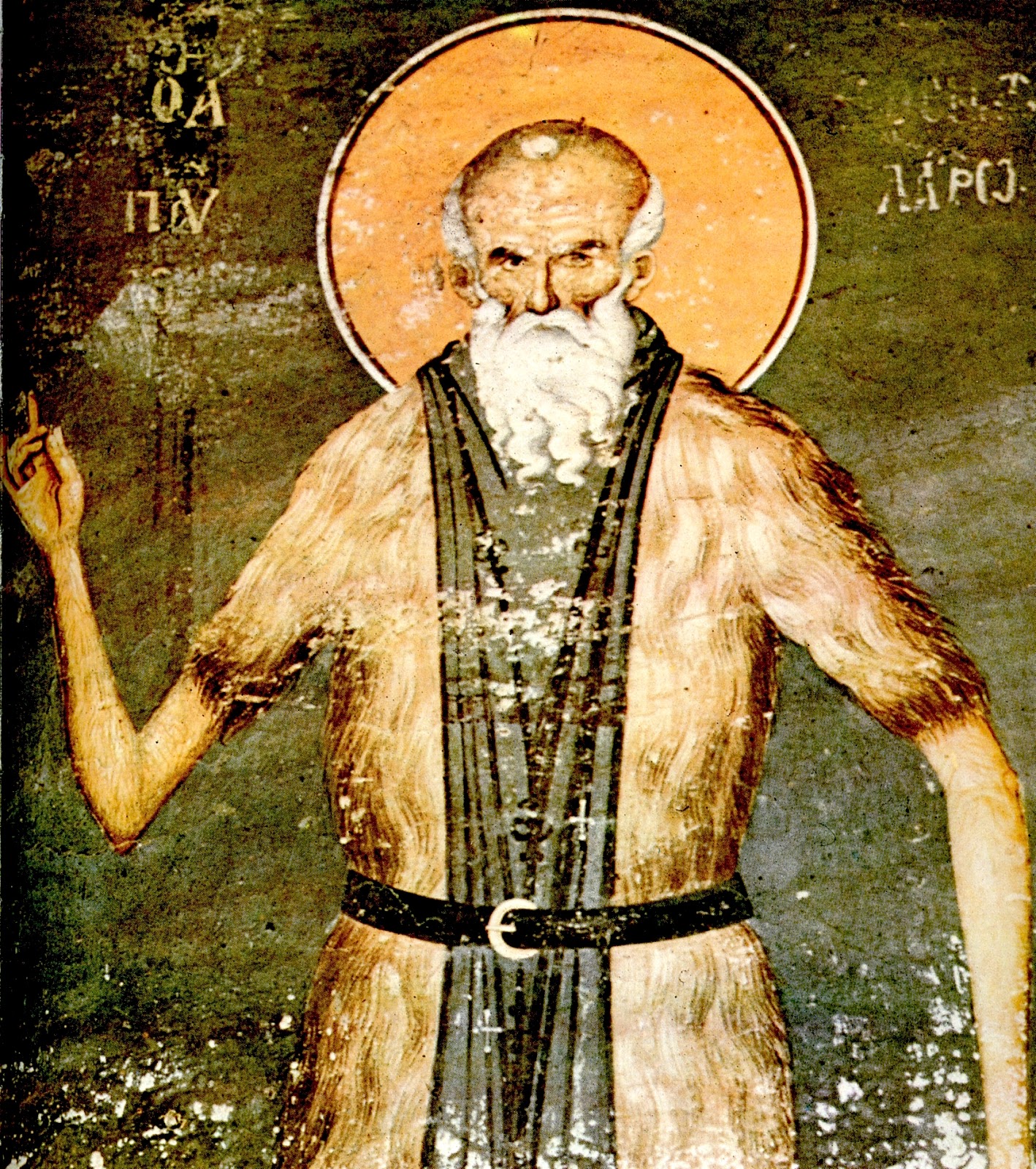
December 15: ST PAUL OF LATROS (A.D. 956)
THE father of this hermit was an officer in the imperial army who was slain in an engagement with the Saracens. His mother then retired from Pergamos, which was the place of his birth, to Bithynia, taking her two sons with her. Basil, the elder, took the monastic habit upon Mount Olympus in that country, but soon for the sake of greater solitude retired to Mount Latros (Latmus). When their mother was dead he induced his brother to embrace the same state of life. Though young, Paul had experienced the world sufficiently to understand the emptiness and dangers of what it has to offer. Basil recommended him to the care and instruction of the abbot of Karia. St Paul desired for the sake of greater solitude and austerity to lead an eremitical life; but his abbot, thinking him too young, refused him leave so long as he lived. After his death Paul’s first cell was a cave on the highest part of Mount Latros, where for some weeks he had no other food than green acorns, which at first made him very sick. After eight months he was called back to Karia. It is said that when he worked in the kitchen the sight of the fire so forcibly reminded him of Hell that he burst into tears every time he looked at it.
When he was allowed to pursue his vocation Paul chose a new habitation on the most rocky part of the mountain, where for the first three years he suffered grievous temptations. A peasant sometimes brought him a little food, but he mostly lived on what grew wild. The reputation of his holiness spreading through the province, several men chose to live near him and built there a laura of cells. Paul, who had been careless about all corporal necessaries, was much concerned lest anything should be wanting to those that lived under his direction. After twelve years his solitude was so much broken into that he withdrew to another part of the mountains, whence he visited his brethren from time to time to cheer and encourage them; he sometimes took them into the forest to sing the Divine Office together in the open air. When asked why he appeared sometimes so joyful, at other times so sad, he answered, ” When nothing diverts my thoughts from God, my heart overflows with joy, so much that I often forget my food and everything else; and when there are distractions, I am upset”. Occasionally he disclosed something of the wonderful communications which passed between his soul and God and of the heavenly graces which he received in contemplation.
But St Paul wished for yet closer retirement, so he passed over to the isle of Samos, and there concealed himself in a cave. But he was soon discovered and so many flocked to him that he re-established three lauras which had been ruined by the Saracens. The entreaties of the monks at Latros induced him to return to his former cell there. The Emperor Constantine Porphyrogenitus wrote frequently to him asking his advice, and often had reason to repent when he did not follow it. Paul had a great tenderness for the poor and he gave them more of his food and clothes than he could properly spare. Once he would have sold himself for a slave to help some people in distress had he not been stopped. On December 6 in 956, foreseeing that his death drew near, he came down from his cell to the church, celebrated the Holy Mysteries more early than usual and then took to his bed. He spent his time in prayer and instructing his monks till his death, which fell on December 15, on which day he is commemorated by the Greeks. He is sometimes referred to as St Paul the Younger.
(Benedict Baur)
_____________________
THE YEAR
AND OUR CHILDREN
Planning the Family Activities for Christian Feasts and Seasons
By Mary Reed Newland (1956)
3
ADVENT:
THE IMMACULATE CONCEPTION
THERE IS a special dearness about Christmas gifts that are made. Even when they are clumsily made, they are lovely because the loveliness that goes into them is from the heart and the mind and the hands—hours and days of tacking and tying, fitting and pasting, stitching and hammering, chiselling and modelling—all of it with a permeation of love and effort that cannot be priced. The making of gifts should be a special part of Advent; an outpouring of self into something we make for someone we love, entirely in the spirit of the remaking of our hearts for Christ, for receiving the gift Someone who loves us made for us.
With this making go long evenings of work together, wonderful conversations, meditations, evening prayers. We need only work together to have an early dinner, clear away the dishes, tidy the kitchen, get the littlest ones off to bed, keep the TV and radio turned off, and there—we have a long evening before us. Perhaps it is not possible to do this every night, but much can be accomplished in even two nights a week when the family works together and talks together. They will soon discover that this kind of creative recreation grows on them.
The making of gifts has a counterpart in the greatest of the Advent feasts, the feast of the Immaculate Conception on December 8, and we learn from this feast with what infinite pains God prepared the gift He gave to us.
God always knew Our Lady just as He always knew us. It is easy for a child to learn this and understand it. You simply tell him and he knows. You know in your mind what you are going to do before you do it; so, God knew us all in His mind before He made us.
One Advent a six-year-old of our acquaintance asked: “Mother, was I in Heaven with God before I was in you?”
“No, dear.”
“Oh, that’s right. But I was in His mind, wasn’t I?” He settled back on the couch contentedly. If someone has told you this, you know you’re important to God. No fear He is going to forget you when He has had you in His mind since forever.
Thus He also knew Our Lady since forever. In her humanness she was to be like ourselves, but in another way she would be different.
When God knew us in His mind before He made us, He knew that we would be conceived and born with original sin on our souls. But when He knew Our Lady in His mind before He made her, He knew she would be conceived without original sin. He was going to make her to be the Mother of Our Lord; so He would make her perfect. Even though she would be one of the children of Adam and Eve, she would not inherit original sin like the rest of us, nor any weakness that might lead her to commit sin.
Now, it is not necessary for God to give any reason for this except that it pleased Him. He is God. Surely He may do as He wants. And of course it is easy for us to understand that the Mother of God should be perfect, the most holy and beautiful of all creatures. But we like to know that things are “fair,” that things fit together like the pieces of a puzzle; and this great privilege of Our Lady’s is not only God’s right and her due, but it is also “fair”—in another word, just.
THE REASON FOR CHRISTMAS PRESENTS
Why are we making gifts for each other two, three, four weeks ahead of time? working as hard as we can to make something beautiful? to wrap it beautifully? to tie it beautifully? to think of something full of love to write on the card that goes with it? Because we know that Christmas is coming. That Jesus should become man and save us from our sins is more than good reason to prepare—to anticipate. We want everything to be perfect for Jesus and for our beloveds when Christmas comes.
Just so, God the Father prepared for the coming of Jesus. He prepared for His divine Son a perfect Mother through whom He could come into the world. This is how He prepared:
God the Father knew that when the time came, from Our Lord’s death on the cross would flow graces which would never end, which would make it possible for Godlike powers to be given to men. For example. He knew that Our Lord would institute a sacrament through which grace would come to wash away the original sin inherited from Adam and Eve, and to fill the soul with marvelous beauty where God Himself could dwell.
In creating a Mother for His Son God used this grace ahead of time–not to wash away original sin but to make a Mother whose soul was untouched by original sin. This is what we mean when we speak of Mary’s Immaculate Conception, the name she used for herself when at last she told St. Bernadette who she was.
God does not live in time. He invented time for us so that we could keep track of ourselves, but He has no need of it, and in the foreverness of Heaven He used all the magnificent graces His divine Son poured forth from His death on the cross in time to merit for Our Lady a perfect soul from the instant He breathed it into being.
That is why when Gabriel came to her in Nazareth he could say: “Hail, full of grace . . . . ” That is why when Mary went to visit Elizabeth, Elizabeth could cry out: “Blessed art thou amongst women . . . . “
This does not mean that Our Lady was conceived in a miraculous manner as her divine Son was conceived. She was born of the lawful union of Anne and Joachim, loving husband and wife. It does mean that at the moment the seed of life which was to become Our Lady was united to her immortal soul, it was to a soul God had created perfect.
Our Lady was made immaculate so that when the time came for the plan of the Redemption to unfold, her pure and holy body would be a perfect resting place wherein the love of God—His Holy Spirit—would breathe and His divine Son would begin to live.
This beautiful doctrine explained to the children on the vigil of her feast will help form the spirit in which the entire family will assist at the Mass in her honor and receive Holy Communion. If it does not seem possible for the school children—especially those going to public school—to receive Holy Communion on a weekday morning, why not give this a try: have a picnic breakfast in the car, with good whole-wheat raisin bread-and-butter sandwiches, fruit you can eat out of your hand, and hot cocoa in a thermos.
The great Advent mysteries in the life of Our Lady relate in many ways to the knowledge we must give our children about their bodies. Now we see again why we must have reverence and awe for our bodies. They are made for great and holy things. All the little girls in the world who will grow up to discover that God’s will for them is to be wives and mothers will, as mothers, carry their babies the way Our Lady carried her baby. Every mother we see who is expecting a baby can remind us of Our Lady.
It is so good of God to have His Son come to us this way, and so sanctify the bearing of babies. He could have come in thunder and lightning. He could have come like a wild storm riding the sun, driving the moon and the stars before Him. But, loving us in our littleness and our struggles and our pains and worries, He chose to be like us in all things save sin, so that we would always know that God knows what it is like to be a man.
If we have children for whom it is time to learn something of the way babies are born, Advent is an especially appropriate time to continue with that part of sex instruction. This carrying of babies within the mother’s body, is it not beautiful? This is how Our Lady carried her Baby, close to her heart, protected and sheltered there by her own pure body. This delivering of babies, as we call it—the emergence of the baby from its mother’s body—is it not wonderful? It is God’s way. He decided it was to be like this. If there were a finer way for it to be, He would have it be that way. “Let us pray tonight and ask Our Lady to help us have reverence for our bodies, and for the bodies of others, and never to do anything with them God does not want us to do.”
These things and a host of others relating to the meaning and spirit of Advent make beautiful, rich, prayerful conversations that go with the making of gifts. Some are for parent and child alone, some for the group; both ways, the treasury to explore is inexhaustible.
(To be continued)
—————————-
Father Krier will be in Pahrump December 19 and in Eureka December 26.
————————-
For those who purchase through Amazon, please help support the work here at Saint Joseph’s by going through this link: http://smile.amazon.com/ch/94-2855162
—————————–
The topics of Faith and Morals will correspond to the Roman Catholic Faith in Tradition and the Magisterium. The News will be of interest. The commentaries are for the reader to ponder and consider. The e-mail address will be for you to provide thought for consideration. The donations will be to support the continuation of this undertaking.
While the Newsletter is free of charge it is not free of cost. Please consider supporting St Joseph’s Catholic Church with a tax – deductible donation by clicking the secure link: Donate
Or if you prefer send a check to
Catholic Tradition Newsletter
c/o St Joseph’s Catholic Church
131 N. 9th St
Las Vegas, NV 89101
Visit us on the Worldwide Web: http://stjosephlv.org
e-mail news and comments to: tcatholicn@yahoo.com
To unsubscribe, please type, “unsubscribe”‚ in subject line
…
[Message clipped] View entire message