Vol 12 Issue 43 ~ Editor: Rev. Fr. Courtney Edward Krier
October 26, 2019 ~ Pope Saint Evaristus, opn!
1. What is the Holy Eucharist
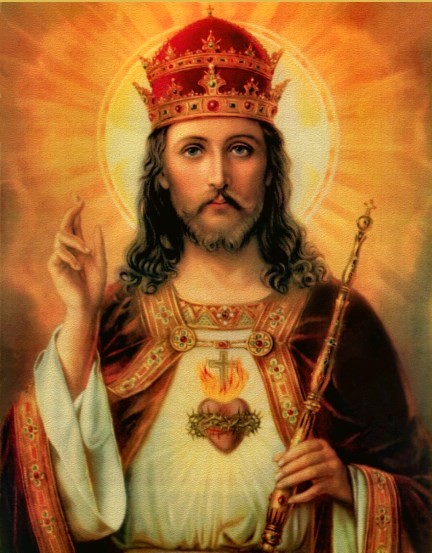
2. Twentieth Sunday after Pentecost
3. Christ the King
4. Family and Marriage
5. Articles and notices
Dear Reader:
This Sunday the Church celebrates Christ as King and every year it is a privilege to address my readers in honoring the Kingship of Christ. No one wants to hear about kings. Many a young girl’s dreams are dashed as they await the prince charming and find the frog stayed a frog or no one sees them as a Sleeping Beauty [though the characteristics of a Snow White is within them if they would develop their womanly nature]. The young lady instead allows herself to turn into a caricature of self-loathing and consciously or unconsciously sees all symbols of authority as oppressive. Many a young man, lacking direction and models of true manhood, adopt the sensitivity and emotions modeled by their mothers or caregivers that are presented as expressing a person who is socially adjusted—no competitiveness, no bravery, no standing up for justice and defending truth—qualities of manliness that are desired by a young woman to be found in a man she seeks—and these young men now find themselves rejected as being unfit husbands. Why not the tales of King Arthur or Charlemagne? Because they were men who exerted their strengths as rulers and were fearless in defending the rights of God. This is kingship and despised by too many: Placing God’s order in society through Wisdom and Strength.
Christ, as King, came to restore the order God originally placed in the world He created. The wicked one knows that this order leads to fulfilling God’s will and directing all things to the end for which they were created: the Glory of God together with the salvation of man. Therefore, the hatred of kingship by the Ancient Serpent is manifested by those who have his spirit. Contrary, the faithful Christian seeks to establish the order in the world, and acknowledges that for it to come about Christ must reign in one’s life. Christ must be the one who forms the thoughts and actions of each individual. This is done by accepting His right to rule one’s life and the submission to that rule. In spiritual matters the Church still insists her members live up to the Gospel. In material matters, the state has departed from its obligation—but this does not mean that Catholics can excuse themselves in this realm, they should fill the vacuum and study and apply Christian values in the public forum. The establishment of the Feast of Christ the King is a call to Catholics to publicly acknowledge that Christ is King of kings and Lord of lords and that Catholics will loyally and faithfully stand with Christ in the public square by fully living a Catholic life and living up to the Catholic principles as set in the 10 Commandments, Precepts of the Church and the Beatitudes.
As always, enjoy the readings and commentaries provided for your benefit.—The Editor
________________
WHAT IS THE HOLY EUCHARIST
By Rev. Courtney Edward Krier
Vatican II:
Most know that Pope Saint Pius X is most remembered for lowering the age for children to receive Holy Communion, in his Decree, Quam Singulari, on August 8, 1910. Already, on December 20, 1905, in his decree Sacra Tridentina, he invited the religious and faithful to receive Communion more frequently:
The Holy Council of Trent, having in view the ineffable riches of grace which are offered to the faithful who receive the Most Holy Eucharist, makes the following declaration: “The Holy Council wishes indeed that at each Mass the faithful who are present should communicate, not only in spiritual desire, but sacramentally, by the actual reception of the Eucharist” (Sess. 22, cap. 6). These words declare plainly enough the wish of the Church that all Christians should be daily nourished by this heavenly banquet and should derive therefrom more abundant fruit for their sanctification.
The wish of the Council fully conforms to that desire wherewith Christ our Lord was inflamed when He instituted this Divine Sacrament. For He Himself, more than once, and in clarity of words, pointed out the necessity of frequently eating His Flesh and drinking His Blood, especially in these words “This is the bread that has come down from heaven; not as your fathers ate the manna, and died. He who eats this bread shall live forever” (John 6:59).
From this comparison of the Food of angels with bread and with the manna, it was easily to be understood by His disciples that, as the body is daily nourished with bread, and as the Hebrews were fed with manna in the desert, so the Christian soul might daily partake of this heavenly bread and be refreshed thereby. Moreover, we are bidden in the Lord’s Prayer to ask “our daily bread” by which words, the holy Fathers of the Church all but unanimously teach, must be understood not so much that material bread which is the support of the body as the Eucharistic bread which ought to be our daily food.
Moreover, the desire of Jesus Christ and of the Church that all the faithful should daily approach the sacred banquet is directed chiefly to this end, that the faithful, being united to God by means of the Sacrament, may thence derive strength to resist their sensual passions, to cleanse themselves from the stains of daily faults, and to avoid those grave sins to which human frailty is liable; so that its primary purpose is not that the honor and reverence due to our Lord may be safe-guarded, or that it may serve as a reward or recompense of virtue bestowed on the recipients (St. Augustine, Serm. 57 in Matth. De Orat. Dom., n. 7.). Hence the Holy Council calls the Eucharist “the antidote whereby we may be freed from daily faults and be preserved from mortal sins” (Sess. 13, cap. 2.).
The will of God in this respect was well understood by the first Christians; and they daily hastened to this Table of life and strength. ‘They continued steadfastly in the teaching of the apostles and in the communion of the breaking of the bread” (Acts 2:42.). The holy Fathers and writers of the Church testify that this practice was continued into later ages and not without great increase of holiness and perfection.
Piety, however, grew cold, and especially afterward, because of the widespread plague of Jansenism, disputes began to arise concerning the dispositions with which one ought to receive frequent and daily Communion; and writers vied with one another in demanding more and more stringent conditions as necessary to be fulfilled.
The result of such disputes was that very few were considered worthy to receive the Holy Eucharist daily, and to derive from this most health-giving Sacrament its more abundant fruits; the others were content to partake of it once a year, or once a month, or at most once a week. To such a degree, indeed, was rigorism carried that whole classes of persons were excluded from a frequent approach to the Holy Table, for instance, merchants or those who were married.
Some, however, went over to the opposite view. They held that daily Communion was prescribed by divine law and that no day should pass without communicating, and besides other practices not in accord with the approved usage of the Church, they determined that the Eucharist must be received even on Good Friday and in fact so administered it.
Toward these conditions, the Holy See did not fail in its duty. A Decree of this Sacred Congregation, which begins with the words Cum ad aures, issued on February 12. 1679, with the approbation of Pope Innocent XI, condemned these errors, and put a stop to such abuses; at the same time it declared that all the faithful of whatsoever class, merchants or married persons not at all excepted, could be admitted to frequent Communion according to the devotion of each one and the judgment of his confessor.
Then on December 7, 1690, by the Decree of Pope Alexander VIII, Sanctissimus Dominus noster, the proposition of Baius was condemned, which required a most pure love of God, without any admixture of defect, on the part of those who wished to approach the Holy Table.
The poison of Jansenism, however, which, under the pretext of showing due honor and reverence to the Eucharist, had infected the minds even of good men, was by no means a thing of the past.
The question as to the dispositions for the proper and licit reception of Holy Communion survived the declarations of the Holy See, and it was a fact that certain theologians of good repute were of the opinion that daily Communion could be permitted to the faithful only rarely and subject to many conditions.
On the other hand, there were not wanting men endowed with learning and piety who offered an easier approach to this practice, so salutary and so pleasing to God. They taught, with the authority of the Fathers, that there is no precept of the Church which prescribed more perfect dispositions in the case of daily than of weekly or monthly Communion; while the fruits of daily Communion will be far more abundant than those of Communions received weekly or monthly.
In our own day the controversy has been continued with increased warmth, and not without bitterness, so that the minds of the confessors and the consciences of the faithful have been disturbed, to the no small detriment of Christian piety and fervor. Certain distinguished men, themselves pastors of souls, have as a result of this urgently begged His Holiness, Pope Pius X, to deign to settle, by his supreme authority, the question concerning the dispositions required to receive the Eucharist daily; so that this practice, so salutary and so pleasing to God, not only might suffer no decrease among the faithful, but rather that it increase and everywhere be promoted, especially in these days when religion and the Catholic faith are attacked on all sides, and the true love of God and piety are so frequently lacking.
His Holiness, being most earnestly desirous, out of his solicitude and zeal, that the faithful should be invited to the sacred banquet as often as possible, even daily, and should benefit by its most abundant fruits, committed the aforesaid question to this Sacred Congregation, to be studied and decided definitely (definiendam).
Accordingly, the Sacred Congregation of the Council, in a Plenary Session held on December 16, 1905, submitted this matter to a very careful study; and, after sedulously examining the reasons adduced on either side, determined and declared as follows:
1. Frequent and daily Communion, as a practice most earnestly desired by Christ our Lord and by the Catholic Church, should be open to all the faithful, of whatever rank and condition of life; so that no one who is in the state of grace, and who approaches the Holy Table with a right and devout intention (recta piaque mente) can be prohibited therefrom (a).
2. A right intention consists in this: that he who approaches the Holy Table should do so, not out of routine, or vain-glory, or human respect, but that he wish to please God, to be more closely united with Him by charity, and to have recourse to this divine remedy for his weaknesses and defects (a).
3. Although it is especially fitting that those who receive Communion frequently or daily should be free from venial sins, at least from such as are fully deliberate, and from any affection thereto, nevertheless, it is sufficient that they be free from mortal sin, with the purpose of never sinning in the future; and if they have this sincere purpose, it is impossible but that daily communicants should gradually free themselves even from venial sins, and from all affection thereto.
4. Since, however, the Sacraments of the New Law, though they produce their effect ex opere operato, nevertheless produce a greater effect in proportion as the dispositions of the recipient are better, therefore, one should take care that Holy Communion be preceded by careful preparation, and followed by an appropriate thanksgiving, according to each one’s strength, circumstances and duties.
5. That the practice of frequent and daily Communion may be carried out with greater prudence and more fruitful merit, the confessor’s advice should be asked. Confessors, however, must take care not to dissuade anyone from frequent or daily Communion, provided he is found to be in a state of grace and approaches with a right intention.
6. But since it is plain that by the frequent or daily reception of the Holy Eucharist union with Christ is strengthened, the spiritual life more abundantly sustained, the soul more richly endowed with virtues, and the pledge of everlasting happiness more securely bestowed on the recipient, therefore, parish priests, confessors and preachers, according to the approved teaching of the Roman Catechism (Part II, Ch. LXIII.) should exhort the faithful frequently and with great zeal to this devout and salutary practice.
7. Frequent and daily Communion is to he promoted especially in religious Institutes of all kinds; with regard to which, however, the Decree Quemadmodum issued on December 17, 1890, by the Sacred Congregation of Bishops and Regulars, is to remain in force. It is to be promoted especially in ecclesiastical seminaries, where students are preparing for the service of the altar; as also in all Christian establishments which in any way provide for the care of the young (ephebeis).
8. In the case of religious Institutes, whether of solemn or simple vows, in whose rules, or constitutions, or calendars, Communion is assigned to certain fixed days, such regulations are to be considered as directive and not preceptive. The prescribed number of Communions should be regarded as a minimum but not a limit to the devotion of the religious. Therefore, access to the Eucharistic Table, whether it be rather frequently or daily, must always be freely open to them according to the norms above laid down in this Decree. Furthermore, in order that all religious of both sexes may clearly understand the prescriptions of this Decree, the Superior of each house will provide that it be read in community, in the vernacular, every year within the octave of the Feast of Corpus Christi.
9. Finally, after the publication of this Decree, all ecclesiastical writers are to cease from contentious controversy concerning the dispositions requisite for frequent and daily Communion.
————————–
The Sunday Sermons of the Great Fathers
M. F. Toal
THE GOSPEL OF THE SUNDAY
JOHN iv. 46-53
At that time: There was a certain ruler, whose son was sick at Caphamaum. He, having heard that Jesus was come from Judea into Galilee, went to him and prayed him to come down and heal his son; for he was at the point of death. Jesus therefore said to him: unless you see signs and wonders, you believe not. The ruler saith to him: Lord, come down before that my son die. Jesus saith to him: Go thy way. Thy son liveth. The man believed the word which Jesus said to him and went his way. And as he was going down, his servants met him; and they brought word, saying, that his son lived. He asked therefore of them the hour wherein he grew better. And they said to him: Yesterday, at the seventh hour, the fever left him. The father therefore knew that it was at the same hour that Jesus said to him: Thy son liveth. And himself believed, and his whole house.
EXPOSITION FROM THE CATENA AUREA
CHRYSOSTOM, Homily 34 in John: Earlier, as has been related, the Lord had come to Cana of Galilee, invited to a wedding. He now goes, of His own will; and to win them the more, leaves His own country. He goes also to strengthen by His Presence the faith begun there when He had wrought the miracle in the beginning.
V. 46. He came again therefore into Cana of Galilee, where he made the water wine.
AUGUSTINE, Tr. XVI, 3, in John: For it was there His Disciples believed in Him, after He had changed water into wine (Jn. ii. 11), And though the house had been filled with guests and the miracle so very great, yet only His Disciples had believed. He now comes again to this city, so that they who had not believed then, because of the miracle, may believe now.
THEOPHYLACTUS: The Evangelist reminds us of the miracle worked in Cana of Galilee, the changing of water into wine, so as to add to the praise of Christ. For the Galileans had received Jesus, not only because of the wonders He had wrought in Jerusalem, but also because of those He had wrought among them. He mentions it also to show that the ruler believed because of the miracle wrought in Cana; although He had not yet come to understand perfectly the dignity of Jesus. So there follows: And there was a certain ruler whose son was sick at Capharnaum.
ORIGEN, Tr. XVII in John, c. 57: Some think this man was a prince of the house of Herod. Others say he was of the household of Caesar, in service in Judea. For it is not said he was a Jew. CHRYSOSTOM, as above: He is called a prince (regulus), either because he was of a royal family, or because of having some office of ruling, and was on this account so described. Some therefore believe him to be the same person as the centurion spoken of in Matthew (viii. 5). But it is plain he was a different person. For when Christ said He would go at once to the house of the centurion, the latter begged Him to remain where He was; whereas this man, though Christ had made no similar offer to him, wished to make Christ come down with him to his house. The centurion came to Him as He was coming down the mountain to Capharnaum, while this ruler approached Him as He came into Cana. It was the other’s servant who was sick of the palsy; the ruler’s son, of a fever. Of this ruler it is then said:
V. 47. He, having heard that Jesus was come from Judea into Galilee, went to him and prayed him to come down and heal his son; for he was at the point of death.
AUGUSTINE, as above: Did he believe who asks this? But why look to me for an answer. Ask the Lord what He thinks of him. Then follows:
V. 48. Jesus therefore said to him: Unless you see signs and wonders, you believe not.
He shows us therefore a man who is lukewarm or cold in faith, or even wholly without faith; yet earnestly seeking, for his son’s sake, to find out what manner of person Jesus was, and who He was, and what He could do. The word wonder (prodigium; as it were porrodicium) speaks of something distant, something to come.
AUGUSTINE, Harmony of the Gospels, Bk. IV, X, 13: The Lord wishes to raise the mind of the faithful far above transitory things, so that He would not have them seek even miracles; which, though divinely wrought, are yet wrought in mutable bodies. GREGORY, Homily 28, on the Gospel: But recall also what he prays for, and you will see plainly that his faith is doubtful. For he asks that Jesus shall come down and heal his son. So we read:
V. 49. The ruler saith to him: Lord, come down before that my son die.
He therefore had little faith in Him, Who, he believed, could not heal, unless he were also present in body. CHRYSOSTOM, as above: See how, still earthly minded, he would bring Christ with him; as though He could not raise his son even from the dead. But it is not to be wondered at that, even without faith, he should come and ask Him. For parents in their great love will not only come to physicians in whom they have confidence, but even to those in whom they have not: unwilling to leave anything untried that might help their child’s recovery. Yet, had he strongly believed in the power of Christ, he would not have failed to have gone even to Judea. GREGORY: But the Lord, asked to come down, shows He is not absent whither He is invited. For He restores health by His word only Who by the act of His will made all things. Hence follows:
V.50. Jesus saith to him: Go thy way. Thy son liveth.
Here our pride is rebuked, which leads us to honour in men, not those made in God’s image, but honours and riches. Our Redeemer, to show that what men honour the saints must despise, and that what men despise the saints must not despise, refused to go to the son of the ruler, though ready at once to go to the servant of the Centurion.
CHRYSOSTOM: Or again. In the centurion there was resolute faith; and so the Lord assures him He will come; that we might learn of the man’s devotion. But this man’s faith was still imperfect, and plainly he does not yet know that though absent in body Jesus could yet cure his son. But he learns this from the fact that Jesus does not come. For there follows: The man believed the word which Jesus said to him and went his way. He believed, but not wholly; not in the true sense. ORIGEN, as above: The man’s authority and office are shown by this, that servants come to meet him. So we read:
V. 51. And as he was going down, his servants met him; and they brought word, saying, that his son lived.
CHRYSOSTOM: They meet him, not alone to bring him word, but also because they now think that Christ’s presence is superfluous; for they thought He was coming. That the ruler did not wholly believe, nor rightly, is seen from what follows:
V. 52: He asked therefore of them the hour wherein he grew better.
He was seeking to find out whether it was by chance or through the command of Christ that this had taken place. Then follows: And they said to him: Yesterday, at the seventh hour, the fever left him. You see how manifest the miracle was. He had been delivered from danger, not simply, or by chance, but of a sudden, all at once: that it might be apparent that it had taken place, not through the course of nature, but from the action of Christ. Hence there follows:
V. 53. The father therefore knew that it was at the same hour that Jesus said to him: Thy son liveth. And himself believed, and his whole house.
AUGUSTINE, in John. Tr. XVI, 3: If then he believed because he was told that his son had been healed, and compared the hour the messenger spoke of with the hour of Christ’s foretelling this, then, at the time he was praying Christ to come, he did not yet believe. BEDE: And so we are given to understand that there are stages in faith as in the other virtues; in which there is a beginning, an increase, and perfection. He therefore had the beginnings of faith when he prays for his son’s health; an increase, when he believes in the word of the Lord saying to him: Thy son liveth. Then perfection, on hearing from his servants.
AUGUSTINE, as above: Many Samaritans had believed solely because of His words. At this miracle only that house believed where it had been wrought. So the Evangelist adds:
V. 54. This is again the second miracle that Jesus did when he was come out of Judea into Galilee.
CHRYSOSTOM: Not without reason does he add this; but to show that, though this was the second miracle Jesus then did, the Jews had not yet come to the height of understanding of the Samaritans who had seen no miracle.
ORIGEN: This sentence may be interpreted in two ways. One, that Jesus, coming from Judea into Galilee, worked two miracles, of which the second was done on behalf of the ruler’s son; or, that of the two miracles Jesus performed in Galilee, He wrought the second coming from Judea to Galilee; and this latter is the true meaning. Mystically, by this that Jesus came twice into Galilee, the twofold Coming of the Saviour into the world is put before us: the first, a visit of compassion; that making wine He may rejoice those who are His guests; the second, that He may raise up the son of the ruler who was at the point of death: that is, the Jewish people, who after the complete conversion of the Gentiles are at the end to approach to salvation.
He is the Great King of Kings, appointed by God over Sion His holy mountain (Ps. ii. 6); Whose day they saw and rejoiced who are known as rulers (Jn. viii. 56). We believe therefore that the ruler is Abraham; his sick son the Jewish people, grown weak in the worship of God, and so heated by the fiery darts of the enemy that they are looked on as sick of a fever. It appears that the saints who have gone before us, even after they have put off the garment of the body, have a care for their people. So we read in Machabees, after the death of Jeremiah: This is he that prayeth much for the people, Jeremias the prophet of God (II Mac. xv. 14). Abraham therefore prays that his sick people may be healed by the Saviour.
And the word of power comes forth from Cana, where it was said: Thy son liveth. But the efficacy of the word is manifested in Capharnaum: for it was there, in the place as it were of consolatio11 (Caphamaum), the son of the ruler was healed: who stands for those who are weak, yet not wholly without fruits. The words: Unless you see signs and wonders you believe not, which were said to the ruler, refer to the multitude of his (Abraham’s) children, and also in a measure to him. For as John waited for the sign given to him, namely, Upon whom thou shalt see the Spirit descending (Jn. i. 33), so also the saints who died before the Coming of Christ in the flesh, looked for Him to be made known by signs and wonders. This ruler had not only a son, but also servants; and these latter signify the mass of those who believe, but less perfectly, as weak in faith. Nor was it by chance the fever left him at the seventh hour: for seven is the number of rest.
ALCUIN: Or it was at the seventh hour, because all forgiveness is through the sevenfold Spirit. For the number seven divided into three and four signifies the Holy Trinity in the four seasons of the year, in the four quarters of the world, and in the four elements. ORIGEN: The twofold coming of Christ (in verse 54) can also signify His two comings to the soul: first from the Wine He made, giving the soul the delight of a spiritual banquet; second, to take away all that remains of infirmity and death.
———————–
Last Sunday in October
The Kingship of Our Lord Jesus Christ
1. “The Lord is King.” This is a day of thanksgiving to the Father, who has conferred universal kingship on His divine Son, the glorious hero of untold sufferings and humiliations. It is a day of homage to the man Christ, to whom “all power was given in heaven and on earth.” “His dominion will reach from sea to sea, from the great river [Euphrates] to the ends of the earth. All the kings of the earth shall bring their homage, all the nations serve him” (Gradual). We, too, do homage and serve Him.
2. The Gospel of today’s Mass concerns itself with that important moment in the history of mankind when Jesus was brought by the Jews to the judgment seat of Pilate, representative of pagan Roman world-power. “Art thou the king of the Jews? . . . Thou art a king, then? Pilate asked. Jesus answered: It is thy own lips that have called me a king. What I was born for, what I came into the world for, is to bear witness to the truth…. My kingdom…. does not belong to this world.” It is, rather, the kingdom of God, which is the Church, full of grace and truth. It is God’s realm, in which we are safe from the dominion of Satan and sin, and become sharers in the divine freedom. It is God’s rule that rejoices our hearts with its divine activity in us. It postulates that our thinking and striving be rooted in God by virtue of our living union with Christ, the Head. Jesus brought this kingdom to earth, establishing it by His teaching and example, but especially by His death on the Cross. He gives laws and commands; all judgment is His (cf. John 5:22). “Everything in heaven and on earth and under the earth must bend the knee before the name of Jesus, and every tongue must confess Jesus Christ as the Lord, dwelling in the glory of God the Father” (Phil. 2:10, 11). We render joyful homage: “Power and Godhead, wisdom and strength, and glory are his by right, the Lamb that was slain. Glory and power be his through endless ages” (Introit). “The Lord sits enthroned as King forever; the Lord will give his people his own blessing of peace” (Communion).
God has transferred us “to the kingdom of his beloved Son” and made us partakers of this kingdom. “In the Son of God, in his blood, we find the redemption that sets us free from our sins.” Emancipated from the power of sin, we obtain the life of grace, sonship of God, power over the world, over the flesh, over the urge of evil passions; we receive God’s gift of interior freedom of heart and spirit in the possession of His life. In addition there is the expectation we have of being taken up into the future kingdom of endless glory. “We return thanks to God our Father for making us fit to share the light which saints inherit, for rescuing us from the power of darkness, and transferring us to the kingdom of his beloved Son” (Epistle).
3. He is the true likeness of the God we cannot see; His is that first birth which precedes every act of creation”; He is the eternal Son of God, God from God, light from light, begotten, not made. It was through Him that all things came into being; everything was made by Him and for Him. All the marvelous and beautiful things that the universe contains are His property. He is the rightful master of the spirit, will, heart and body of man. To Him belong heaven and earth; He has the might and the right to make use of all earthly things. In every way the primacy was to become His. It was God’s pleasure to let all completeness dwell in Him, the man Jesus Christ. He must be King also over me, my very being and existence. I must live for whatever He wishes of me.
We rejoice with Holy Church that the Father made Him Lord and King of the universe, saying: “Ask thy will of me, and thou shalt have the nations for thy patrimony; the very ends of the world for thy domain” (Offertory). “Christ conquers; Christ rules; Christ is King” (Inscription on the obelisk in St. Peter’s square, Rome).
The Lord is a king; He directs with strong hand His kingdom, His Church, our souls. Powerful enemies will besiege His kingdom in vain. “Do not be afraid, you, my little flock. Your Father has determined to give you his kingdom” (Luke 12:32).
We dedicate ourselves and all we have to Christ the King. We pray that all men, all races and nations of the earth may bow to His dominion.
Collect: Almighty, ever-living God, who hast willed that in Thy beloved Son, the universal king, all things should be made new, grant in Thy loving-kindness that all peoples of the earth, now torn asunder by the wound of sin, may be subdued to the gentle sway of Him who is God. Amen.
(Benedict Baur)
THE YEAR
AND OUR CHILDREN
Planning the Family Activities for Christian Feasts and Seasons
By Mary Reed Newland (1956)
22
THANKSGIVING
LOOKS LIKE a happy coincidence that our American feast of Thanksgiving should come at the end of the Church year where properly a thanksgiving ought to come, but actually it is no coincidence at all. The Pilgrim’s feast was another manifestation of the sense of God that is common in all men, and the need they have for giving thanks to Him. Everywhere men have had thanksgiving feasts to whatever gods they worshipped, celebrating their harvests, the end of their journeys, their protection under a divine providence. For thousands of years before a rite and feast of thanksgiving was dictated in the law of Moses, their forms appeared everywhere, out of the instinct of man. After the Exodus, the One True God made it a law for the Jews.
Three times every year you shall celebrate feasts to me: Thou shalt keep the feast of the unleavened bread . . . And the feast of the harvest of the first-fruits of thy work . . . . The feast also in the end of the year, when thou hast gathered in all thy corn out of the field. (Exod. 23: 14-17)
Perhaps Elder Brewster held this in mind when he and Governor Bradford and the others planned the Pilgrim prayer meeting and the feast of thanks to follow. God gave explicit instructions to the Jews.
Thou shalt celebrate the solemnity also of tabernacles seven days, when thou . . . make merry in thy festival time, thou, thy son, and thy daughter, thy manservant and thy maidservant, the Levite also and the stranger, and the fatherless, and the widow that are within thy gates. Seven days shalt thou celebrate feasts to the Lord thy God in the place which the Lord shall choose; and the Lord thy God will bless thee in all thy fruits, and in every work of thy hands, and thou shalt be in joy (Deut. 16:13).
For the Pilgrims, the “stranger within the gates” was Massasoit and some ninety of the Wampanoags who had helped the Pilgrims clear ground, plant crops, and hunt game that first difficult year. There were fatherless and widows, you may be sure: of the original one hundred and two, only fifty remained, twenty-nine of them women and children, some with familiar names, some with strange. There were the Carvers and the Bradfords and the Allertons, Priscilla Mullins who would marry John Alden, and Myles Standish in charge of their military affairs. The Hopkins children were Constantia, Damaris, and Oceanus, and among the other children were Desire Minter, Resolved White, Humility Cooper, Love and Wrestling Brewster and a baby named Peregrine White who was born on the Mayflower and probably never knew he bore the name of a half dozen martyrs. Governor Bradford and Elder Brewster had been with the original group who left Scrooby in England, went to Leyden in Holland, and finally set out for the new England.
They were Bible-living Christians, no more tolerant of the religious convictions of others than the Church of England was of their own, but neither is that new under the sun. Even with the ancient form of worship unrecognizable after its truncation, limping after its dismemberment, the instinct to worship is still common; if there is a meeting point left anywhere, this it is. This is the beginning point of the struggle for unity among men who two hundred years before would have offered in thanksgiving “from among Thy gifts bestowed upon us, a victim perfect, holy and spotless, the holy bread of everlasting life and the chalice of everlasting salvation.”
We must not think of ourselves as islands of “tolerant” men, worshipping in the way that is most pleasing to each. There is a true way, taught by One Who said, “I am the Way, and the Truth and the Life.” We must go all the way in our desire to bring all men to His Way, meeting them where we can meet them, sharing warmly with them at least the desire to give some kind of praise, some kind of thanks.
They marched to the fort to the roll of drums, held prayer meeting, sang Psalms in thanksgiving, then gathered round the festive tables. Massasoit and his people brought five deer as their offering. Governor Bradford sent Pilgrim men to the forest with Indians to hunt wild turkey, and they brought down wild geese, duck and water fowl as well. The women cooked cod and shell fish, prepared barley loaves, corn bread, and vegetables from the harvest of their tiny fields.
These are the things our children learn in school about this great national feast of Thanksgiving, and they love to hear the stories that go with the preparations. It is part of our history. Tell them, if they do not know, that George Washington made it a national feast by proclamation in 1789, with words of homage to the One True God:
Whereas it is the duty of all nations to acknowledge the providence of Almighty God, to obey his will, to be grateful for his benefits, and humbly implore his protection, aid and favors …. Now, therefore, I do recommend and assign Thursday, the 26th day of November next, to be devoted by the people of these States to the service of that great and glorious Being, Who is the Beneficent Author of all the good that was, that is, or that will be; that we may then all unite in rendering unto Him our sincere and humble thanks for His kind care and protection of the people of this country, and for all the great and various favors which He has been pleased to confer on us.
And in 1867 Abraham Lincoln reaffirmed the observance by another Thanksgiving proclamation.
If they should visit Plymouth one day, they would find the William Harlow house there, built in 1677 from the timbers of the old fort, where in the springtime Plymouth school children follow the Pilgrim custom and plant in the yard corn and flax, “when the oak leaves are the size of a mouse’s ear.” The corn is fertilized with alewives from Town Brook, three to the hill. Let them mark the calendar in their own kitchen, for April or May or whenever the oak leaves peek out, mouse-like, in your countryside, and plant some corn and flax of their own. They may not spin the flax, but it has a beautiful blue blossom, exactly the color for bouquets for Our Lady; and once they know the plant they will begin to notice how often flax and fine linen and linen cloth are mentioned in their favorite stories from Holy Scripture.
PREPARING FOR THE FEAST
Pine cone turkeys are made for Thanksgiving by almost every schoolchild in America. Although no novelty, they are one of the symbols of the feast. Our children never tire of making them. They are decorative as place favors, or all together (if you have a large family with a turkey for each) they are an amusingly large flock of turkeys. Pine cones, pipe cleaners, cupcake papers and crayons are the materials. The pine cone is used “sideways,” with the top for the turkey’s head, the flat bottom part for his tail. A pipe cleaner is twisted around the top. The end sticking out as the turkey’s neck is daubed with lipstick for red wattles. Another pipe cleaner is twisted around the bottom, with two ends sticking out and turned under for feet. A cupcake paper is folded in half, colored bright colors in the little ridged sections, and this is slipped between the petals of the cone for the turkey’s tail.
Several years ago we typed out individual copies of a “long” Grace before Meals, Monica decorated them with little figures praying, and we have used these each year as our special Thanksgiving Grace. They are a bit greasy now, what with all those turkey dinners rubbed off on them; but they have become so traditional a part of our Thanksgiving that we are loath to make new copies. Since it may be used at any time, it is not accurately called Grace before Thanksgiving Dinner—but that is what it is for our family.
Father. Bless ye.
All. Bless ye.
Father. The eyes of all hope in Thee, O Lord.
All. And Thou gives them their food in due season. Thou openest Thy hand, and fillest with blessing every living creature.
Father. Glory be to the Father, and to the Son, and to the Holy Ghost.
All. As it was in the beginning, is now. and ever shall be, world without end. Amen.
Father. Lord, have mercy on us.
All. Christ, have mercy on us. Lord, have mercy on us. (The Our Father, silently.)
Father. And lead us not into temptation.
All. But deliver us from evil. Amen.
Father. Let us pray. Bless us, O Lord, and these Thy gifts, which we are about to receive. Through Christ, Our Lord.
All. Amen.
Grace after Thanksgiving Dinner
(Suggestion: Say this as soon as all are finished with dessert; then the children may leave to play, and the grownups may stay and talk.)
Father. Do Thou, O Lord, have mercy on us.
All. Thanks be to God.
Father. Let all Thy works, O Lord, praise Thee. All. And let all Thy Saints bless Thee.
Father. Glory be to the Father, and to the Son, and to the Holy Ghost.
All. As it was in the beginning, is now, and ever shall be, world without end. Amen.
Father. We give Thee thanks, O Almighty God, for all Thy benefits. Who livest and reignest world without end.
All. Amen.
Now we are prepared for our feast. Dinner is planned; the silver is polished; the linen is ready; the Grace is copied for each one. The turkeys are made for decorations; the cranberry sauce is molded; the stuffing is prepared, and the sauce for the onions; and the celery is crisping ahead of time. When the morning of our feast day has come, let us offer Him in Thanksgiving.
THE MASS: THE PERFECT THANKSGIVING
Men have not only prayed in thanksgiving, but have offered in thanksgiving: something that was a sign of themselves, to show they were thankful for life, were sorry for their sins against the Giver of life, would give their lives in return, if they might, to the One they owe so much. They made offerings in thanks for the things that sustain life, for the preservation of life.
“Abel also offered of the firstlings of his flock, and of their fat.” . . . “So Noe went out, he and his sons, his wife and the wives of his sons . . . . all living things went out of the ark. And Noe built an altar unto the lord: and taking of all cattle and fowl that were clean, offered holocausts upon the altar . . . . “
They made bloody offerings, because the offering is a symbol of the offerer, and blood is the essence of life. Blood is life.
There were other offerings. . . . “Melchidesech, the king of Salem, bringing forth bread and wine, for he was the priest of the most high God, blessed him and said: Blessed be Abram by the most high God, who created heaven and earth.” . . . Because bread maintains life, and wine enhances life.
God told them what to sacrifice, and how to sacrifice; but especially He told them to make the sacrifice of the Pasch, because it was a memorial to their freedom and their protection, a memorial of thanksgiving to the God who loved them. “. . . and it shall be a lamb without blemish, a male, one year … and the whole multitude of the children of Israel shall sacrifice it in the evening.” . . . “And this day shall be a memorial unto you: and you shall keep it a feast to the Lord . . . for with a strong hand the lord hath brought you out of this place.”
He brought them through water, led them by fire, fed them with manna, and when they sinned against Him, He chastised them and accepted their sacrifices of expiation. He made it part of their Law, their Covenant, that they were to offer sacrifice: of reparation, of petition, of praise, of thanksgiving.
Then Christ came.
When it was time for the thing to happen for which He came, He said to the Apostles: “This is My body, which is being given for you; do this, in remembrance of Me.”
And He said: “This cup is the new covenant in My blood, which shall be shed for you.”
This was the new covenant, the new Pasch . . . “in My blood,” He said. From that moment on they were to make sacrifice “in My blood.”
The offering is a symbol of the offerer. Blood is the essence of life. This is our gift to offer: His Body and Blood, every day.
Think of all the things the Redemption accomplished, and do not forget this last: to put into our hands the perfect Gift, the pure Victim—”holy and spotless, the holy bread of everlasting life and the chalice of everlasting salvation.”
With the sacrifice of Holy Mass, Catholics make their thanksgiving.
—————————-
Father Krier will be in Pahrump, Nevada, October 17 and Eureka, October 24. He will be in the Czech Republic (Touzim) November 5-10 and 16-17. In between he will be in Germany (Munich) November 11-15. Afterwards he will be in Los Angeles November 19.
————————-
For those who purchase through Amazon, please help support the work here at Saint Joseph’s by going through this link: http://smile.amazon.com/ch/94-2855162
—————————–
The topics of Faith and Morals will correspond to the Roman Catholic Faith in Tradition and the Magisterium. The News will be of interest. The commentaries are for the reader to ponder and consider. The e-mail address will be for you to provide thought for consideration. The donations will be to support the continuation of this undertaking.
While the Newsletter is free of charge it is not free of cost. Please consider supporting St Joseph’s Catholic Church with a tax – deductible donation by clicking the secure link: Donate
Or if you prefer send a check to
Catholic Tradition Newsletter
c/o St Joseph’s Catholic Church
131 N. 9th St
Las Vegas, NV 89101
Visit us on the Worldwide Web: http://stjosephlv.org
e-mail news and comments to: tcatholicn@yahoo.com